Israel Strikes Central Beirut Without Warning — Claims Iran Ceasefire Doesn’t Apply to Lebanon
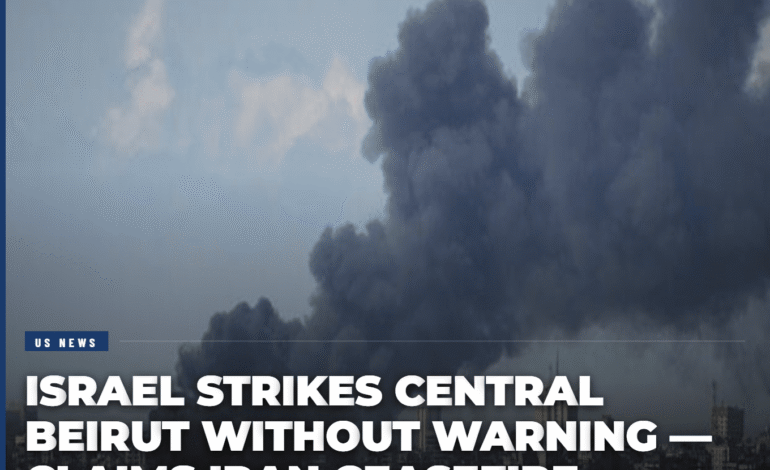

Hours after the world celebrated a US–Iran truce, Israel launched “Operation Eternal Darkness” — its deadliest attack on Lebanon yet. At least 254 people are dead, 100 targets hit in 10 minutes, and the fragile ceasefire is now under severe strain.
Quick SummaryOn April 8, 2026, Israel launched “Operation Eternal Darkness” — its largest airstrike campaign on Lebanon since the current war began — hours after the US–Iran ceasefire took effect. Fifty Israeli Air Force jets dropped 160 bombs on 100 targets in under 10 minutes across central Beirut, southern Lebanon, and the Bekaa Valley. At least 254 people were killed. Israel says the ceasefire doesn’t cover Lebanon. Pakistan, Iran, and France say it does. The strikes have put the fragile Iran truce in immediate danger.
1. What Happened: Israel Strikes Beirut Without Warning
Wednesday, April 8 started with hope in Lebanon. After months of brutal fighting, the news that the United States and Iran had agreed to a two-week ceasefire spread fast. Families sleeping in displacement tents on Beirut’s seafront began gathering their belongings. After weeks of uncertainty, many thought they might finally be able to go home.
Then the bombs came.
In the early afternoon, 50 Israeli Air Force fighter jets swept over Lebanon. Within 10 minutes, they dropped approximately 160 bombs on 100 targets — in central Beirut, southern Beirut’s suburbs, the port city of Sidon, the southern city of Tyre, and the eastern Bekaa Valley. No warnings were given to residents of central Beirut. Black smoke columns rose across the skyline of the Mediterranean capital.
Lebanon’s health ministry reported dozens killed in an initial estimate. The final count from Lebanese Civil Defense reached at least 254 dead and more than 1,160 injured as of April 9 — making it the deadliest single day of the conflict in Lebanon.
“I grabbed my laptop and rushed to the street. It was apocalyptic. Bodies on the ground. Blood everywhere. I saw countless wounded adults and children. I walked further but it was the same scene in the other neighbourhoods too. I did not know where to go.”
— Fatima, eyewitness in Salim Salam, Beirut, quoted by Amnesty International, April 8, 2026
2. Operation Eternal Darkness: What Israel Said It Targeted
Israel named the campaign “Operation Eternal Darkness.” The Israel Defense Forces (IDF) said it targeted only Hezbollah military assets — not civilians. Specifically, the IDF said it struck:
- Hezbollah command and intelligence headquarters in Beirut
- Missile and rocket storage infrastructure
- Sites linked to the Radwan Force — Hezbollah’s elite ground unit
- Naval and aerial facilities
- Command centers in the Bekaa Valley and southern Lebanon
Israeli Defense Minister Israel Katz said “hundreds of Hezbollah operatives were targeted in surprise attacks on headquarters across Lebanon, in the largest coordinated strike” since the war began. IDF Chief of Staff Lt. Gen. Eyal Zamir said the military would “utilize every operational opportunity” to strike Hezbollah.
A separate Israeli report said the strikes also included an attempt to kill Hezbollah Secretary-General Naim Qassem, who was not at the targeted location at the time. Israel did confirm the killing of Qassem’s personal secretary and nephew, Ali Yusuf Harshi, in a later Beirut strike.
What Observers on the Ground Said
The picture from the ground was starkly different from the IDF’s framing. Associated Press journalists reported seeing charred bodies in vehicles and on the street at Beirut’s Corniche al-Mazraa neighborhood — a busy, mixed commercial and residential district. One Beirut municipality official said bluntly: “This is a residential area. There is nothing military here.”
An Israeli airstrike hit a cemetery in the Bekaa Valley village of Shmestar during an active funeral, killing at least 10 mourners. Three girls were killed in the coastal town of Adloun. Doctors Without Borders reported its staff at Hiram Hospital in Tyre were injured, and the facility suffered extensive damage. An Israeli strike also hit an ambulance near Tyre.
Amnesty International called the April 8 attacks “the deadliest day since the latest round of fighting began” and demanded urgent protection for civilians. The organization’s Lebanon researcher described attacks on “crowded civilian areas in central Beirut — many without warning.”
“I saw a motorcycle next to me… the driver was covered in dust and blood. This is the most dangerous day since this war began.”
— Ahmed Al Zoghbi, taxi driver, Khandaq al-Ghamiq district, Beirut, quoted by CBC News
3. The Ceasefire Dispute: Did Lebanon Count or Not?
This is where things get genuinely complicated — and politically explosive. The question of whether Lebanon was included in the US–Iran ceasefire has produced four different answers from four key parties:
| Party | Position on Lebanon & Ceasefire |
|---|---|
| Pakistan (mediator) | Ceasefire covers “Lebanon and elsewhere” — explicitly included in PM Sharif’s announcement |
| Iran | Lebanon is fully included; Israeli strikes are a ceasefire violation; Iran threatened to withdraw from talks |
| France (Emmanuel Macron) | Lebanon is fully included in the ceasefire; situation is “critical” |
| Israel (Netanyahu) | Ceasefire “does not include Lebanon” — war on Hezbollah continues regardless |
| United States (Trump) | Lebanon is a “separate skirmish” — not part of the Iran deal |
Pakistan’s Prime Minister Sharif was explicit when he announced the truce: “the United States of America and the Islamic Republic of Iran… have agreed to an immediate ceasefire everywhere including Lebanon and elsewhere, EFFECTIVE IMMEDIATELY.” Iran echoed this language. France’s Emmanuel Macron also confirmed Lebanon was fully included.
Netanyahu’s office said the opposite almost immediately: the ceasefire “does not include Lebanon.” Trump backed Netanyahu when he spoke to PBS NewsHour, calling Lebanon a “separate skirmish” and adding: “Yeah, they were not included in the deal… Because of Hezbollah. That’ll get taken care of too.”
The disagreement isn’t just a diplomatic footnote — it directly threatens the entire ceasefire framework. Iran’s core demand was that Israel stop striking Lebanese territory as part of any truce. When it didn’t, Iran’s Tasnim news agency said Tehran was considering withdrawing from the ceasefire. Iran’s Foreign Minister Abbas Araghchi put it starkly on X: “The Iran–U.S. ceasefire terms are clear and explicit: the U.S. must choose — ceasefire or continued war via Israel. It cannot have both.”
The contradiction also reveals a deeper tension: the U.S. and Israel coordinated the war effort, but they may not fully align on where to stop fighting. Netanyahu appears to be using the ceasefire window with Iran to accelerate — not pause — his campaign against Hezbollah.
4. On the Ground: Beirut in Chaos
The emotional whiplash in Beirut on April 8 was extraordinary. The morning brought news of peace. The afternoon brought bombs.
At a large displacement camp on Beirut’s waterfront — where hundreds of families had been living in tents for weeks — people had started packing their bags to go home after hearing about the Iran ceasefire. Then Netanyahu announced Lebanon wasn’t included. Then the strikes began.
“We can’t take this anymore, sleeping in a tent, not showering, the uncertainty… But we’ll be targeted if we go home.”
— Fadi Zaydan, 35, displaced from Nabatieh, stranded at Beirut waterfront camp, quoted by AP/PBS
Lebanon’s National News Agency confirmed strikes hit at least five different neighborhoods in Beirut’s central and coastal areas. The hardest-hit areas included Corniche al-Mazraa, Salim Salam, Khandaq al-Ghamiq, the Manara seafront neighborhood, and areas near the port. All are mixed residential and commercial districts. None are Hezbollah’s traditional southern suburbs stronghold — Dahieh — which Israel had been striking for months.
Hospitals were overwhelmed immediately. The American University of Beirut Medical Center (AUBMC) — one of the region’s finest hospitals — issued an urgent appeal for blood donations. Lebanese Health Minister Rakan Nassereddine called the situation “catastrophic,” with civil defense teams still pulling people from the rubble hours after the initial strikes.
The Lebanese Red Cross reported at least 300 killed or wounded in Beirut and surrounding areas from the strikes in the capital alone. The shop owner Najib Merhe, who runs a long-standing burger joint called Hani’s near the seafront, returned to find the glass facade of his restaurant destroyed. His son had been inside and survived. “People are afraid,” he said. “This kind of situation no one can afford nor endure.”
5. Israel’s Justification: Pre-Planned and Deliberate
The IDF was unusually forthcoming about one key detail: these strikes were not a spontaneous reaction to the ceasefire. Military officials briefing reporters confirmed the operation had been planned several weeks in advance. They said they were prepared to carry out “Operation Eternal Darkness” regardless of whether any ceasefire was reached with Iran.
The IDF said the strikes were launched when “operational conditions” were judged optimal — a statement that analysts read as a sign Israel chose the day of the Iran ceasefire deliberately, not coincidentally.
“Netanyahu is saying that Israel, and not Pakistan, Washington, or Tehran, will decide the tempo in Lebanon.”
— Andreas Krieg, King’s College London School of Security Studies, quoted by CBC News, April 8, 2026
This interpretation is consistent with Netanyahu’s broader strategic logic. He has said repeatedly that Israel will not stop fighting Hezbollah until it is disarmed and Israeli troops can safely withdraw from southern Lebanon — or until a demilitarized buffer zone is established south of the Litani River. He views any ceasefire that leaves Hezbollah intact as a failure.
The Hezbollah Dimension
Hezbollah had been warning that it was not bound by any ceasefire Israel didn’t adhere to. A Hezbollah official told the AP before the strikes: “We have not announced our adherence to the ceasefire since the Israelis are not adhering to it.” The official added: “We will not accept for the Israelis to continue behaving as they did before this war.”
After the strikes, Hezbollah said it had the right to respond — and in the early hours of April 9, it launched a missile attack against northern Israel. The cycle of escalation was already turning again.
6. Iran’s Response: Ceasefire or War — Choose One
Iran’s reaction was fast and unambiguous. Iranian state media cited sources saying Iran would withdraw from the ceasefire agreement if Israeli attacks on Lebanon continued. Tasnim News Agency also reported that oil tankers transiting through the Strait of Hormuz had been stopped by Iranian forces following the strikes — meaning the key concession at the heart of the ceasefire was already being threatened.
Iran’s Foreign Minister Abbas Araghchi made his country’s position crystal clear on X: the United States must choose between a ceasefire and continued war via Israel. It cannot, he said, have both.
Pakistan’s Prime Minister Sharif, the ceasefire mediator, also expressed alarm, posting that violations had “been reported at few places across the conflict zone which undermine the spirit of peace process.” He urged all parties to “exercise restraint and respect the ceasefire for two weeks.”
- Stopping Israeli strikes on Lebanon was one of Iran’s explicit conditions for the ceasefire.
- Iran can reclose the Strait of Hormuz at any time — and already paused tanker traffic briefly on April 8.
- Iran’s domestic hardliners were already calling the ceasefire a humiliation. More Israeli strikes give them ammunition.
- Iran’s Supreme National Security Council said the ceasefire “does not signify the termination of the war” — leaving room to resume fighting.
VP JD Vance tried to thread the needle on the U.S. side. He said Israel had “offered to check themselves a little bit in Lebanon” to help the U.S. negotiation succeed. But he also said that if Iran withdrew over Lebanon, “that would be dumb but that’s their choice.” The White House, he added, was “not currently concerned” that Lebanon would collapse the Iran ceasefire. Given what happened on April 8, that confidence looks optimistic.
7. Hour-by-Hour Timeline: April 7–8, 2026
Trump posts on Truth Social threatening that “a whole civilization will die tonight” if Iran doesn’t reopen the Strait of Hormuz by 8 p.m.
Pakistan announces a ceasefire agreement, 90 minutes before Trump’s deadline. PM Sharif says it covers Lebanon. Iran agrees. Displaced Lebanese families begin preparing to return home.
Netanyahu says the ceasefire “does not include Lebanon.” Israel issues evacuation warnings for Beirut’s southern suburbs and parts of the south.
Operation Eternal Darkness begins. 50 Israeli jets drop 160 bombs on 100 targets across Lebanon within 10 minutes. Central Beirut struck without warning. Black smoke rises across the city.
Hospitals flooded. AUBMC issues blood donation appeal. Lebanese Health Minister calls situation “catastrophic.” Lebanese President Aoun declares a national holiday and calls the strikes a “massacre.”
Iran threatens to withdraw from ceasefire if attacks continue. Tanker traffic through the Strait of Hormuz paused. Iranian FM Araghchi says U.S. must choose between ceasefire and war.
Trump tells PBS NewsHour Lebanon is a “separate skirmish.” VP Vance calls ceasefire a “fragile truce.” Israel says it killed Hezbollah leader Qassem’s personal secretary and nephew in a Beirut strike.
Hezbollah launches missile attack on northern Israel in retaliation. Death toll from April 8 strikes rises to at least 254. Islamabad talks set for April 10, still officially on schedule.
8. International Reactions: Condemnation and Confusion
The international response to the April 8 strikes was swift — and notable for the role of America’s NATO allies.
France’s President Emmanuel Macron, who had just said Lebanon was fully included in the ceasefire, expressed “concern” about the “critical” situation and said Israel’s strikes and occupation of southern Lebanon “cannot be a long-term solution.” Lebanon’s Prime Minister Nawaf Salam launched an urgent appeal to all Lebanon’s “friends” to intervene “by any means available.”
Italy was drawn into the crisis directly. An Israeli military unit stopped and fired warning shots at an Italian UNIFIL (UN peacekeeping) convoy that was traveling in Lebanon for routine operations. One Italian military vehicle was damaged. Italian Foreign Minister Antonio Tajani addressed parliament angrily, demanding answers from the Israeli ambassador. Italian Defense Minister Guido Crosetto said he expressed “firmest and most indignant protest.” Italian Prime Minister Meloni called the actions “irresponsible” and demanded attacks on Lebanon stop.
- France: Lebanon included in ceasefire; situation “critical”; occupation “cannot be long-term solution”
- Italy: Condemned warning shots on Italian UNIFIL convoy; called actions “irresponsible”
- Lebanon (PM Salam): Called on all friends of Lebanon to help stop attacks “by any means”
- Lebanon (President Aoun): Called strikes a “massacre”; declared a national holiday of mourning
- UN Security Council: Emergency session called over peacekeepers killed in Lebanon
- Amnesty International: Called for urgent protection of civilians; condemned attacks on civilian areas
- Russia: Welcomed ceasefire with Iran but no comment on Lebanon
9. Background: How Lebanon Got Here
To understand April 8, you have to understand how Lebanon got dragged into a war that started with Iran. Here’s the short version.
When the U.S. and Israel launched coordinated strikes on Iran on February 28, 2026, Hezbollah — Iran’s most powerful regional proxy and a political-military organization based in Lebanon — responded by firing missiles across the Israeli border. That action opened a new, intense front in the war.
Israel responded with widespread bombardment across Lebanon and eventually launched a ground invasion on March 16, deploying five divisions into southern Lebanon. By April 8, Israeli forces occupied about 10% of Lebanese territory. Over one million Lebanese civilians had been displaced.
Israel had long demanded that Hezbollah be disarmed and pushed north of the Litani River. A nominally ceasefire after the 2024 Israel-Hezbollah war had never been fully observed by either side. The March 2026 escalation shattered it entirely. Before the April 8 strikes, Israeli airstrikes had already killed more than 1,530 people in Lebanon — over 100 of them women, more than 130 children.
10. People Also Ask: Frequently Asked Questions
Pakistan’s mediator and Iran say yes — the ceasefire covers “Lebanon and elsewhere.” Israel says no, the ceasefire “does not include Lebanon.” Trump backed Israel, calling Lebanon a “separate skirmish.” France’s Macron said Lebanon was fully included. The contradiction is unresolved and is the primary threat to the ceasefire’s stability.
Operation Eternal Darkness is the IDF’s codename for its April 8, 2026 strike campaign. It involved 50 Israeli Air Force jets dropping 160 bombs on 100 Hezbollah targets within 10 minutes across Lebanon. Israel describes it as targeting Hezbollah’s command centers, missile infrastructure, and intelligence facilities. It is the largest single military operation Israel has conducted in Lebanon since the current war began.
At least 254 people were killed across Lebanon on April 8, 2026, with more than 1,160 wounded, according to Lebanese Civil Defense. The Lebanese Red Cross reported at least 300 killed or wounded in Beirut and its immediate surroundings alone. It was the deadliest single day in Lebanon since the current war began in March 2026.
Israel says it struck Hezbollah military assets — headquarters, command centers, and weapons infrastructure. The IDF says the operation had been planned weeks in advance, independent of the Iran ceasefire. Analysts suggest Netanyahu deliberately chose the ceasefire day to demonstrate that Israel — not the U.S., Pakistan, or Iran — controls the tempo of the Lebanon war.
Yes. Hezbollah had previously stated it was giving mediators a chance to secure a ceasefire but was not formally committed to one since Israel wasn’t adhering to it. After the April 8 strikes, Hezbollah said it had the right to respond. In the early hours of April 9, it launched a missile attack against northern Israel.
Yes. Iran threatened to withdraw from the ceasefire agreement if Israeli attacks on Lebanon continued. Iranian state media reported that tanker passage through the Strait of Hormuz — the key concession at the heart of the ceasefire — was again being paused. Iran’s foreign minister said the U.S. must choose between the ceasefire and continued war through Israel. The Islamabad peace talks scheduled for April 10 are still officially on, but their outcome is deeply uncertain.
An Israeli military unit stopped an Italian UNIFIL (UN peacekeeping) convoy and fired warning shots, damaging one Italian military vehicle. Italy’s foreign minister condemned the incident before parliament and demanded an immediate explanation from the Israeli ambassador. Italy’s defense minister said he was lodging his “firmest and most indignant protest.” Prime Minister Meloni called the actions “irresponsible.”
11. What Happens Next: Three Critical Questions
The next 72 hours will determine whether April 8 was a dangerous stumble or a full collapse of the fragile peace framework. Three questions will decide it.
Will the Islamabad talks on April 10 proceed? Iran’s Supreme National Security Council confirmed participation. But Iran’s foreign minister and state media have repeatedly said continued Israeli strikes on Lebanon are a ceasefire violation. If Israel strikes Lebanon again before April 10, Iran may refuse to show up.
Will the U.S. pressure Israel to pause operations in Lebanon? Trump called Lebanon a “separate skirmish.” VP Vance said Israel had “offered” to restrain itself but framed it as a favor, not a requirement. So far, no public pressure from Washington on Netanyahu to stop. Without it, Israel has no incentive to halt operations.
Will the Strait of Hormuz stay open? Iran paused tanker traffic briefly on April 8 in retaliation. If it closes the strait again — as it did during the war — global oil markets will spike again, and the pressure on the U.S. to either force Israel to stop or resume direct military action on Iran will become enormous.
The April 8 strikes confirm what many analysts feared: Israel and the U.S. may have overlapping but not identical goals in this conflict. The U.S. wants a nuclear deal with Iran and an open Strait of Hormuz. Israel wants Hezbollah dismantled and secure northern borders — regardless of whether that fits into the Iran ceasefire framework.
For now, the ceasefire exists on paper. Whether it survives April 10 depends entirely on whether the United States is willing to choose between its two objectives: peace with Iran, or unconditional support for Israel’s war on Hezbollah. So far, it is trying to have both — and Lebanon is paying the price.
Discover more from MatterDigest
Subscribe to get the latest posts sent to your email.