Iran Vows ‘Devastating and Widespread’ Retaliation if Trump Follows Through With Fresh Strikes
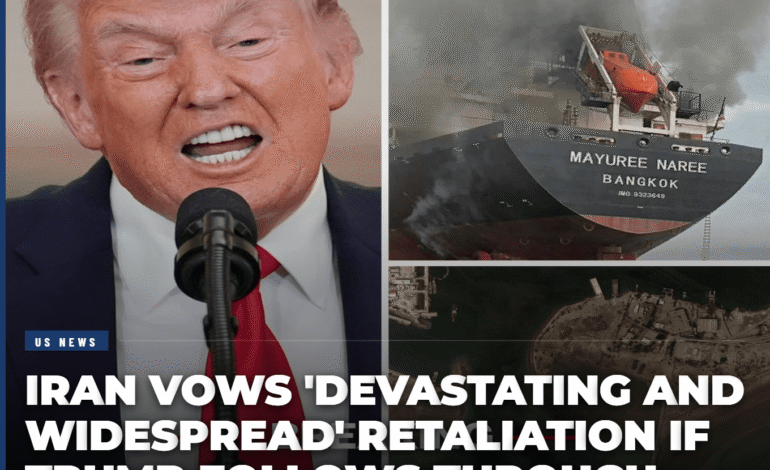

As a 45-day ceasefire proposal lands on both sides’ desks and a Tuesday deadline looms, the world’s most dangerous ongoing military conflict reaches a critical crossroads.
| AT A GLANCE — KEY FACTS AS OF APRIL 6, 2026
Iran’s military warns of ‘much more devastating and widespread’ retaliation if Trump bombs civilian infrastructure. Trump set a Tuesday, April 8 deadline (8 p.m. ET) for Iran to reopen the Strait of Hormuz or face strikes on power plants and bridges. Egyptian, Pakistani and Turkish mediators delivered a 45-day ceasefire proposal to both sides late Sunday — neither has accepted. Iran shot down a US F-15E fighter jet; one crew member has been rescued in a White House-described ‘Easter miracle.’ The conflict began February 28, 2026. Over 3,540 Iranians and at least 23 Israeli civilians have been killed to date. Oil at $114/barrel. The Strait of Hormuz — through which 20% of the world’s oil flows — remains effectively closed. |
By the Numbers: The Toll of Week Six
| 3,540+ People killed in Iran since Feb. 28 |
244+ Children killed in Iran |
20%
Of world’s oil blocked at Hormuz |
| $114 Brent crude per barrel (Apr. 6) |
38 days
Duration of active conflict |
45 days Proposed ceasefire window |
The Warning That Stopped the World
Early Monday morning, April 6, 2026, Iran’s central military command delivered a message carried on state media that made global headlines within minutes. If the United States follows through on President Trump’s threat to strike civilian infrastructure — power plants, bridges, energy facilities — Iran promised retaliation on a scale not yet seen in the 38-day conflict.
‘If attacks on civilian targets are repeated, the next stages of our offensive and retaliatory operations will be much more devastating and widespread,’ the statement read.
The warning arrived less than 24 hours after Trump posted on Truth Social in terms that left no diplomatic room for misinterpretation — using profanity to demand Iran open the Strait of Hormuz or face catastrophic consequences.
‘Tuesday will be Power Plant Day, and Bridge Day, all wrapped up in one, in Iran,’ Trump wrote. ‘There will be nothing like it!!! Open the F—in’ Strait, you crazy b—–ds, or you’ll be living in Hell.’
And yet, simultaneously, a ceasefire proposal was quietly landing in both capitals — submitted by Egyptian, Pakistani and Turkish mediators and calling for a 45-day pause in hostilities. The contrast between the public posturing and the private diplomacy could hardly be more stark.
How Did We Get Here? The Road to War
The Origins of the 2026 Iran–US War
The current conflict did not erupt from nowhere. It was the culmination of years of failed diplomacy, escalating regional tensions, and — crucially — a prior 12-day air conflict between Israel and Iran in June 2025 that left grievances unresolved.
In January 2026, Iranian security forces killed thousands of protesters during the largest civil unrest the country had seen since 1979. President Trump responded with escalating threats of military action and oversaw the largest US military buildup in the Middle East since the 2003 Iraq War.
On February 28, 2026, the United States and Israel launched coordinated surprise airstrikes across Iran in what the Pentagon designated Operation Epic Fury. Among those killed in the initial strikes was Supreme Leader Ali Khamenei — a seismic event in modern geopolitics. Multiple other senior Iranian officials were also killed.
Iran’s response was swift and sweeping. The Islamic Revolutionary Guard Corps launched missile and drone strikes against US military bases, Israeli cities, and Gulf Arab neighbors. Most significantly, Iran shut down the Strait of Hormuz.
Why the Strait of Hormuz Matters So Much
The Strait of Hormuz is a narrow waterway between Iran and Oman — just 21 miles wide at its narrowest point. In peacetime, it carries roughly 20% of the world’s oil supply and a significant portion of global liquefied natural gas (LNG). There is no practical alternative route for most of this traffic.
Since Iran effectively closed the strait at the end of February, global energy markets have been in upheaval. Brent crude, which stood at around $80 per barrel before the conflict, surged past $166 per barrel at its March peak. Gas prices in California exceeded $5 per gallon by mid-March. The disruption has been described by economists as the world’s largest energy supply shock since the 1970s oil crisis.
Up to 30% of internationally traded fertilizers also transit the strait in normal times, meaning the closure threatens food supply chains across Asia, Africa and parts of Europe.
| KEY CONTEXT: The Strait of Hormuz
Width at narrowest point: 21 miles. Typical daily oil flow in peacetime: approximately 17-21 million barrels. Share of world LNG supply transiting the strait: roughly 20%. Countries most dependent: Japan, South Korea, India, China. Current status (April 6, 2026): Effectively closed. LNG tankers turned back Monday. Limited vessel passage reported. |
A Timeline of Escalation: Key Moments
| Date | Development |
| Feb. 28, 2026 | US and Israel launch Operation Epic Fury. Supreme Leader Khamenei killed. Iran closes Strait of Hormuz. |
| Early March | Iran launches waves of missiles and drones at Israel, US bases, Bahrain, Kuwait, Qatar, UAE and Saudi Arabia. |
| March 9, 2026 | Trump announces intent to ‘seize control’ of the Strait of Hormuz. France launches naval escort mission. |
| March 19, 2026 | US Armed Forces begin active military campaign to open the strait. Dubai crude peaks at $166/barrel. |
| March 23, 2026 | Trump announces pause on strikes on Iran’s energy infrastructure following ‘productive conversations.’ |
| March 27, 2026 | Brent crude at $114 after no ceasefire reached. IRGC formally declares strait closed. |
| Late March | Trump says Iran ‘begged for a ceasefire’ but claims he rejected it. Vows to bomb Iran ‘back to the Stone Ages.’ |
| April 4, 2026 | UN Security Council vote on Bahrain’s proposal remains uncertain due to divisions among major powers. |
| April 5, 2026 | Iran shoots down US F-15E Strike Eagle. Two crew members go missing. One rescued; second located Easter Sunday. |
| April 5–6, 2026 | Egypt, Pakistan and Turkey submit 45-day ceasefire proposal. Trump extends pause to April 8, 8 p.m. ET deadline. |
| April 6, 2026 | Iran warns of ‘much more devastating and widespread’ retaliation. Over 25 people killed in new US-Israeli strikes. |
What Is Happening Right Now — April 6, 2026
Strikes Continue as Ceasefire Talks Intensify
Even as ceasefire diplomacy accelerates, the killing has not stopped. Monday’s strikes by the US and Israel killed more than 25 people across Iran. Among the dead was Maj. Gen. Majid Khademi, the intelligence chief of Iran’s paramilitary Revolutionary Guard — killed in a targeted Israeli strike. Israeli Defense Minister Israel Katz vowed to continue ‘hunting down’ Iran’s leaders.
A strike near Tehran’s Azadi Square hit the grounds of Sharif University of Technology. Another near Eslamshar, southwest of Tehran, killed at least 13. Five were killed in Qom, and more in other cities. Iran’s state-run media also confirmed six children were among the overnight dead.
The 45-Day Ceasefire Proposal
Late Sunday, the most serious diplomatic effort to date reached both Tehran and Washington. Egyptian, Pakistani and Turkish mediators — who have been working as intermediaries since direct talks stalled — delivered a proposal calling for a 45-day ceasefire and the full reopening of the Strait of Hormuz.
The proposal was presented to Iranian Foreign Minister Abbas Araghchi and US Mideast envoy Steve Witkoff. Pakistan’s army chief, Field Marshal Asim Munir, was reportedly in contact ‘all night long’ with US Vice President JD Vance and Special Envoy Witkoff simultaneously.
The plan envisions the 45-day window as a space for intensive negotiations aimed at producing a permanent ceasefire — the first serious attempt at a structured exit from the conflict.
| WHITE HOUSE RESPONSE (April 6, 2026)
‘This is one of many ideas, and [Trump] has not signed off on it. Operation Epic Fury continues.’ — White House official, quoted by Reuters. Trump is expected to address the war and the proposal at a 1 p.m. ET news conference at the White House on April 6. Trump also confirmed the rescue of a second F-15 crew member, calling it ‘an Easter miracle.’ |
Iran’s Response to the Proposal
Iran has not accepted the ceasefire proposal, but it has also not flatly rejected it — at least not in the same terms it previously used. Foreign ministry spokesperson Esmail Baghaei said Iran had ‘formulated its response’ to the proposals conveyed by intermediaries and would inform the public as to how they would be announced.
Crucially, Iran said it would not engage in direct talks with the US and Israel while strikes continue — a condition that makes immediate diplomacy structurally very difficult. ‘We are calling for an end to the war and for preventing its recurrence,’ Baghaei said, indicating Iran’s goal is not merely a pause but a permanent resolution.
Iran’s senior adviser Ali Velayati issued a separate stark warning, suggesting Tehran ‘views the Bab al-Mandab Strait with the same intensity as Hormuz’ — a signal that Iran could extend the shipping disruption to a second critical choke point in the Red Sea if it chose to.
Shipping Remains Severely Curtailed
The ceasefire diplomacy has not yet translated into movement on the water. Two LNG tankers — the Rasheeda and Al Dayeen, loaded with Qatari natural gas — turned back Monday before attempting to transit the strait. Had they made it through, it would have been the first LNG transit since the war began.
A small number of vessels have continued to move through the strait, including Turkish-registered ships. The Turkish vessel Ocean Thunder crossed Sunday, becoming the third Turkish vessel to leave the Persian Gulf since the conflict began. But for most of global shipping, the strait remains effectively closed.
International Reactions and Diplomatic Pressure
Regional and Global Stakeholders
The world has watched the standoff at Hormuz with growing alarm. The economic stakes alone have driven governments across Asia, Europe and the Middle East to weigh in.
- UAE: Diplomatic adviser Anwar Gargash said any settlement must guarantee free access through Hormuz and that the strait ‘cannot be weaponized.’ He added any deal must also address Iran’s nuclear program and ongoing missile and drone attacks.
- Qatar: Prime Minister Mohammed bin Abdulrahman bin Jassim Al-Thani called Monday for a return to negotiations.
- Oman: Engaged with Iranian diplomats over the weekend to discuss the Hormuz proposal.
- France: President Macron announced a ‘purely defensive’ naval escort mission and deployed frigates to the wider Middle East as part of Operation Aspides.
- UK, Germany, Italy: Working to support commercial shipping through the strait.
- India: Proposed deploying its Navy in March to safeguard its oil supplies.
- Ukraine: President Zelensky offered Ukraine’s expertise in keeping maritime corridors open, drawing on its Black Sea experience.
- China: Called the war unjustified and criticized Iran for attacking neighboring states, while stopping short of backing the US-Israeli campaign.
The UN Security Council Deadlock
A vote on Bahrain’s proposal at the United Nations Security Council on April 4 failed to produce consensus, with major powers divided. The UN Secretary-General Antonio Guterres has condemned the original US-Israeli strikes; a subsequent UNSC resolution condemned Iran’s retaliatory strikes on Gulf states. The divergent condemnations illustrate why no unified international pressure has been able to halt the conflict.
The Human Cost: A Growing Humanitarian Crisis
Behind the geopolitical headlines lies an accelerating humanitarian catastrophe. The US-based human rights group HRANA reported that approximately 3,540 people have been killed in Iran since the war began on February 28 — at least 244 of them children.
Iran’s government has not updated official casualty figures for several days, which human rights observers have flagged as a cause for concern about transparency. Multiple cities across Iran — Tehran, Qom, Eslamshar and others — have been struck repeatedly.
In Lebanon, where Israel has launched ground operations against Iran-backed Hezbollah, more than 1,460 people have been killed and over one million displaced. Eleven more were killed by Israeli strikes on Sunday alone, including a 4-year-old girl.
In Israel, Iranian missiles have struck residential buildings. Four civilians were killed in Haifa in a missile attack overnight, bringing the total Israeli civilian death toll from Iranian and Hezbollah strikes to 23. Israel has described its missile interceptors as increasingly strained and has announced plans to accelerate their production.
| HUMANITARIAN SNAPSHOT (As of April 6, 2026)
Iran: ~3,540 killed, including 244+ children (HRANA / rights groups). Official toll not updated. Lebanon: 1,460+ killed, 1 million+ displaced since Israeli ground operations began. Israel: 23 civilian deaths from Iranian and Hezbollah attacks. Gulf states: Ongoing missile and drone attacks on energy and civilian infrastructure. Refugees and displacement: Detailed figures remain incomplete due to access restrictions. |
Economic Impact: The World Economy Under Pressure
Energy Markets in Shock
The Strait of Hormuz crisis has delivered the biggest shock to global energy markets since the 1970s. At the peak in mid-March, Dubai crude hit a record $166 per barrel. Brent crude has since settled around $114 but remains roughly 40% above pre-conflict levels.
California gasoline prices exceeded $5 per gallon by mid-March. European natural gas prices have surged as LNG supplies from Qatar — one of the world’s largest LNG exporters — are effectively stranded. Two Qatari LNG tankers turned back on Monday rather than attempt the strait.
Global Trade Disruption
Up to 30% of internationally traded fertilizers normally move through Hormuz. With that route closed, agricultural supply chains across South Asia, East Africa and Southeast Asia face the prospect of significant price increases for fertilizers — a development with food security implications.
Aviation and tourism industries across the Gulf have also been severely disrupted. The Panama Canal has seen a modest increase in traffic as shippers seek alternative routes, though its capacity is far below what Hormuz handles.
Financial Markets
US stock index futures edged higher on Monday as investors assessed the prospect of a ceasefire. Oil prices dropped over $2 a barrel at one point on ceasefire optimism. The pattern has repeated throughout the conflict — markets rally on any peace signal, only to retreat when talks stall or strikes resume.
On March 23, when Trump first signaled ‘very good and productive conversations’ with Iran, Brent crude fell from $114 to $102 in a single session, demonstrating the enormous premium markets have priced in for a resolution.
Understanding Trump’s Approach: Deadlines, Pauses, and Escalation
One of the most striking features of Trump’s management of this conflict has been the repeated use of deadlines paired with last-minute extensions — a pattern that has become central to both his leverage strategy and his critics’ concerns.
The Pause-and-Extend Pattern
On March 23, Trump announced a pause on strikes against Iranian energy targets, citing ‘very good and productive conversations’ with Iran. He extended that pause to April 6, claiming Iran had ‘given him ships’ — oil tankers that Iran allowed through the strait.
Then, last week, Trump insisted Iran had begged for a ceasefire, rejected it, and vowed to bomb the regime ‘back to the Stone Ages.’ Now, on April 6, he has extended his latest deadline to Tuesday, April 8 at 8 p.m. ET — while simultaneously leaving the door open to a deal.
A White House official’s statement that the ceasefire proposal is ‘one of many ideas’ while confirming ‘Operation Epic Fury continues’ captures the dual-track nature of American strategy: maximum pressure combined with a diplomatic off-ramp.
The F-15 Rescue and Trump’s Framing
Sunday’s rescue of the second downed F-15E crew member has given Trump an emotionally resonant narrative on Easter Sunday — framing the rescue as ‘an Easter miracle’ in a message to NBC News. The administration is holding a 1 p.m. news conference Monday focused on the rescue.
The crew member, described by Trump as a ‘respected colonel,’ was the second to be recovered after Iran shot down the F-15E on Friday. The first was rescued in ‘broad daylight’ after seven hours over Iran. Trump called the operation ‘a rarely attempted type’ due to the danger involved.
Iran’s Position: Defiance, Leverage, and Red Lines
The Hormuz Stranglehold as a Bargaining Chip
Iran’s closure of the Strait of Hormuz has been the single most economically powerful tool in its arsenal since the war began. Unlike conventional military confrontation, where the US and Israel hold enormous advantages, Iran’s control of Hormuz gives it leverage over global oil markets and thus over every major economy on Earth.
Tehran has consistently linked the reopening of Hormuz to a permanent, verified ceasefire — refusing to treat it as a goodwill gesture or a preliminary confidence-building measure. That position makes quick diplomatic resolution structurally difficult.
The Bab al-Mandab Threat
Iran’s warning through adviser Ali Velayati that it ‘views Bab al-Mandab with the same intensity as Hormuz’ is significant. The Bab al-Mandab Strait, between Yemen and Djibouti, controls access to the Red Sea and the Suez Canal. It is another critical choke point for global trade. Any Iranian move to disrupt that waterway — whether through direct action or through allied Houthi forces in Yemen — would compound the current energy and shipping crisis dramatically.
Iran’s Domestic Political Constraints
The regime in Tehran is operating under significant domestic pressure. The January 2026 crackdown on protesters — in which thousands were killed — left deep social wounds. A ceasefire perceived domestically as capitulation to US demands could further destabilize the regime’s already tenuous position with its own population.
Conversely, a prolonged war with continued strikes on Iranian cities creates its own domestic vulnerabilities. The regime’s insistence on a ‘permanent’ rather than ‘temporary’ ceasefire likely reflects this calculation — a brief pause, followed by a resumed conflict, would be politically untenable.
Frequently Asked Questions
What is the Strait of Hormuz and why is it so important?
The Strait of Hormuz is a narrow waterway between Iran and Oman connecting the Persian Gulf to the Gulf of Oman and the wider Indian Ocean. In normal times, roughly 20% of the world’s oil and a significant share of global LNG passes through it daily. There is no viable alternative route for most of this traffic. Its closure has sent global energy prices to record levels.
When did the US-Iran war begin?
The current conflict began on February 28, 2026, when the United States and Israel launched coordinated airstrikes on Iran in Operation Epic Fury, killing Supreme Leader Ali Khamenei and other senior officials. Iran responded with missile and drone attacks across the region and closed the Strait of Hormuz. The conflict is now in its sixth week.
What is the 45-day ceasefire proposal?
The proposal was delivered late Sunday, April 5, 2026 by mediators from Egypt, Pakistan and Turkey. It calls for an immediate 45-day ceasefire and the reopening of the Strait of Hormuz, with that window used to negotiate a permanent end to the conflict. Neither the US nor Iran has formally accepted it. A White House official described it as ‘one of many ideas.’
What happens if the Strait of Hormuz remains closed?
The longer Hormuz stays closed, the more severe the global economic damage becomes. Oil and gas prices remain elevated, food supply chains face disruption due to fertilizer shortages, and LNG-dependent economies — particularly in East Asia — face energy shortfalls. The conflict has already been described as the worst global supply disruption since the 1970s energy crisis.
What is Trump’s Tuesday deadline?
Trump has set a deadline of Tuesday, April 8, 2026 at 8 p.m. Eastern Time for Iran to reopen the Strait of Hormuz. If it does not, he has threatened massive strikes on Iranian power plants, bridges, and other infrastructure. Trump has issued similar deadlines before and extended them, most recently pushing back from April 6 to April 8, citing ceasefire diplomacy.
What Comes Next: Scenarios to Watch
Scenario 1: Ceasefire Deal Before Tuesday Deadline
The most optimistic scenario is that intensive overnight diplomacy — Pakistan’s army chief was reportedly in contact ‘all night’ with US and Iranian officials — produces enough agreement to pause the fighting before Trump’s 8 p.m. Tuesday deadline. This would halt the immediate threat of strikes on power plants and bridges, and give both sides 45 days to negotiate. Markets would rally sharply.
Scenario 2: Trump Strikes Civilian Infrastructure
If no deal is reached by Tuesday night, Trump has explicitly threatened to strike power plants and bridges — a significant escalation from current targeting of military and nuclear infrastructure. Iran has explicitly warned this will trigger its most severe retaliation yet. The consequences for civilian populations in Iran and for regional stability would be severe.
Scenario 3: Continued Stalemate and Rolling Deadlines
Based on the pattern of the last six weeks, a third scenario is a continuation of the current rhythm — Trump issues a deadline, extends it, strikes continue at the current tempo, Iran retaliates, and diplomacy inches forward without a decisive breakthrough. This scenario carries its own risks: attrition, economic damage, and the ever-present possibility of a miscalculation that triggers catastrophic escalation.
Conclusion: The World on the Edge of a Decision
The Iran-US-Israel conflict has reached its most dangerous inflection point since February 28. A ceasefire proposal sits on two desks in Tehran and Washington. A deadline of Tuesday night hangs over the world’s most critical oil artery. And the gap between the public language — ‘hell,’ ‘devastating and widespread retaliation’ — and the private diplomacy could not be wider.
The next 48 hours will determine whether this conflict takes a catastrophic new turn or whether intensive diplomacy from Egypt, Pakistan and Turkey can broker at least a temporary halt. What is not in dispute is the scale of what is at stake: the global energy supply, the lives of millions across Iran, Israel, Lebanon and the Gulf, and the broader architecture of international order in the Middle East.
Whatever happens before Trump’s Tuesday deadline, the underlying questions — Iran’s nuclear ambitions, the legitimacy of the strikes, the future of the Strait of Hormuz as a shared global commons — will require a political resolution that no military campaign alone can deliver.
Key Takeaways
- Iran has issued its most explicit threat yet — warning of ‘much more devastating and widespread’ retaliation if Trump strikes civilian infrastructure.
- A 45-day ceasefire proposal from Egyptian, Pakistani and Turkish mediators is on the table but unaccepted by either side as of April 6, 2026.
- Trump’s deadline — reopen the Strait of Hormuz by Tuesday, April 8 at 8 p.m. ET or face massive strikes — has not been backed down from publicly, though a deal remains possible.
- The conflict is now in its sixth week, with over 3,540 killed in Iran, 23 Israeli civilians dead, and the global energy crisis deepening.
- The Strait of Hormuz remains effectively closed, keeping global oil markets in turmoil and LNG supplies to Asia severely disrupted.
- Diplomatic pressure is intensifying: Pakistan, Egypt, Turkey, Oman, Qatar, France, the UK, Germany, Italy and others are all actively involved in efforts to end the conflict.
Sources & Further Reading
- New York Post — ‘Iran vows devastating and widespread retaliation if Trump follows through with fresh strikes,’ Emily Crane (April 6, 2026)
- The Associated Press — ‘Iran and US receive proposal for 45-day ceasefire and reopening of Strait of Hormuz’ (April 6, 2026)
- CNN — Iran war live updates (April 6, 2026)
- NPR — ‘Iran pushes back against Trump’s deadline to open the Strait of Hormuz’ (April 6, 2026)
- Al Jazeera — ‘Iran war live: Tehran rejects temporary ceasefire, Trump sets deadline for Strait of Hormuz’ (April 6, 2026)
- NBC News — Live blog: Iran war updates (April 6, 2026)
- Wikipedia — ‘2026 Iran War’ and ‘2026 Strait of Hormuz Crisis’ (continuously updated)
- RTE News — ‘Iran has formulated its response to ceasefire proposals’ (April 6, 2026)
WORLD NEWS | CRISIS DISPATCH | BREAKING COVERAGE
Published April 6, 2026. All information current as of 7:24 a.m. ET. Story is developing.
Discover more from MatterDigest
Subscribe to get the latest posts sent to your email.