Illinois Makes History: Residents Can Now Sue ICE Agents
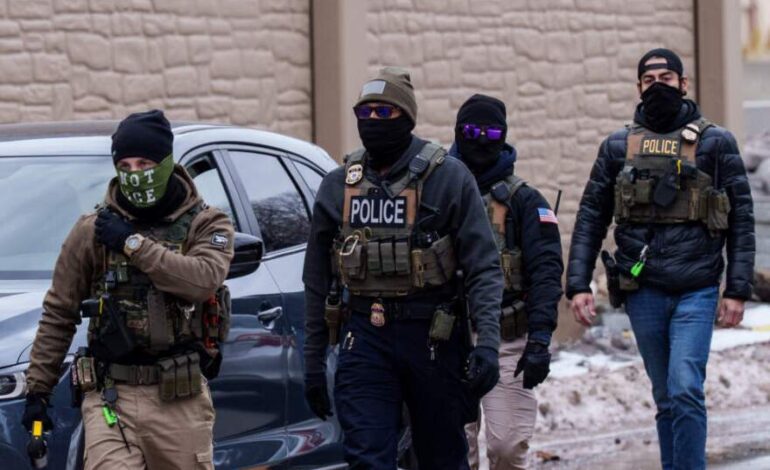

Illinois Makes History: Residents Can Now Sue ICE Agents for Rights Violations — Here’s What That Really Means
Something major just happened in American immigration law — and most people do not fully understand what it means yet. Illinois has become the first state in the country to give its residents the legal right to sue federal immigration agents, specifically ICE officers, for violating their constitutional rights. This is not a small policy tweak. It is a direct challenge to a legal system that has, for decades, made it nearly impossible to hold federal agents personally accountable for what they do on the job.
Governor JB Pritzker signed the legislation into law in December 2025. Within days, the Trump administration filed a federal lawsuit trying to kill it. And as of April 2026, ICE agents are still showing up at Illinois courthouses — including a domestic violence courthouse in Chicago — in what officials say is a direct violation of the new law.
So what exactly does this law do? Why does it matter so much that both sides are fighting this hard over it? And what could it mean for the rest of the country? This article breaks it all down.
What the New Illinois Law Actually Does
The law has two major parts that work together. The first part is called the Illinois Bivens Act. It gives any Illinois resident the right to sue a federal immigration agent who violates their constitutional rights during a civil immigration enforcement action. That means if an ICE officer arrests someone without a warrant, conducts an unreasonable search, or denies someone their right to due process, that person now has a legal path to hold that specific officer personally responsible in an Illinois court.
The second part is called the Court Access, Safety, and Participation Act. It bans civil immigration arrests at or within 1,000 feet of any Illinois state courthouse. The idea is simple: people should be able to go to court — as a witness, a victim, a juror, or a party to a case — without fearing they will be grabbed by immigration agents on the way in or out. Anyone arrested in violation of this part of the law faces statutory damages of $10,000.
There is also a meaningful detail about how damages are calculated under the new law. If the agent who made the arrest was wearing a mask, hiding their identity, had no body camera, or was driving a vehicle with out-of-state plates, the punitive damages can go even higher. This is a direct response to tactics that Illinois officials documented during Operation Midway Blitz — the Trump administration’s aggressive immigration enforcement campaign that launched in Chicago in the fall of 2025.
Why Federal Immunity for ICE Agents Was Such a Big Shield
To understand why this law is such a big deal, you need to understand what “federal immunity” actually means in practice.
Under longstanding legal doctrine, federal officers have strong protections from personal lawsuits. In most situations, if an ICE agent arrests the wrong person, violates their rights, or uses excessive force, that person’s only real legal option is to file a complaint with the federal government itself — the same government that employs the agent. As you might imagine, that process does not always lead to accountability.
There is a federal tool called a “Bivens claim” — named after a 1971 Supreme Court case — that theoretically allows people to sue federal agents for constitutional violations. But over the decades, the Supreme Court has steadily narrowed the situations where Bivens claims are allowed. For immigration enforcement specifically, the courts have largely shut the door on these claims. That has left people who believe their rights were violated by ICE or Border Patrol with very limited options.
What Illinois has done is essentially create a state-level version of the Bivens claim — one that applies specifically to constitutional violations during civil immigration enforcement within the state’s borders. It is a creative legal move designed to fill a gap that the federal system has left wide open.
What Triggered This Law: Operation Midway Blitz and Its Fallout
This law did not come out of nowhere. It was a direct response to a dramatic escalation of federal immigration enforcement in Illinois that began in the fall of 2025.
In September 2025, the Department of Homeland Security launched Operation Midway Blitz — a large-scale deployment of ICE and U.S. Customs and Border Protection agents to Chicago and the surrounding area. The operation quickly drew widespread criticism. Illinois officials documented agents conducting warrantless arrests, deploying tear gas on bystanders that included children and elderly residents, conducting a military-style helicopter raid on a Chicago apartment building, and detaining everyone inside — including children.
The operation also resulted in two shootings by Border Patrol agents. One of those shootings killed 38-year-old Silverio Villegas-Gonzalez, an undocumented father of two, after he dropped his son off at daycare. The other involved a Chicago woman named Marimar Martinez, who was shot five times. A federal grand jury initially indicted her before the charges were later dropped.
In response to all of this, the Illinois General Assembly moved quickly. By October 2025, state lawmakers had passed the legislation that Pritzker signed in December. The message was clear: the state was not going to sit back and let federal agents operate in Illinois as if they were above the law.
Governor Pritzker and the State’s Legal Battle With the Trump Administration
Governor JB Pritzker has been one of the most outspoken Democratic governors in the country when it comes to pushing back against the Trump administration’s immigration policies. Since Trump returned to office, Illinois has filed or joined more than four dozen separate lawsuits against the federal government on issues ranging from immigration enforcement to the withholding of congressionally approved state funding.
When Pritzker signed the courthouse protection and ICE accountability law in December 2025, he called it part of a “nation-leading” response to what he described as the federal government’s violent overreach. He said he believed the law was on solid constitutional ground and expressed confidence it would survive legal challenges.
The Trump administration did not wait long to respond. Within weeks, the Department of Justice filed a federal lawsuit directly naming Pritzker and Illinois Attorney General Kwame Raoul as defendants. The DOJ argued that the law violates the supremacy clause of the U.S. Constitution — the provision that establishes federal law as the supreme law of the land — and claimed the law would expose federal agents to harassment and threats of violence.
Pritzker’s office fired back. In a statement, his spokesperson said: “The Trump Administration’s masked agents are not targeting the ‘worst of the worst’ — they are harassing and detaining law-abiding U.S. citizens and Black and Brown people at daycares, hospitals, and courthouses. This new law reflects our belief that no one is above the law, regardless of their position or authority.”
That federal lawsuit is still working its way through the courts as of April 2026.
ICE Keeps Showing Up Anyway: The Courthouse Standoff
Here is where the story takes an even more troubling turn. Despite the new law being signed, despite a court order from Cook County’s chief judge prohibiting warrantless civil immigration arrests at county courthouses, ICE agents have continued appearing at Illinois courthouses.
As recently as April 2, 2026, an ICE agent reportedly showed up at Cook County’s Domestic Violence Courthouse in Chicago, apparently intending to take someone into custody who was there for a court appearance. It was the fifth known incident of ICE presence at Cook County courthouses in just over a month. Three of those incidents resulted in actual arrests.
State Senator Graciela Guzman was direct about what she believes is happening: “They are not confused. They are not acting in a gray area. They are knowingly and willingly violating the law of this state.”
Advocates have also noted that ICE appears to be adapting its tactics in response to the new rules. Before the law, agents were openly marching into courthouses and arresting people in full view of everyone inside. Now, the pattern seems to have shifted toward staking out the surrounding area and approaching people just outside the protected zone — or identifying themselves in ways designed to obscure their authority.
The domestic violence courthouse situation is particularly concerning to advocates. People coming to that courthouse are often survivors of abuse seeking protective orders or appearing in safety-related proceedings. If fear of immigration enforcement keeps them away from court, it does not just affect their immigration status. It leaves them exposed to the very danger they went to court to escape.
The Constitutional Battle at the Heart of This Fight
The legal fight over Illinois’s law comes down to a fundamental question that the courts have not fully resolved: how much power do states have to protect their residents from federal enforcement actions they believe are unconstitutional?
The Trump administration’s argument rests on the supremacy clause. Federal immigration law is federal law. States cannot override it, obstruct it, or create liability for the agents enforcing it. That argument has intuitive force. The federal government does have broad authority over immigration.
But Illinois’s argument rests on the 10th Amendment and on the basic constitutional rights of its residents. The 10th Amendment reserves certain powers to the states. It is the constitutional foundation for what lawyers call “state sovereignty.” Illinois is arguing that the federal government is not just enforcing immigration law — it is using immigration enforcement as a weapon against states that disagree with its policies. It is coercing Illinois to abandon its own laws and direct its own resources toward federal priorities. That, the state argues, is beyond what the Constitution allows.
Constitutional law experts say both sides have real arguments. Craig Futterman, a clinical law professor at the University of Chicago, said the states’ theory is that federal immigration law is being used as a cover for something else: targeting Democratic-led states and cities to retaliate against them for their policies and to interfere with their local governance. Whether the courts will accept that argument remains to be seen.
Illinois Is Not Alone: Minnesota and the Growing State Resistance
Illinois is not the only state pushing back against the Trump administration’s immigration tactics. Minnesota filed its own lawsuit against federal immigration enforcement tactics on the same day as Illinois — January 12, 2026. Both states cited the 10th Amendment and accused the federal government of overreach that threatens their ability to govern their own communities.
Minnesota’s lawsuit came in the wake of its own tragedy. An ICE agent shot and killed a woman named Renee Nicole Good in Minneapolis. Her death drew national attention and intensified calls for accountability measures like those Illinois has now put in place.
There is already a federal court injunction — a judge’s order — limiting how ICE and Border Patrol agents can use force during Operation Midway Blitz in the Chicago area. That injunction came from a lawsuit brought by journalists, protesters, and clergy who argued their First Amendment rights were being violated. The fact that a federal judge has already placed restrictions on agent behavior in Illinois suggests the courts are not uniformly siding with the Trump administration on these questions.
What This Means for Immigrants Living in Illinois Right Now
For immigrants living in Illinois — documented or undocumented — the new law is a meaningful development, even if its full impact depends on how courts ultimately rule.
First, it sends a clear signal about where the state government stands. Illinois is not a passive bystander in this fight. The state is actively deploying legal tools to protect the people who live within its borders, regardless of their immigration status.
Second, the courthouse protection specifically addresses a chilling effect that had become very real. When people stop going to court — to report crimes, to testify, to seek protective orders — the entire judicial system suffers. Local schools went into lockdown. Social service organizations had to cut back services. Businesses saw declining sales as everyday Illinoisans became afraid to go about their daily lives. The law is designed to stop that damage from spreading further.
Third, the law provides a genuine legal remedy where virtually none existed before. If you were wrongly arrested by an ICE agent in Illinois, or subjected to an unreasonable search, or denied your constitutional right to due process, you now have a real legal path to seek justice — one that does not depend on the federal government policing its own agents.
Could Other States Follow Illinois’s Lead?
The caption that inspired this article asks exactly that question: should other states follow Illinois’s lead? It is worth thinking through seriously.
On the one hand, Illinois’s approach is legally bold and almost certain to face years of litigation. States that follow its lead would be walking into the same legal battles. The Trump administration’s DOJ has shown it will move quickly and aggressively to challenge state laws it sees as interfering with federal immigration enforcement. Any state that passes a similar law should expect a federal lawsuit within weeks.
On the other hand, the political and moral argument for action is strong. When federal agents are conducting warrantless arrests, deploying tear gas on children, and showing up at domestic violence courthouses to detain crime victims seeking help, state governments face a real question: are they going to do something, or are they going to watch?
Several other Democratic-led states are reportedly watching the Illinois case closely. California, New York, and Washington state have all had their own confrontations with federal immigration enforcement. If Illinois’s law survives its legal challenges, it could quickly become a model that spreads to a dozen or more states.
The bigger question — the one the courts will have to answer — is whether a state even has the authority to do what Illinois has done. That question goes all the way to the heart of American federalism: the balance of power between state governments and the federal government that has been contested since the founding of the country.
Final Thoughts: A Legal Fight That Will Define the Limits of Federal Power
What Illinois has done is genuinely historic. No other state has gone this far in creating legal accountability for federal immigration agents operating within its borders. The law is already being tested — by a federal lawsuit from the DOJ, by ICE agents who keep showing up at protected courthouses, and by the ongoing legal proceedings that will eventually force the federal courts to weigh in.
The outcome of this fight will matter far beyond immigration policy. It will help define, for this generation, how much power a state actually has to protect its residents from federal enforcement actions that it believes are unconstitutional. That is a question as old as the republic itself — and one that has never been more urgent.
In the meantime, what is clear is this: Illinois has decided it will not be a passive participant in a federal enforcement campaign it believes is unlawful and harmful to its people. Whether you agree with that decision or not, the legal and political consequences of it are going to ripple across the country for years to come.
Discover more from MatterDigest
Subscribe to get the latest posts sent to your email.