Hungary Just Banned LGBTQ Ideology from Schools
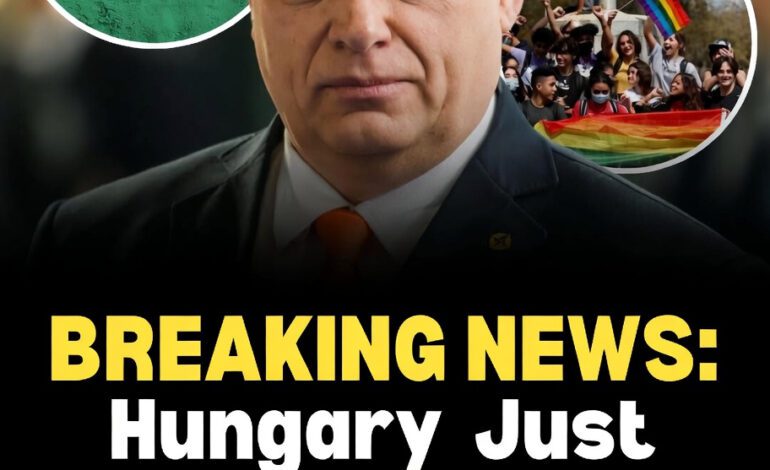

Verdict: Partly True — But Significantly Distorted
Hungary has indeed passed sweeping laws restricting LGBTQ+ content in schools and public life. That part is confirmed by multiple credible sources. But the viral framing of these laws — celebrating them as simple ‘common sense child protection’ while hiding their full scope, legal controversies, and democratic costs — tells only a fraction of the story. Here is what the evidence actually shows.
What Actually Happened: Hungary’s LGBTQ Laws — A Timeline
The 2021 Law: Where It Started
The foundation of the current controversy is Hungary’s Act LXXIX of 2021, passed on June 15 of that year. The law was originally drafted to combat pedophilia — a goal few would oppose. But at the last minute, lawmakers inserted an amendment banning all LGBTQ+ related content in schools and media aimed at minors. The opposition majority, which had initially supported the anti-pedophilia bill, boycotted the final vote in protest of the amendment. The bill passed with 157 votes for and just one against.
Under the 2021 law, any content “portraying or promoting sex reassignment or homosexuality” is banned from schools, television, films, advertisements, and literature aimed at those under 18. Books with LGBTQ+ themes must be sold in closed packaging, kept away from youth sections, and cannot be displayed in store windows or sold within 200 metres of schools. TV shows depicting homosexuality — including mainstream programs like Friends and Bridget Jones — face restrictions or censorship for minors.
March–April 2025: Hungary Goes Further
In early 2025, Orbán’s government escalated significantly. On March 18, 2025, parliament fast-tracked — in a single day — a new law banning all public events that “promote or display any deviation from a person’s gender at birth, as well as gender reassignment and homosexuality.” This includes Budapest Pride, one of the largest annual events in Hungary. Attending a banned event now carries fines of up to 200,000 Hungarian forints (approximately $546). Organizing one is a criminal offence punishable by up to one year in prison.
The law also permits the use of facial recognition software to identify and log participants at prohibited events — a measure that legal scholars say violates the EU’s GDPR and AI regulations, and which civil liberties groups warn can be used to chill any political protest the government dislikes.
On April 14, 2025, Hungary went even further: parliament passed the 15th Amendment to the Hungarian Constitution itself. The amendment declares children’s rights to moral, physical, and spiritual development as superseding all other fundamental rights — except the right to life. Interpreted through the lens of the 2021 law, critics note this effectively writes the ban on LGBTQ+ content into the country’s supreme legal document.
June 2025: Budapest Pride Defies the Ban
On June 3, 2025, Budapest police formally denied permission for the annual Pride march, arguing it was now illegal. Organizers called the decision a “textbook example of tyranny” and vowed to proceed anyway. On June 28, 2025, between 100,000 and 200,000 people attended — making it the largest anti-government demonstration in Hungary in years. No arrests were made. The event became a watershed moment in Hungarian civil society.
Separating Fact from Fiction: A Claim-by-Claim Breakdown
| Claim | Verdict | Reality |
| Hungary banned LGBTQ content from schools | TRUE | Confirmed since 2021. The law bans any mention of LGBTQ+ topics in school education programs for under-18s. |
| The ban is about ‘no more gender theory lessons’ | MISLEADING | The law bans any mention of LGBTQ+ existence — including historical or factual references — not just contested gender theory. |
| Europe is “shaking” because Hungary stood firm | EXAGGERATED | The EU has launched its largest-ever human rights case against Hungary. 20 member states condemned the laws as of May 2025. |
| The law protects children from ‘premature sexualization’ | CONTESTED | Courts and the EU Commissioner found the law ‘disproportionate.’ The European Court of Human Rights found no scientific evidence that mentioning homosexuality harms children. |
| Parents and common sense win | OPINION | Tens of thousands of Hungarians — including parents — protested against the laws. 100,000–200,000 attended banned Pride in June 2025. |
| The West teaches ‘5-year-olds to choose their gender’ | FALSE / Strawman | No Western country has a national curriculum mandating this. The claim misrepresents age-appropriate diversity education. |
| Hungary’s schools now focus on ‘reading, math, history’ | MISLEADING | Critics note Hungary’s education system faces serious underfunding. A Háttér Society coordinator noted ‘the terrible condition of education’ is one of the real problems Orbán avoids discussing. |
| The USA should pass similar laws nationwide | OPINION | This is a political advocacy position, not a news claim. It requires democratic debate, not factual assessment. |
What the Law Actually Does — Beyond the School Headline
It Goes Far Beyond Schools
The viral framing focuses on schools. But Hungary’s laws reach much further. Television and streaming content showing homosexuality or gender transition is restricted for under-18s. Booksellers face heavy fines for failing to wrap LGBTQ-themed books in closed packaging. Corporate advertising showing same-sex couples is restricted. The 2025 law makes attending a Pride march a criminal matter. The constitutional amendment entrenches these restrictions in Hungary’s supreme law.
Facial Recognition as a Surveillance Tool
One of the most alarming — and least-reported — aspects of the 2025 law is its authorisation of mass facial recognition surveillance at banned events. Legal scholars and civil liberties groups warn this tool can easily be extended beyond Pride events to any political protest the government chooses to label unlawful. Human rights lawyer Ádám Remport noted the technology creates a “chilling effect” — people become afraid to attend any demonstration for fear of being identified and punished.
The ‘Child Protection’ Framing and What It Obscures
The laws are officially branded as child protection measures. Critics — including the EU Commissioner for Democracy, Justice and Rule of Law — argue the framing deliberately conflates homosexuality with pedophilia, a tactic that has been condemned as both scientifically unfounded and deeply harmful. The European Court of Human Rights has found “no scientific evidence or sociological data” suggesting that mentioning homosexuality or open public debate about sexual minorities adversely affects children.
Tamás Dombos, a project coordinator at Hungarian LGBTQ+ rights group Háttér Society, stated that Orbán’s targeting of minorities is “a very common strategy of authoritarian governments” to distract from real issues — citing inflation, the economy, and underfunded education and healthcare as the problems most affecting ordinary Hungarians.
The European and Global Response: Not Silence — A Historic Pushback
The EU’s Largest-Ever Human Rights Case
The viral post frames Europe as “shaking” because Hungary dares to stand alone. The reality is more complex. The European Commission launched infringement proceedings against Hungary at the Court of Justice of the European Union. By May 2025, 20 EU member states — Austria, Belgium, Cyprus, Czechia, Denmark, Estonia, Finland, France, Germany, Greece, Ireland, Latvia, Lithuania, Luxembourg, Malta, the Netherlands, Portugal, Slovenia, Spain, and Sweden — had formally joined the case. The European Parliament also joined. Legal observers described it as the largest human rights case in EU history.
The UN Weighs In
UN Human Rights Chief Volker Türk personally called on Hungary to repeal the laws, describing them as “contrary to international human rights law.” The UN Human Rights office expressed deep concern that the laws impose “arbitrary and discriminatory restrictions on the rights of LGBTIQ+ individuals to freedom of expression, peaceful assembly and privacy.”
22 Ambassadors Issue a Joint Warning
On March 27, 2025, ambassadors from 22 countries — including Australia, Austria, Belgium, Czechia, Denmark, Estonia, Finland, France, Germany, Iceland, Ireland, Latvia, Lithuania, Luxembourg, the Netherlands, Norway, Poland, Slovenia, Spain, Sweden, Switzerland, and the United Kingdom — jointly expressed deep concern about Hungary’s new legislation.
The Russia Comparison: Not a Talking Point — A Legal Precedent
Multiple credible observers — including Amnesty International’s David Vig — have drawn direct parallels between Hungary’s laws and Russia’s 2013 “anti-gay propaganda” law. That comparison is not simply rhetorical. The European Court of Human Rights ruled in the Bayev and Others v. Russia case that such anti-LGBTI propaganda laws “reinforce stigma and prejudice and encourage homophobia, which is incompatible with the notions of equality, pluralism and tolerance inherent in a democratic society.”
Russia expanded its own propaganda ban from minors to all adults in December 2022. Hungary’s 2025 laws and constitutional amendment have moved in a parallel direction. CNN noted that Orbán is an ally of both Vladimir Putin and Donald Trump — a political alignment that shapes how both the laws and the international response are understood.
What the Viral Post Ignores: The Impact on LGBTQ Youth in Hungary
Mental Health Concerns
The viral post frames the laws as protecting children. But Hungarian LGBTQ+ advocacy groups have raised serious concerns about the impact on LGBTQ youth — the very children these laws claim to protect. Háttér Society warned when the 2021 law passed that suicide rates could rise dramatically, particularly among minors, as a consequence of the law removing access to support resources and affirming information. Monika Sipos, a Budapest English teacher who said she would defy the 2021 law, stated it “questions the core of the individual’s personality” — the last thing teenagers need.
Teachers Who Refuse to Comply
Not all educators in Hungary accepted the new restrictions. NPR documented teachers in Budapest — including 60-year-old literature teacher Mariann Schiller, who had taught since communist times — who stated they would defy the law. Their reasoning: removing LGBTQ+ students from curricula doesn’t make those students disappear. It isolates them at their most vulnerable developmental stage.
Should the USA Do the Same? Examining the Actual Debate
What Is Actually Being Debated in American Schools
The viral post calls for banning “LGBTQ ideology” from US public schools, citing a threat from “5-year-olds being taught they can choose their gender.” This characterisation is a significant exaggeration of what most age-appropriate diversity education actually involves. In the United States, school curricula are controlled at the state and district level. Multiple states have already passed laws limiting LGBTQ+ content in classrooms — notably Florida’s 2022 “Parental Rights in Education” law (dubbed by critics the “Don’t Say Gay” bill), which restricts classroom instruction on sexual orientation and gender identity through grade 3, and later expanded.
The Legitimate Debate Around Age-Appropriateness
There is a genuine, ongoing democratic debate in the United States about what is age-appropriate in school curricula, the role of parents in education, and local versus federal control of schools. These are real questions worthy of real discussion. Reasonable people disagree. What the evidence does not support is the claim that American schools are uniformly engaged in radical indoctrination, that no LGBTQ students exist in those schools, or that Hungary’s specific approach — which criminalises Pride attendance and deploys facial recognition on protesters — is the appropriate model.
What Hungary’s Model Actually Entails
Anyone advocating the American adoption of Hungary’s model should be clear about what that model includes: criminal penalties for attending a Pride march. Constitutional amendments that supersede the right to peaceful assembly. Mass facial recognition surveillance of protesters. A legal framework that 20 EU nations and the United Nations have condemned as discriminatory. These are not optional footnotes to the school curriculum story — they are the law as it actually exists.
Who Is Viktor Orbán? Context the Viral Post Omits
Viktor Orbán has been Prime Minister of Hungary continuously since 2010. His Fidesz party holds a supermajority in parliament. Under his rule, Hungary has systematically weakened judicial independence, restricted press freedom, and curtailed civil society. The LGBTQ+ laws are part of a broader pattern that legal scholars increasingly describe as “democratic backsliding” — the erosion of democratic institutions while maintaining the form of elections.
Orbán faces a genuine political challenge: a rising opposition, a struggling economy, inflation, and widespread dissatisfaction with underfunded public services. Critics — including LGBTQ+ rights groups, opposition politicians, and economists — argue the focus on LGBTQ+ issues is a deliberate distraction strategy, one Hungary’s own history of marginalising minorities (first Roma people, then migrants, then homeless people, then civil society organisations) has followed before.
Key Takeaways: Five Things to Know
- Hungary’s school ban is real. Since 2021, Hungarian law bans any LGBTQ+ content in school curricula for under-18s. This is confirmed and documented by multiple credible sources.
- The laws go far beyond schools. The 2025 legislation criminalises Pride attendance, authorises mass facial recognition surveillance, and has been constitutionally embedded — measures that 20 EU nations, the UN, and the ECHR have condemned.
- The ‘child protection’ framing is disputed. The EU Commission stated the law ‘stigmatises LGBTIQ-related content’ and is ‘disproportionate.’ Courts found no scientific evidence that mentioning homosexuality harms children.
- Hungarians are not uniformly in favour. Between 100,000 and 200,000 people defied the Pride ban in June 2025, making it Hungary’s largest anti-government demonstration in years.
- Applying this model to the USA is a political advocacy position, not a news fact. It deserves democratic debate — including honest acknowledgment of what Hungary’s model actually entails.
Conclusion: Real Law, Distorted Framing
Hungary’s restrictions on LGBTQ+ content in schools are real, documented, and significant. Reporting on them accurately is important. But the viral post does not accurately report them — it celebrates a sanitised version of the laws while omitting the criminal penalties for protest attendance, the facial recognition surveillance, the condemnation of 20 democratic nations and the United Nations, the largest EU human rights case in history, and the massive popular opposition within Hungary itself.
Debates about the appropriate content of school curricula are legitimate. Debates about parental rights in education are legitimate. Debates about age-appropriateness are legitimate. What is not legitimate is presenting a comprehensive civil liberties crackdown as simple common sense, hiding its full scope from readers, and calling for its adoption in another democracy without disclosure of what it actually involves.
Read the primary sources. Understand the full law. Then form your own view.
Sources & Further Reading
- Hungarian Anti-LGBTQ Law — Wikipedia (continuously updated through 2025)
- LGBTQ Rights in Hungary — Wikipedia (continuously updated through 2025)
- PBS NewsHour — ‘Hungary passes anti-LGBTQ+ law banning Pride events,’ March 18, 2025
- CNN — ‘New anti-LGBTQ+ law banning Pride events passes in Hungary,’ March 18, 2025
- NBC News — ‘Hungary’s parliament passes law banning Pride events in new assault on LGBTQ rights,’ March 19, 2025
- NPR — ‘Hungary passes constitutional amendment to ban LGBTQ+ public events,’ April 15, 2025
- NPR — ‘Hungary bans LGBTQ content from schools, but some teachers say they will defy it,’ July 9, 2021
- European Parliament Research Service — ‘Hungary’s Pride ban’ briefing, 2025
- European Parliament Research Service — ‘Hungary’s ban on Pride’ analysis (EPRS_BRI 2025)
- Friedrich Naumann Foundation — ‘New legislation in Hungary bans LGBT+ related content in schools and TV,’ June 2021
- UN Human Rights Office — Statement on Hungary’s LGBTQ+ legislation, March 2025
- Amnesty International — Statement by David Vig on Hungary’s anti-LGBTQ laws
This article is a journalistic fact-check. All individuals and organisations named are referenced in accordance with publicly available information. This article does not express support for or opposition to any political position on LGBTQ+ rights policy.
Discover more from MatterDigest
Subscribe to get the latest posts sent to your email.