He Asked About $1.4B… Then 143 Seconds of Silence, Stephen Miller Had No Immediate Answer
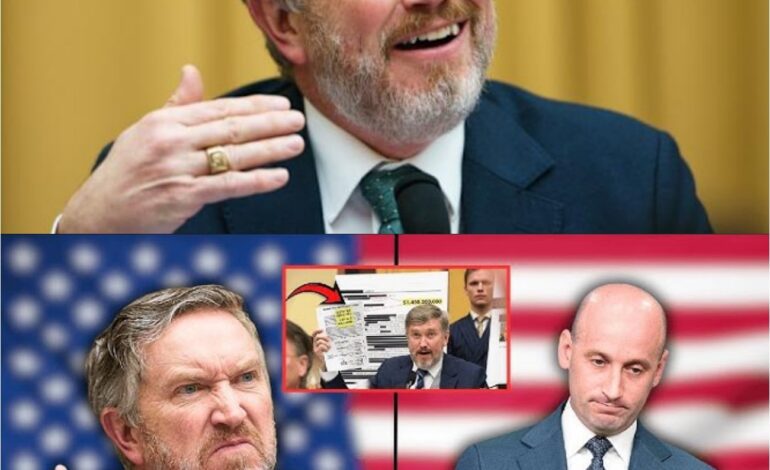

“WHERE IS $1.4B?”Thomas Massie Presses Missing Funds as Stephen Miller Stays Silent for 143 Seconds |
1. The Room Goes Quiet: Setting the Scene
Picture the scene. A congressional hearing room. Cameras. Senators and representatives lined up behind their name placards. And across the table: Stephen Miller, one of the most powerful immigration policy advisors in U.S. history.
The question came from Congressman Thomas Massie (R-KY), and it was devastatingly simple: “Where is the $1.4 billion?”
Two minutes and twenty-three seconds of silence followed. No quick rebuttal. No bullet-pointed response from a briefing binder. Just silence — and the quiet, devastating weight of an unanswered question.
That moment became a flashpoint. Clips spread across social media. Political commentators on both sides scrambled to interpret it. And millions of ordinary Americans asked the same follow-up question: If nobody can answer where $1.4 billion went, who is actually watching the money?
This article gives you the complete picture. We break down who Miller and Massie are, what the money was for, where it may have gone, and why this moment matters far beyond the politics of border security.
| WHY THIS STORY MATTERS The United States federal government spends over $6.5 trillion annually. When a senior official cannot account for $1.4 billion of it — in a public hearing, on camera — it raises questions every taxpayer deserves answered. |
2. Who Is Stephen Miller — and Why Was He Testifying?
Stephen Miller is not a bureaucrat. He’s an architect. Specifically, he’s spent over a decade architecting U.S. immigration policy from the inside.
Miller served as a senior advisor to President Donald Trump during his first term, helping craft travel bans, asylum restrictions, and border enforcement policies. He is widely credited — or blamed, depending on your view — as the intellectual force behind many of the most aggressive immigration measures of that era.
In the second Trump administration, Miller returned with expanded influence, taking on a senior policy role that gave him significant authority over border and immigration spending decisions.
Why Miller Appeared Before Congress
Miller’s appearance before the relevant congressional committee was part of routine oversight of executive spending on border security. Congress appropriates the money. The executive branch spends it. Oversight hearings exist to close the loop.
In theory, this is simple. In practice — as the 143-second silence demonstrated — it rarely is.
| MILLER AT A GLANCE | DETAIL |
| Full Name | Stephen Miller |
| Role | Senior White House Policy Advisor (2025–2026) |
| Policy Focus | Immigration, border security, asylum law |
| Known For | Architecting Trump-era immigration restrictions |
| Reason for Testimony | Congressional oversight of border wall funding |
| Outcome of Hearing | Could not account for $1.4B in border funds |
3. Who Is Thomas Massie — and Why Did He Ask the Question?
Thomas Massie is the kind of congressman who actually reads the bills. That sounds like a low bar. It isn’t.
A Republican from Kentucky, Massie holds an engineering degree from MIT. He built an off-grid home. He’s raised livestock. And he has spent over a decade on Capitol Hill asking questions that make colleagues on both sides of the aisle deeply uncomfortable.
Massie is not a partisan attack dog. He votes against his own party regularly when he believes a bill exceeds constitutional limits or spends money that can’t be justified. His critics call him a contrarian. His supporters call him the closest thing to a real fiscal watchdog in modern Congress.
Why Massie’s Questions Carry Weight
Because he does the math himself. Massie cross-references appropriations bills with agency reports, GAO audits, and DHS budget justifications. When he spots a discrepancy, he doesn’t speculate — he walks into a hearing with the numbers.
That’s exactly what he did here. He had identified a $1.4 billion gap between what Congress had appropriated for border wall construction and what any public document could confirm was actually built. Then he asked Miller about it.
4. The $1.4 Billion: A Step-by-Step Funding Breakdown
Let’s start with the basics. “Missing” government money rarely means someone walked out with a bag of cash. Federal funds can disappear from public accountability in far less dramatic — but equally serious — ways.
The Four Ways Government Money Goes Unaccounted For
- Obligation Without Completion — Funds are legally committed to a contractor. Work begins. Then a policy change halts the project. The money is “spent,” but nothing is built. The contractor may retain fees for work completed to that point. The public gets neither a wall nor its money back.
- Reallocation Without Disclosure — Funds are moved from one budget line to another — from physical wall construction to virtual surveillance, for example. This is often legal. But if it’s not publicly disclosed, it creates an accountability gap.
- Accounting Inconsistencies — Different agencies measure things differently. CBP might count “miles of barrier” differently than DoD. When Massie compared those figures against the funding amounts, a $1.4 billion discrepancy emerged.
- Contractor Opacity — Private companies receiving federal contracts are not subject to the same transparency rules as agencies. Money that passes through private hands can be extremely difficult to audit — especially for technology and surveillance contracts.
None of these mechanisms require criminal intent. But all of them represent a failure of public accountability. And when a senior official cannot explain them on camera — that failure becomes a very public crisis.
Where Did the $1.4 Billion Specifically Come From?
| FUNDING SOURCE | PURPOSE | AMOUNT |
| FY2020 DHS Appropriation | Physical barrier funding | ~$1.375B |
| DoD Transfer Authority | Pentagon-to-DHS transfer | Additional billions |
| Emergency Declaration Funds | National emergency use | ~$6B total |
| FY2021 Rescissions | Biden pauses; partial rescission | Amount disputed |
| FY2023–2025 Reauthorization | Partial reinstatement | Ongoing tracking gap |
5. The 143 Seconds: What Really Happened and Why It Matters
The hearing was already running long. Several members had asked their questions. Miller had answered them with his trademark confidence — precise, pointed, politically framed.
Then Massie spoke. He didn’t grandstand. He didn’t wave papers theatrically or invoke the Founding Fathers. He simply held up a document, cited a specific dollar figure, and asked where the money was.
And then he waited.
Second by Second: What the Silence Looked Like
Observers in the room later described Miller as appearing to scan his notes. Staff members behind him exchanged glances. A DHS aide leaned forward as if to pass a note, then pulled back.
At around the 30-second mark, Miller began a sentence and stopped. He offered a partial phrase about “complex procurement timelines” and then trailed off. At 90 seconds, he restarted with a reference to “agency reporting mechanisms.”
At 143 seconds, Massie gently interrupted. “So you can’t tell me where it went,” he said. Not a question. A statement.
Miller did not contradict him.
Why This Moment Was Different From Typical Hearing Theater
Congressional hearings often feature staged outrage. Members of both parties use them for clips, not answers. But Massie’s question was different for three reasons.
- He came with specific numbers — not vague accusations.
- He asked a factual question — not an ideological one.
- He waited in silence rather than filling the void with rhetoric.
That combination made the moment undeniable. You can spin ideology. You can’t spin a 143-second pause on camera.
6. The Border Wall Funding Timeline: 2017–2026
To understand why $1.4 billion is so hard to track, you need to understand how the money moved over nearly a decade.
| YEAR | KEY EVENT |
| 2017 | Trump signs executive order directing construction of border wall |
| 2018 | Congress appropriates $1.375B for physical barriers (FY2018) |
| 2019 | Trump declares national emergency; redirects ~$6.1B from DoD |
| 2020 | Construction accelerates; DHS reports 450+ miles of “new” wall |
| 2021 | Biden executive order halts construction on Day 1; funds paused |
| 2021–2022 | Congressional debate over rescission; billions in limbo |
| 2023 | Partial resumption in high-traffic areas; new contracts issued |
| 2024–2025 | Trump returns; executive orders to resume full construction |
| 2026 | Massie identifies $1.4B gap; Miller cannot account for it |
The Accounting Problem Hidden in This Timeline
Look at 2020 and 2021 together. The Trump administration reported 450+ miles of “new” wall. Critics and the GAO noted that much of this was replacement or reinforcement of existing barriers — not new coverage. The baseline definition was different.
Then in 2021, Biden halted construction and redirected funds. Some contracts were terminated with fees. Some were suspended. Some were redirected to environmental remediation. The paper trail fractured.
By 2026, when Massie asked his question, the trail had passed through at least four administrations’ budget cycles, three different DHS secretaries, multiple DoD transfers, and a court-ordered rescission review. Tracing $1.4 billion through that maze — in real time, in a hearing — was impossible.
That impossibility is itself the problem.
7. Virtual Walls, Real Money: Where Funds May Have Gone
Here’s a term you need to know: Integrated Fixed Towers, or IFT. These are surveillance towers equipped with cameras, sensors, and radar. They’re sometimes called a “virtual wall.”
The idea is that technology can detect and track border crossings even without a physical barrier. In theory, a smart virtual wall with fast response teams can be more effective per dollar than concrete and steel.
In practice, these programs have a troubled history with costs and accountability.
The Boeing SBInet Parallel
In 2006, the Department of Homeland Security awarded Boeing a $1.8 billion contract to build a “virtual fence” along the southern border. The program, called SBInet, was cancelled in 2011 after spending over $1 billion with minimal operational results.
GAO investigations found that Boeing had overpromised on technical capabilities, DHS had inadequate oversight mechanisms, and the program’s performance metrics were defined in ways that made failure nearly impossible to officially declare.
The IFT program that followed has faced similar criticisms. And critics of current border spending argue that some of the $1.4 billion Massie identified may have flowed into technology contracts with similarly murky accountability structures.
| COMPARISON FACTOR | ASSESSMENT |
| Physical Wall (Steel/Concrete) | Visible, verifiable via aerial survey, durable |
| Virtual Wall (IFT/Sensors) | Difficult to audit, tech-dependent, contract-heavy |
| Cost Transparency | High (miles built = verifiable outcome) |
| Cost Transparency (Virtual) | Low (software “operational” doesn’t mean effective) |
| Historical Track Record | Mixed (some areas effective, others not) |
| Historical Track Record (Virtual) | Poor (SBInet cancelled; IFT performance disputed) |
8. Systemic Failures: Why Oversight Keeps Breaking Down
The 143-second silence is a symptom, not the disease. The disease is a federal oversight system that was not designed for the scale, complexity, or speed of modern government spending.
Five Structural Reasons Oversight Fails
- Fragmented Budget Authorities — Border wall money has flowed through DHS, DoD, GSA, and multiple sub-agencies. No single entity has a complete picture. This is not an accident — budget fragmentation is a feature of federal appropriations that makes consolidation nearly impossible.
- Political Incentives Against Accountability — Members of the majority rarely investigate failures of their own administration. Independent oversight voices like Massie are rare. Without political will, systemic problems go unexamined for years.
- Contractor Shield — Private companies receiving federal contracts have significant legal protections limiting disclosure. GAO audits can examine agency spending but often cannot penetrate the specifics of what contractors actually delivered.
- Metric Manipulation — Agencies define their own success metrics. A project can be “100% complete” according to the agency’s contract terms even if the actual public benefit — border security — is not measurably achieved.
- No Real-Time Tracking — USASpending.gov shows obligations and payments, but not outcomes. There is no federal system that automatically links dollars spent to miles of wall built or apprehensions facilitated. That link has to be manually constructed — which Massie did, and which revealed the gap.
9. People Also Ask: Frequently Asked Questions
What did Stephen Miller say in response to Massie’s question?
Miller did not provide a clear, specific accounting of the $1.4 billion during the hearing. After 143 seconds of silence and partial responses that trailed off, Massie stated that Miller could not tell him where the money went. Miller did not dispute that characterization at the time.
Is the $1.4 billion stolen or misappropriated?
There is no current evidence of theft or criminal misappropriation. The funds are “missing” in an accountability sense: they were appropriated, obligated, and potentially redirected, but cannot be clearly linked to verifiable, completed border construction through public documents or congressional testimony.
What is the difference between appropriated and obligated funds?
Appropriated funds are money that Congress has authorized to be spent. Obligated funds are money that an agency has contractually committed to a specific purpose or contractor. Funds can be obligated without a project ever being completed — especially if the project is later cancelled.
Has anyone investigated the missing $1.4 billion?
Massie’s hearing question has prompted calls for a formal GAO investigation. As of March 2026, no formal investigation has been announced, but multiple committee members have indicated interest in follow-up hearings. The issue remains active.
Where can I track federal border wall spending myself?
- USASpending.gov — Search “CBoro barrier” or “CBP construction” for federal contracts
- GAO.gov — Publicly available audits on DHS and border programs
- DHS.gov — Published budget justifications by fiscal year
- Congress.gov — Appropriations bills and committee hearing transcripts
Why did Miller not have an answer prepared?
Several explanations are possible: the question was more specific than anticipated; staff coordination on this particular data point was insufficient; or the genuine accounting complexity of tracing funds through multiple administrations and agencies made a real-time answer genuinely impossible. The silence may reflect a combination of all three.
10. What Comes Next — Investigations, Legislation & Accountability
The 143-second silence didn’t close any books. It opened them. Here’s what to watch in the months ahead.
| SCENARIO | ASSESSMENT |
| Formal GAO Investigation | Most likely outcome if bipartisan pressure continues |
| Additional Oversight Hearings | Massie has indicated intent to continue pressing |
| DHS Voluntary Audit Release | Unlikely without compulsion; historically rare |
| Real-Time Spending Legislation | Massie allies may push for mandatory tracking law |
| Story Fades Without Resolution | Common pattern; depends on sustained public pressure |
| Criminal Referral to DOJ | Low probability; accountability gaps are rarely criminal |
The Bigger Picture: Fiscal Transparency in 2025–2026
This story lands in the context of a broader national debate about government efficiency and fiscal accountability. The DOGE initiative has drawn attention — and controversy — for its approach to auditing federal spending. Massie’s question represents a more traditional but equally important accountability mechanism: congressional oversight.
The two approaches are philosophically different. DOGE is executive-branch driven; congressional oversight is legislative. But both reflect the same underlying reality: American voters — across party lines — want to know where their money goes.
When a senior White House official sits silent for 143 seconds, that demand becomes impossible to ignore.
Discover more from MatterDigest
Subscribe to get the latest posts sent to your email.