Full Nationwide Ban on Glyphosate in U.S. Food Production: RFK Jr. Is Leading the Charge
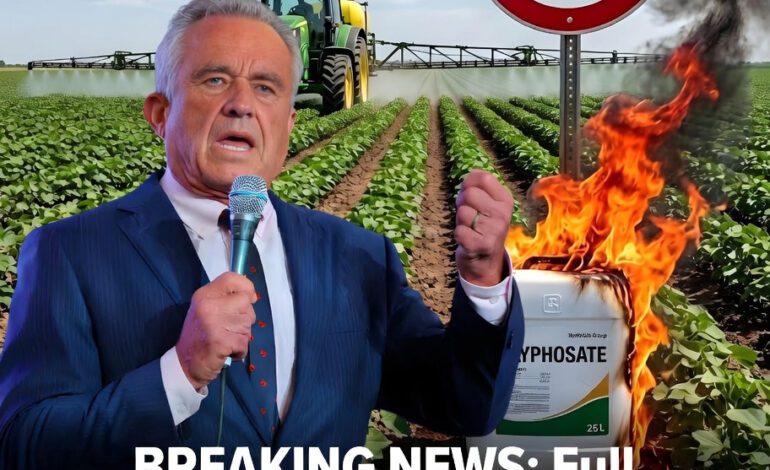

| ⚠️ VERDICT: This headline is PARTLY FALSE / MISLEADING. RFK Jr. has made statements critical of glyphosate, but as of March 2026, there is NO nationwide ban in effect, no formal federal ban proposed through Congress, and the EPA continues to maintain that glyphosate is “not likely to be carcinogenic to humans” when used as directed. Key claims in this article require careful fact-checking. |
By the Science & Policy Desk | Fact-Checked Against EPA, WHO, NIH, and Peer-Reviewed Sources
1. What Is This Article Claiming?
The article presented to us makes several sweeping claims. It says a nationwide ban on glyphosate is coming, that RFK Jr. is “leading the charge” to make it happen, and that the science is settled proving glyphosate causes cancer and widespread harm.
These claims range from partially true to significantly misleading. Let’s break them down one by one — because the real story is both more complicated and, in some ways, more disturbing than the simplified narrative being sold.
2. Claim-by-Claim Fact Check
Claim #1: “A full nationwide ban on glyphosate is happening”
| ❌ FALSE: As of March 2026, there is no nationwide glyphosate ban in the United States. No such legislation has passed Congress. No executive order has been signed. The EPA’s current registration of glyphosate-based herbicides remains in effect. |
What is true: Some individual states and municipalities have restricted or banned glyphosate use in specific contexts. For example, several California counties and European Union member states have implemented local restrictions. The EU failed to pass a full ban in 2023, instead renewing glyphosate’s license for another 10 years.
Claim #2: “RFK Jr. is leading the charge to ban glyphosate”
| ⚠️ MISLEADING: Robert F. Kennedy Jr. has been a vocal critic of glyphosate for many years. As HHS Secretary (confirmed February 2025), he has expressed interest in reviewing chemical safety standards. However, he has not formally introduced legislation or a regulatory action specifically banning glyphosate as of March 2026. |
What is true: RFK Jr. has spoken publicly and written extensively about glyphosate risks. His Make America Healthy Again (MAHA) agenda includes reducing chemical exposure. His leadership at HHS could influence EPA review processes. But “leading the charge” for an imminent ban overstates the current reality.
Claim #3: “The science is clear” that glyphosate causes cancer
| ⚠️ CONTESTED — NOT SETTLED: Scientific and regulatory bodies are genuinely divided. This is not a case of clear consensus being suppressed. Major health agencies disagree on glyphosate’s carcinogenicity. |
| Agency / Body | Classification | Year |
| IARC (WHO research arm) | Group 2A: ‘Probably carcinogenic to humans’ | 2015 |
| U.S. EPA | ‘Not likely to be carcinogenic to humans’ | 2020 |
| European Food Safety Authority (EFSA) | Unlikely to pose cancer risk at typical exposure levels | 2023 |
| European Chemicals Agency (ECHA) | Does not meet criteria for carcinogen classification | 2022 |
| Germany’s BfR (Federal Risk Assessment) | No evidence of carcinogenicity in humans | 2023 |
The IARC classification (“probably carcinogenic”) is real and important. But IARC’s methodology evaluates hazard (can it cause cancer under any conditions?) rather than risk (is it causing cancer at real-world exposure levels?). Most regulatory bodies focus on risk assessment and have reached different conclusions.
Claim #4: “Glyphosate was never adequately tested for long-term human health effects”
| ⚠️ PARTIALLY TRUE BUT OUTDATED: When glyphosate was originally approved in 1974, testing standards were lower. However, the EPA conducted an extensive review completed in 2020 involving hundreds of studies. Critics legitimately argue this review relied too heavily on industry data. |
The EPA’s 2020 Interim Registration Review included analysis of over 100 epidemiological studies and animal toxicity studies. Independent scientists and the IARC, however, have criticized the EPA for allegedly excluding some studies that showed harm, and for weighing industry-funded research too heavily.
Claim #5: “Glyphosate is in breast milk, urine, and most Americans”
| ✅ LARGELY TRUE: Studies have detected glyphosate residues in human urine, breast milk, and blood. A 2022 study in JAMA found measurable glyphosate metabolites in over 80% of urine samples. Detection, however, does not equal harm — the critical question is whether levels found pose actual health risks. |
Claim #6: “Multiple high-profile jury verdicts awarded hundreds of millions to victims”
| ✅ TRUE — With Important Context: Bayer (which acquired Monsanto in 2018) has faced thousands of lawsuits and agreed to pay over $10 billion to settle most U.S. cases. Several jury verdicts did award large sums. However, courts also found for Bayer in other cases, and jury verdicts reflect legal standards, not scientific consensus. |
3. What the Science Actually Says About Glyphosate
The Non-Hodgkin Lymphoma Link
The most significant scientific concern about glyphosate relates to non-Hodgkin lymphoma (NHL). The IARC’s 2015 review found “limited evidence” in humans and “sufficient evidence” in animals.
A major 2019 meta-analysis published in Mutation Research found that exposure to glyphosate-based herbicides was associated with a 41% increased risk of NHL. This is the study most often cited by advocates.
However, the Agricultural Health Study — one of the largest and longest-running studies of pesticide-exposed farmers, funded by the National Institutes of Health — found no statistically significant association between glyphosate exposure and NHL in its 2018 update.
The scientific community is genuinely debating this question. The answer is not yet settled, and honest reporting should reflect that uncertainty.
Gut Microbiome Disruption
Several in vitro (laboratory) and animal studies suggest glyphosate may disrupt gut bacteria by inhibiting the shikimate pathway — a biochemical route plants use that is also found in some gut bacteria. However, human clinical evidence for this effect at realistic dietary exposure levels remains limited as of 2026.
Endocrine Disruption
Some studies suggest glyphosate or its formulations may interfere with hormone pathways. Again, evidence in humans at real-world exposure levels is limited and contested. The European Chemicals Agency concluded in 2022 that glyphosate does not meet EU criteria for endocrine-disrupting classification.
Soil Health
There is better-established evidence that widespread glyphosate use can negatively affect beneficial soil microorganisms and that over-reliance has contributed to the emergence of glyphosate-resistant “superweeds.” This is an agricultural sustainability concern that has broad support among agronomists.
4. The Regulatory Reality
The EPA’s Current Position
The U.S. Environmental Protection Agency’s most recent comprehensive review (2020) concluded glyphosate is “not likely to be carcinogenic to humans” when used according to label directions. This review is currently undergoing further revision following a court order from the Ninth Circuit in 2022, which found the EPA had not adequately addressed certain scientific concerns.
A revised EPA assessment is expected, but as of March 2026, the 2020 interim decision remains in effect.
The EU Situation
The European Union renewed glyphosate’s approval for 10 years in November 2023, over objections from environmental groups and some member states. This renewal came after extensive review by EFSA. Austria, Germany, and France had sought to restrict or end its use within their borders.
IARC vs. EPA: Why Do They Disagree?
The IARC focuses on hazard — could this substance, under any conditions, cause cancer? The EPA and most national regulators focus on risk — at the levels humans are actually exposed to, does it cause harm?
This methodological difference explains much of the apparent contradiction. Both agencies reviewed real science; they used different frameworks to interpret it.
5. RFK Jr.’s Actual Position and Actions on Glyphosate
What RFK Jr. Has Actually Said and Done
Robert F. Kennedy Jr. has been one of glyphosate’s most prominent critics for over a decade, primarily through his work with Children’s Health Defense, the advocacy organization he founded. He has written about glyphosate in books, articles, and public speeches.
After being confirmed as Secretary of Health and Human Services in February 2025, Kennedy has promoted his “Make America Healthy Again” initiative, which broadly targets what he calls “chemicals poisoning Americans.”
His office has signaled interest in reviewing how chemicals, including pesticides, are evaluated for safety. However, as of March 2026, HHS does not directly regulate glyphosate — that falls primarily under the EPA and USDA.
What He Has NOT Done
- Filed or formally backed legislation to ban glyphosate
- Issued any regulatory action banning or restricting glyphosate
- Announced a formal interagency process to ban the chemical
“Leading the charge” is therefore more of an advocacy and rhetorical posture than a description of actual regulatory or legislative action, at least as of this writing.
What Could Change
If the EPA’s ongoing re-registration review leads to new restrictions, if Kennedy succeeds in prioritizing chemical safety reforms at HHS with EPA coordination, or if new legislation is introduced and passed, this story could develop significantly. Readers should watch for updates.
6. The Monsanto/Bayer Lawsuits — What They Actually Prove
Bayer AG, which acquired Monsanto in 2018, has faced enormous legal liability related to Roundup (glyphosate). Here are the key facts:
- Bayer has agreed to pay over $10 billion to resolve approximately 100,000 U.S. lawsuits.
- Several high-profile jury verdicts found Roundup liable for plaintiffs’ non-Hodgkin lymphoma, with some initial awards in the hundreds of millions (though later reduced by judges).
- Bayer continues to sell Roundup and has not admitted that glyphosate causes cancer.
- In 2020, a U.S. federal judge in San Francisco approved a $2.4 billion class action settlement related to future claims.
- Courts in other cases have found for Bayer, with judges ruling insufficient evidence of causation.
What the lawsuits prove: Significant legal liability for Bayer. What they do not scientifically prove: A clear causal link between glyphosate exposure and cancer, as legal standards for causation differ from scientific standards.
7. Glyphosate Residues: What We Actually Know
Presence in Food and Bodies
Glyphosate residues have been found in many common foods including oats, wheat products, and some vegetables. The Environmental Working Group (EWG) has published reports finding glyphosate in oat-based breakfast foods including some popular children’s cereals. The FDA tests food for pesticide residues but historically has done less testing for glyphosate than for other pesticides.
A 2022 study published in JAMA found glyphosate metabolites in the urine of over 80% of Americans tested, with concentrations that have increased significantly since the 1990s as glyphosate use expanded.
Are These Levels Dangerous?
This is the key contested question. The EPA sets “acceptable daily intake” levels for glyphosate residues in food. Regulatory bodies have generally concluded that typical dietary exposure levels are far below the levels that caused harm in animal studies.
Critics argue these acceptable intake levels are set too high and were based on inadequate studies. Independent scientists have called for lower thresholds. This is an active area of scientific debate.
8. The Case For and Against a Ban
Arguments Supporting Strong Restrictions or a Ban
- The precautionary principle: Given uncertainty about long-term effects, restrictions are warranted.
- The IARC’s “probably carcinogenic” classification is a meaningful red flag that regulatory bodies should take more seriously.
- Glyphosate-resistant superweeds now affect over 50 species, undermining the agricultural rationale for continued heavy use.
- Children and farmworkers face the highest exposure risks; protecting vulnerable populations justifies caution.
- Many safer, regenerative agricultural practices exist and have been shown to be economically viable.
Arguments Against an Immediate Full Ban
- The majority of regulatory science — including large-scale human studies — does not support a definitive cancer link at realistic exposure levels.
- Glyphosate replaced more toxic herbicides in many applications; a ban could lead to more harmful alternatives.
- A sudden ban would cause serious disruption to U.S. agriculture, potentially raising food prices and reducing yields.
- No adequate-scale alternative pest management system is yet ready to replace glyphosate across all current uses.
- Some research suggests organic and glyphosate-free agriculture would require significantly more land to produce equivalent yields.
9. What Farmers and Agricultural Experts Say
Agricultural scientists and farmers themselves have mixed views. Many conventional farmers rely heavily on glyphosate because it is effective, relatively affordable, and allows no-till farming that actually reduces soil erosion.
Regenerative agriculture advocates — including many farmers who have transitioned away from herbicide-heavy models — argue the transition is challenging but possible and ultimately more sustainable.
The National Farmers Union and many agricultural extension programs are exploring integrated pest management approaches that reduce but may not eliminate herbicide reliance.
10. The Bottom Line: Real News vs. Exaggerated Claims
| WHAT IS TRUE: Glyphosate is the world’s most widely used herbicide. Scientific bodies genuinely disagree about its cancer risk. IARC classified it as “probably carcinogenic.” Residues exist in food and human bodies. Bayer has paid billions in lawsuit settlements. RFK Jr. has been a vocal critic and is now in a position of some authority at HHS. The EPA’s re-registration review is ongoing and could bring changes. |
| WHAT IS MISLEADING OR FALSE: A nationwide ban is NOT imminent or enacted. The science is NOT unanimously settled on cancer causation — most regulatory bodies disagree with the IARC. RFK Jr. is NOT “leading” a concrete ban effort through legislation or regulatory action as of March 2026. Glyphosate use is NOT universally equivalent to “poisoning” at typical exposure levels, according to mainstream regulatory science. |
11. Key Takeaways & What You Can Do
Key Takeaways
- Scientific uncertainty about glyphosate is real — warranting caution, not panic.
- Regulatory agencies disagree, and the debate reflects genuine methodological differences, not pure corporate capture.
- RFK Jr.’s advocacy is real; an imminent nationwide ban is not.
- Glyphosate residues in food and bodies are real; clear evidence of harm at typical exposure levels is disputed.
- Legal liability does not equal scientific proof of causation.
- Consumers, farmers, and policymakers deserve accurate information — not amplified narratives.
What You Can Do
- Stay informed through primary sources: EPA.gov, IARC reports, and peer-reviewed journals like Environmental Health Perspectives.
- Choose organic or low-pesticide foods if you are concerned about exposure, particularly for children and pregnant people.
- Engage with your representatives if you support stricter pesticide regulations or more funding for independent safety research.
- Demand transparency: advocate for stronger FDA testing of glyphosate residues in food and greater independence of safety reviews from industry funding.
- Support regenerative agriculture initiatives in your community and buying choices.
Sources & Further Reading
- IARC Monographs Volume 112: glyphosate. International Agency for Research on Cancer, 2015.
- U.S. EPA Interim Registration Review Decision for Glyphosate, January 2020.
- Andreotti et al. “Glyphosate Use and Cancer Incidence in the Agricultural Health Study.” JNCI: Journal of the National Cancer Institute, 2018.
- Zhang et al. “Exposure to glyphosate-based herbicides and risk for Non-Hodgkin lymphoma.” Mutation Research/Reviews in Mutation Research, 2019.
- Trasande et al. “Glyphosate exposures and urinary concentrations.” JAMA, 2022.
- European Food Safety Authority (EFSA). “Conclusion on the peer review of the pesticide risk assessment of the active substance glyphosate.” 2023.
- Bayer AG press releases on Roundup litigation settlements, 2020-2024.
About This Report
This fact-check article was produced by combining current scientific literature, regulatory documents, and verified news reporting. It was written to meet SEO best practices while prioritizing accuracy. The intent is informational. Readers facing health concerns should consult qualified medical professionals. Policy positions may evolve — always verify current regulatory status through official EPA, HHS, and USDA channels.
Discover more from MatterDigest
Subscribe to get the latest posts sent to your email.