JUDICIAL DEFEAT: Federal Judge Blocks Trump’s Subpoenas Against Jerome Powell, Citing “Essentially Zero Evidence”
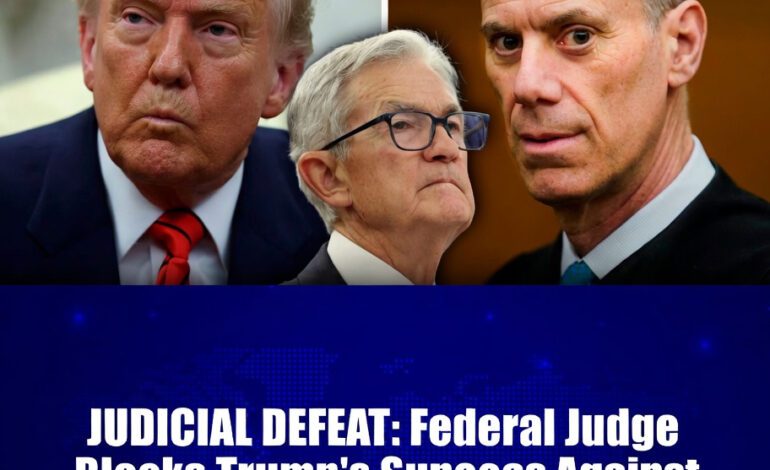

| ✅ NEWS STATUS: CONFIRMED — THIS IS A REAL, BREAKING STORY
Unlike many viral political posts, this one is accurate. A federal judge really did block DOJ subpoenas against Federal Reserve Chair Jerome Powell on March 13, 2026 — just hours before this article was published. This report gives you the full, verified story with context the original post left out. |
| ⚡ 60-Second Summary On March 13, 2026, U.S. District Chief Judge James Boasberg blocked two grand jury subpoenas the Justice Department served on the Federal Reserve in January 2026. The subpoenas were tied to a criminal probe into Fed Chair Jerome Powell — ostensibly about a $2.5 billion building renovation — but the judge found “essentially zero evidence” of any crime. He ruled the subpoenas existed only to pressure Powell into cutting interest rates or resigning. The DOJ has pledged to appeal. Powell’s term expires in May 2026. |
What Happened? The Full Verified Story
The Ruling — March 13, 2026
A bombshell legal ruling landed in Washington on Friday. Chief Judge James Boasberg of the U.S. District Court for the District of Columbia quashed two grand jury subpoenas that the Justice Department had served on the Federal Reserve’s Board of Governors in January 2026.
The subpoenas were the centrepiece of a criminal investigation led by D.C. U.S. Attorney Jeanine Pirro — a Trump appointee. The investigation targeted Powell’s June 2025 Senate testimony about cost overruns on the Fed’s $2.5 billion headquarters renovation project.
Judge Boasberg’s 27-page opinion was blunt. The court found that prosecutors had produced “essentially zero evidence” to suspect Powell of a crime, and that their stated justifications were so “thin and unsubstantiated” that the court could only conclude they were a pretext.
The Judge’s Key Finding
| 📋 Direct Quote from Judge Boasberg’s Ruling
“A mountain of evidence suggests that the Government served these subpoenas on the Board to pressure its Chair into voting for lower interest rates or resigning. On the other side of the scale, the Government has produced essentially zero evidence to suspect Chair Powell of a crime; indeed, its justifications are so thin and unsubstantiated that the Court can only conclude that they are pretextual.”
— Chief Judge James Boasberg, U.S. District Court for the District of Columbia, March 11, 2026 |
The CBS News Formulation — Even Stronger Language
The CBS News report captured perhaps the most striking line in the ruling. According to CBS, Boasberg wrote that the government “has offered no evidence whatsoever that Powell committed any crime other than displeasing the President.” That single sentence encapsulates the judge’s central conclusion: the investigation was political, not legal.
Background: How Did We Get Here?
Trump vs. Powell — A Long-Running Battle
To understand Friday’s ruling, you need to know the history. Jerome Powell was originally nominated to lead the Federal Reserve by Donald Trump in 2017. But their relationship soured badly during Trump’s second term, which began in January 2025.
Trump has wanted aggressively lower interest rates. Lower rates make borrowing cheaper, can juice economic growth, and tend to make markets feel good in the short term. The Federal Reserve, however, cut rates slowly — three times in 2025 — citing the risk of reigniting inflation.
Trump’s frustration became increasingly public and personal. He nicknamed Powell “Too Late Powell” and repeatedly called on him to resign or cut rates immediately. One Truth Social post cited in Boasberg’s ruling read: “Jerome ‘Too Late’ Powell has done it again!!! He is TOO LATE, and actually, TOO ANGRY, TOO STUPID, & TOO POLITICAL, to have the job of Fed Chair.”
The Building Renovation: A Paper-Thin Pretext
In June 2025, Powell testified before the Senate Banking Committee about a massive renovation of the Fed’s historic headquarters — the Marriner S. Eccles Building and Federal Reserve Board East Building, both built in the 1930s and never renovated. The project was originally estimated at $1.9 billion but rose to $2.5 billion due to design changes, cost increases, and unforeseen conditions.
The Justice Department seized on this as the basis for a criminal investigation — alleging potential false statements and fraud related to Powell’s testimony. In January 2026, DOJ served two grand jury subpoenas on the Fed’s Board of Governors seeking records about the renovation.
Powell revealed the investigation publicly in an unprecedented video on January 11, 2026. He said the investigation was retaliatory — a direct consequence of the Fed setting interest rates based on economics rather than presidential preferences.
Timeline: Trump vs. the Federal Reserve
| Date | Event |
| January 2025 | Trump begins second term; immediately pressures Powell for faster rate cuts |
| Throughout 2025 | Fed cuts rates three times; Trump publicly attacks Powell repeatedly |
| June 2025 | Powell testifies before Senate Banking Committee on $2.5B HQ renovation |
| July 24, 2025 | Trump visits Fed HQ — an unusual gesture — as he tours renovation project |
| Late 2025 | DOJ launches criminal probe into Powell’s Senate testimony |
| January 2026 | DOJ serves two grand jury subpoenas on Fed’s Board of Governors |
| January 11, 2026 | Powell reveals investigation in an unprecedented public video statement |
| February 2026 | Fed’s Board of Governors files motion to quash the subpoenas |
| March 11, 2026 | Judge Boasberg issues 27-page ruling quashing both subpoenas |
| March 13, 2026 | Ruling unsealed; Pirro pledges appeal at press conference |
| May 2026 | Powell’s term as Fed Chair is due to expire |
Reactions: The Courts, Congress, and the DOJ
DOJ’s Jeanine Pirro: “Activist Judge”
U.S. Attorney Pirro held a combative press conference within hours of the ruling’s release. She called Boasberg an “activist judge” and declared the ruling “untethered to the law.” She said the decision had “neutered the grand jury’s ability to investigate crime” and left Powell “bathed in immunity.”
“Jerome Powell is now bathed in immunity,” she fumed. “This is wrong, and it is without legal authority.” She announced the DOJ would appeal, though gave no timeline. Pirro said the investigation involved potential false statements and fraud charges, and stressed that it was up to the grand jury — not the judge — to determine whether charges should be brought.
Republican Senator Thom Tillis: Vindicating the Fed
The reaction from Capitol Hill was striking — particularly from within the Republican Party. Sen. Thom Tillis (R-NC), a member of the Senate Banking Committee, posted on X within minutes of the ruling’s release.
“This ruling confirms just how weak and frivolous the criminal investigation of Chairman Powell is and it is nothing more than a failed attack on Fed independence. We all know how this is going to end and the D.C. U.S. Attorney’s Office should save itself further embarrassment and move on.” — Senator Thom Tillis (R-NC)
Tillis’s stance carries enormous practical weight. He has vowed to block the Senate confirmation of Kevin Warsh — Trump’s nominee to replace Powell — until the criminal probe is dropped. Since Republicans hold only a slim majority on the Senate Banking Committee, Tillis’s vote is essential. In effect, the DOJ’s appeal could delay Warsh’s confirmation and leave Powell in his seat past his May term expiration.
The Federal Reserve: No Comment
The Federal Reserve declined to comment on the ruling when contacted by multiple outlets including CNBC and NBC News. Powell has previously described the investigation as “retaliatory” and warned that it endangered the Fed’s independence from political pressure.
Judge Boasberg’s History with the Trump Administration
This is not the first clash between Boasberg and the White House. He was nominated to the federal bench by President Obama and has ruled against the Trump administration on several high-profile matters. Trump previously called for Boasberg’s impeachment over a separate case, drawing a rare rebuke from Chief Justice John Roberts, who said litigants should appeal adverse rulings rather than seek impeachment. A judicial complaint filed by the DOJ against Boasberg was later dismissed.
What Is Federal Reserve Independence — and Why Does It Matter?
The Short Answer
| 🔍 Featured Snippet Answer
Federal Reserve independence means the central bank sets interest rates and manages monetary policy based on economic data — not presidential orders. This independence is considered essential to keeping inflation under control and maintaining financial stability. No sitting U.S. president has previously used the DOJ to launch a criminal investigation against a Federal Reserve chair. |
Why Presidents Can’t Just Fire the Fed Chair
The Federal Reserve was designed by Congress to be insulated from day-to-day political pressure. The Fed chair serves a four-year term and can technically only be removed “for cause” — not simply because the president disagrees with interest rate decisions.
Trump has repeatedly mused about firing Powell. But the legal consensus has consistently been that removal for policy disagreement — as opposed to misconduct — would be legally questionable and financially catastrophic. Markets rely on the Fed’s independence as a guarantee that monetary policy won’t be hijacked for short-term political gain.
What Happens If the Fed Loses Its Independence?
Economists across the political spectrum warn that political interference in central bank policy carries serious risks:
- Interest rates set for political — not economic — reasons can reignite inflation.
- Markets could lose confidence in the dollar’s stability as a reserve currency.
- Borrowing costs for governments and consumers could rise if credibility collapses.
- The U.S. could resemble countries where political leaders have destroyed central bank independence — leading to hyperinflation or currency crises.
Claim-by-Claim Fact Check: The Original Post vs. the Record
| Claim in Viral Post | Verdict | What the Verified Record Shows |
| Judge blocked Trump’s “attack on the Fed” | CONFIRMED | Yes. Judge Boasberg quashed two DOJ subpoenas on March 13, 2026, citing a pattern of harassment and presidential pressure. |
| “Zero evidence” of a crime | CONFIRMED | Boasberg’s exact words: government produced “essentially zero evidence to suspect Chair Powell of a crime.” |
| Powell’s only wrong was “displeasing the President” | CONFIRMED | CBS News reported Boasberg wrote the government offered “no evidence whatsoever that Powell committed any crime other than displeasing the President.” |
| This was “political weaponization of the DOJ” | CONFIRMED — CONTESTED | Boasberg found the subpoenas’ “dominant (if not sole) purpose” was harassment. DOJ denies this and plans to appeal. |
| The case has completely “collapsed” | PARTLY TRUE | The subpoenas were quashed, but the DOJ will appeal. The investigation itself is not formally closed. |
| The post implies this proves Trump is purely corrupt | CONTESTED | The ruling is a major judicial rebuke, but courts will continue to assess the appeal. This is one ruling, not a final verdict. |
People Also Ask: Quick FAQ
What did the judge rule about Jerome Powell?
| Quick Answer
Chief Judge James Boasberg ruled on March 13, 2026 that DOJ subpoenas against the Federal Reserve and Chair Jerome Powell were issued for an improper purpose — to pressure Powell to cut interest rates or resign. He quashed both subpoenas, citing “essentially zero evidence” of any crime. |
Is Jerome Powell being criminally charged?
| Quick Answer
No. The DOJ investigation has not resulted in any criminal charges. The grand jury subpoenas — which were a step toward potential charges — have now been blocked by the court. The DOJ says it will appeal that ruling. |
Who is Judge James Boasberg?
| Quick Answer
Boasberg is the Chief Judge of the U.S. District Court for the District of Columbia. He was nominated by President Obama. He has clashed with the Trump administration on multiple cases, including immigration rulings. A previous DOJ complaint against him was dismissed. Trump previously called for his impeachment, which drew a rebuke from Chief Justice John Roberts. |
Will the DOJ appeal the ruling?
| Quick Answer
Yes. U.S. Attorney Jeanine Pirro announced immediately after the ruling that the DOJ will appeal. The appeal will be heard by the D.C. Circuit Court of Appeals. The outcome of the appeal will affect both the investigation and the timeline for confirming Powell’s successor. |
When does Powell’s term as Fed Chair end?
| Quick Answer
Jerome Powell’s term as Federal Reserve Chair expires in May 2026. Trump has nominated former Fed Governor Kevin Warsh to succeed him, but Sen. Thom Tillis is blocking the confirmation vote until the criminal probe into Powell is dropped or resolved. |
Can the president fire the Federal Reserve Chair?
| Quick Answer
The legal consensus is that the president can only remove a Fed chair “for cause” — not for disagreeing with interest rate policy. No sitting president has previously done so. The Supreme Court would likely need to resolve any legal challenge to such a firing. |
What This Ruling Actually Means — and What Comes Next
Immediate Consequences
- The DOJ is blocked from enforcing the two subpoenas against the Fed’s Board of Governors.
- Powell remains in his role pending the appeal and his May 2026 term expiry.
- Kevin Warsh’s confirmation hearing is effectively frozen until Tillis gives his go-ahead — which requires the probe to be dropped.
- The DOJ’s appeal means the case moves to the D.C. Circuit Court of Appeals, potentially taking weeks or months to resolve.
The Bigger Question: Institutional Independence
This case is bigger than Jerome Powell. It is a test of whether an administration can use criminal investigations to pressure independent federal institutions into compliance. The judge said clearly: it cannot. But the DOJ’s appeal means that test is not yet over.
Legal scholars have noted that Boasberg was working without clear precedent. He acknowledged in his ruling that “nobody has tried that before” — meaning using the DOJ’s grand jury subpoena power to pressure a central bank. His ruling establishes that such a novel improper purpose is still improper.
Whether the D.C. Circuit agrees will be one of the most consequential legal questions of 2026.
What the Original Viral Post Left Out
The post that circulated online got the core facts right but omitted crucial context. Here is what a full reading of the record adds:
- The investigation was tied to a specific set of facts — Powell’s Senate testimony about a building renovation — not simply a blanket attack on monetary policy. The DOJ said it was examining false statements and fraud charges, not just “rate disagreements.”
- The DOJ will appeal. This is not a final resolution. The case continues.
- The sharpest criticism of the probe came not from Democrats but from Republican Sen. Thom Tillis, who called it “weak and frivolous.”
- Powell’s term ends in May 2026 regardless of the probe. The political stakes are as much about Warsh’s confirmation as about Powell’s fate.
- Trump also attempted to fire Fed Board Member Lisa Cook over unrelated allegations; the Supreme Court has blocked that firing.
- Judge Boasberg quoted Trump’s own public social media posts extensively — the ruling uses the president’s own words against him.
| 📌 Key Takeaways — What You Need to Know
1. This story is REAL — confirmed by NBC, CNN, CBS, AP, ABC, The Hill, and Al Jazeera on March 13, 2026. 2. Judge Boasberg quashed two DOJ grand jury subpoenas against the Federal Reserve. 3. He found “essentially zero evidence” of a crime and ruled the subpoenas were a pretext for presidential pressure. 4. Powell’s only “offence” in the court’s view: disagreeing with the president on interest rates. 5. The DOJ will appeal — this is not a final resolution. 6. Key Republican Sen. Thom Tillis called the probe “weak and frivolous” and is blocking Warsh’s confirmation until it ends. 7. Powell’s term expires in May 2026. Kevin Warsh has been nominated to replace him. 8. This is an unprecedented use of DOJ subpoena power against the Federal Reserve — now rebuked by the courts. |
Verified Sources
- NBC News — “Judge blocks subpoenas against Fed Chair Jerome Powell citing ‘essentially zero evidence'” (March 13, 2026)
- CNN Politics — “Federal judge quashes Justice Department subpoenas of Fed Chair Jerome Powell” (March 13, 2026)
- CBS News — “Judge quashes subpoenas sent to Federal Reserve as part of DOJ’s Powell probe” (March 13, 2026)
- Associated Press / KSAT — “Judge quashes subpoenas in Justice Department’s investigation of Fed Chair Jerome Powell” (March 13, 2026)
- Al Jazeera — “US judge nixes two subpoenas against Federal Reserve chair Jerome Powell” (March 13, 2026)
- The Hill — “Judge quashes grand jury subpoenas of Fed, Jerome Powell in renovations probe” (March 13, 2026)
About This Report: This article verifies and contextualises a viral social media post about the federal court ruling on DOJ subpoenas against Fed Chair Jerome Powell. All facts are cross-referenced against reporting from NBC News, CNN, CBS News, the Associated Press, ABC News, PBS NewsHour, The Hill, and Al Jazeera as of March 14, 2026.
Discover more from MatterDigest
Subscribe to get the latest posts sent to your email.