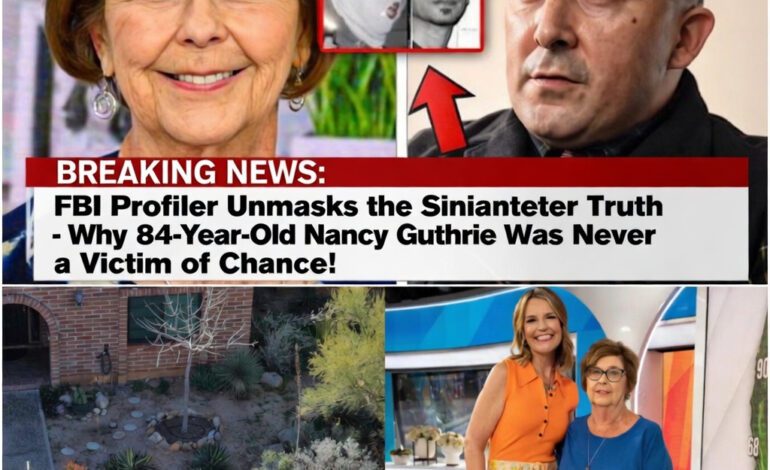
FBI Profiler Unmasks the Sinister Truth – Why 84-Year-Old Nancy Guthrie Was Never a Victim of Chance

MEDIA LITERACY | CRIME REPORTING ETHICS | MISINFORMATION & MISSING PERSON
“FBI Profiler Reveals the Sinister Truth”: How Fake Crime Theory Headlines Exploit Real Missing Persons Cases
|
A headline appears in your feed. It promises the inside story on a real, unresolved case. An authority figure — an FBI profiler, a criminal psychologist, a forensic expert — has apparently broken through the official silence. They have named a motive. They have identified a pattern. They have declared, with confidence, that this was no accident.
The headline is compelling. The case is real. The suffering is real. But the expert, the revelation, and the conclusion are almost certainly invented.
The ‘FBI profiler reveals’ format is one of the most ethically serious categories of online misinformation. Unlike fake celebrity health rumors or fabricated interview clips, this format attaches invented criminal theories to real, active investigations. It names real victims. It implies real perpetrators. And it spreads while investigators are still working to find the truth.
This guide explains how this format works, why it is uniquely harmful, and how to identify it immediately — before you click, before you share, and before you inadvertently become part of the problem.
What Is the ‘FBI Profiler Reveals’ Headline Format?
Defining the Format Precisely
The format has several consistent defining features that distinguish it from legitimate crime reporting:
- A real, named, unsolved or ongoing case is used as the anchor.
- An unnamed or vaguely named authority figure — ‘an FBI profiler,’ ‘a criminal psychologist,’ ‘investigative sources’ — is credited with a dramatic new finding.
- The finding is a specific motive theory: vengeance, targeting, premeditation, or conspiracy.
- The theory is stated as established fact, not speculation or hypothesis.
- No law enforcement agency has publicly confirmed the finding.
- The article contains no verifiable quotes, no named sources, and no institutional attribution.
- The case remains officially unsolved or under active investigation.
The formula is reliable enough that once you recognize it, you will see it everywhere. The specific case changes. The specific theory changes. The fabricated expert changes. But the structure never does.
How It Differs From Legitimate Crime Analysis
Real investigative journalism and genuine expert crime analysis exist. They are valuable. They serve the public interest. This format mimics their appearance while sharing none of their substance. The differences are precise and detectable.
| Feature | Legitimate Crime Analysis vs. ‘FBI Profiler Reveals’ Fake |
| Expert credentials | Named, verifiable, with institutional affiliation vs. unnamed or untraceable |
| Source of theory | Based on documented evidence vs. invented for narrative effect |
| Relationship to case | Independent of investigation vs. implies insider access without proof |
| Claim status | Clearly labeled as analysis or hypothesis vs. stated as confirmed fact |
| Law enforcement | Consistent with or distinguished from official findings vs. contradicts without explanation |
| Verifiability | Claims can be checked against public record vs. designed to be uncheckable |
| Purpose | Inform public understanding vs. generate emotional engagement and clicks |
The Anatomy of a Fake Crime Theory Headline
Deconstructing the Formula Word by Word
Fake crime theory headlines are not randomly constructed. Every word is chosen to maximize credibility, emotional impact, and shareability. Understanding the formula makes it immediately transparent.
The Authority Anchor: ‘FBI Profiler’ or ‘Criminal Psychologist’
The FBI’s Behavioral Analysis Unit is one of the most recognized law enforcement entities in popular culture. Decades of television dramas have made ‘FBI profiler’ synonymous with unassailable expertise and insider knowledge. Attaching this label to a fabricated theory borrows that cultural authority without any actual connection to the institution.
In reality, FBI behavioral analysts do not make public statements about active cases to unnamed bloggers or content farms. They do not ‘unmask sinister truths’ in press releases. Their work is confidential, methodical, and coordinated with the case investigators. Any claim that an ‘FBI profiler’ has revealed something publicly, through an anonymous source, about an active case should be treated as fabricated by default.
The Revelation Verb: ‘Unmasks,’ ‘Reveals,’ ‘Exposes’
These verbs do specific emotional work. They imply that a truth has been hidden — suppressed, covered up, or overlooked — and is now finally coming to light. This framing positions the reader as a privileged recipient of forbidden knowledge. It makes reading the article feel like an act of discovery rather than an act of consumption.
The revelation framing also pre-empts skepticism. If a truth has been ‘unmasked,’ questioning it means questioning the unmasker. The emotional logic is: the brave expert took a risk to tell you this. Are you really going to doubt them?
The Motive Claim: ‘Vengeance,’ ‘Prey,’ ‘Sinister Truth’
Motive claims are the most dangerous element of this format. Asserting that a missing person or crime victim was specifically targeted — that someone chose them for a reason, planned it, and executed it — is not a neutral analytical observation. It is a claim about a specific criminal act committed by a specific person or persons.
When that claim is published without evidence, without named sources, and without law enforcement confirmation, it is not analysis. It is an accusation made in the dark — potentially pointing at real people in the victim’s life without naming them, but unmistakably implying that the answer lies among those close to the victim.
Critical Warning: Motive claims in unverified crime theory articles are not just factually irresponsible — they can constitute defamation by implication, directing suspicion at real, identifiable people without evidence.
The Certainty Signal: ‘Never a Victim of Chance,’ ‘the Truth’
Real investigators use language of probability and evidence. They say ‘evidence suggests,’ ‘investigators believe,’ ‘the working theory is.’ Fake crime theory articles use language of absolute certainty. They do not speculate — they declare. This certainty is a red flag, not a marker of credibility. It signals that the writer is not constrained by evidence, because there is no evidence to be constrained by.
Why Missing Persons Cases Are Especially Targeted
The Information Vacuum Problem
Active missing persons cases create an information vacuum. Official investigators cannot share details that might compromise their work. Families often know more than they can say publicly. The public, especially when the case involves someone well-known, desperately wants answers. That combination — high public interest, limited official information, emotional urgency — is the ideal environment for fabricated content to thrive.
Fake crime theory articles do not fill this vacuum with facts. They fill it with narrative. And narrative, in the absence of facts, feels like progress. It feels like someone is finally explaining what happened. That feeling is entirely manufactured.
Vulnerable Families as Emotional Leverage
Cases involving elderly missing persons, children, or family members of public figures generate particularly intense public empathy. Content creators who exploit these cases understand that empathy drives engagement. A headline promising to explain why a vulnerable person disappeared — and who is really responsible — will generate more clicks than almost any other format.
The family’s suffering is not incidental to this calculation. It is central to it. The more visible and real the family’s grief, the more emotionally compelling the fabricated theory becomes. Real pain is being used as a vehicle for false content.
The ‘Connected to Celebrity’ Amplification
When a missing person is connected to a public figure — a parent, a sibling, a spouse — the case reaches an audience far larger than most missing persons cases do. This amplification is genuinely valuable when it helps find the missing person. It becomes harmful when it is exploited to distribute fabricated criminal theories to that same large audience.
The public figure connection also adds a layer of political or cultural framing that makes the fake theory even more shareable. The case stops being just a missing persons story and becomes a proxy for whatever broader narrative the content creator wants to advance.
Key insight: The larger the audience a missing persons case reaches, the larger the potential audience for fabricated theories about that case. Viral missing persons coverage and viral misinformation about that case travel the same networks.
The Fabricated Expert: How Anonymous Authority Is Manufactured
Why No Name Is Ever Given
The unnamed expert is the structural foundation of this format. No name is given for a simple reason: a name can be checked. A named FBI profiler can be contacted. Their institutional affiliation can be verified. Their public statements can be reviewed. An unnamed ‘FBI profiler’ cannot be verified because they do not exist.
The vagueness is not an oversight. It is a deliberate design choice that protects the fabrication from fact-checking while preserving the appearance of authority.
Variants of the Fabricated Expert
The unnamed FBI profiler is the most common version, but the format uses several variants depending on the case and the target audience:
- ‘A criminal psychologist familiar with the case’ — implies insider access without specifying who
- ‘Forensic experts who reviewed the evidence’ — plural and unnamed, impossible to verify
- ‘Sources close to the investigation’ — the journalism phrase repurposed for fiction
- ‘A retired law enforcement official’ — retired status makes verification harder
- ‘Behavioral analysts’ without institutional affiliation — borrows FBI language without FBI accountability
In every variant, the pattern is the same: enough specificity to sound credible, not enough to be checkable.
What Real Expert Crime Commentary Looks Like
Genuine expert commentary on criminal cases is not difficult to identify. Real experts are named. Their credentials are stated. Their institutional affiliations are disclosed. Their comments are clearly labeled as analysis or opinion rather than findings. They acknowledge the limits of what they know. They do not claim access to non-public evidence. And they coordinate with — or explicitly distinguish their views from — the positions of official investigators.
Simple rule: If an expert is not named, their institution is not identified, and their comments cannot be verified through any public record, treat their ‘revelation’ as invented until proven otherwise.
Seven Specific Harms This Format Causes
Harm 1: Misdirecting Investigators
When a fabricated theory goes viral, investigators receive a flood of tips and leads based on that theory. Real witnesses who saw real things may not come forward because the public narrative has already ‘solved’ the case. Investigators must spend resources evaluating false leads generated by content that has no evidentiary basis. In time-sensitive cases — particularly missing persons cases where survival windows matter — this diversion of resources can have life-or-death consequences.
Harm 2: Poisoning the Witness Pool
People who witnessed something relevant to a case do not encounter that case in a neutral state. They encounter it after the viral narrative has already framed what happened and why. Witnesses may unconsciously reshape their memories to fit the theory they have already consumed. This phenomenon — called ‘memory contamination’ in forensic psychology — is documented, serious, and essentially irreversible once it occurs.
Harm 3: Directing Suspicion at Real People
A motive theory — ‘this was vengeance,’ ‘this was targeted’ — does not exist in a vacuum. It implies a perpetrator. Readers immediately begin speculating about who in the victim’s life had a motive for vengeance. Those speculations, in the social media age, quickly attach to real names. Real people — who may be entirely innocent — find themselves publicly accused based on a theory someone invented for clicks.
Harm 4: Traumatizing Families
Families of missing persons and crime victims are in a state of acute psychological distress. Encountering a fabricated theory about their loved one — especially one that implies targeted violence and assigns blame — causes additional trauma on top of already devastating grief. Families report in documented cases that viral misinformation about their cases makes the experience significantly worse and extends their suffering.
Harm 5: Undermining Public Trust in Real Investigations
When fabricated theories are widely believed, official investigators who contradict those theories face public suspicion. ‘Why is law enforcement dismissing what the FBI profiler said?’ becomes a common question — even though the FBI profiler was invented. This erosion of trust in legitimate investigators makes public cooperation with real investigations harder to achieve.
Harm 6: Compromising Future Prosecutions
In serious criminal cases, the widespread circulation of specific theories about motive, perpetrators, and methods can affect the ability to seat an impartial jury. Defense attorneys routinely cite prejudicial pre-trial publicity in motions to dismiss or change venue. Fabricated viral theories contribute directly to this problem, potentially allowing actual perpetrators to escape accountability on procedural grounds.
Harm 7: Exploiting Grief for Commercial Gain
Most fake crime theory content is monetized. It generates advertising revenue, subscription clicks, and social media engagement metrics that translate to financial value for creators. This means real human suffering — a missing elderly person, a grieving family, a community in distress — is being converted into commercial profit by people who contribute nothing to finding the truth and cause active harm in the attempt.
These seven harms are not theoretical. Each has been documented in real cases where fabricated crime theories went viral. The harm is specific, measurable, and in some cases, permanent.
The Psychology: Why These Headlines Are So Compelling
Our Need for Narrative Closure
Human beings are pattern-seeking creatures. Unexplained events — especially tragic ones — create psychological discomfort. We want to know why things happen. We want the world to make sense. A missing person with no explanation is deeply unsettling. A missing person with a clear narrative — targeted, chosen, a victim of vengeance — is still tragic, but it is comprehensible. The narrative, even a false one, provides relief from uncertainty.
Fake crime theory articles exploit this need directly. They offer the closure that real investigations cannot yet provide. The emotional relief of ‘finally understanding’ what happened overrides the critical question of whether the explanation is actually true.
The Authority Heuristic
When time is short and information is complex, our brains use shortcuts called heuristics to make judgments. One of the most powerful is the authority heuristic: we trust claims made by apparent experts. FBI agents, criminal psychologists, and forensic analysts occupy positions of genuine authority in our cultural understanding. When a headline invokes those titles, it triggers trust responses that bypass more deliberate evaluation.
Morbid Curiosity and Its Normalization
The true crime genre has normalized intense public engagement with real criminal cases. Podcasts, documentaries, and social media communities have built large audiences around discussing, theorizing, and analyzing real cases. This is not inherently problematic — public interest in justice is legitimate and valuable. But it creates an audience that is primed to consume criminal theories about real cases, and that has developed habits of engagement — sharing theories, speculating about motives — that make them particularly susceptible to fabricated content in the same format.
The Sharing Imperative
Social media platforms have built sharing into their core mechanics. Sharing signals tribal membership, demonstrates awareness, and generates social response. When a piece of content triggers strong emotion — outrage, vindication, grief, the satisfaction of apparent understanding — the impulse to share is nearly automatic. Fake crime theory content is engineered to trigger precisely these emotions before critical evaluation can intervene.
How Real FBI Profiling Actually Works
Behavioral Analysis Is Not What Television Suggests
The FBI’s Behavioral Analysis Units (BAUs) exist and do genuinely valuable work. But that work looks almost nothing like what popular culture — or fake crime theory headlines — suggests. Understanding the reality makes the fabrications immediately obvious.
What FBI Behavioral Analysts Actually Do
- Provide consultation to local and state law enforcement who request assistance with complex cases.
- Analyze crime scene evidence, victimology, and offender behavior patterns to develop investigative strategies.
- Create offender profiles as investigative tools — not public declarations of who the perpetrator is.
- Testify as expert witnesses in trials when evidence supports their analysis.
- Conduct research on criminal behavior to improve investigative techniques.
What FBI Behavioral Analysts Do Not Do
- Issue public statements about active investigations to unnamed bloggers or content websites.
- Declare definitive motive theories before an investigation is complete.
- Grant anonymous interviews revealing what investigators have ‘really found.’
- Bypass the public affairs offices of the FBI and cooperating law enforcement agencies.
- Make pronouncements that contradict or undermine the official position of the investigating agency.
| From the FBI’s Own Public Communications Policy
The FBI does not comment on active investigations except through official channels, and behavioral analysis findings are shared with requesting law enforcement agencies, not with the public or media. Any claim that an ‘FBI profiler’ has revealed findings about an active case through an anonymous media source is inconsistent with how the FBI actually operates. |
Eight Immediate Red Flags to Identify This Format
You can identify fake crime theory content quickly and reliably. Here are eight red flags present in virtually every example:
Red Flag 1: The Expert Is Unnamed or Unverifiable
If you cannot find the expert’s name, institutional affiliation, and a verifiable public record of their work, they do not exist as described. Full stop.
Red Flag 2: The Case Is Active and Officially Unresolved
Real breakthroughs in active cases are announced by law enforcement through official channels — press conferences, official statements, verified social media accounts. A breakthrough published exclusively on a content website with no corresponding official announcement did not happen.
Red Flag 3: Motive Is Stated as Fact, Not Hypothesis
Language like ‘was never a victim of chance’ or ‘prey of vengeance’ presents a theory as established truth. Real analysis uses language like ‘evidence may suggest’ or ‘investigators are exploring.’ Certainty without evidence is a fabrication signal.
Red Flag 4: The Headline Uses Dramatic, Emotionally Loaded Language
‘Sinister truth,’ ‘unmasks,’ ‘prey,’ ‘vengeance’ — these are not journalism words. They are marketing words. They are chosen to produce emotional arousal before you have read a single sentence of the article. That is the purpose they serve.
Red Flag 5: No Official Agency Confirms the Finding
Search for a press release, official statement, or verified social media post from the investigating law enforcement agency confirming the claimed finding. If none exists, the finding is fabricated.
Red Flag 6: The Article Appears on a Low-Credibility Site
Check where the article is published. Is it a recognized news organization with an editorial standard, a corrections policy, and named journalists? Or is it a content farm, a clickbait aggregator, or a recently created website with no clear editorial identity? The publication context matters enormously.
Red Flag 7: No Other Credible Outlet Is Reporting the Same Finding
Apply the universal test: if this finding were real, every major outlet would be covering it. A genuine FBI revelation about a high-profile active case would be on the front page of every newspaper in the country. If it exists only on one site, it did not happen.
Red Flag 8: The Article Generates Grief or Outrage Before Providing Evidence
Notice your emotional state as you read. If you feel grief, outrage, or the urgent need to share before you have read a single verifiable fact, you are being manipulated. That feeling is the product — the facts are irrelevant to the creator’s purpose.
Eight Red Flags Summary: 1) Unnamed expert 2) Active unresolved case 3) Motive stated as fact 4) Emotionally loaded headline language 5) No official confirmation 6) Low-credibility publication 7) No coverage by major outlets 8) Emotional response triggered before evidence provided
What Responsible Crime Journalism Actually Looks Like
The Standards That Distinguish Real From Fake
Legitimate crime journalism exists in genuine tension with the needs of active investigations. Good journalists know what responsible coverage looks like, and they apply consistent standards that are absent from fake crime theory content.
- Named sources with verifiable credentials and institutional accountability.
- Clear distinction between confirmed facts, working theories, and speculation.
- Coordination with law enforcement to avoid publishing details that could compromise investigations.
- Corrections policies that address errors publicly and promptly.
- Editorial oversight with named editors and a chain of accountability.
- No commercial incentive to generate emotional engagement at the expense of accuracy.
- Respect for the privacy and dignity of victims and their families.
- Explicit acknowledgment of what is not yet known.
These standards are not always perfectly met by even the best journalists. But they represent a framework of accountability that fake crime theory content entirely lacks. The absence of any of them in a piece of crime coverage is a warning sign. The absence of all of them is a near-certain indicator of fabrication.
How to Verify — and What to Do When You Find a Fake
The Verification Process for Crime Theory Content
- Search the investigating agency’s name plus the claimed finding on Google News (past week filter). Is there an official statement?
- Search for the named expert, if one is given, on the FBI website, university faculty pages, or professional association directories.
- Check major established outlets — AP, Reuters, BBC, major national newspapers. Are any of them reporting the same finding?
- Visit the investigating agency’s official website and verified social media. Has anything been announced there?
- Search established fact-checking sites: Snopes, PolitiFact, FactCheck.org, AP Fact Check.
- Assess the publication: Does it have named journalists, an editorial policy, a corrections page, and a track record?
What to Do When You Identify a Fake
- Do not share the original article — even to criticize it. Every share increases reach.
- If you already shared it, delete your share and post a brief correction for your audience.
- Report the content to the platform using misinformation or harassment reporting tools.
- If the article names or implies suspicion of real people, consider whether those people need to be aware.
- Share fact-checks and legitimate coverage of the real case, not the fabricated theory.
- If you are a family member or representative of someone mentioned in a fake article, consult a media attorney about content removal options.
The most important action you can take is the one that happens before you share: the two-second pause to ask whether what you are reading is verified, sourced, and consistent with what official investigators have actually said.
Key Takeaways and Action Steps
What This Format Is
- The ‘FBI profiler reveals’ format attaches fabricated criminal theories to real, active, unresolved cases.
- It uses unnamed, unverifiable experts to manufacture authority for invented motive claims.
- It is designed to generate emotional engagement — grief, outrage, the satisfaction of false certainty — before critical evaluation can occur.
Why It Causes Unique Harm
- It misdirects investigators, poisons witness memories, and directs suspicion at real innocent people.
- It traumatizes families already in crisis by layering invented narratives onto real suffering.
- It can compromise future prosecutions and undermines public trust in legitimate investigations.
- It converts real human grief into commercial revenue for its creators.
How to Protect Yourself and Others
- Apply the eight red flags checklist to any crime theory content before engaging.
- Use the six-step verification process before forming or sharing any judgment.
- Never share unverified criminal theories about real, active cases — regardless of how compelling the headline is.
- Support responsible crime journalism from named reporters at accountable outlets.
- Speak up when you see this format being shared in your network — a simple, factual correction can interrupt the spread.
Final thought: Every person named in a real missing persons case — victim, family, and anyone else the fabricated theory implies — is a real human being whose life is already in crisis. The least we can do is refuse to make it worse by sharing content that invents criminal narratives about them without a single verifiable fact.
Sources and Further Reading
- Federal Bureau of Investigation — About the Behavioral Analysis Units, fbi.gov/investigate/violent-crime/bau
- Loftus, E.F. (2005). ‘Planting misinformation in the human mind.’ Learning & Memory — foundational research on memory contamination in witnesses
- Columbia Journalism Review — standards and guidelines for responsible crime and missing persons reporting
- Dart Center for Journalism and Trauma — resources on ethical coverage of crime victims and families
- First Draft / Meedan — verification guides for crime-related viral content
- National Center for Victims of Crime — documentation of secondary harm caused by media misinformation about active cases
About This Article
This article is an educational resource on media literacy and the ethics of crime reporting. No specific active cases, named victims, named family members, or fabricated theories are reproduced or referenced. All research citations refer to publicly available academic, institutional, and journalistic sources. Last updated: March 6, 2026.
Discover more from MatterDigest
Subscribe to get the latest posts sent to your email.