Ethereum Price Prediction 2026
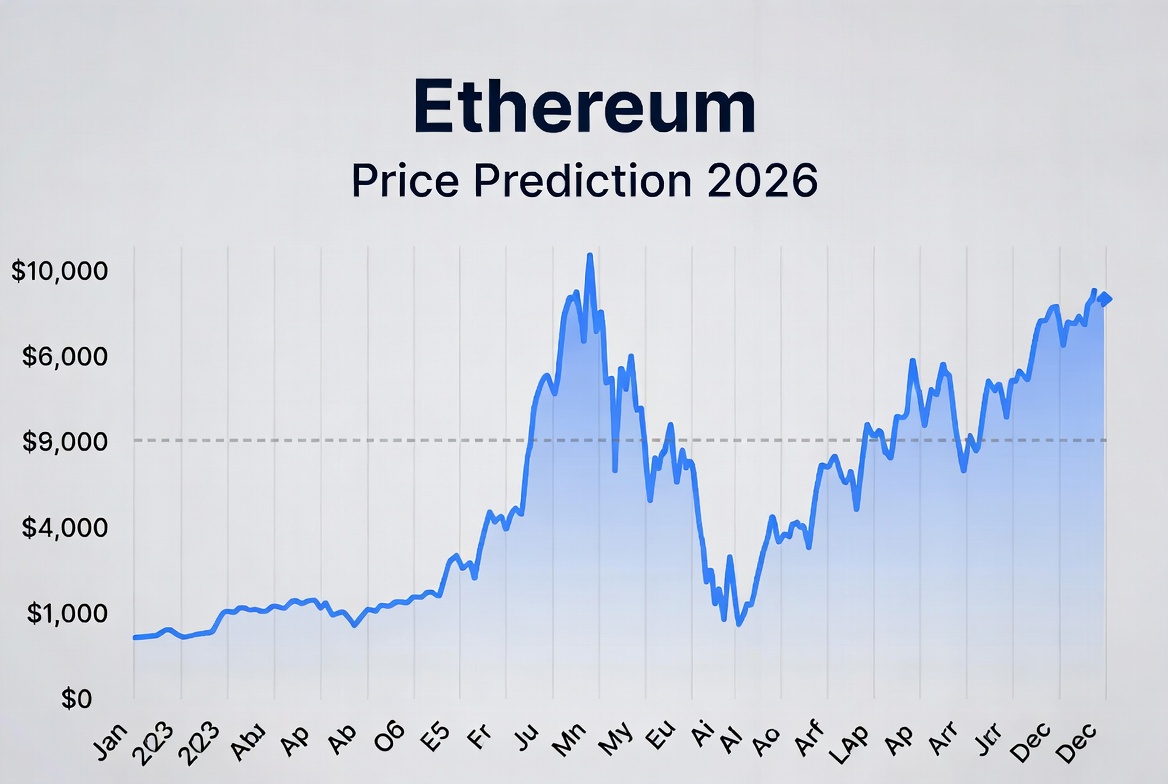

Ethereum Price Prediction 2026: Can ETH Recover?
Expert Forecasts, Scenario Analysis & Key Catalysts — Updated February 2026
Published: February 16, 2026 | Reading Time: ~14 minutes |
| ⚠ IMPORTANT DISCLAIMER: This article is for informational purposes only and does not constitute financial advice. Cryptocurrency markets are highly volatile. Always do your own research and consult a qualified financial advisor before investing. Past performance is not indicative of future results. |
|
Why Ethereum’s 2026 Price Story Is Just Getting Started
It’s been a brutal few months for Ethereum. After hitting an all-time high of $4,946 in August 2025, ETH has shed nearly 60% of its value. As of mid-February 2026, it trades around $1,970 — hovering at levels last seen during the mid-2023 bear market consolidation.
So, is this a crash — or an opportunity? That’s the question on every ETH investor’s mind right now.
Here’s the honest answer: nobody knows for certain. But the range of credible analyst forecasts for end-2026 spans from a conservative $3,500 all the way to a bold $15,000 — and the case for significant upside is surprisingly well-supported by on-chain data, institutional inflows, and upcoming network upgrades.
This guide covers everything you need to make sense of it. We’ll walk through current market conditions, the key price drivers for 2026, what major institutions are saying, and the realistic scenarios for where ETH could be trading by December.
|
1. Ethereum in February 2026: Current Market Snapshot
Before making any predictions, let’s ground ourselves in the current data. Here’s where Ethereum stands right now:
| Metric | Current Data (Feb 2026) |
| Current Price (Feb 16, 2026) | ~$1,970 USD |
| 24-Hour Trading Volume | ~$24.7 billion |
| Market Capitalization | ~$238 billion (#2 by market cap) |
| All-Time High | $4,946 (August 2025) |
| 90-Day Price Change | -39% (from ~$3,345 peak) |
| Circulating Supply | ~120.7 million ETH |
| Proof-of-Stake Status | Active since Sep 2022 (The Merge) |
| Layer-2 Ecosystem | 50+ active L2 networks |
| Spot ETH ETFs | Live in U.S. since July 2024 |
| Key Support Level | $1,900 |
| Key Resistance Level | $2,000–$2,100 |
The picture is clear: ETH is in a deep correction phase. But context matters. The broader crypto market has pulled back across the board. Bitcoin is trading well below its own recent highs. And macro headwinds — including renewed U.S.-China trade tensions and risk-off sentiment in traditional markets — have contributed to the selling pressure.
The good news? Ethereum’s fundamental infrastructure continues to strengthen even as the price corrects. That’s the dichotomy that makes this moment so interesting for analysts.
2. What Drove ETH’s Drop from $4,946 to ~$1,970?
To predict where Ethereum is going, you need to understand why it fell. The drop from $4,946 to ~$1,970 — a loss of roughly 60% in under six months — wasn’t random. Several factors converged:
Macro Risk-Off Sentiment
President Trump’s threats of 100% tariffs on Chinese goods in late 2025 and early 2026 triggered a broad sell-off in risk assets. Crypto, being among the most volatile risk assets, bore a disproportionate share of the decline. When fear rises in traditional markets, crypto typically amplifies the move in both directions.
ETH/BTC Ratio Compression
Ethereum has significantly underperformed Bitcoin during this correction phase. While Bitcoin maintained more of its gains, ETH’s ETH/BTC ratio declined sharply. Some analysts attribute this to Bitcoin’s maturing status as a store-of-value asset, while Ethereum remains more closely tied to “speculative” DeFi and NFT activity — sectors that contracted sharply in the sell-off.
Ethereum Foundation Leadership Uncertainty
In early February 2026, it was reported that Tomasz Stańczak stepped down as co-executive director of the Ethereum Foundation — just months after the departure of former chief Aya Miyaguchi. Leadership transitions at the Foundation, which drives protocol development, can unsettle investor confidence in the short term. The market reacted negatively to the news, adding pressure to an already-weak price.
Large OTC Sells and Whale Activity
On-chain data showed concentrated large-volume sell orders on major exchanges, particularly Binance, creating sharp intraday price moves. These patterns suggest coordinated distribution from large holders, which typically precedes extended consolidation or further decline before a reversal.
| None of these factors change Ethereum’s core value proposition. Infrastructure doesn’t become less useful because the market sells off. But price and value can diverge significantly in the short term — and that divergence is exactly what creates opportunities for informed investors. |
3. Ethereum Price Prediction 2026: The Forecast Landscape
The range of published Ethereum price predictions for end-2026 is enormous — from under $2,500 on the bearish end to $15,000 on the most bullish institutional forecast. Here’s the full picture:
| Source / Analyst | Bear Case | Base Case | Bull Case |
| Citibank (Oct 2025) | $2,000–$3,500 | $5,440 | $8,000+ |
| Standard Chartered | $3,000 | $5,500 | $7,500 |
| VanEck (Institutional) | $4,000 | $10,000 | $15,000 |
| JPMorgan Analysts | $3,500 | $6,000–$8,000 | $10,000+ |
| LiteFinance | $3,347 | $4,573 | $6,376 |
| DigitalCoinPrice | $3,212 | $3,510 | $5,695 |
| CoinCodex | $3,300 | $4,367 | $5,500 |
| CoinDCX Analysis | $1,850 | $2,560 (Q1) | $3,900+ |
| Standard (Consensus) | $2,800 | $4,500–$5,500 | $7,500 |
Notice how wide this spread is. VanEck’s $15,000 bull case is seven times higher than CoinDCX’s near-term bear scenario. That’s not unusual for crypto — but it does highlight how much depends on external factors that no one can fully predict.
The consensus range — where most credible mid-tier analysts cluster — sits between $4,500 and $5,500 by year-end 2026, assuming moderate adoption growth and no major macro shocks. That would represent a roughly 125%–180% recovery from current levels.
Capital.com’s comprehensive review of third-party forecasts confirms this: most published 2026 targets fall in the mid-$3,000s to low-$5,000s range, with outliers on both ends. The key variables are institutional adoption, regulatory developments, and network usage rather than technical chart patterns.
4. Three Scenarios: Bear, Base, and Bull Cases for ETH 2026
Bear Case: $2,000–$3,000 by December 2026
The bear case assumes a prolonged macro downturn that keeps risk appetite suppressed throughout most of 2026. In this scenario:
- Bitcoin fails to break and hold new all-time highs, limiting the “rising tide” effect on altcoins.
- Regulatory crackdowns in major markets — particularly the EU or U.S. — dampen institutional inflows.
- Competing Layer-1 blockchains (Solana, Sui, Aptos) continue to capture DeFi and NFT market share.
- Ethereum network upgrades face delays, undermining the narrative of improving scalability.
- Price remains range-bound between $1,900 and $3,000 for most of the year.
Probability assessment: Roughly 20–25% of analysts lean toward this scenario as of early 2026, largely due to macro uncertainty.
Base Case: $4,000–$5,500 by December 2026
The base case assumes gradual recovery as macro conditions stabilize, ETF inflows continue, and Ethereum’s network upgrades proceed on schedule. In this scenario:
- Bitcoin stabilizes above $75,000, dragging the broader altcoin market higher.
- Spot ETH ETFs accumulate $50–$75 billion in AUM by year-end, matching early BTC ETF growth.
- DeFi Total Value Locked (TVL) recovers to $100 billion+ across the Ethereum ecosystem.
- The Pectra upgrade (EIP-7251) successfully improves validator efficiency, boosting network confidence.
- ETH/BTC ratio stabilizes and begins recovering from recent lows.
Probability assessment: Approximately 50–55% of analysts see this as the most likely scenario. It requires no extraordinary events — just continued ecosystem development and recovering market sentiment.
Bull Case: $7,500–$15,000 by December 2026
The bull case requires multiple positive catalysts to align simultaneously. This is the scenario VanEck and JPMorgan are describing in their most optimistic notes:
- ETH spot ETFs attract $100B+ in AUM as pension funds and sovereign wealth funds allocate to crypto.
- Tokenized real-world assets (RWAs) hit $100B in Total Value Locked on Ethereum — driven by BlackRock, JPMorgan, and others.
- The Glamsterdam upgrade (sharding) dramatically reduces transaction costs, triggering a wave of new dApp activity.
- ETH restaking primitives (EigenLayer) generate 10%+ annualized yields, creating massive demand-side pressure.
- Favorable U.S. regulatory framework treats ETH as a commodity, unlocking mainstream investment.
Probability assessment: About 20–25% of analysts see this as achievable but unlikely without specific catalysts aligning. VanEck’s $15,000 target is the most bullish credible institutional forecast.
|
5. Quarter-by-Quarter 2026 Price Roadmap
Let’s break down the expected Ethereum price trajectory by quarter, based on the aggregate of available analyst forecasts:
| Quarter | Price Range | Sentiment | Key Driver |
| Q1 2026 (Now) | $1,900–$2,560 | Cautious | BTC stabilization |
| Q2 2026 | $2,500–$4,200 | Neutral–Bullish | ETF inflows |
| Q3 2026 | $3,500–$5,500 | Bullish | Network upgrades |
| Q4 2026 | $4,000–$7,500 | Bullish | Cycle momentum |
| Year-End Target | $4,500–$5,500 | Base Case | Consensus view |
Q1 2026 is already nearly done, and the picture matches the forecast: ETH is consolidating between $1,900 and $2,100, fighting to hold key support while macro sentiment remains cautious.
The real inflection point will likely come in Q2 and Q3 — when Bitcoin’s next leg (up or down) becomes clearer, when ETF inflow data accumulates, and when the Pectra upgrade effects begin materializing on-chain.
6. Key Catalysts That Could Drive ETH Higher in 2026
Catalyst 1: Spot ETH ETF Inflows
U.S. spot Ethereum ETFs launched in July 2024. They attracted initial inflows but have since moderated. The next phase of growth depends on institutional adoption — specifically pension funds, endowments, and sovereign wealth funds adding crypto to their portfolios.
If ETH ETFs follow the trajectory of Bitcoin ETFs — which eventually accumulated $250B+ in AUM — the capital inflows could be enormous. JPMorgan analysts project ETH ETFs could reach $75B AUM in 2026, which would create substantial buying pressure on ETH itself.
Catalyst 2: Pectra and Glamsterdam Upgrades
Ethereum’s development roadmap continues to advance. The Pectra upgrade (combining Prague and Electra changes) introduces EIP-7251, which allows validators to stake larger amounts of ETH — improving network efficiency and reducing overhead. This directly improves the economic model for stakers.
The upcoming Glamsterdam upgrade targets sharding improvements that could push Ethereum’s effective throughput to 100,000 transactions per second via Layer-2 networks — a 3,000x improvement over the base layer’s current ~30 TPS.
Catalyst 3: Tokenized Real-World Assets (RWAs)
One of the most underappreciated Ethereum narratives is the tokenization of real-world assets. Major institutions — BlackRock, JPMorgan, Hamilton Lane, Securitize — are actively building tokenized bond, equity, and money-market products on Ethereum’s infrastructure.
If RWA tokenization grows to $100B in Total Value Locked (TVL) on Ethereum — a target cited by VanEck — the demand for ETH as “gas” for those transactions could become a powerful price driver.
Catalyst 4: DeFi Revival
DeFi’s Total Value Locked collapsed from its peaks but has begun stabilizing. A new wave of DeFi protocols — combining traditional finance mechanics with on-chain transparency — could reignite interest in using and holding ETH.
Restaking protocols like EigenLayer add another dimension: users can stake ETH to simultaneously secure multiple networks, earning layered yields. If annualized yields remain competitive at 8–12%, this creates a strong incentive to hold (rather than sell) ETH.
Catalyst 5: Regulatory Clarity in the U.S.
The U.S. regulatory environment for crypto has gradually become clearer. Ethereum has generally been classified as a commodity — not a security — which is favorable for institutional investment. Continued regulatory clarity, particularly around staking, could unlock capital that institutions have held on the sidelines.
7. Key Risks That Could Keep ETH Suppressed in 2026
Any honest prediction must weigh risks as carefully as opportunities. The following factors could prevent Ethereum from reaching consensus price targets:
- Macro deterioration — A global recession or significant equity market sell-off would likely drag crypto down regardless of fundamentals.
- Competition from Layer-1 alternatives — Solana, Sui, and Aptos continue to capture users and developers with faster, cheaper transactions. If Ethereum loses its dominance in DeFi and NFTs, its valuation thesis weakens.
- ETF outflows — If institutional demand for spot ETH ETFs disappoints or reverses (as it did with some gold ETFs over time), the expected buying pressure would not materialize.
- Protocol bugs or exploits — A significant smart contract exploit on a major Ethereum-based protocol could trigger a crisis of confidence in the ecosystem.
- Ethereum Foundation governance concerns — Recent leadership changes at the Foundation have raised questions about direction and prioritization. Continued instability could slow development timelines.
- Regulatory crackdown — While the U.S. has been relatively accommodating, the EU’s MiCA regulations and potential SEC actions could dampen institutional participation.
- Quantum computing threat — While Ethereum aims for post-quantum security by 2029, any earlier-than-expected breakthrough in quantum computing could threaten current cryptographic systems.
|
8. Technical Analysis: Key Price Levels to Watch
Technical analysis is an imperfect tool in crypto — sentiment and news can overwhelm chart signals instantly. But it’s useful for understanding where buyers and sellers are likely to be active:
Critical Support Levels
- $1,900 — The most important near-term support. Multiple analysts cite this as the line in the sand. A decisive break below $1,900 could trigger acceleration toward $1,700–$1,750.
- $1,700–$1,750 — Secondary support zone corresponding to 2023 consolidation highs. Would represent a roughly 65% drawdown from ATH.
- $1,500 — The last line of defense for long-term bulls. Below this level, the narrative of “healthy correction” becomes a genuine bear market.
Key Resistance Levels
- $2,000–$2,100 — Immediate overhead resistance. ETH has struggled to close above $2,100 in recent weeks. A clean break above would signal the worst of the correction may be over.
- $2,500–$2,800 — Next major resistance zone where prior support could flip to resistance.
- $3,200–$3,400 — Recovery target for Q2 2026 in the base case. Reclaiming this range would signal a genuine trend reversal.
- $4,000+ — The psychologically important level that would confirm a bull market resumption. Above here, the ATH re-test becomes the primary target.
Technical Indicators (February 2026)
As of mid-February 2026, several technical indicators suggest a mixed but cautiously optimistic short-term outlook:
- The 50-day moving average has recently been sloping upward on the 4-hour chart (bullish short-term signal).
- The 200-day moving average continues to slope downward — suggesting the longer-term trend remains bearish.
- RSI is in oversold territory on daily charts, which has historically preceded bounce rallies in ETH’s price history.
- Elliott Wave analysis (LiteFinance) suggests ETH is in the final stages of a correction wave, with potential recovery expected in H2 2026.
9. Ethereum vs. Bitcoin vs. Solana: A 2026 Comparison
Ethereum doesn’t operate in a vacuum. Its price is heavily influenced by how it compares to Bitcoin and its closest competitors. Here’s a snapshot:
| Factor | Ethereum (ETH) | Bitcoin (BTC) | Solana (SOL) |
| Primary Use | Smart contracts / DeFi | Store of Value / Digital Gold | High-speed transactions |
| Market Cap Rank | #2 | #1 | #6 (approx.) |
| 2025 ATH Performance | -60% from ATH | -25% from ATH (approx.) | -65% from ATH (approx.) |
| Institutional Products | Spot ETFs (live) | Spot ETFs (live) | No spot ETF (yet) |
| 2026 Consensus Target | $4,500–$5,500 | $95,000–$120,000 | $120–$180 |
| Main Risk | L1 competition | Regulatory uncertainty | Centralization concerns |
| Main Advantage | Ecosystem depth & DeFi | Brand, liquidity, scarcity | Speed, cost, developer growth |
The comparison reveals Ethereum’s unique position: it’s neither the safest bet (that’s Bitcoin) nor the riskiest high-upside play (that’s often smaller altcoins). It sits in the middle — with a complex, mature ecosystem that creates both significant upside potential and significant competition risk.
10. Long-Term Ethereum Price Outlook: 2027–2030
Since you’re already researching ETH for 2026, it’s worth looking at what analysts expect in the years beyond:
- 2027 Forecast: $5,600–$7,000 (LiteFinance), driven by scaling solutions and increased developer adoption.
- 2028 Forecast: $7,000–$10,000, assuming crypto market cycle continues and DeFi matures.
- 2029–2030 Forecast: $9,700–$22,964 (LiteFinance range), with some analysts projecting $25,000+ by 2030 if Ethereum becomes the backbone of a tokenized global economy.
The most compelling long-term bull case is structural: if trillions of dollars in global assets eventually migrate to blockchain-based infrastructure, and Ethereum hosts the majority of that infrastructure, the demand for ETH could dwarf anything seen today.
The most compelling bear case is equally structural: if Ethereum fails to scale competitively — and cheaper, faster alternatives capture the market — ETH could become the MySpace of blockchain: historically important but ultimately displaced.
| Which scenario plays out will depend almost entirely on Ethereum’s roadmap execution over the next three to five years. The sharding upgrades, post-quantum security work, and Layer-2 ecosystem development are the metrics to watch — not the daily price chart. |
11. People Also Ask: Common ETH Questions Answered
What will Ethereum be worth at the end of 2026?
| Featured Snippet Answer
Most credible analysts forecast Ethereum between $4,000 and $7,500 by end-2026, with a consensus base case near $4,500–$5,500. Citibank projects $5,440, Standard Chartered forecasts $7,500, and VanEck holds a bullish $15,000 institutional target. Bear scenarios put ETH below $3,000 if macro conditions deteriorate significantly. |
Will Ethereum reach $10,000 in 2026?
Reaching $10,000 in 2026 is possible but not part of the mainstream consensus. It would require the bull scenario to play out in full — massive ETF inflows, successful sharding upgrades, and a Bitcoin breakout that pulls the entire market higher. JPMorgan includes $10,000 in their bull case, but most analysts see that level as a 2027–2028 target at the earliest.
Is Ethereum a good investment in 2026?
Whether ETH is a good investment depends entirely on your risk tolerance, time horizon, and financial situation. Ethereum’s fundamentals — DeFi leadership, growing institutional infrastructure, network upgrades — are arguably stronger today than at its $4,946 peak. But “strong fundamentals” and “going up soon” are very different statements. Consult a financial advisor before making any investment decisions.
Why is Ethereum falling in early 2026?
ETH’s early-2026 decline reflects several converging factors: broader crypto market pullback following macro uncertainty (U.S.-China trade tensions), the ETH/BTC ratio compression as Bitcoin outperforms, Ethereum Foundation leadership changes unsettling investors, and large-volume sell pressure from whale wallets. The fundamentals remain intact, but short-term price action is driven by sentiment, not technology.
What is Ethereum’s all-time high?
Quick Answer
|
What is the Pectra upgrade and how does it affect ETH price?
The Pectra upgrade combines the Prague (execution layer) and Electra (consensus layer) improvements. Its most significant component — EIP-7251 — raises the maximum staking balance per validator from 32 ETH to 2,048 ETH. This simplifies staking operations for large holders, reduces overhead, and may create additional demand for ETH as a staking asset. More efficient staking mechanics generally support higher valuations by making ETH a more attractive yield-bearing asset.
How does Ethereum staking affect its price?
When users stake ETH, they lock it in the Ethereum consensus mechanism in exchange for yield rewards. As of early 2026, roughly 28–30 million ETH is staked — meaning it’s removed from liquid circulation. This supply reduction, combined with ETH being burned through transaction fees (EIP-1559), creates deflationary pressure during periods of high network activity. Lower circulating supply with steady or rising demand typically supports higher prices over time.
12. Key Takeaways and What to Watch for the Rest of 2026
Here’s the bottom line on Ethereum’s price outlook for 2026:
- ETH currently trades ~60% below its August 2025 ATH of $4,946, near $1,970 in mid-February 2026.
- The analyst consensus base case puts ETH at $4,500–$5,500 by year-end 2026 — a 125–180% recovery from current levels.
- The biggest catalysts to watch: Bitcoin’s price trajectory, ETH ETF inflow data, and the Pectra upgrade rollout.
- Key risks: Prolonged macro downturn, Ethereum Foundation governance instability, and competition from Solana/other Layer-1s.
- Critical price levels: $1,900 support (must hold), $2,100 resistance (must break for bullish signal), and $3,200 as the first major recovery milestone.
- Long-term (2030) forecasts range from $10,000 to $25,000+, tied almost entirely to Ethereum’s ability to scale and maintain DeFi/RWA dominance.
|
Sources & Credible References
This analysis draws on data and reporting from the following sources (all verified as of February 2026):
- CoinDesk — Live ETH price data and market cap (coindesk.com/price/ethereum)
- com — Institutional forecast review, January 2026
- LiteFinance — Ethereum Price Prediction & Forecast (litefinance.org)
- CoinDCX — Ethereum Price Weekly Update, February 2026
- deVere Group — Citibank Ethereum Price Prediction 2026 (devere-group.com)
- com — Ethereum Forecast & Institutional Analysis (naga.com)
- co.in — Ethereum Price Prediction 2026-2030 Analysis
- Bybit — Live ETH Price Data, February 16, 2026
- Ethereum Foundation — ethereum.org (protocol documentation)
- Bitrue — Ethereum ETH Price Forecast 2026 Deep Analysis (bitrue.com)
| Editorial Note & Disclaimer
This article was created for informational and educational purposes. All price predictions referenced are sourced from third-party analysts and publications; they are speculative and not guarantees of future performance. Cryptocurrency markets are exceptionally volatile and unpredictable. Nothing in this article constitutes financial, investment, tax, or legal advice. The author and publisher accept no liability for investment decisions made based on this content. Always conduct your own research and consult qualified professionals. |
Discover more from MatterDigest
Subscribe to get the latest posts sent to your email.