Durbin Warns SAVE America Act Would Strip 21 Million Americans of Voting Rights
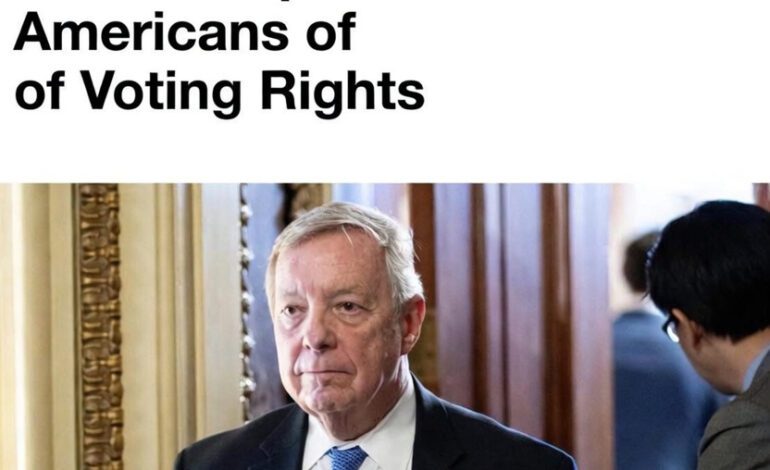

Imagine showing up to register to vote — only to be turned away because your driver’s license isn’t good enough. That is exactly what Senator Dick Durbin (D-IL) says the SAVE America Act would do to millions of eligible American citizens.
The bill — officially the Safeguard American Voter Eligibility Act — passed the U.S. House of Representatives in February 2026 and is now awaiting a Senate vote. Supporters say it protects election integrity. Critics, including Durbin, say it’s a thinly veiled attempt to remove legal voters from the rolls.
So what does the bill actually do? Who gets hurt? And is the problem it claims to solve even real? This article breaks it all down — clearly and completely.
What Is the SAVE America Act?
The SAVE America Act (Safeguard American Voter Eligibility Act) is a federal bill that would require every American to present documentary proof of U.S. citizenship — such as a passport or birth certificate — when registering to vote in federal elections. Standard driver’s licenses, REAL IDs, and military IDs would not qualify. The House passed the bill in February 2026. The Senate has not yet voted on it.
The bill amends the National Voter Registration Act of 1993. It prohibits states from registering anyone to vote in a federal election unless they first hand over documentary proof of citizenship — in person.
This is a significant shift from current law. Right now, registering to vote requires providing a driver’s license number or the last four digits of your Social Security number. Election officials then verify eligibility through databases from the Department of Homeland Security, the Social Security Administration, and the U.S. Postal Service.
The SAVE America Act would flip that model entirely. Instead of the government verifying who you are, you would have to prove it yourself — with specific paper documents.
The bill also has additional teeth in its 2026 version. It requires states to hand their voter rolls over to the Department of Homeland Security. It mandates voter roll purges every 30 days. It would effectively end online voter registration and automatic (motor voter) registration in most states. It also includes a restrictive photo ID requirement at the polls.
Durbin’s Warning: What He Said and Why It Matters
Senator Dick Durbin (D-IL), the Senate’s Democratic Whip and Ranking Member of the Judiciary Committee, took to the Senate floor to deliver a pointed warning. His message was direct: don’t let the name fool you.
“Don’t let the name of this bill fool you. The SAVE America Act would not protect our elections. Instead, it would make it more difficult for millions of Americans to vote.”
— Senator Dick Durbin (D-IL), Senate floor speech
Durbin highlighted a critical point: noncitizen voting is already illegal under federal law. It has been since 1996. And election officials already verify citizenship status through existing databases. The problem the bill claims to fix, Durbin argued, doesn’t really exist at any meaningful scale.
He pointed to the conservative Heritage Foundation’s own data. Over 20 years — from 2003 to 2023 — their database documented just a handful of confirmed noncitizen votes out of more than a billion ballots cast. That’s not a crisis. That’s a rounding error.
The senator also drew attention to groups who would be disproportionately hurt: military families who move frequently, married women whose birth certificates carry a different name, seniors without current passports, and rural Americans who may never have needed a passport in their lives.
“Making Americans fill out more paperwork will not secure our elections. This bill only makes it harder for women, members of our military, and seniors to participate in the democratic process.”
— Senator Dick Durbin (D-IL)
Who Would Lose Voting Access?
This is where the numbers get striking. A nonpartisan study by the Brennan Center for Justice and the University of Maryland found that more than 21.3 million eligible American voters — roughly one in ten voting-age citizens — do not have documentary proof of citizenship readily available.
By the Numbers: Who Lacks Required Documents
The groups most likely to struggle with the requirement are not random. They skew working-class, older, rural, and female. Specifically:
- Married women — About 84% of women who marry change their surname. That means a birth certificate might list a completely different name than their current ID. The bill makes no accommodation for marriage certificates.
- Military families — Active-duty members who move frequently may have ID and documents scattered or out of date. Durbin noted military voters are already 27% less likely to vote than their civilian counterparts.
- Low-income Americans — Passports cost money. Getting a birth certificate replacement can mean fees, travel, and time off work. These aren’t trivial obstacles for hourly workers.
- Rural voters — The Center for American Progress found some voters in Alaska and Hawaii would need to fly to reach a qualifying election office to register in person.
- Seniors — Older Americans may have outdated documents or face challenges navigating a new bureaucratic process.
- Native Americans — Tribal IDs would not qualify under the bill, despite being valid government-issued identification.
The Center for American Progress notes that young, college-educated, wealthy Americans and those identifying as liberal are the most likely groups to already have qualifying documents. Working-class voters, seniors, and rural Americans are the most likely to be blocked. Critics call this pattern “structural voter suppression.”
What Documents Would (and Wouldn’t) Work
Here is the critical detail that many people miss. The bill sounds broad — “proof of citizenship” — but in practice, the list of accepted documents is very narrow.
| Document | Accepted? | Notes |
|---|---|---|
| Valid U.S. Passport | ✔ Yes | Must be current; 52% of registered voters don’t have one |
| U.S. Birth Certificate | ✔ Yes | Name must match current legal name; problem for married women |
| Naturalization Certificate | ✔ Yes | For naturalized citizens only |
| Consular Report of Birth Abroad | ✔ Yes | For Americans born overseas |
| Enhanced Driver’s License (EDL) | ✔ Yes* | Only available in 5 states: MI, MN, NY, VT, WA |
| Standard REAL ID Driver’s License | ✘ No | Does not indicate citizenship; noncitizens can also get REAL IDs |
| Regular Driver’s License | ✘ No | Not sufficient |
| Military ID | ✘ No | Does not explicitly confirm citizenship status |
| Tribal ID | ✘ No | Not accepted under the bill’s requirements |
| Social Security Card | ✘ No | Not sufficient alone |
The REAL ID confusion is worth emphasizing. REAL IDs were specifically created to be a rigorous federal identity standard. Many Americans assume having a REAL ID means they’ve proven their citizenship. Not so. Noncitizen legal residents can also obtain REAL IDs. Even the bill’s own sponsor, Rep. Chip Roy (R-TX), admitted during a 2025 hearing that standard REAL IDs would not work for the vast majority of citizens.
Enhanced driver’s licenses are different — they function essentially as passport cards for border crossing. But they’re only offered in five states. If you live in Georgia, Texas, Florida, or 45 other states, you simply cannot get one.
Is Noncitizen Voting Actually a Problem?
No — noncitizen voting in federal elections is already illegal and extremely rare. The Heritage Foundation’s database, covering 2000–2026, documented only 100 instances of noncitizen voter fraud across 1.5 billion ballots cast. That equals 0.000007% of all ballots — statistically zero.
Let’s put that in perspective. One hundred incidents across 1.5 billion ballots over 26 years. That’s less than four incidents per year, nationwide. And none of those documented cases are known to have altered the outcome of any election.
Recent state-level audits confirm the rarity. Utah conducted a comprehensive citizenship review of its entire voter registration list from April 2025 through January 2026. They reviewed more than 2 million registered voters through a rigorous, multi-step process. The result: one confirmed instance of noncitizen registration and zero instances of noncitizen voting.
States that began using the federal USCIS verification system in 2025 found that only 0.04% of voter verification cases involved potential noncitizens — and even that figure is likely an overestimate. Travis County, Texas reported that 25% of voters flagged as potential noncitizens by USCIS had already provided proof of citizenship when they registered.
Current federal law already requires that registration forms include driver’s license numbers or Social Security digits. Election officials must verify these against DHS, SSA, and USPS databases. The system, Durbin says, already works.
Even the Heritage Foundation — the conservative organization behind Project 2025 — has only been able to document 100 instances of noncitizen voter fraud since 2000. That represents just 6% of all voter fraud cases in their database. The remaining 94% involve U.S. citizens. Proof-of-citizenship requirements would have zero impact on those cases.
What Happened When States Tried This Before
This isn’t the first time proof-of-citizenship requirements have been tested. Arizona and Kansas both implemented similar policies at the state level. The results were instructive.
In both states, tens of thousands of eligible citizens were blocked from registering. Not noncitizens. Eligible American voters who simply didn’t have the specific paperwork on hand when they tried to register. The courts eventually struck down Kansas’s law after years of litigation.
The Brennan Center noted that the same problems would scale dramatically at the federal level. State-level confusion would multiply across 50 states with 50 different implementation processes — all under an extremely compressed timeline if the bill passes.
The bill, if enacted, could take effect immediately or within one to two years depending on the specific provision. Implementation experts have warned that standing up an entirely new voter registration infrastructure in that timeframe would “wreak havoc on election administration.”
Constitutional Questions Around the Bill
Legal scholars have raised serious constitutional concerns about the SAVE America Act. The heart of the debate centers on what powers Congress actually has over elections.
Supporters of the bill point to the Constitution’s Elections Clause, which gives Congress the power to regulate the “Times, Places and Manner” of congressional elections. Sen. Mike Lee (R-UT) explicitly cited this clause in defending the original SAVE Act.
But the Elections Clause only grants authority over election procedures — not voter qualifications. The Supreme Court made this distinction explicitly in the Inter Tribal Council of Arizona v. Arizona ruling. Congress can require states to use a uniform federal voter registration form. What it cannot do, courts have suggested, is impose blanket voter qualification mandates that override state authority.
Separately, courts have already blocked one attempt by the Trump administration to impose citizenship requirements by executive order in March 2025, finding it unconstitutional.
The League of Women Voters has filed legal challenges. Additional lawsuits are widely anticipated if the Senate passes the bill and it is signed into law.
Where the Bill Stands Right Now (March 2026)
The SAVE America Act passed the House on February 11, 2026, on a largely party-line vote. It now faces the Senate, where its path is uncertain.
Senate Majority Leader John Thune stated it is unlikely the bill can pass in the Senate because there are not enough votes to overcome the filibuster. Breaking a filibuster requires 60 votes — far more than Republicans currently hold.
President Trump has made the bill a personal priority, vowing not to sign any legislation until it passes. He has also called on Republicans to abolish the filibuster to force it through — a move Thune has resisted.
The original version of the bill — the SAVE Act — passed the House in April 2025 but stalled in the Senate amid widespread public opposition. The current “SAVE America Act” is a rebranded and in some ways more expansive version of that original bill.
The Full Debate: Both Sides Explained
The Case For the SAVE America Act
Supporters, including President Trump and many Republican lawmakers, argue that citizenship verification is a common-sense safeguard. Their core argument: only American citizens should decide American elections, and the country should have a reliable way to confirm that.
They point to other democracies as models. Countries like India and Brazil tie voter ID to biometric databases. Germany and Canada require paper ballots. Denmark and Sweden limit mail-in voting. Supporters argue the U.S. lags behind on election verification.
Proponents also argue that requiring documentation prevents potential noncitizen voter fraud before it happens — even if current levels are low, preventive measures are worth taking.
The Case Against the SAVE America Act
Critics — led by Durbin and Democratic colleagues — counter that the bill solves a nonexistent problem while creating a very real one. Noncitizen voting is already illegal and already extremely rare. The existing verification system, they argue, already works.
The cost of the bill, critics say, is born entirely by eligible voters who lack the right paperwork. Those voters are disproportionately working-class, older, female, and rural. The bill would require in-person registration with qualifying documents — effectively ending online registration and reducing mail voting.
The Bipartisan Policy Center, while acknowledging the goal of ensuring only citizens vote, concluded there are “easier, more cost-effective ways to improve citizenship verification that don’t create new barriers for eligible voters.”
Frequently Asked Questions
What is the SAVE America Act?
The SAVE America Act (Safeguard American Voter Eligibility Act) is a federal bill requiring all Americans to present documentary proof of U.S. citizenship when registering to vote in federal elections. Standard driver’s licenses, REAL IDs, and military IDs would not be sufficient. The House passed it in February 2026.
How many voters could be removed from the rolls?
According to the Brennan Center for Justice and the University of Maryland, more than 21.3 million eligible Americans — about 1 in 10 voting-age citizens — do not have documentary proof of citizenship readily available.
Would a driver’s license or REAL ID work?
No. Standard driver’s licenses and REAL IDs would not be sufficient under the bill. Only an enhanced driver’s license (available in just 5 states), a valid passport, birth certificate, or naturalization documents would qualify.
Is noncitizen voting actually a widespread problem?
No. Noncitizen voting in federal elections is already illegal. The Heritage Foundation — a conservative organization — has documented only 100 instances of noncitizen voter fraud since 2000, across 1.5 billion ballots cast. That’s 0.000007% of all ballots.
Has President Trump supported this bill?
Yes. Trump made the SAVE America Act a top priority in early 2026, vowing to veto any other legislation until it passes. He has called for abolishing the Senate filibuster to force a vote.
Has this been tried before?
Yes. Arizona and Kansas implemented similar proof-of-citizenship requirements at the state level. In both cases, tens of thousands of eligible citizens were blocked from registering to vote.
What happens to current voters already on the rolls?
The bill’s requirement applies to new registrations and registration updates. However, it also requires states to conduct ongoing voter roll audits and purges — including submitting voter rolls to the Department of Homeland Security — which critics say could lead to eligible voters being incorrectly removed.
Key Takeaways
- The SAVE America Act would require documentary proof of citizenship — like a passport or birth certificate — to register to vote in federal elections.
- Standard driver’s licenses, REAL IDs, and military IDs would not be accepted.
- Senator Durbin warns the bill would effectively remove over 21 million eligible voters from participation.
- Noncitizen voting is already illegal and vanishingly rare — Heritage Foundation data shows just 100 confirmed instances across 1.5 billion ballots over 26 years.
- Groups most likely to be impacted include married women, military families, low-income voters, seniors, and rural Americans.
- State-level experiments in Arizona and Kansas blocked tens of thousands of eligible citizens under similar laws.
- The bill passed the House in February 2026 but faces significant hurdles in the Senate.
- Legal experts and voting rights groups have raised serious constitutional questions about the bill.
Stay informed on voting rights legislation and how it may affect your ability to participate in elections.
Sources & Further Reading
- Sen. Durbin Senate Floor Speech — Senate Judiciary Committee
- Brennan Center for Justice: New SAVE Act Bills Would Still Block Millions
- Center for American Progress: SAVE America Act Explained
- Bipartisan Policy Center: Five Things to Know About the SAVE Act
- Congress.gov: H.R.22 — SAVE Act, 119th Congress
Discover more from MatterDigest
Subscribe to get the latest posts sent to your email.