POLITICAL SHOCKWAVE! Historic Double Impeachment Being Prepared Against Trump and Vance
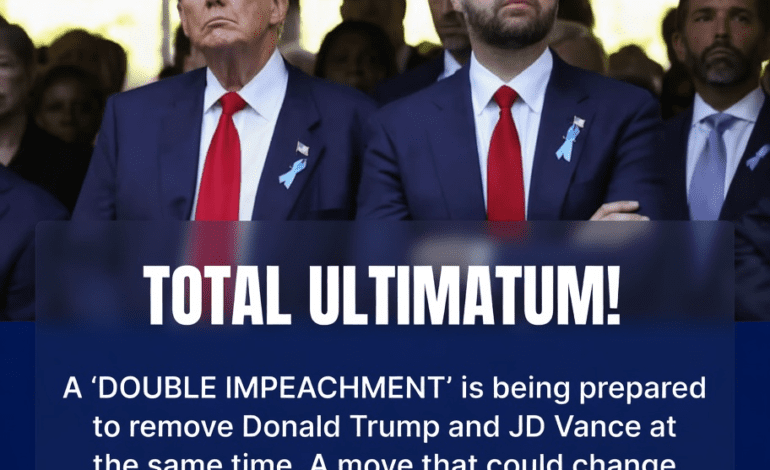

| How a “double impeachment” would legally work | Which constitutional mechanisms Democrats are exploring | What history tells us about simultaneous executive removal | Why the 25th Amendment keeps entering the conversation | What happens if both Trump and Vance are removed | Expert legal analysis and real political implications |
1. The Big Picture: What Is a Double Impeachment?
Washington has seen political crises before. But what is now being discussed in legal and Democratic Party circles is something the country has never witnessed — the simultaneous impeachment and potential removal of both a sitting president and vice president.
This is what political insiders are calling the “double impeachment” scenario. The idea is audacious, constitutionally complex, and — depending on who you ask — either a desperate last resort or a legitimate constitutional remedy.
So what does it actually mean, and how would it work?
| QUICK ANSWER: A ‘double impeachment’ refers to the effort to impeach both President Donald Trump and Vice President JD Vance simultaneously or in rapid succession. If both were removed, the Speaker of the House would become president. |
At its core, impeachment is a political and constitutional process — not a criminal trial. The House of Representatives votes to impeach (essentially to charge), and the Senate holds a trial to decide whether to remove the official from office. You need a majority in the House to impeach and a two-thirds supermajority in the Senate to convict and remove.
Doing this to one person is already a massive political lift. Doing it to two at the same time? That is the political earthquake that is now being seriously discussed on Capitol Hill and in constitutional law circles.
Why is this conversation happening now? Let us dig into the details.
2. How Impeachment Works: A Quick Constitutional Primer
Before we get into the double impeachment strategy, it helps to understand the basics. Many Americans are unfamiliar with the full constitutional mechanics — and that gap matters here.
What the Constitution Actually Says
Article II, Section 4 of the U.S. Constitution states that the president, vice president, and all civil officers can be removed from office if impeached and convicted of “treason, bribery, or other high crimes and misdemeanors.”
That last phrase — “high crimes and misdemeanors” — is intentionally vague. The Founders left it broad so that Congress could address serious abuses of power that might not fit neatly into criminal statutes.
The Two-Step Process
- Step 1 — House Impeachment: A simple majority of House members (218 of 435) must vote to approve articles of impeachment. This is the equivalent of a grand jury indictment. The person is now “impeached” but not yet removed.
- Step 2 — Senate Trial: The Senate then holds a formal trial. The Chief Justice of the Supreme Court presides when a sitting president is tried. A two-thirds supermajority (67 of 100 senators) is required to convict and remove from office.
| KEY FACT: Impeachment and removal are two different things. Bill Clinton was impeached in 1998 but was not removed. He served out his full second term. Andrew Johnson was also impeached but not removed. |
Who Has Been Impeached Before?
| Official | Year | Result | Removed? |
| Andrew Johnson | 1868 | Senate acquitted | No |
| Bill Clinton | 1998 | Senate acquitted | No |
| Donald Trump | 2019 & 2021 | Senate acquitted both times | No |
Notice the pattern? Being impeached does not mean being removed. The Senate has never voted to convict and remove a sitting president. That record makes the current double impeachment push even more extraordinary.
3. The Legal Case: Grounds Being Discussed for Trump
What could Democrats actually charge Trump with? To justify articles of impeachment, the House needs to identify specific constitutional violations or abuses of power. Here are the main arguments being discussed in 2026.
Abuse of Executive Power
This is the broadest and most commonly cited ground. Democrats are arguing that Trump has used the powers of the presidency in ways that fundamentally undermine democratic norms and constitutional checks. This includes allegations related to the use of executive orders to bypass Congress, attempts to direct federal agencies in ways critics call politically motivated, and what opponents characterize as the weaponization of government resources.
Obstruction of Congressional Oversight
Congress has constitutional authority to oversee the executive branch. When an administration stonewalls subpoenas, refuses to allow witnesses to testify, or withholds documents from congressional investigations, it creates grounds for obstruction charges. Democrats have pointed to multiple instances where they allege the Trump administration defied legal congressional requests.
Foreign Policy Controversies
Specific actions in foreign affairs — including decisions critics argue bypassed legal requirements for congressional notification or approval — have also been cited as potential impeachment grounds. These involve complex legal arguments about the War Powers Act and treaty obligations.
| IMPORTANT DISCLAIMER: The grounds discussed in this article reflect what political opponents and legal scholars are debating. They are not legal findings. Trump’s supporters strongly contest all these characterizations, and no impeachment vote has been taken as of publication. |
Violation of the Emoluments Clause
The Constitution prohibits the president from receiving financial benefits — called “emoluments” — from foreign governments without congressional approval. Critics have long argued that Trump’s business interests create ongoing violations. This argument has been part of Democratic discussions since his first term.
4. Why Vance? Understanding the Second Target
Here is where the double impeachment strategy gets genuinely novel. Why target the vice president too?
The answer is strategic and constitutional at the same time. If Trump is impeached and removed but Vance remains, Vance simply becomes president. For Democrats, that does not solve the problem — it just changes the name on the door. So the logic goes: if you want to change the direction of the executive branch, you may need to remove both.
What Could Vance Be Charged With?
This is the harder legal question. The vice president has far fewer formal powers than the president, which means fewer direct opportunities to commit “high crimes and misdemeanors” in the constitutional sense. However, critics have focused on several areas.
- Allegations related to Vance’s role in policy decisions where his influence is claimed to have been exerted in legally questionable ways.
- Claims that Vance made false statements to Congress or the American public in his official capacity.
- Arguments that Vance facilitated or enabled unconstitutional executive actions through his advice and coordination.
| LEGAL NOTE: Impeaching a vice president faces the same constitutional standard as impeaching a president. However, because vice presidents exercise less formal power, building a case is generally considered more difficult by constitutional scholars. |
It is worth noting that no vice president has ever been impeached in American history. The closest precedent is Vice President Aaron Burr, who was indicted for murder in 1804 while still serving — but he was never impeached by the House.
5. The Constitutional Mechanics of Removing Both
Let us talk logistics. How would a double impeachment actually work procedurally?
Can You Impeach Both Simultaneously?
The Constitution does not prohibit it, but it also does not specifically address it. Legal scholars are divided on whether the House should pursue both simultaneously or in sequence.
Option A: Sequential Impeachment
- House impeaches Trump first.
- Senate trial begins for Trump.
- If Trump is convicted and removed, Vance becomes president.
- House immediately impeaches Vance.
- Senate trial begins for Vance (now president).
The problem with this approach is obvious. If Trump is removed and Vance becomes president before Vance is also impeached and removed, there is a window during which the political goal has not been achieved.
Option B: Parallel Impeachment
- House passes articles of impeachment against both Trump and Vance simultaneously, or within days of each other.
- Senate holds separate trials for both.
- If both are convicted, the Speaker of the House (third in the line of succession) assumes the presidency.
| CONSTITUTIONAL GRAY AREA: Nothing in the Constitution explicitly allows or prohibits simultaneous impeachment proceedings. Legal scholars note this would be unprecedented and would likely face immediate legal challenges in federal court. |
Who Presides Over the Trials?
When a sitting president is on trial in the Senate, the Chief Justice of the Supreme Court presides — not the vice president (who normally presides over the Senate). This is explicitly stated in the Constitution. But what happens when both the president and vice president are on trial simultaneously? That constitutional question has no clear answer and would likely require a ruling from the courts.
6. The 25th Amendment Option: A Parallel Track
Impeachment is not the only constitutional mechanism being discussed. The 25th Amendment offers a different path — and it does not require a public trial.
What Is the 25th Amendment?
Ratified in 1967 in the wake of President Kennedy’s assassination, the 25th Amendment addresses presidential disability and succession. Section 4 is the relevant part.
| 25th AMENDMENT SECTION 4 (SUMMARY): If the vice president and a majority of the Cabinet declare in writing that the president is unable to perform his duties, the vice president immediately assumes power as acting president. The president can dispute this, but Congress can override the challenge with a two-thirds vote in both chambers. |
Why the 25th Amendment Does Not Solve the Double Problem
Here is the catch: the 25th Amendment requires the vice president to be part of the declaration. If Vance supports Trump — which is the current political reality — he would never sign such a declaration. That makes Section 4 a non-starter in the current political environment unless something dramatic changes within the administration.
However, legal scholars point out that Section 4 was never intended as a political tool. It was designed for situations of genuine physical or mental incapacity. Using it for political disagreements would be constitutionally dubious.
7. Historical Precedents: Has Anything Like This Happened Before?
Short answer: No. The double impeachment of a sitting president and vice president is constitutionally unprecedented in American history. But there are some partial precedents worth examining.
The Closest Historical Parallel: The Nixon Crisis
In 1974, President Richard Nixon resigned before the House could vote on articles of impeachment. What most people do not remember is that Vice President Spiro Agnew had already resigned the previous year, in 1973, after pleading no contest to tax evasion charges. So while there was a period with both the top executive officials under severe legal and political pressure, they fell in sequence — not simultaneously.
The Watergate Cascade
The Watergate scandal resulted in the resignation or prosecution of dozens of officials. The “Saturday Night Massacre,” in which Nixon ordered the firing of the special prosecutor, came close to triggering the kind of constitutional crisis that a double impeachment would represent. But the political will was never assembled for simultaneous action against both executive officers.
Britain’s Parliamentary Precedents
While not directly applicable to American constitutional law, Britain’s parliamentary system has seen simultaneous removal of entire governments through votes of no confidence. This is the kind of political earthquake that American constitutional designers actually feared and tried to prevent through the system of staggered elections and separated powers.
8. The Political Reality: Can Democrats Actually Pull This Off?
Here is where idealism meets hard political arithmetic. Let us be direct: a double impeachment faces enormous obstacles.
The House Question
To impeach, Democrats need a simple majority in the House. Whether they currently hold that majority depends on the outcome of the most recent elections and any subsequent special elections or party switches. As of early 2026, this remains a contested political calculation.
Unifying the Democratic Caucus
Even if Democrats have the numbers, maintaining caucus unity is notoriously difficult. Moderate Democrats from swing districts are often reluctant to vote for impeachment, knowing it could cost them their seats. Leadership has to weigh the political cost against the constitutional argument.
| POLITICAL REALITY CHECK: In a polarized Congress, getting the 218 House votes needed for impeachment AND the 67 Senate votes needed for conviction are two very different challenges. No president has ever been removed by the Senate. |
The House challenge is significant. The Senate challenge is even greater.
9. The Senate Math: Why This Is So Difficult
Even if the House impeaches both Trump and Vance, the Senate must convict to remove them. And the Senate math is brutally unfavorable for Democrats.
The 67-Vote Threshold
To convict a president or vice president, you need 67 senators to vote yes. That means that even if every Democrat and independent who caucuses with Democrats votes for conviction, they would need a substantial number of Republican senators to break ranks.
Have Republicans Ever Broken With Trump in Sufficient Numbers?
Historical precedent is not encouraging. In Trump’s first impeachment in 2019, just one Republican senator voted to convict — Mitt Romney. In the 2021 impeachment, seven Republican senators voted to convict, which was historically high but still far short of the 67-vote threshold.
What Would It Take?
To reach 67 votes, assuming all Democrats vote to convict, you would need approximately 17 to 20 Republican senators to vote against their own president and vice president. Political analysts across the spectrum view this as unlikely under current conditions, absent a new and dramatic revelation of criminal conduct.
10. What Happens If Both Are Removed? Speaker in the White House
This is the scenario that makes the double impeachment story truly explosive. If both Trump and Vance were impeached and convicted, who becomes president?
The Line of Succession
Under the Presidential Succession Act, the line of succession after the vice president goes to the Speaker of the House. As of early 2026, that means the House Speaker would become president of the United States.
| EXPLOSIVE IMPLICATION: If both Trump and Vance were removed, the Speaker of the House — a Democrat if Democrats control the House — would become president. This is why Republicans view the double impeachment push as a partisan coup attempt rather than a legitimate constitutional exercise. |
Has a House Speaker Ever Become President This Way?
Never. This would be the first time in American history that a Speaker of the House ascended to the presidency through the removal of both the president and vice president. It would be one of the most dramatic political events in the history of the republic.
Constitutional Legitimacy Questions
Even if constitutionally valid, a Speaker-turned-president would immediately face questions of democratic legitimacy. They were elected to represent a single congressional district, not to lead the nation. The political turbulence of such an outcome would be unlike anything America has seen in the modern era.
11. Republican Response: What the Other Side Is Saying
Republicans are not sitting quietly. Their response to the double impeachment discussion has been forceful and focused on several key arguments.
“This Is a Coup, Not a Constitutional Process”
The most common Republican argument is that the double impeachment push represents an attempt by Democrats to undo the results of a democratic election. They point out that Trump won the presidential election with the support of millions of Americans, and that using the impeachment process to reverse that outcome — especially when aiming to install a Speaker as president — is anti-democratic in spirit, even if technically within constitutional bounds.
“The Grounds Are Fabricated”
Republican constitutional lawyers argue that the alleged grounds for impeachment do not meet the legal standard of “high crimes and misdemeanors.” They contend that Democrats are mischaracterizing policy decisions and legitimate exercises of executive power as constitutional violations.
The Counter-Messaging Strategy
Republican leadership has been framing the double impeachment discussion as evidence of Democratic “extremism” and “desperation.” This messaging is aimed not just at their own base but at independent voters who may be uncomfortable with what they see as constitutional hardball.
12. Legal Expert Opinions: Constitutional Scholars Weigh In
What do constitutional law experts actually say about all this? The academic and legal community is genuinely divided.
Those Who Say It Is Constitutionally Permissible
Several prominent constitutional law scholars have argued that nothing in the Constitution prohibits simultaneous or sequential impeachment of the president and vice president. They point to the broad language of the impeachment clause and the clear precedent of impeaching officials for non-criminal conduct. Their argument is essentially that impeachment is a political process, not a legal one, and its scope is broad by design.
Those Who Express Serious Concerns
Other scholars — including some who are critics of the current administration — have expressed significant concerns about using impeachment as a mechanism to engineer a specific political outcome, particularly the elevation of a particular House Speaker to the presidency. They argue this would represent a dangerous erosion of the norms that protect democratic governance.
| ACADEMIC CONSENSUS: Most constitutional law scholars agree that a double impeachment is theoretically possible under the Constitution. However, there is significant disagreement about whether it would be politically legitimate or constitutionally wise, even if technically permissible. |
The Uncharted Territory Problem
Perhaps the most important thing legal experts agree on is this: nobody truly knows how courts would respond to a double impeachment, what legal challenges would be filed, or how quickly the judiciary could — or would want to — intervene. The Supreme Court has historically been reluctant to insert itself into the impeachment process, treating it as a political question. But the stakes of a double removal scenario might push even a reluctant Court to weigh in.
13. Timeline: How Events Could Unfold
If the double impeachment push moves forward, here is how events might realistically unfold. Note that this is a political and constitutional analysis of possible scenarios, not a prediction.
| Phase | What Happens |
| Phase 1 | House Judiciary Committee drafts articles of impeachment. Hearings are held, witnesses are called, evidence is presented. This phase alone could take weeks to months. |
| Phase 2 | Full House vote on articles of impeachment. If 218 members vote yes, the subject is officially impeached. This is a major political event in itself, regardless of what follows. |
| Phase 3 | House managers are appointed to prosecute the case in the Senate. The Senate sets the rules for the trial. |
| Phase 4 | Senate trial begins. Opening arguments, witness testimony, and deliberations. This could last weeks. |
| Phase 5 | Senate vote. 67 votes needed to convict and remove. If reached, removal is immediate. |
| Phase 6 | If both removed: The Speaker of the House is sworn in as president. A constitutional crisis of the first order has occurred. |
14. Frequently Asked Questions
What is a double impeachment?
A double impeachment refers to the simultaneous or sequential impeachment of both the president and the vice president. If both were convicted by the Senate and removed, the Speaker of the House would become president under the Presidential Succession Act.
Has a president ever been removed through impeachment?
No. Three presidents have been impeached by the House — Andrew Johnson (1868), Bill Clinton (1998), and Donald Trump (2019 and 2021) — but none was ever convicted by the Senate and removed from office. Richard Nixon resigned in 1974 before the House voted on articles of impeachment.
Is it legal to impeach both the president and vice president?
Constitutional scholars generally agree the Constitution does not prohibit it. However, it is entirely unprecedented, and legal challenges would almost certainly follow any attempt to do so. The courts have historically treated impeachment as a political question, but the stakes of removing both top executive officials might force judicial involvement.
Who becomes president if both Trump and Vance are removed?
Under the current Presidential Succession Act, the Speaker of the House would become president. This is a major reason why Republicans frame the double impeachment effort as a partisan power grab rather than a constitutional remedy.
What are the chances of a double impeachment actually succeeding?
Political analysts across the spectrum rate the chances of conviction and removal — especially of both officials — as very low given the Senate math. No president has ever been removed. To convict in the Senate, you need 67 votes, which means a substantial number of Republican senators would need to vote against their own party’s president and vice president.
What is the difference between impeachment and the 25th Amendment?
Impeachment is a congressional process requiring a majority House vote and two-thirds Senate conviction. The 25th Amendment allows the vice president and Cabinet to declare the president incapacitated, bypassing Congress initially. However, the 25th Amendment requires the vice president’s participation, making it unavailable when the VP supports the president politically.
15. Conclusion: Checkmate or Political Theater?
The double impeachment strategy is one of the most audacious political gambits in the history of American constitutional politics. Whether you view it as a principled constitutional remedy or a destabilizing political overreach depends largely on your assessment of the current administration and the seriousness of the underlying allegations.
Here is what we know for certain. The mechanics exist in the Constitution. The precedent is zero. The Senate math makes conviction nearly impossible under current political conditions. And the consequences of success — a House Speaker ascending to the presidency — would represent a constitutional earthquake unlike anything the modern republic has experienced.
What we cannot know for certain is how events will unfold. Politics moves fast. New information emerges. Alliances shift. The same Senate that seemed immovable in 2021 when seven Republicans voted to convict was unthinkable just months before it happened. Nobody should be certain about anything in Washington right now.
| BOTTOM LINE: The double impeachment discussion is real, serious, and constitutionally grounded — but faces near-insurmountable political obstacles. Watch the Senate Republican caucus. If more than ten senators begin publicly calling for accountability, the calculus changes rapidly. |
Key Takeaways
- A double impeachment of both Trump and Vance is constitutionally possible but historically unprecedented.
- The House needs 218 votes to impeach; the Senate needs 67 to convict and remove.
- No president has ever been removed from office through impeachment.
- If both are removed, the Speaker of the House becomes president.
- The 25th Amendment is not a viable parallel track given the current VP’s political alignment.
- Legal scholars are divided on the wisdom — not the legality — of a double impeachment attempt.
- The Senate math remains the biggest obstacle to any impeachment effort succeeding.
The game of constitutional chess in Washington is ongoing. Whether this particular gambit ends in checkmate or a stalemate remains to be seen — but the players are at the board, and the stakes could not be higher.
Further Reading & Authoritative Sources
- U.S. Constitution, Article II, Section 4 — Impeachment Clause (constitution.congress.gov)
- U.S. Constitution, 25th Amendment — Presidential Succession and Disability (archives.gov)
- Congressional Research Service: “Impeachment and the Constitution” — crs.congress.gov
- Presidential Succession Act, 3 U.S.C. § 19 — govinfo.gov
- The Federalist Papers, No. 65-66 — Alexander Hamilton on Impeachment (gutenberg.org)
Discover more from MatterDigest
Subscribe to get the latest posts sent to your email.