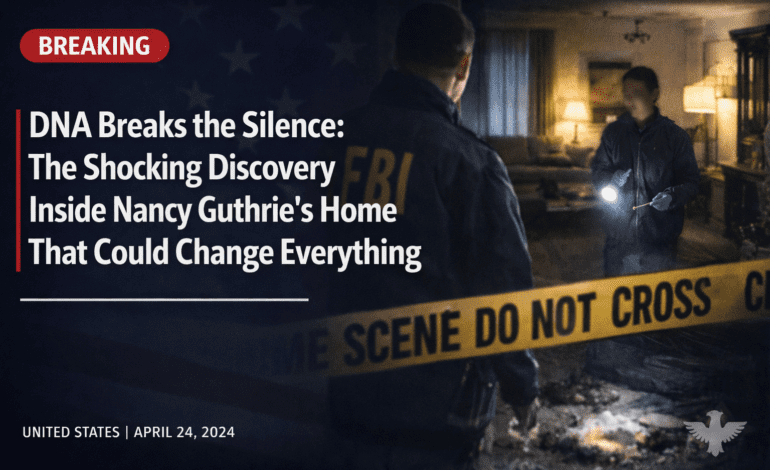
DNA Breaks the Silence: The Shocking Discovery Inside Nancy Guthrie’s Home That Could Change Everything

A Quiet Street With a Dark Secret
For weeks, the house sat silent. The curtains stayed shut. The porch light burned all night long, even when the sun was already up. Neighbors passed by every morning, glancing toward the windows and wondering. Something felt wrong. It was the kind of wrong that sits in your stomach and does not go away.
Nancy Guthrie’s home, once a normal and unremarkable house on a quiet street, had slowly turned into the center of a mystery that gripped an entire community. People whispered at the grocery store. Parents held their children a little closer. Friends of Nancy exchanged worried text messages late at night, asking each other the same question over and over: What really happened to her?
For a long time, investigators had very little to go on. The case seemed to stall. Tips came in, were checked out, and led nowhere. Witnesses were interviewed but their stories did not quite fit together. Rumors spread across social media like wildfire, some pointing at family members, others at strangers, and still others at people Nancy had known for years. But none of it added up to a clear picture.
Then came the DNA.
What Investigators Found Inside the Home
According to sources who are familiar with how the investigation has been moving, forensic specialists spent hours going through Nancy Guthrie’s home from top to bottom. They examined furniture, floors, doorways, and personal belongings. They used special tools and chemicals that can detect evidence invisible to the naked eye. They worked slowly and carefully, because in cases like this, even a tiny mistake can mean a guilty person walks free.
What they found inside the home was not what many people had expected. Sources connected to the case say that forensic specialists uncovered genetic material — DNA — that authorities believe could be a major turning point. The exact details of what type of DNA was found, and exactly where it was located inside the property, have not been made fully public. Investigators are keeping those specifics locked down tight, and with good reason. In criminal cases, releasing too much information too early can actually hurt a prosecution.
But what sources have confirmed is this: the discovery has changed the direction of the investigation. Before the DNA results came back, detectives were working with a certain set of assumptions about what may have happened and who may have been involved. After the results came in, some of those assumptions were thrown out entirely. New questions are now being asked, and people who were not previously considered persons of interest are reportedly now on investigators’ radar.
Officials have not confirmed these details publicly. They have simply said the investigation is ongoing and that they are following all available leads. But sources say, behind closed doors, the mood has shifted.
DNA: The Most Powerful Tool in Modern Crime Solving
To understand why this discovery matters so much, it helps to understand what DNA evidence actually is and why investigators and prosecutors treat it as one of the most reliable forms of evidence available today.
DNA, which stands for deoxyribonucleic acid, is the unique genetic code found inside almost every single cell in the human body. Think of it like a fingerprint, except far more detailed and far harder to fake. Every person on Earth — with the rare exception of identical twins — has a completely unique DNA profile. No two people share the same exact code.
DNA can be left behind without a person even realizing it. A single hair. A tiny drop of saliva. Skin cells shed from a hand that briefly touched a surface. In some cases, forensic scientists have been able to recover usable DNA from objects that were touched only once, years before the crime was even discovered. Modern laboratory techniques are now so advanced that investigators can pull a complete DNA profile from samples that would have been completely useless just ten or fifteen years ago.
Once a DNA profile is built from crime scene evidence, it can be run through national databases. In the United States, law enforcement uses a massive system called CODIS — the Combined DNA Index System — which holds the genetic profiles of millions of people who have been previously arrested or convicted of crimes. A match from CODIS can instantly connect a person to a crime scene, even if that person has never been directly suspected before.
But even when there is no immediate match in CODIS, DNA evidence is still incredibly valuable. It can rule out suspects. It can confirm that someone was definitely present at a location. It can also be used in investigative genetic genealogy — a newer and rapidly growing technique where scientists use public ancestry databases to find distant relatives of an unknown suspect, then work backward through family trees to try to identify who left the DNA behind. This technique has cracked dozens of cold cases across the country in recent years, solving crimes that investigators had given up on ever solving.
Rumors, Theories, and What the Community Believes
From the very beginning, the disappearance and reported death of Nancy Guthrie sparked intense speculation. People who knew her, and many people who did not, took to social media to share theories about what had happened. Some people pointed at romantic relationships gone wrong. Others focused on financial disputes. A few pointed toward family tensions that had reportedly been building for some time before Nancy vanished.
Online communities dedicated to true crime and missing persons cases dug through every piece of publicly available information. They analyzed old social media posts. They looked at photos. They read between the lines of official statements. They mapped out timelines and cross-referenced stories told by different people connected to Nancy’s life.
Some of these community investigators got remarkably close to what sources now say are real elements of the case. Others went completely off track, spreading misinformation that made things harder for the real investigators doing the actual work.
One theory that has circulated widely suggests that Nancy may not have died at the location where her body was found, or where investigators initially believed she died. This particular theory lines up with something sources close to the investigation have quietly hinted at: the DNA evidence suggests the crime, or at least part of it, may have taken place somewhere other than where people originally assumed.
That detail alone is significant. It means investigators may need to search new locations. It means the timeline of events that detectives had been working with may need to be completely rebuilt. And it means that whoever was responsible for what happened to Nancy Guthrie may have gone to great lengths to make sure the full truth stayed hidden.
What the DNA Evidence Suggests About the Investigation So Far
Detectives working cases like this operate on a simple principle: follow the evidence, not the assumptions. It sounds straightforward, but in practice it is one of the hardest things to do. When a case draws heavy media attention and public pressure, investigators sometimes get pushed toward theories that feel right to the public, even when the physical evidence is pointing somewhere else entirely.
The new DNA evidence, according to sources, appears to be pulling investigators in a fresh direction. It has reportedly raised questions about at least one individual who had not previously been considered a primary focus. Authorities have not publicly named anyone as a suspect, and they are being very careful not to suggest that any arrest is imminent. But the tone of their statements has shifted slightly. Where they previously spoke about the investigation in general terms, they are now hinting at progress.
Sources also note that while DNA is powerful, it still needs to be understood in context. Finding someone’s DNA inside another person’s home does not, on its own, prove that a crime was committed. People visit homes. They leave traces behind innocently all the time. A defense attorney would certainly make that argument in court. Prosecutors know this, which is why investigators are still working to build a fuller picture around what the DNA evidence shows.
What makes this particular DNA discovery stand out, sources suggest, is not just the presence of the genetic material — it is where exactly inside the home it was found, and what that location implies about the sequence of events that may have unfolded there.
Nancy Guthrie: Who She Was
In cases that attract significant public attention, it is easy for the victim to become reduced to a name in a headline. Nancy Guthrie was much more than that. By all accounts from those who knew her, she was a warm, outgoing person who cared deeply about the people in her life. She was known in her community. She had friends who loved her. She had family who are still waiting, with enormous pain, for answers.
Her family has not spoken in great detail publicly about the investigation, likely on the advice of law enforcement. But in the statements they have shared, the grief is clear. They want justice. They want to know the full truth of what happened. And they want the person or persons responsible to be held accountable.
People who knew Nancy well describe her as someone who was not the type to disappear quietly. She was active. She checked in with people she cared about. She kept commitments. So when she stopped responding to messages and her home went dark and quiet, those who loved her knew immediately that something was terribly wrong.
The days and weeks that followed were agonizing. First came the hope that maybe there was some simple explanation. Then came the slow, crushing realization that there was not. And then came the investigation — the interviews, the searches, the appeals to the public for information, and the long, painful waiting.
The Role of Forensic Science in Modern Murder Cases
The Nancy Guthrie case is a reminder of how much forensic science has changed the way crimes are investigated and solved. Decades ago, a case like this might have gone cold within months if there were no eyewitnesses and no confession. Today, the tools available to investigators are extraordinary.
Beyond DNA, forensic scientists can reconstruct events using bloodstain pattern analysis, digital forensics, cell phone location data, surveillance camera footage, and a dozen other techniques. Each piece of technology adds another layer of detail to what investigators can see.
Digital evidence in particular has become a game changer. People’s phones record enormous amounts of information about where they go, who they contact, what they search for online, and what they say in private messages. In many recent high-profile cases, digital evidence has been just as damning — sometimes more so — than physical evidence at the crime scene.
It is not known whether digital evidence is playing a significant role in the Guthrie investigation. But investigators working cases of this type almost always pursue every avenue available to them, and it would be surprising if digital records were not being examined alongside the physical evidence recovered from the home.
What Happens Next: The Path Toward Justice
For the family of Nancy Guthrie, the revelation that significant new evidence has been found is a bittersweet development. On one hand, it represents movement — after so much waiting, something is finally happening. The investigation is not dead. People are still working. The case has not been forgotten.
On the other hand, no piece of evidence, no matter how powerful, brings a loved one back. Justice, when it finally comes, is not the same as closure. It is simply a measure of accountability — a way of saying that what was done to Nancy Guthrie was wrong, that it mattered, and that the person responsible will face consequences.
Investigators have emphasized, through their carefully worded public statements, that they are committed to following this case wherever the evidence leads. They have asked the public to continue coming forward with any information, no matter how small it might seem. In cases like this, a single detail that an ordinary person might consider insignificant — a car they saw parked somewhere unusual, a conversation that seemed strange in hindsight, a person acting oddly in the days around when Nancy disappeared — can be exactly the piece that allows investigators to connect all the other dots.
The DNA discovery, sources say, has given the investigation new energy and new direction. Detectives who had been running into walls are now finding new paths forward. Lab results that are still being processed may yield additional answers in the weeks ahead. And the broader forensic picture being built around the genetic evidence is growing clearer by the day.
A Community Still Waiting for the Full Truth
Out in the neighborhood where Nancy Guthrie once lived, life has technically gone back to normal. People come and go. Kids ride bikes. The mail gets delivered. But things are not really the same. A shadow sits over the street. People still look at that house and think about her.
That is what violent crime does to a community. It does not just take one person. It takes something from everyone who knew that person, and even from people who simply lived nearby and understood that what happened there could have happened anywhere. It reminds people that safety is never guaranteed, and that sometimes evil passes right through the most ordinary-looking places without anyone seeing it coming.
But communities also have a way of fighting back. They share information. They support the families of victims. They demand answers from the people in charge of finding them. And they refuse to let cases go forgotten, even when months or years pass without a breakthrough.
The people who loved Nancy Guthrie are still fighting. The investigators assigned to her case are still working. And now, with DNA evidence pointing in new directions, there is reason — for the first time in a while — to believe that the full truth of what happened inside that quiet house is finally beginning to come to light.
For Nancy’s family, for her friends, and for everyone who has been following this case and hoping for justice — that is not nothing. That is everything.
Matter News will continue to follow developments in this investigation. If you have information related to this case, contact your local law enforcement agency.