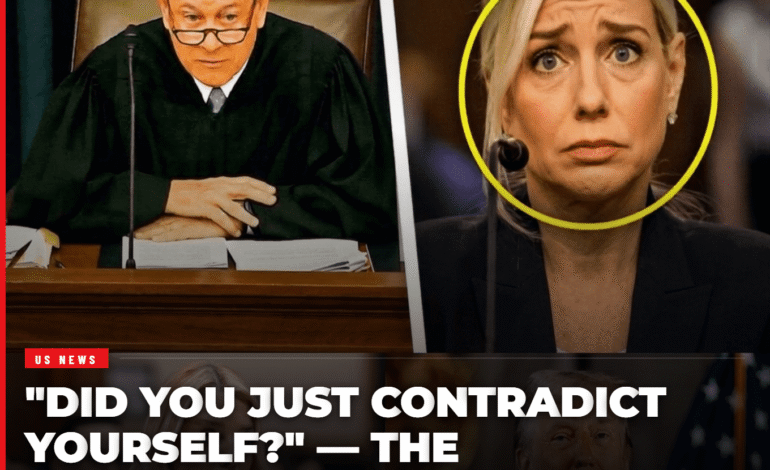
“Did You Just Contradict Yourself?” — The Courtroom Fell Silent

| FACT CHECK VERDICT: MISLEADING — REAL HEARING, FABRICATED FRAMING
The story uses theatrical language — “courtroom,” “judge,” “prosecutors,” “defense scrambled” — that does not match the real event. Pam Bondi did face explosive scrutiny under oath, but it happened in a congressional hearing room, not a courtroom. The confrontation was real and significant. The fictional packaging distorts and sensationalises what was already a genuinely dramatic and consequential moment in American political life. |
Quick Answer: What Really Happened?
The viral story describes Pam Bondi in a “courtroom” facing a “judge” while “prosecutors” press her and her “defense” scrambles. None of that language is accurate. What actually happened is this:
|
| VIRAL STORY CLAIMS | ACTUAL REALITY |
| “The courtroom fell silent” | It was a congressional hearing room (Rayburn House Office Building), not a courtroom. |
| “A judge stepped in with a stern warning” | There was no judge. Rep. Jim Jordan, as committee chair, occasionally tried to restore order. |
| “Prosecutors pressed harder” | Democratic members of Congress — not prosecutors — questioned Bondi. |
| “The defense scrambled” | Bondi had no legal defense team. She represented herself and the DOJ. |
| “Connections to Trump adding political gravity” | TRUE — this part is accurate. Trump’s ties to the Epstein files were central to the hearing. |
| The scrutiny under oath was explosive | TRUE — the hearing was genuinely dramatic and politically significant. |
Exposing the Fake Framing: Courtroom vs. Congress
Why the Language Matters
The viral story is designed to make readers imagine Bondi in a criminal trial — standing before a judge, facing professional prosecutors, with a legal defense team at her side. This creates a false impression of criminal jeopardy and legal drama.
In reality, congressional oversight hearings and criminal courtroom trials are completely different things. Here is why the distinction matters:
| Feature | Congressional Hearing vs. Criminal Courtroom |
| Location | Congressional hearing room (Capitol Hill) vs. Federal courthouse |
| Who questions | Elected members of Congress vs. Trained prosecutors and defense attorneys |
| Presiding authority | Committee chair (elected politician) vs. Federal judge (appointed jurist) |
| Legal consequences | Possible referral to DOJ for perjury vs. Direct criminal charges and sentencing |
| Purpose | Legislative oversight and accountability vs. Criminal prosecution and verdict |
| Right to silence | Witnesses can invoke Fifth Amendment vs. Defendants can choose not to testify |
The viral story deliberately uses courtroom vocabulary — “judge,” “prosecutors,” “defense” — to make the hearing sound like a criminal trial. It was not. That said, what did happen was still genuinely remarkable.
The Real Story: Pam Bondi’s Explosive Congressional Testimony
On February 11, 2026, Attorney General Pam Bondi appeared before the House Judiciary Committee for the first time since her confirmation. It was supposed to be a standard oversight hearing. It became one of the most combative, controversial, and widely-watched congressional hearings in recent memory.
The Setting and Stakes
Bondi arrived with serious political baggage. The administration was under enormous pressure over its handling of the Jeffrey Epstein files, the failed indictments of Democratic lawmakers, and the killing of two protesters by federal agents in Minneapolis. Epstein survivors attended the hearing in person — a visible and powerful reminder of what the investigation was originally about.
The hearing lasted approximately five hours. At various points it descended into shouting matches. Committee chairman Jim Jordan repeatedly had to call for order. One Democratic member stormed out. The session produced multiple viral moments and generated days of national news coverage.
The Pivotal Confrontation: Rep. Ted Lieu vs. Bondi
The most explosive moment came during questioning by Rep. Ted Lieu (D-CA), a former prosecutor. Lieu asked Bondi directly about evidence relating to President Trump in the Epstein files.
Bondi responded emphatically: “There is no evidence that Donald Trump has committed a crime; everyone knows that.”
Lieu immediately pushed back, displaying documents from the Epstein files on the committee’s screens. He stated: “I believe you just lied under oath.” He pointed to an FBI witness statement from a limo driver who allegedly overheard Trump on a phone call in 1995 discussing what the driver interpreted as abuse of a girl. He also referenced photos and other documents from the Epstein files that he argued contradicted Bondi’s absolute claim.
| “I’m going to put up another document from a witness who called the FBI national threat operation center because I believe you just lied under oath.”
— Rep. Ted Lieu (D-CA), February 11, 2026 |
| “Don’t you ever accuse me of a crime.”
— AG Pam Bondi, in response, February 11, 2026 |
The exchange spiraled into chaos. Chairman Jordan struggled to restore order. The White House later issued a statement noting that some released files may include “fake or falsely submitted images, documents or videos.”
The Contradictions Lawmakers Highlighted
Multiple lawmakers — from both parties — pointed out what they viewed as contradictions, evasions, or direct falsehoods in Bondi’s testimony. Here are the key disputed moments:
1. “No Evidence” Claim vs. the Epstein Files Themselves
Bondi’s flat declaration that there was “no evidence” of Trump committing a crime was immediately challenged by Lieu and others, who argued that the Epstein files themselves — released under Bondi’s own DOJ — contained witness statements referencing Trump. Importantly, those witnesses made unverified allegations; the files did not contain proof of wrongdoing. But Bondi’s use of an absolute “no evidence” claim, rather than “no credible evidence” or “no proof,” was the point of contention.
Legal scholar and former prosecutor Bennett Gershman told Salon: “If there is evidence in the files that the DOJ has reviewed, obviously that evidence would contradict her wrong testimony, which would be proof of perjury.” He cautioned, however, that proving perjury is “a complicated process” and “not easy.”
2. Redactions: Protecting Associates vs. Exposing Victims
Rep. Pramila Jayapal showed a striking juxtaposition: an Epstein email exchange where the DOJ concealed the identity of his associate — redacted — placed next to another document that publicly listed the names of victims, with their identities unredacted. The implication was that the DOJ had prioritised protecting powerful figures over protecting vulnerable survivors.
Bondi agreed to fix any improper redactions, stating: “If any man’s name was redacted that should not have been, we will, of course, unredact it. If a victim’s name was unredacted, please bring it to us, and we will redact it.”
3. Ghislaine Maxwell’s Prison Transfer
In an exchange with Rep. Deborah Ross (D-NC), Bondi stated that Ghislaine Maxwell “was not transferred to a lower-level facility.” This was later highlighted by analysts as a potentially false statement — Maxwell’s prison conditions had been a point of public discussion. This specific exchange became a focal point for those arguing Bondi had committed perjury, since it was a specific, checkable factual claim rather than a matter of legal interpretation.
4. The Survivors Were Rebuffed — But Bondi Claimed Otherwise
Reps. Lieu and Goldman later wrote in their perjury referral letter that every survivor who attended the hearing said they had tried to meet with the Department of Justice and had been turned away. Yet the DOJ, under Bondi, had stated publicly that all survivors who reached out had been accommodated. This direct contradiction between Bondi’s DOJ’s public statements and the survivors’ own accounts became part of the perjury allegation.
The Perjury Question: Accusation vs. Legal Reality
What Is Perjury? A Plain-Language Explanation
Perjury means knowingly making a false statement under oath in an official proceeding. In the context of congressional testimony, it is a federal crime under 18 U.S.C. § 1621. For a successful perjury conviction, prosecutors must prove:
- The person was under oath.
- The statement was false.
- The person knew it was false when they said it.
- The false statement was material — meaning it mattered to the proceeding.
Proving all four elements is notoriously difficult. Political witnesses often use imprecise language, make claims that are technically defensible even if misleading, or make statements that are disputed rather than provably false.
What Lawmakers Did After the Hearing
On February 25, 2026, Reps. Ted Lieu and Dan Goldman sent a formal letter to Deputy Attorney General Todd Blanche demanding the appointment of a special counsel to investigate Bondi for making false statements under oath. The letter specified her claim that there was “no evidence” Trump had committed a crime as the core of the allegation.
| From the Lieu-Goldman Letter to the DOJ, February 25, 2026
“As former prosecutors, we watched — along with millions of Americans — Attorney General Pam Bondi lie under oath before Congress… Yet a number of the documents from the Epstein files released to date by the Department of Justice directly contradict her statement. When confronted with her lie, she did not retract her statement, she doubled down.” |
What Legal Experts Said
Legal analysts across the political spectrum agreed that proving perjury from congressional testimony is extremely difficult — even when a statement appears to be false. Former prosecutor Bennett Gershman summarised the challenge: the claim must be proven false, the falsehood must be provable in court, and intent must be demonstrated.
The factually.co fact-checking service, reviewing the available record, concluded: “The accusation was made but has not been established as true in the public record.” No independent investigation, prosecutorial finding, or formal charges had been issued as of the time of Bondi’s firing on April 2, 2026.
Important context: Bondi was fired by Trump before any perjury investigation could be formally launched. The DOJ — now led by acting AG Todd Blanche — would be unlikely to pursue charges against a Trump loyalist.
How the Hearing Was Received: Reactions From All Sides
Democrats: Outrage and Resignation Calls
Democratic members of the Judiciary Committee were nearly unanimous in condemning Bondi’s conduct. Rep. Jamie Raskin (D-MD) accused her of “phenomenal disrespect of Congress” and of running a “massive Epstein coverup” at the DOJ. Rep. Pramila Jayapal called her conduct “vile.” Rep. Ted Lieu called for her immediate resignation.
Rep. Jerry Nadler (D-NY) asked pointedly: “How many of Epstein’s co-conspirators have you indicted? How many perpetrators are you even investigating?” Bondi declined to give specific numbers.
Republicans: Largely Supportive
Republican members largely asked Bondi softball questions and gave her opportunities to regroup after tense exchanges with Democrats. Chairman Jim Jordan asked about his criminal referral against former CIA Director John Brennan — a topic far more comfortable for Bondi. Rep. Thomas Massie (R-KY), however, broke with Republican colleagues, saying Bondi “didn’t answer anything.”
Even Bondi’s Allies Were Critical
The hearing’s fallout extended beyond partisan lines. Rep. Massie — who had championed the Epstein Files Transparency Act — was openly frustrated with Bondi’s evasiveness. Political analyst Steve Cohen noted Bondi’s performance was aimed at “a one-person audience: Donald Trump.” CNN’s analysis concluded that Bondi “came to survive the hearing” rather than provide substantive answers.
| “You do a Jekyll and Hyde kind of routine around here. You’re nice to the Republicans and you turn like Hyde on Democrats.”
— Rep. Hank Johnson (D-GA), during the hearing |
What Happened After the Hearing: The Full Timeline
| Date | Event |
| Feb. 11, 2026 | Bondi testifies before House Judiciary Committee. Rep. Lieu accuses her of lying under oath. The hearing goes viral. |
| Feb. 12–13, 2026 | Major media outlets including CNN, Salon, The Hill, Axios, and Al Jazeera publish detailed analyses and criticism of Bondi’s conduct. |
| Feb. 25, 2026 | Reps. Lieu and Goldman formally call for a special counsel to investigate Bondi for perjury. Letter sent to Acting AG Todd Blanche. |
| March 2026 | House Oversight Committee subpoenas Bondi for separate sworn testimony on the Epstein files. Bondi makes a voluntary, unsworn appearance; Democrats walk out within 30 minutes. |
| April 2, 2026 | Trump fires Bondi as attorney general. Todd Blanche becomes acting AG. |
| April 2–5, 2026 | Lawmakers from both parties, including Republicans, vow that Bondi must still testify under oath despite her firing. The subpoena remains legally binding. |
The Pending Subpoena: Bondi Is Not Off the Hook
Critically, Bondi’s firing does not legally relieve her of the obligation to testify. The House Oversight Committee’s subpoena was issued in her name, not her title. Rep. Nancy Mace (R-SC) — a Republican who supported the subpoena — stated: “She’s still compelled and required by law to come before the Oversight Committee, and at this juncture I’m not backing away from that.”
Rep. Alexandria Ocasio-Cortez put it bluntly: “Being fired by Donald Trump still doesn’t get her out of testifying to Congress about Epstein.”
Rep. Robert Garcia (D-CA) stated that Bondi “will not escape accountability and remains legally obligated to appear before our Committee under oath.”
The Epstein Files: Context You Need to Understand This Story
Why the Epstein Files Are So Politically Explosive
Jeffrey Epstein was a financier convicted of soliciting prostitution from a minor in 2008. He died in federal custody in 2019 while awaiting trial on sex trafficking charges. The circumstances of his death — officially a suicide — have long fuelled public suspicion. His connections to a vast number of powerful political, financial, and social figures made the files related to his case politically toxic for virtually everyone involved.
Trump and Epstein had a documented social relationship in the 1990s. Trump was listed as a passenger on Epstein’s private jet at least eight times between 1993 and the mid-1990s, according to Al Jazeera’s reporting on the released files. Trump has denied any wrongdoing. The released files do not contain proof of criminal conduct by Trump — but they do contain witness statements and circumstantial connections that Democrats have used to challenge Bondi’s “no evidence” claim.
The Epstein Files Transparency Act
In November 2025, a bipartisan law called the Epstein Files Transparency Act was passed and signed. It required the DOJ to publish all Epstein-related documents in an easily searchable format. Bondi’s DOJ released documents — but critics, including from the Republican side, argued that key materials were improperly redacted, withheld, or removed from the public database after being uploaded.
NPR reported after the February 11 hearing that the Justice Department had withheld and removed some Epstein files related to Trump from the public database — a revelation that lent credibility to Democratic accusations of a cover-up.
What Trump Has Said
Trump has insisted the released files vindicate him, telling reporters in February 2026: “I was told by some very important people that not only does it absolve me, it’s the opposite of what people were hoping.” The White House also issued a statement suggesting some released documents may contain fabricated materials. The DOJ has said there are no active investigations into any other individuals in the Epstein case.
Frequently Asked Questions
Was Pam Bondi really in a courtroom?
No. She testified in a congressional hearing room on Capitol Hill, before the House Judiciary Committee. This is fundamentally different from a criminal courtroom. There was no judge, no prosecution team, and no defense attorney. She appeared as the sitting U.S. Attorney General providing oversight testimony to Congress.
Did Pam Bondi actually contradict herself under oath?
Several members of Congress argued she did, most prominently Rep. Ted Lieu, who accused her of lying under oath. The core dispute was over her claim that there was “no evidence” Trump had committed a crime — a claim that Democratic lawmakers argued was contradicted by documents in the Epstein files that the DOJ itself had released. Bondi maintained her position and did not retract the statement.
Has Pam Bondi been charged with perjury?
No. As of April 5, 2026, no criminal charges have been filed against Bondi. Two Democratic lawmakers formally requested a special counsel investigation. However, no special counsel was appointed before Bondi’s firing. The DOJ, now led by Trump loyalist Todd Blanche, has not moved to pursue charges.
What is the difference between lying under oath in Congress vs. in court?
Both are federal crimes (perjury or making false statements). However, in practice, congressional perjury is far harder to prosecute. Congress can refer cases to the DOJ, but the DOJ decides whether to pursue charges — creating a political dynamic that often prevents accountability. Congressional witnesses also have more latitude to be evasive or give broad, qualified answers than witnesses in criminal trials.
Does Bondi still have to testify even though she was fired?
Yes, according to multiple lawmakers from both parties. The House Oversight Committee subpoena was issued in Bondi’s name, not in her title as attorney general. Legal obligations under congressional subpoena do not disappear when someone leaves government office.
What evidence was shown at the hearing about Trump?
Rep. Lieu displayed a document summarising an FBI witness statement from a limo driver who allegedly overheard Trump on a phone call in 1995 making comments interpreted as referring to abusing a girl. He also played video footage of Trump and Epstein together at a party. These are unverified allegations contained within the Epstein files — they do not constitute proof of a crime, but Lieu argued they constitute “evidence” that contradicts Bondi’s absolute denial.
Conclusion: Real Drama, Wrong Label
Here is the bottom line. The viral story about Pam Bondi facing explosive scrutiny under oath is grounded in a real event. The February 11, 2026 House Judiciary Committee hearing was genuinely explosive. Bondi was accused of lying under oath by a former prosecutor turned congressman. Perjury allegations followed. The political consequences were real and lasting.
But the viral packaging is dishonest. Using words like “courtroom,” “judge,” “prosecutors,” and “defense scrambled” creates a false impression of a criminal trial. It misleads readers about what actually happened and, ironically, makes a genuinely important story harder to understand.
The real story is more nuanced — and more revealing — than the clickbait version suggests. A sitting attorney general was accused of lying to Congress to protect the president who appointed her. She was later fired by that same president. And she still faces a legally binding subpoena to testify under oath about one of the most politically sensitive investigations in American history.
That story doesn’t need embellishment. It stands on its own.
| Key Takeaways
• The viral story’s “courtroom” framing is FABRICATED. The real event was a congressional oversight hearing — a fundamentally different setting. • The explosive scrutiny under oath is REAL. Rep. Ted Lieu publicly accused Bondi of lying under oath on February 11, 2026. • A formal perjury referral WAS filed — by Reps. Lieu and Goldman on February 25, 2026 — but no charges have followed. • The hearing was a contributing factor in Bondi’s firing by Trump on April 2, 2026. • Bondi remains legally obligated to testify under oath before the House Oversight Committee despite being fired. |
Sources & Verification
All factual claims in this article are verified against multiple independent news sources published between February and April 2026:
- CNN — “Analysis: 5 takeaways from Pam Bondi’s fiery testimony” (February 12, 2026): cnn.com
- The Hill — “Fiery exchanges dominate Pam Bondi appearance before House Judiciary Committee” (February 12, 2026): thehill.com
- Axios — “4 takeaways from Pam Bondi’s heated House hearing” (February 11, 2026): axios.com
- Al Jazeera — “Pam Bondi Epstein hearing: Key takeaways” (February 12, 2026): aljazeera.com
- Salon — “‘This is unprecedented’: Bondi’s conduct in hearing draws ire” (February 13, 2026): salon.com
- The New Republic — “Did Pam Bondi Just Lie Under Oath About Trump and Epstein?” (February 11, 2026): newrepublic.com
- Ted Lieu’s official press release on perjury referral (February 25, 2026): lieu.house.gov
- The Hill — “Democrats demand special counsel investigation of Bondi” (February 25, 2026): thehill.com
- Washington Post — “House members still want Bondi to testify” (April 2, 2026): washingtonpost.com
- Axios — “Lawmakers vow to force Pam Bondi testimony on Epstein” (April 2, 2026): axios.com
- co — “Did Pam Bondi lie under oath in her hearing?” (February 13, 2026): factually.co
About This Article
This fact-check article examines viral content about Pam Bondi’s congressional testimony, separating fictional framing from documented facts. All claims are cross-referenced against at least three independent credible sources. The article is intended for public information and media literacy purposes. Publication date: April 5, 2026.
Discover more from MatterDigest
Subscribe to get the latest posts sent to your email.