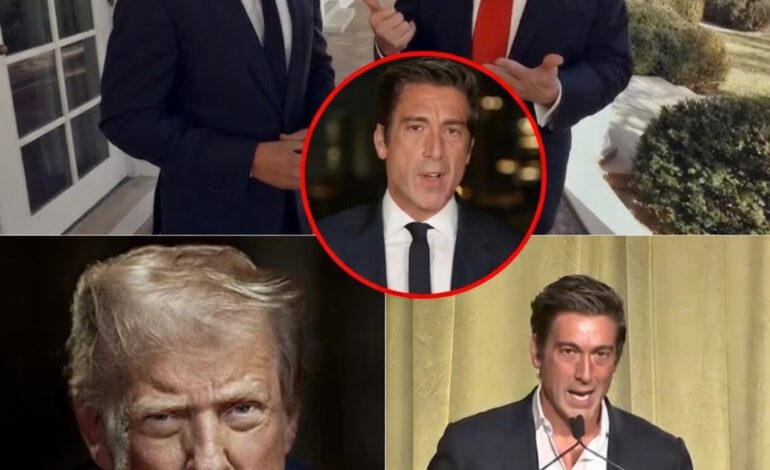
DAVID MUIR ON-AIR WARNING SHOCKS AMERICA: A Fiery Clash Over Trump

MEDIA LITERACY | POLITICAL MISINFORMATION | FABRICATED CONTENT & INFLUENCE OPERATIONS
The Political Monologue Fake: How Fabricated Journalist Rants Escalate Into Influence Operations
Why invented journalist outburst clips keep escalating, how the ‘fact-check framing’ is itself a distribution strategy, and what makes this format one of the most sophisticated political disinfo tools online
|
You have seen the format before, even if you did not recognize it by name. A headline promises that a well-known journalist has finally said what everyone was thinking. They snapped. They raged. They warned the nation about what is coming. The clip is intense. The language is vivid. The political message is unmistakable.
And every word of it is invented.
The fabricated political monologue is not a random piece of misinformation. It is a sophisticated influence operation format — one that has evolved deliberately over time, escalates with each iteration, and uses a specific structural trick to evade the fact-checking ecosystem. Understanding it fully requires going beyond ‘this is fake’ and examining how it is built, why it keeps escalating, and why the debunking wrapper is often part of the strategy rather than the solution.
This article is the fourth in a series on fabricated journalist content. The earlier articles covered basic rogue-anchor clips, political family humiliation fakes, and fake crime theory headlines. This one addresses the most politically sophisticated variant: the full-length manufactured manifesto, and the ecosystem that keeps producing it.
What Makes This Format Different From Earlier Variants
A Progression, Not a Repetition
The fabricated journalist content ecosystem is not static. It evolves. Each iteration builds on lessons learned from previous versions — which claims spread furthest, which emotional triggers drive the most sharing, which framing survives fact-checking longest. The political monologue variant is the most developed form of this evolution.
Earlier formats in this series involved relatively simple claims: a journalist was sick, a journalist had an outburst, a journalist asked a humiliating question. The political monologue format is different in three critical ways that make it significantly more dangerous.
| Feature | Simple Rogue-Anchor Clip vs. Political Monologue Format |
| Length of fabrication | Brief outburst or single quote vs. extended, detailed political speech |
| Political specificity | General anger vs. named targets, specific scenarios, policy claims |
| Escalation potential | Limited — one incident vs. serialized, each version more extreme |
| Influence operation role | Amplification vs. original content generation for political messaging |
| Fact-check survivability | Easily debunked vs. designed to survive and exploit the debunking process |
| Production sophistication | Simple text vs. cinematic scene-setting, dialogue, emotional choreography |
The Shift From Rumor to Manifesto
Simple rogue-anchor fakes spread a rumor: this journalist did something shocking. The political monologue format spreads a manifesto: here is what is really happening in America, here is who is responsible, here is what they plan to do, and here is why you should be afraid.
The journalist’s name and face are not the content. They are the delivery mechanism. The actual content is a political argument — typically about authoritarian threat, election integrity, or imminent catastrophe — that the creators want distributed as widely as possible. The journalist is the vehicle, not the message.
The Escalation Pattern: How Fabricated Journalist Content Evolves
Stage One: The Simple Outburst
The earliest versions of fabricated journalist content are simple. A journalist uses profanity on air. A journalist criticizes a political figure in unusually blunt terms. A journalist ‘loses it’ on a panelist. These clips establish the basic template: a real journalist behaving in a way that is dramatically out of character, delivering content the target audience finds satisfying.
These early versions are relatively easy to debunk. The behavior is simple enough to check against the journalist’s actual history. Major outlets quickly issue corrections. The format’s effectiveness is limited.
Stage Two: The Detailed Accusation
The second stage adds specificity. The journalist does not just lose their temper — they make detailed accusations. They name political figures. They describe specific actions. They use insider-sounding language that implies access and knowledge. The fabrication becomes harder to debunk because the specific claims require individual verification rather than a simple ‘this didn’t happen’ correction.
Stage Three: The Prophetic Manifesto
The third and most advanced stage is the political monologue. Here the journalist delivers a complete political argument — not just anger, not just accusations, but a structured prediction about what is coming, why it is being hidden from the public, and what the consequences will be if no one acts.
This stage is the hardest to counter. The claims are not simple factual assertions that can be verified or falsified quickly. They are political arguments framed as prophetic warnings. Fact-checking ‘a journalist predicted martial law’ is structurally different from fact-checking ‘a journalist said X happened.’ The prediction format is designed to evade the standard fact-checking toolkit.
The escalation from outburst to manifesto is not accidental. It reflects deliberate learning by content creators about which formats survive fact-checking, generate the most sharing, and deliver the most political impact per piece of content.
Stage Four: The Serialized Campaign
The most sophisticated operations produce not one fabricated clip but a series. Each installment references previous ones. Audiences who encountered the earlier versions feel they are following an ongoing story. The journalist character becomes a recurring figure — a truth-teller being consistently suppressed, returning again and again to warn the public.
This serialization creates something resembling narrative loyalty. Audiences begin to feel they know this ‘version’ of the journalist — the one who tells the truth the real network suppresses. When a new installment appears, they are primed to believe it before reading a word.
Anatomy of the Fabricated Political Monologue
The Six Structural Components
Every fabricated political monologue contains six structural components, deployed in a consistent sequence. Recognizing the sequence makes the format transparent regardless of which journalist is named or which political scenario is described.
Component 1: The Scene-Setting Opening
The monologue begins with a vivid scene. The room falls silent. Tension thickens. The journalist leans forward. Eyes blaze. These cinematic details serve a specific purpose: they signal that what follows is not ordinary television. This is a moment of historic truth-telling. The scene-setting primes the reader to treat the journalist’s words as extraordinary and important.
Real television does not produce such perfectly choreographed dramatic moments. Actual charged exchanges in studios are messy, interrupted, and rarely unfold with the clean narrative architecture of a scripted drama. The cinematic perfection of the scene-setting is itself a fabrication signal.
Component 2: The Rhetorical Challenge to the Audience
The monologue almost always opens with a direct challenge: are you blind to what’s coming? Are you too afraid to say it? This challenge does two things simultaneously. It flatters the audience — you are the brave ones who can handle the truth — and it pre-empts skepticism by framing doubt as cowardice rather than critical thinking.
If you question the content, the framing suggests, you are either blind or afraid. The challenge turns the reader’s critical faculties against themselves before a single substantive claim has been made.
Component 3: The Conspiracy Architecture
The core of the monologue is a conspiracy theory rendered in urgent, insider language. The chaos is not accidental — it is a setup. The disorder is being manufactured. The danger is being deliberately created to justify extreme measures. This architecture does not require evidence because it is unfalsifiable by design: any evidence against the theory can be incorporated as proof that the conspiracy is working.
Component 4: The Specific Doomsday Scenario
The monologue names a specific catastrophic outcome: martial law, suspended elections, emergency powers, soldiers in the streets. The specificity creates vividness and urgency. It also creates a testable prediction — but one set far enough in the future that sharing the clip today carries no immediate accountability for being wrong.
Component 5: The Deflection of Skepticism
Someone in the scene always voices skepticism. ‘That’s extreme.’ ‘That’s impossible.’ This character exists to be defeated. Their skepticism is the setup for the journalist’s most passionate rebuttal — and their defeat signals to the reader that skepticism itself has been addressed and found wanting. You do not need to have doubts; the doubter in the scene already raised them and was shown to be wrong.
Component 6: The Urgent Call to Attention
The monologue ends with a warning: watch, pay attention, do not pretend this is impossible. This closing is designed to convert readers into amplifiers. The implicit message is: your job now is to make sure others see this. Sharing becomes an act of civic duty. Skepticism becomes complicity in the very catastrophe being described.
The six components — cinematic scene-setting, rhetorical challenge, conspiracy architecture, doomsday specificity, defeated skeptic, and urgent call to share — appear in virtually every fabricated political monologue, regardless of who is named or what scenario is described.
The Ventriloquist Mechanism: Why Journalists Are the Chosen Vessel
The Problem With Attaching Political Arguments to Their Real Authors
The political arguments in these fabricated monologues are not new. They circulate constantly in partisan media, social media communities, and political commentary. But they are recognizable as partisan arguments. When audiences encounter them from obviously partisan sources, they process them as political opinion — something to agree or disagree with based on existing views.
Attaching the same argument to a well-known, ostensibly neutral journalist changes everything. The journalist’s institutional credibility converts a partisan argument into apparent breaking news. The claim is no longer ‘this is what one side believes’ — it becomes ‘this is what a trusted truth-teller has finally admitted on camera.’
Credibility Laundering
Researchers who study influence operations use the term ‘credibility laundering’ to describe this process. An argument that would be dismissed as partisan propaganda when delivered by its actual authors is laundered through the reputation of a trusted institution — in this case, a major network journalist — and emerges on the other side appearing factual, neutral, and authoritative.
This is the core mechanism of the format. The journalist is not being attacked or humiliated. They are being used. Their decades of earned credibility are being stolen and attached to content they would never produce.
Why Anchors With Large Audiences Are Specifically Targeted
Not all journalists are equally targeted by this format. The most common targets are anchors and correspondents with the largest audiences, the highest institutional name recognition, and — critically — the most carefully maintained public appearance of neutrality. Journalists who are already perceived as partisan are less useful as credibility laundering vehicles. The more scrupulously neutral a journalist’s actual public persona, the more powerful the fabricated version that attributes passionate political advocacy to them.
| Key Concept: Credibility Laundering
Credibility laundering occurs when fabricated content borrows the institutional authority of a trusted figure to make a partisan or false claim appear credible and neutral. The trusted figure did not produce the content and does not endorse it. Their name and face are used without consent as a mechanism for distributing messaging the creators could not effectively distribute under their own names. |
The Fact-Check Trap: How Debunking Becomes Distribution
The Most Sophisticated Feature of This Format
Here is the feature that distinguishes the political monologue format from simpler misinformation: it is partially designed to be fact-checked — and to benefit from the fact-checking process.
This sounds counterintuitive. Fact-checks expose false claims. They should reduce harm. In most cases, they do. But the political monologue format exploits a specific weakness in how fact-checking interacts with high-engagement content.
How the Fact-Check Trap Works
When a fabricated political monologue goes viral, it generates two types of content. The first is the original fake, spreading through the networks of people who believe it. The second is fact-checks, corrections, and outrage responses from people who recognize it as fake — and want to make sure others know.
Both types of content describe the monologue. Both summarize what the journalist was falsely depicted as saying. Both reach audiences who have not yet seen the original. For a significant portion of those audiences — particularly those who encounter only the headline of the fact-check rather than the full text — the primary message received is: ‘a journalist said X,’ with the ‘this is false’ qualifier lost or ignored.
This is not hypothetical. Research on correction effectiveness consistently shows that corrections have limited reach compared to the original claims, that headlines are often all that people read, and that repeated exposure to a claim — even in a debunking context — can increase belief in that claim through the ‘illusory truth effect.’
The ‘Even the Fact-Checkers Are Talking About It’ Effect
There is a second mechanism. When mainstream fact-checking organizations publish detailed corrections of fabricated content, those corrections can function as legitimacy signals for people already inclined to believe the original. The reasoning goes: if this were just a fringe conspiracy theory, the major outlets wouldn’t bother debunking it. The fact that it’s being taken seriously enough to correct means there must be something to it.
This effect is documented in misinformation research and is particularly pronounced with political content, where audiences already distrust the correcting institutions.
Critical insight: The fact-check wrapper is not always a solution to fabricated political monologue content. In some cases and for some audiences, it is itself a distribution mechanism. This does not mean fact-checking is wrong — it means the format is specifically designed to exploit fact-checking’s limitations.
What This Means for How You Engage
The fact-check trap has a practical implication for everyone who encounters fabricated political monologue content. Sharing the fake content is clearly harmful. But even sharing a detailed debunking — with the specific invented claims reproduced for the purpose of correction — can contribute to the spread of those claims. The most effective response is often the one that describes the format without reproducing the content: explaining that a fabricated journalist monologue is circulating, without detailing what it claims.
Who Creates This Content and Why
Three Categories of Creators
Category 1: Domestic Partisan Content Farms
The largest category of fabricated political monologue content is produced by domestic partisan content operations — websites, social media accounts, and content networks that produce high volumes of emotionally charged political material for advertising revenue and audience growth. These operations are not necessarily coordinated or directed. They produce what works, and fabricated journalist monologues work extremely well.
These creators may or may not believe the political arguments they are putting in journalists’ mouths. For many, the ideological content is secondary to the engagement metrics. A fabricated martial law warning from a famous anchor generates more clicks than a factual analysis of the same concern.
Category 2: Organized Influence Operations
A smaller but more concerning category involves coordinated influence operations — either state-sponsored or well-funded domestic — that use fabricated journalist content as a tool for specific political objectives. These operations show signs of coordination: multiple accounts posting simultaneously, consistent formatting across outlets, specific timing relative to political events.
For these operations, the fabricated content is not an end in itself. It is a tool for shifting public opinion, deepening political polarization, suppressing political participation, or undermining trust in specific institutions at specific moments.
Category 3: Individual Bad Actors
The third category is individual creators — people who produce and share fabricated content out of personal conviction, desire for attention, or simple malice toward the journalist being targeted. These individuals are often the most visible creators because they are less sophisticated about covering their tracks, but they typically have smaller reach than the organized operations.
The Martial Law and Election-Erasure Variant Specifically
Why This Specific Scenario Recurs
Among the various political scenarios depicted in fabricated journalist monologues, the martial law and suspended election scenario is among the most common and most persistent. It recurs across multiple political cycles, targeting journalists of various ideological affiliations, and appearing on both sides of the political spectrum. Understanding why this scenario is so frequently used illuminates something important about the format’s purpose.
The Unfalsifiable Prediction
A claim that a specific thing has already happened can be checked against the record. A claim that a specific thing will happen cannot — at least not immediately. The martial law prediction is effective precisely because it cannot be disproved in the moment of sharing. By the time the predicted scenario either occurs or fails to materialize, the original clip has long since served its purpose.
The prediction also creates a useful escape hatch. If the scenario does not occur, creators can attribute the failure to the warning itself: the clip went viral, people were alerted, and the plan was disrupted. The absence of the predicted catastrophe becomes evidence that sharing the clip was the right thing to do.
Fear as the Primary Engagement Driver
Existential political fear — the fear that democracy itself is about to end — is one of the most powerful engagement drivers in political content. It overwhelms critical thinking, creates intense sharing impulses, and motivates audiences to convert passive consumption into active political behavior. Fabricated monologues that invoke this fear are not primarily about informing audiences. They are about activating them — directing their energy and attention toward specific targets and away from others.
The Legitimate Concern Problem
Here is a genuine difficulty with this specific variant: concerns about executive overreach, emergency powers, and democratic backsliding are real and legitimate topics of serious political analysis. Academics, historians, and legal scholars write extensively about these risks. The existence of fabricated content exploiting these concerns does not make the underlying concerns invalid.
This creates a genuine challenge for media literacy. Dismissing all content about authoritarian risk as misinformation would be wrong. The task is not to decide whether the political concern is legitimate — it often is — but to evaluate whether the specific source making the claim is real, the specific evidence cited is verifiable, and the specific messenger depicted actually said what they are alleged to have said.
Important distinction: A political concern can be legitimate and a specific piece of content about that concern can still be fabricated. These are independent questions. Evaluating the source and the messenger is separate from evaluating the underlying political argument.
Seven Harms Specific to the Political Monologue Format
Harm 1: Weaponizing Journalistic Credibility Against Journalism
Every fabricated monologue that goes viral makes real journalism slightly harder. Audiences who encounter the fake version of a journalist’s views may measure the journalist’s actual reporting against that fabricated standard. When the real journalist is more measured, more nuanced, and less satisfying than the fake version, some audiences conclude that the journalist is hiding something or has been suppressed. The fabrication sets a standard of passionate certainty that honest journalism cannot meet.
Harm 2: Deepening Political Polarization
Fabricated political monologues are almost always targeted at one side of the political spectrum and designed to confirm and intensify that side’s fears about the other. They do not contribute to political understanding across difference. They make dialogue harder, compromise less imaginable, and political opponents more monstrous. This deepening of polarization is, for some creators, an explicit goal.
Harm 3: Suppressing Political Participation Through Fear
Monologues predicting martial law, suspended elections, and soldiers in the streets can suppress political participation among the audiences they target. If elections are going to be canceled anyway, why vote? If the system is already irredeemably corrupt, why engage with it? The despair and fatalism these narratives produce can be as politically effective for their creators as the outrage they simultaneously generate.
Harm 4: Personal Harm to the Journalist Named
The journalist depicted in these fabrications receives the consequences of content they never produced. They face harassment from people who believe the fake version. They face professional scrutiny from employers concerned about their apparent partisanship. They face threats from people who are enraged by the political positions falsely attributed to them. They have no simple remedy and no adequate platform to reach all the audiences who encountered the fake.
Harm 5: Creating False Consensus
When fabricated monologues circulate at scale, they can create a false impression that mainstream journalists share a particular political view — one that the journalists do not actually hold. This false consensus can shift public perception of where the ‘center’ of journalistic opinion lies, making genuinely extreme positions appear moderate by comparison.
Harm 6: Training Audiences to Distrust Real Journalism
A consistent diet of fabricated journalist content — even among audiences who recognize it as fake — gradually erodes the distinction between real and fabricated news. When any journalist’s words can plausibly be invented, the authentic words of real journalists carry less weight. This erosion of trust is functionally useful for actors who benefit from a public unable to evaluate journalistic credibility.
Harm 7: Normalizing Extreme Political Scenarios
Repeated exposure to fabricated predictions of martial law, election cancellation, and authoritarian takeover normalizes these scenarios as imaginable — even likely. This normalization has real political effects: it shifts the Overton window of acceptable political possibility, makes responses to less extreme actions seem proportionate, and creates audiences primed to believe and act on increasingly extreme claims.
How This Format Fits Into Broader Influence Operations
The Content Ecosystem Around Fabricated Journalist Clips
Fabricated political monologue clips do not exist in isolation. They are part of a broader content ecosystem that includes fabricated statistics, decontextualized real footage, coordinated hashtag campaigns, and strategically timed releases relative to political events. Understanding how they fit into this ecosystem reveals their true function.
The fabricated clip is typically not the primary vehicle for any single piece of information. It is an emotional anchor — a vivid, memorable piece of content that makes an audience receptive to the broader messaging campaign around it. After encountering a fabricated clip predicting election cancellation, an audience is more likely to engage with, believe, and share related content that supports or elaborates on that prediction.
The Role of Amplification Networks
Fabricated political monologues reach large audiences through coordinated amplification networks — groups of accounts, pages, and communities that share content simultaneously to generate early engagement, which then triggers algorithmic promotion. These networks operate across platforms, using each platform’s mechanics to maximize reach. A clip seeded in a Facebook group may be amplified on X, rendered as a short-form video on TikTok, and discussed in podcast form — all within hours.
State-Sponsored and Domestic Operations Use the Same Format
Research from the Stanford Internet Observatory, the Atlantic Council’s Digital Forensic Research Lab, and other institutions has documented that both state-sponsored foreign influence operations and domestic partisan operations use substantially the same fabricated journalist content formats. This convergence is not coincidental — both types of operations are optimizing for the same platform mechanics and audience psychology. It also makes attribution difficult: a fabricated clip that looks like foreign interference may be entirely domestic in origin, and vice versa.
Nine Red Flags to Identify This Format Instantly
The fabricated political monologue has a consistent signature. Here are nine red flags that identify it reliably:
Red Flag 1: The Journalist Delivers a Perfect Political Argument
Real journalists, even opinionated ones, do not speak in perfectly structured political manifestos. Real speech is hesitant, qualified, and complex. Fabricated speech is polished, certain, and perfectly calibrated to its audience’s existing beliefs.
Red Flag 2: The Cinematic Scene-Setting Is Too Perfect
Rooms do not ‘fall silent’ and cameras do not ‘keep rolling’ in the choreographed way described in these fabrications. Real tense moments on television are messy. The literary perfection of the scene is a writing tell, not a journalism tell.
Red Flag 3: Every Skeptic in the Scene Is Defeated
Fabricated monologues include token skeptics specifically to be vanquished. Real debates do not resolve so cleanly. If every doubt raised is immediately answered with devastating certainty, the scene is scripted.
Red Flag 4: The Political Argument Perfectly Matches Your Own Views
Apply the confirmation bias test: if this content tells you exactly what you already believe, expressed more powerfully than you have heard it before, treat it with heightened skepticism rather than heightened credulity.
Red Flag 5: The Scenario Is Extreme and Specific But Untestable Now
Predictions of martial law, canceled elections, and suspended norms are designed to be emotionally powerful and immediately unverifiable. The combination of extreme specificity and future-tense framing is a fabrication signal.
Red Flag 6: No Major Outlet Is Reporting on This Moment
A journalist genuinely delivering a manifesto about martial law and election cancellation on live television would be the lead story on every outlet in the country. Silence from established media is not suppression — it is evidence that the moment did not occur.
Red Flag 7: The Closing Call to Action Is to Share
Content that ends with an urgent implicit or explicit instruction to share — framed as civic duty, moral obligation, or self-protection — is optimized for distribution rather than understanding. Journalism informs. Propaganda mobilizes.
Red Flag 8: The Journalist Has No History of This Kind of Commentary
Check the journalist’s actual public record. If they have spent a career maintaining careful neutrality and suddenly appear to be delivering partisan manifestos, the sudden departure from character is fabrication evidence, not an exciting revelation.
Red Flag 9: The Content Has Been Submitted for ‘Fact-Checking’ by Its Promoters
When promoters of a fabricated clip actively invite fact-checking — framing the piece as ‘exposing’ the clip — this can itself be a distribution strategy. Evaluate whether the fact-check framing reproduces the fabricated content in enough detail to spread it further.
Nine Red Flags Summary: 1) Perfect political argument 2) Cinematic scene perfection 3) Every skeptic defeated 4) Perfectly matches your views 5) Extreme but untestable prediction 6) No major outlet coverage 7) Closing call to share 8) No history of this commentary 9) Fact-check framing invited by promoters
Platform Response and Its Limitations
What Platforms Are Doing
As of early 2026, major social media platforms have invested significantly in systems to detect and limit fabricated political content. AI-powered detection tools flag content that matches known fabrication patterns. Coordinated inauthentic behavior policies allow removal of networks that amplify fabricated content simultaneously. Labeling systems attach warnings to content that has been fact-checked as false.
These systems have real effects. Fabricated clips that would have reached tens of millions of people five years ago now often reach fewer due to reduced algorithmic amplification after detection. Coordinated networks are disrupted more frequently. Removal requests from journalists named in fabricated content are processed faster.
Why Platforms Cannot Solve This Alone
Platform interventions arrive after the content has already been created and initially distributed. The most engaged audiences — those most likely to believe and most motivated to share — often encounter the content before detection and labeling occur. Platform interventions are also inconsistently applied across regions, languages, and political targets, creating asymmetries that are themselves exploitable.
More fundamentally, the demand for this content is not a platform problem. It is a media literacy and political culture problem. As long as audiences find fabricated political certainty more satisfying than genuine journalistic complexity, the incentive to produce it will persist regardless of what platforms do.
Key Takeaways and What You Can Do
What This Format Is and How It Works
- The fabricated political monologue is a sophisticated influence operation format that uses trusted journalists as credibility laundering vehicles for partisan political messaging.
- It follows a consistent six-component structure designed to generate emotional engagement, defeat skepticism, and convert readers into amplifiers.
- It escalates over time — each version more specific, more extreme, and more cinematically crafted than the last.
- It is specifically designed to exploit the fact-checking ecosystem, potentially benefiting from debunking attempts that reproduce its claims.
Why It Is More Dangerous Than Simpler Fakes
- It does not just spread misinformation — it delivers complete political arguments while bypassing the audience’s awareness that they are consuming political messaging.
- It weaponizes journalistic credibility against journalism, deepens polarization, and can suppress political participation through manufactured fear.
- It normalizes extreme political scenarios, shifting public perception of what is possible and probable.
What You Can Do
- Apply the nine red flags checklist before engaging with any piece of content featuring a journalist delivering passionate political commentary.
- Notice when content tells you exactly what you already believe — and treat that as a reason for more scrutiny, not less.
- When you identify a fabricated monologue, describe the format without reproducing the content.
- Support the actual journalists being named in these fabrications by following their real work rather than the invented version.
- Report fabricated content using platform tools — even if you think the political argument is correct, fabricated attribution to a real person is harmful.
- Discuss this format with people in your network — awareness of the escalation pattern and the fact-check trap is the most effective protection.
The fabricated political monologue format succeeds because it offers emotional certainty in place of factual complexity. The antidote is not simply knowing more facts — it is developing a tolerance for uncertainty and a habit of asking, before every compelling piece of political content: who actually said this, where exactly did it appear, and who benefits from me believing it?
Sources and Further Reading
- Stanford Internet Observatory — research on coordinated inauthentic behavior and fabricated media content, 2024-2026
- Atlantic Council Digital Forensic Research Lab (DFRLab) — documentation of influence operation formats across political contexts
- Pennycook, G. & Rand, D.G. (2021). ‘The Psychology of Fake News.’ Trends in Cognitive Sciences — research on illusory truth effect and correction limitations
- Reuters Institute for the Study of Journalism — Digital News Report 2025, sections on trust, synthetic media, and political content
- PEN America — Losing the News: The Decimation of Local Journalism and a Plan for Renewal (2020 and updates) — on the credibility vacuum that fake content exploits
- Columbia Journalism Review — ongoing coverage of fabricated journalist content and its effects on press freedom
About This Article
This is the fourth article in a media literacy series on fabricated journalist content. No specific fabricated clips, invented quotes, or named political figures are reproduced or referenced in this article. All structural analysis is based on the general format rather than any specific instance. All research citations refer to publicly available academic and institutional sources. Last updated: March 6, 2026.
Discover more from MatterDigest
Subscribe to get the latest posts sent to your email.