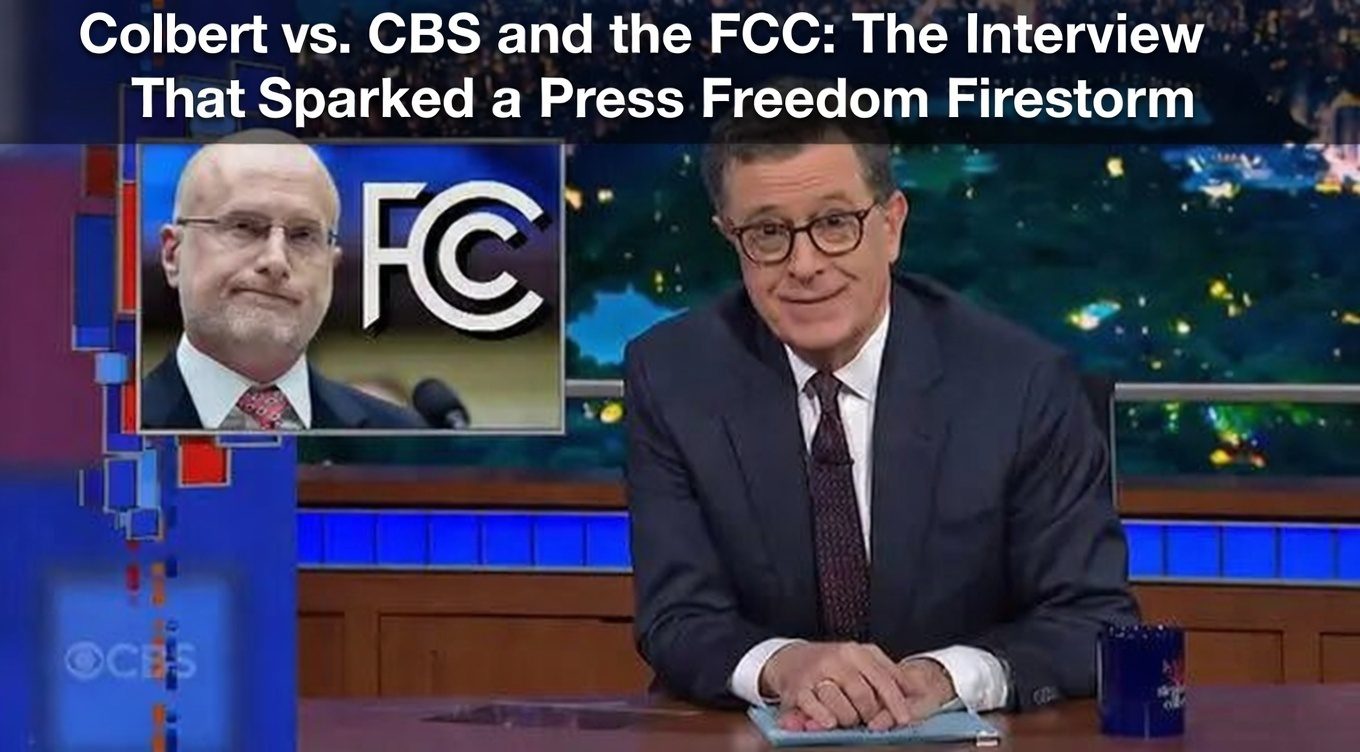
Colbert vs. CBS and the FCC: The Interview That Sparked a Press Freedom Firestorm

| NOTE: A viral claim that Colbert filed a $750M lawsuit against the FCC and Trump is FALSE. No credible news outlet has confirmed any such lawsuit. This article covers only verified, reported facts. |
A Late Night Host, a Senate Candidate, and a Network That Said No
Stephen Colbert has spent 11 years hosting The Late Show on CBS. He has interviewed presidents, world leaders, and cultural icons. He has never, until now, gone on television to publicly accuse his own network of censoring his work.
That changed in February 2026, when Colbert told his live studio audience that CBS lawyers had blocked him from airing an interview with James Talarico — a Democratic candidate running for U.S. Senate in Texas against incumbent Republican John Cornyn.
The story immediately ignited a national conversation about press freedom, political influence over media, and the role of the Federal Communications Commission. It also raised serious questions about whether CBS’s parent company, Paramount, was making editorial decisions with one eye on a pending merger that requires FCC approval.
Here is every verified fact, in full context, stripped of the misinformation that has spread alongside it.
1. The Story at a Glance
|
| Key Detail | Information |
| Interview subject | James Talarico, Democratic U.S. Senate candidate (Texas) |
| Opponent in race | Sen. John Cornyn (R-TX), incumbent |
| CBS’s stated reason | FCC equal time rule (Section 315 of the Communications Act) |
| Colbert’s claim | CBS lawyers told him ‘in no uncertain terms’ not to air it |
| CBS’s response | Provided ‘legal guidance’ but did not prohibit broadcast |
| Where interview aired | YouTube (posted by Talarico’s campaign) |
| YouTube views | 6+ million |
| Talarico fundraising after story broke | $2.5 million in 24 hours |
| FCC investigation | Separate probe into ‘The View’ over equal time compliance |
| Paramount merger status | Pending FCC approval — Skydance acquisition |
| Viral lawsuit claim | FALSE — no $750M lawsuit has been filed or confirmed |
2. Who Is James Talarico?
James Talarico is a 34-year-old Democrat from Texas who previously served three terms in the Texas state legislature. He announced his run for the U.S. Senate seat held by Republican John Cornyn in late 2025.
Talarico is a progressive candidate in a state that has not sent a Democrat to the U.S. Senate since 1988. His candidacy gained national attention when Beto O’Rourke — who came within 2.6 points of defeating Ted Cruz in 2018 — endorsed him. Talarico’s campaign has leaned heavily into digital outreach and earned media.
He was booked to appear on The Late Show with Stephen Colbert as part of a broader media push. The interview was recorded. It was never aired on television.
3. Why Did CBS Block the Interview?
According to Colbert’s on-air account, CBS’s legal team invoked the FCC’s equal time rule — formally known as Section 315 of the Communications Act of 1934 — as the reason the interview could not be broadcast.
The equal time rule requires that if a broadcast station gives airtime to a legally qualified political candidate, it must offer equal airtime to all other candidates running for the same office under the same conditions. In a Texas Senate race with multiple candidates, airing a Talarico interview could theoretically require CBS affiliates to offer equal airtime to every other candidate in the field.
Colbert’s description of the CBS lawyers’ instruction was pointed and specific.
|
CBS did not dispute that it communicated concerns to Colbert’s team. However, the network pushed back sharply on his characterization. CBS said it provided legal guidance — consistent with its legal obligations — but maintained that it did not issue a prohibition.
4. The FCC Equal Time Rule Explained Simply
The equal time rule is one of the oldest and most debated regulations in U.S. broadcast law. Here is how it actually works.
What the Rule Says
If a broadcaster gives or sells airtime to one political candidate, it must give all other candidates for that same office the same opportunity. The rule applies to broadcast stations — those using public airwaves licensed by the FCC — but not to cable-only channels or streaming platforms.
Key Exemptions
The law has important carve-outs. Appearances in bona fide news interviews, news documentaries, and on-the-spot news coverage are exempt. Late night talk shows have historically operated in a legal gray area: they are entertainment programs, not news, so the exemption may not apply cleanly.
Why This Gets Complicated
CBS affiliates across the country air The Late Show. If Talarico appeared and the station had to offer equal time to every other Texas Senate candidate — including minor party or fringe candidates — the logistics and airtime costs could be significant. Legal teams at major networks routinely flag this risk during election cycles.
Critics argue the rule, designed in 1934 for a radio landscape, is poorly adapted to the modern media environment where YouTube and podcasts face no equivalent obligation.
5. Colbert Goes Public On-Air
Rather than quietly accepting the network’s guidance, Colbert did something unusual for a network television host: he told his audience what happened.
In a segment on The Late Show, Colbert described the blocked interview, explained the equal time rule to his audience, and made clear he personally disagreed with the decision. He framed it as a story about the intersection of media regulation, corporate caution, and political speech.
It was a moment of rare transparency in network television. Late show hosts typically do not go on air to criticize their own networks’ legal decisions — particularly when still employed by that network.
The segment itself went viral. The clip was widely shared on social media and covered by major outlets including The Washington Post, CNN, CNBC, and The New York Times. Colbert’s willingness to publicly air the dispute turned a routine legal compliance decision into a national story about press freedom.
6. CBS Disputes Colbert’s Account
CBS moved quickly to distance itself from Colbert’s characterization. In a statement to media outlets, the network said it had provided its legal team’s guidance to The Late Show’s producers — which is standard practice during election periods — but rejected the claim that it had prohibited the interview from airing.
The distinction CBS drew was meaningful but subtle. “Providing legal guidance” and “telling someone in no uncertain terms they cannot air something” can feel functionally identical to the recipient, even if they carry different legal and editorial meanings.
Colbert did not publicly walk back his account. His on-air statement remained as broadcast.
Neither CBS nor Colbert’s representatives have provided additional comment beyond their initial positions as of the time of publication.
7. The Paramount-Skydance Merger: The Hidden Conflict of Interest
To understand why many observers found CBS’s caution suspicious, you need to understand what Paramount is waiting for right now.
Paramount Global — CBS’s parent company — has agreed to be acquired by Skydance Media in a multibillion-dollar deal. The merger requires approval from the Federal Communications Commission, because Paramount holds broadcast licenses for CBS and its affiliates across the United States.
The FCC under the current administration has shown a willingness to use its regulatory power as leverage against media companies it views as politically unfriendly. The agency launched an investigation into ABC News over a 2024 presidential debate. It opened a separate probe into The View, also on ABC, over equal time compliance. And it has made no secret of its scrutiny of legacy broadcast networks.
Critics — including several First Amendment scholars and press freedom advocates — argue that Paramount’s editorial caution on political content involving Democratic candidates cannot be fully separated from the company’s need to maintain a good relationship with the FCC during the merger review process.
Paramount and CBS have not publicly acknowledged any connection between the merger and their editorial decisions.
8. The FCC Investigation Into ‘The View’
The Colbert-Talarico controversy did not emerge in a vacuum. It came shortly after the FCC announced it was investigating ABC’s The View for potential equal time violations.
The probe focused on whether The View’s hosts — who discuss political candidates regularly — were providing unequal coverage in a way that violated broadcast regulations. The FCC’s inquiry was seen by media critics as part of a broader pattern of using regulatory power to pressure networks perceived as hostile to the Trump administration.
The View investigation had a chilling effect across the broadcast industry. Network legal teams became more conservative in flagging political content, particularly involving candidates in contested races. CBS’s reaction to the Talarico interview may have been influenced, directly or indirectly, by watching what was happening to a competitor network.
|
9. The Interview Goes Viral on YouTube: 6 Million Views
The blocked interview did not stay blocked for long. Talarico’s campaign posted the full interview on YouTube. Within days, it had accumulated over 6 million views — a number that dwarfs the typical audience for a Late Show political segment.
The irony was immediate and obvious: CBS’s decision to block the interview to avoid giving Talarico unequal airtime produced exponentially more attention for Talarico than a standard Late Show broadcast would have generated.
The YouTube posting was not subject to the FCC’s equal time rules. Unlike broadcast television, streaming and online video platforms have no equivalent regulatory obligation. This meant the interview reached a massive audience without triggering any of the compliance concerns that reportedly caused CBS to block it in the first place.
The situation illustrated a fundamental tension in the current regulatory framework: broadcast television faces significant speech constraints that digital platforms do not, even when reaching comparable audience sizes.
10. Talarico’s Campaign Raises $2.5 Million in 24 Hours
For James Talarico, the controversy was a political gift of staggering proportions.
In the 24 hours following the story breaking nationally, Talarico’s Senate campaign raised $2.5 million in small-dollar donations. It was one of the largest single-day fundraising totals for a Texas Democratic Senate campaign in recent memory.
The fundraising surge reflected a pattern that has become familiar in the social media era: attempts to suppress or limit political speech often produce the opposite of their intended effect. Talarico’s campaign amplified the story relentlessly, framing the blocked interview as evidence of exactly the kind of corporate-political collusion his campaign was running against.
Whether the fundraising translates to electoral viability in a Texas Senate race remains to be seen. Texas has not elected a Democratic senator since Lloyd Bentsen won in 1988. But the Talarico campaign enters a critical fundraising period with significant resources and a national profile it did not have before the controversy.
11. First Amendment and Press Freedom Implications
The Colbert-CBS-FCC story raises genuine and serious questions about the state of press freedom in American broadcast television. Legal experts have identified several distinct concerns.
Government Pressure on Private Editorial Decisions
The First Amendment prohibits government censorship of speech. But when government regulatory power creates an environment in which private companies voluntarily suppress political content to avoid regulatory retaliation, the constitutional question becomes murkier. Legal scholars call this ‘chilling effect’ doctrine — and it has been recognized by the Supreme Court as a legitimate First Amendment concern even when no direct government order is issued.
The Broadcast Licensing Problem
Broadcast stations operate on public airwaves under government-issued licenses. That public trust relationship has always created some tension with pure editorial freedom. But critics argue the current FCC’s conduct goes beyond the traditional licensing framework into active political pressure.
The Digital Asymmetry
Perhaps the most structurally interesting issue raised by this case is the profound asymmetry between broadcast and digital media. CBS faces legal risk for airing a Talarico interview. YouTube faces none. This disparity may ultimately require congressional or judicial attention.
12. Timeline of the Controversy
| Date | Event |
| Late 2025 | James Talarico announces U.S. Senate campaign (Texas) against Sen. John Cornyn |
| Early 2026 | FCC launches investigation into ABC’s The View over equal time compliance |
| February 2026 | Talarico tapes interview with Colbert for The Late Show |
| February 2026 | CBS legal team flags equal time concerns; communicates guidance to Late Show producers |
| February 2026 | Colbert publicly discloses the blocked interview on-air; calls it being told ‘in no uncertain terms’ |
| February 2026 | CBS disputes Colbert’s framing; says it gave legal guidance, not a prohibition |
| February 2026 | Talarico campaign posts full interview on YouTube |
| Within days | YouTube interview exceeds 6 million views |
| Within 24 hours | Talarico campaign raises $2.5 million in donations |
| Ongoing | Paramount-Skydance merger awaiting FCC approval; FCC scrutiny of CBS continues |
| Circulating online | FALSE viral claim: ‘$750M Colbert lawsuit against FCC and Trump’ — not confirmed by any credible outlet |
13. Key Takeaways
- CBS blocked Stephen Colbert from airing his interview with Texas Senate candidate James Talarico, citing FCC equal time rule concerns
- Colbert publicly challenged the decision on-air, saying he was told ‘in no uncertain terms’ not to broadcast the interview
- CBS disputed his framing, saying it provided legal guidance but did not issue a prohibition
- The full interview was posted on YouTube by Talarico’s campaign and received over 6 million views
- Talarico’s campaign raised $2.5 million in 24 hours after the story broke nationally
- A key conflict of interest: Paramount (CBS’s parent) needs FCC approval for its pending Skydance acquisition, creating pressure to avoid regulatory friction
- The FCC had already launched a separate investigation into ABC’s The View, creating a chilling effect across broadcast networks
- No lawsuit by Colbert against the FCC or Trump has been filed or confirmed — that viral claim is false
- The case illustrates a growing asymmetry: broadcast TV faces significant speech constraints that YouTube and streaming do not
- First Amendment scholars have raised ‘chilling effect’ concerns about the regulatory environment’s impact on editorial independence
14. Frequently Asked Questions (FAQs)
Did CBS block Stephen Colbert from airing an interview with James Talarico?
Yes. CBS communicated legal concerns to The Late Show’s producers about the FCC’s equal time rule before an interview with Texas Senate candidate James Talarico could air. Colbert said he was told ‘in no uncertain terms’ not to broadcast it. CBS says it provided legal guidance but did not prohibit the broadcast.
Did Stephen Colbert file a $750 million lawsuit against the FCC and Trump?
No. This claim is circulating on social media but has not been confirmed by any credible news outlet. No such lawsuit appears in any court record or has been reported by CNN, NBC, NPR, Reuters, AP, or any other verified news source. The claim originated on clickbait websites.
What is the FCC equal time rule?
Section 315 of the Communications Act requires broadcast stations that give airtime to one political candidate to offer equal airtime to all other candidates for the same office. It applies to broadcast TV and radio but not to cable-only or streaming platforms. Bona fide news programs have limited exemptions.
Why did Talarico’s interview get blocked but still reach millions of viewers?
CBS blocked the interview from airing on broadcast television due to FCC equal time concerns. Talarico’s campaign then posted the full interview on YouTube, which is not subject to the FCC’s equal time rule. The blocked interview received over 6 million YouTube views — far more than a typical Late Show political segment.
Why is Paramount’s merger relevant to this story?
Paramount Global — CBS’s parent company — is seeking FCC approval for its acquisition by Skydance Media. Critics argue this creates a conflict of interest: Paramount may be reluctant to make editorial decisions that antagonize the current FCC leadership, whose approval it needs. Paramount has not acknowledged any such connection.
What is the FCC’s investigation into The View?
The FCC launched an investigation into ABC’s The View for potential violations of the equal time rule, examining whether the show’s coverage gave unequal airtime to political candidates. Press freedom advocates and media critics have described the probe as part of a broader pattern of regulatory pressure on networks perceived as politically unfriendly to the Trump administration.
How much did Talarico raise after the controversy?
Talarico’s Senate campaign raised $2.5 million in the 24 hours following the story breaking nationally — one of the largest single-day fundraising totals for a Texas Democratic Senate campaign in recent memory.
Sources
All information in this article is sourced from verified news reporting. The ‘$750M lawsuit’ claim is not sourced because it has not been confirmed by any credible outlet.
- The Washington Post — Colbert CBS interview controversy and First Amendment analysis
- CNN — Coverage of the Talarico interview blockage and CBS response
- CNBC — Reporting on FCC equal time rule and Paramount merger context
- The New York Times — Coverage of the Late Show segment and CBS dispute
- Texas Tribune — Talarico campaign fundraising surge and Senate race context
- Axios — FCC investigation into The View and broader regulatory pattern
- Al Jazeera — Press freedom analysis and international reaction
- Fortune — Paramount-Skydance merger and FCC approval status
Note: This article reflects verified information available as of February 20, 2026. The investigation and political campaign are both ongoing. This article will be updated as confirmed developments emerge.
Discover more from MatterDigest
Subscribe to get the latest posts sent to your email.