Classic Car History: Explore America’s Most Famous Auto Plants
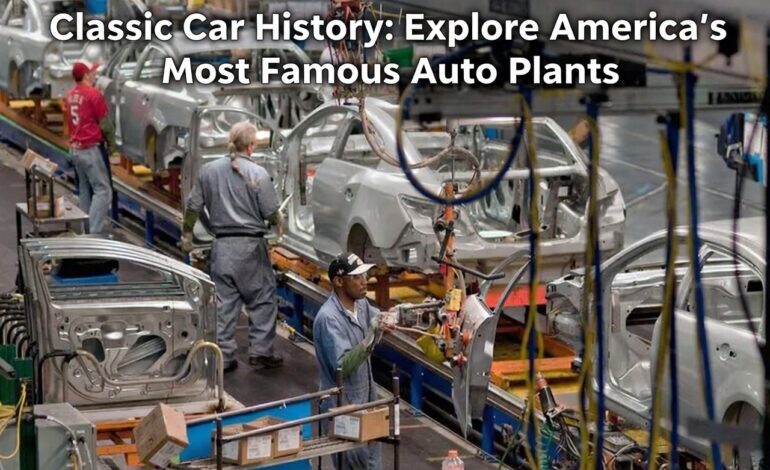

1. Why America’s Auto Plants Are Living History
You can read about the Model T in a textbook. But nothing prepares you for standing on the actual factory floor where Henry Ford’s engineers invented the moving assembly line in 1913 — an innovation that changed the entire world.
America’s famous auto plants aren’t just manufacturing facilities. They’re monuments to ingenuity, ambition, and the restless American drive to build something bigger than anyone thought possible. They’re also surprisingly fun to visit.
Classic car history in the United States stretches across dozens of iconic factories, museums, and racetracks — from the gritty industrial corridors of Detroit to the polished galleries of Los Angeles and the rolling farmland of Indiana. This guide takes you to all of them.
QUICK ANSWER: What are America’s most famous auto plants? America’s most historically significant auto plants include the Ford Highland Park Plant (birthplace of the moving assembly line, 1913), the Ford River Rouge Complex in Dearborn, Michigan (the world’s largest integrated manufacturing facility, 1928), and the Dodge Main Plant in Hamtramck. Of these, the Ford River Rouge Complex is the only one still operating and open to public tours.
Whether you’re a die-hard gearhead, a history buff, or just looking for an unforgettable family road trip, America’s auto plants and classic car museums offer something extraordinary. Let’s explore them all.
2. The Birthplace of Mass Production: Ford Highland Park Plant
There is one moment that divided the history of manufacturing into Before and After. It happened in 1913 at 91 Manchester Street in Highland Park, Michigan. That’s when Henry Ford’s engineers strung a rope through the factory floor and dragged a car chassis past a line of workers — each adding a single part — and the modern moving assembly line was born.
Before that day, it took Ford’s workers more than 12 hours to assemble a single Model T. Within a year of continuous refinement, they had that time down to 93 minutes. That single productivity leap made affordable cars possible for the average American family.
“The great breakthrough at Highland Park came in 1913 when Ford and his engineers developed the continuously moving assembly line — it defined and changed the face of manufacturing.”
— Michigan Place, Historic Landmarks Division
The Five-Dollar Day: A Revolution in Labor
In January 1914, Ford announced the Five-Dollar Day — doubling the standard wage of the time while cutting the workday from nine hours to eight. Workers flooded Detroit from across the country and around the world seeking these wages.
This was more than generosity. Ford understood that workers who earned good wages could afford to buy the cars they built — creating a consumer economy that would define the 20th century. That insight, born at Highland Park, arguably shaped modern capitalism.
Can You Visit Highland Park Today?
The original Highland Park plant still stands, though most of it is no longer open for tours. The building — called the Crystal Palace for its floor-to-ceiling glass walls — is a National Historic Landmark. History enthusiasts can view the exterior from Woodward Avenue and Manchester Street.
For a full immersive experience of what Highland Park launched, visit the Henry Ford Museum in nearby Dearborn, where you can sit in an actual Model T and learn the full story.
| Fast Fact | Detail |
| Location | 91 Manchester St, Highland Park, Michigan |
| Opened | January 1, 1910 |
| Landmark Designation | National Historic Landmark |
| Moving Assembly Line Invented | 1913 |
| Five-Dollar Day Announced | January 5, 1914 |
| Model T Production Ended | 1927 (15 millionth car) |
| Architect | Albert Kahn |
| Current Status | Standing; exterior viewing only |
3. The World’s Most Famous Auto Plant: Ford River Rouge Complex
If Highland Park was the invention of mass production, River Rouge was its apotheosis. Henry Ford built this 2,000-acre complex starting in 1915 with one obsessive goal: to bring raw materials in one side and drive finished cars out the other, without depending on a single outside supplier.
At its peak, the Rouge employed 120,000 workers, operated 93 buildings, ran 100 miles of internal railroad track, and had its own docks, power plant, steel mill, foundry, and glass factory. Historians called it the greatest industrial complex in the world. They weren’t wrong.
“By the mid-1920s, the Rouge was easily the greatest industrial domain in the world and was without parallel in sheer mechanical efficiency.”
— Historian David L. Lewis
From Iron Ore to Finished Car in 28 Hours
At the peak of its vertical integration, the Rouge could take raw iron ore delivered by Lake freighter at the dock and turn it into a finished automobile in just 28 hours. Ford owned the mines, the ships, the railroad, and the factory — an empire of self-sufficiency never replicated before or since.
The complex inspired automobile manufacturers worldwide. Renault copied the concept in France in the 1920s. The Soviet GAZ factory, Volkswagen’s Wolfsburg plant, FIAT’s Mirafiori factory, and Hyundai’s Ulsan complex all drew direct inspiration from the Rouge.
The Rouge Today: A Living Factory Tour
The Rouge still builds trucks. Every day. That’s what makes the Ford Rouge Factory Tour unique — it’s not a museum. It’s a real, working Ford F-150 assembly plant, producing roughly 900 trucks per day, that you can walk through on an elevated suspended walkway.
Can you tour the Ford River Rouge factory?
Yes. The Ford Rouge Factory Tour at The Henry Ford in Dearborn, Michigan is open to the public year-round (closed Sundays). Visitors walk an elevated suspended walkway through the Dearborn Truck Plant’s final assembly area, watch F-150s being built in real time, and explore five separate attractions including theaters, an observation deck, and the Legacy Gallery. Tickets must be purchased online.
The five-part experience includes:
- Legacy Theater — cinematic history of the Rouge
- Art of Manufacturing Theater — the poetry of industrial production
- Observation Deck — sweeping views of the factory complex and living roof
- Dearborn Truck Plant — real working assembly of Ford F-150s
- Legacy Gallery — artifacts and history exhibits
The 1.1-million-square-foot Dearborn Truck Plant also features one of the world’s largest living roofs — 10.4 acres of sedum (low-growing groundcover) that manages rainwater and insulates the building. It’s both green architecture and a statement of what American manufacturing looks like in 2026.
Pro Tip: Assembly at the Dearborn Truck Plant stops during breaks, shift changes, weekends, and holidays. Book weekday visits for the best chance of seeing full production. The Henry Ford cannot guarantee active assembly during your visit.
| Fast Fact | Detail |
| Location | 20900 Oakwood Blvd, Dearborn, Michigan 48124 |
| Construction Began | 1918 |
| Completed | 1928 |
| National Historic Landmark | 1978 |
| Peak Employment | ~120,000 (WWII) |
| Living Roof Area | 10.4 acres (sedum) |
| Current Product | Ford F-150 & F-150 Lightning |
| Tour Operator | The Henry Ford |
| Tour Days | Monday–Saturday (closed Sundays) |
4. The Henry Ford Museum & Greenfield Village: Where History Comes Alive
Across the street from the Rouge, the Henry Ford Museum of American Innovation is one of the largest indoor history museums in the United States. It covers 12 acres under one roof, telling the story of American ingenuity from the Wright Brothers’ bicycle shop to a 1946 railroad locomotive to the bus where Rosa Parks refused to give up her seat.
For classic car enthusiasts, the museum is a pilgrimage site. The collection includes the Lincoln Continental limousine in which President Kennedy was assassinated, a 1901 Oldsmobile curved-dash runabout (America’s first mass-produced automobile), and the original Mustang I concept car.
Greenfield Village: Drive a Real Model T
Next door to the museum, Greenfield Village is a 200-acre open-air historical park where costumed interpreters work in authentic 19th-century buildings. But the signature experience for auto history fans? Riding in a real Ford Model T, driven by an enthusiastic guide along paved village roads.
The Model T operates with three foot pedals (not a gas, brake, and clutch like modern cars — it uses a unique mechanical system), one hand lever, and two hand controls on the steering column. Experiencing this in person destroys any remaining assumption that early motoring was simple.
5. Petersen Automotive Museum, Los Angeles: Hollywood Meets Horsepower
Los Angeles has a different relationship with cars than Detroit. In LA, the car is identity, status, and canvas. The Petersen Automotive Museum — a gleaming stainless steel building on Wilshire Boulevard in the Miracle Mile district — captures exactly that.
The Petersen holds over 150 vehicles spread across three floors of permanent and rotating exhibits, plus the legendary Vault — a sub-level storage and display space that houses more than 250 additional vehicles in various states of restoration and preservation.
What Makes the Petersen Special
The private Vault Tour is unlike anything else in American automotive tourism. You walk through climate-controlled corridors past a 1955 Mercedes-Benz 300 SL Gullwing, a Bugatti Veyron, one-of-a-kind movie cars, and racing legends that have never been publicly displayed. It sells out. Book well in advance.
The main galleries mix Hollywood car culture (the 1989 Batmobile, the Back to the Future DeLorean) with serious automotive history (a 1910 Mercer Raceabout, early electric vehicles from the 1890s). The Modern Concepts room bridges past and future, featuring everything from a 2005 Ford Shelby GR-1 to Google’s Waymo self-driving prototype.
| Feature | Detail |
| Location | 6060 Wilshire Blvd, Los Angeles, CA 90036 |
| Vehicles on Display | 150+ (plus 250+ in The Vault) |
| Vault Tours | Private guided, advance booking required |
| Hours | 10 AM – 5 PM daily |
| Founded | 1994 |
| Notable Cars | 1989 Batmobile, Rosa Parks’ bus, Waymo, Gulf McLaren F1 |
6. Auburn Cord Duesenberg Automobile Museum, Auburn, Indiana
If you’ve ever seen a photograph of a gleaming 1935 Duesenberg SJ Roadster and felt your jaw drop — this is where you go in person. The Auburn Cord Duesenberg Automobile Museum in Auburn, Indiana preserves the legacy of three of America’s most beloved pre-war luxury marques inside the original 1930 Auburn Automobile Company showroom.
The building itself is a registered National Historic Landmark. Designed in Art Deco style, it’s as beautiful as the cars inside. Docent-led Highlights Tours run every first Saturday of the month at 11 AM, included with admission.
Why ACD Is a Hidden Gem
Most car enthusiasts know the big three in American auto history: Ford, GM, and Chrysler. But the golden era of American coachbuilt automobiles — the 1920s and 1930s, when cars were treated as rolling sculptures — was dominated by smaller marques like Auburn, Cord, and Duesenberg.
In August 2025, the museum received a $750,000 federal grant for National Historic Landmark preservation — ensuring these priceless vehicles stay protected for generations. The public capital campaign for additional repairs launched in late 2025, making this a particularly exciting moment to visit and support the museum.
7. LeMay — America’s Car Museum, Tacoma, Washington
On the West Coast, LeMay — America’s Car Museum (ACM) in Tacoma, Washington stands as one of the most comprehensive automotive collections in the country. The museum draws from the personal collection of Harold LeMay, a garbage entrepreneur who amassed what Guinness once certified as the world’s largest private automobile collection.
In 2026, ACM is celebrating the 100th anniversary of Route 66 with a refreshed exhibition and the epic Drive Home — a cross-country convoy of nine museum vehicles traveling the full length of Route 66, ending at the Detroit Auto Show. Throughout 2026, the Route 66 exhibit at Tacoma features centennial-themed additions, films, and vehicles honoring America’s most famous highway.
Tacoma Cars & Coffee: Free Monthly Event
Starting January 2026, ACM hosts Tacoma Cars & Coffee every third Saturday of the month from 9–11 AM. The event is free, open to all makes and years, and features great coffee from a local roaster. It’s the West Coast equivalent of Detroit’s car show culture — relaxed, community-focused, and packed with fascinating machines.
8. Gilmore Car Museum, Hickory Corners, Michigan
Set on a sprawling 90-acre campus in rural southwest Michigan, the Gilmore Car Museum is the largest automotive museum complex in the United States. It houses over 400 vehicles spread across 22 historic buildings — barns, service stations, and showrooms transported from their original locations and rebuilt on site.
What sets Gilmore apart is the experience. You don’t just look at cars behind velvet ropes. You wander a living village of automotive history, ducking into a 1930s gas station or a restored 1950s Blue Moon Diner (a real operating lunch counter on campus).
Rides in Classic Cars: The 2026 Season
From May to September 2026, Gilmore offers chauffeured rides in classic cars from its collection, available Tuesday through Friday. The signature experience is the Model T ride — behind the wheel (or in the passenger seat) of an authentic Ford Tin Lizzie, guided by an experienced instructor on campus roads.
The Classic Car Club of America Museum on the Gilmore Campus hosts The Jazz Experience June 5–6, 2026 in Hickory Corners, including a guided tour by chauffeured 1937 Packard V12 Victoria Convertible — a once-in-a-generation automotive experience.
9. Indianapolis Motor Speedway Museum, Indiana
The Indianapolis Motor Speedway has been hosting the Indianapolis 500 since 1911. That makes it the oldest continuously operating major racetrack in the world — and the site of more motorsport history than almost anywhere else on Earth.
The IMS Museum, located inside the oval’s infield, displays the winning cars of every Indy 500, the Borg-Warner Trophy (featuring the face of every winner since 1936), and rotating exhibits on racing legends including A.J. Foyt, Al Unser, and Mario Andretti. The museum is open year-round.
Track Tours: Kiss the Bricks
Track tours at IMS take you right down onto the famous Yard of Bricks — the section of original brick pavement preserved at the start/finish line where winners and fans traditionally kneel and kiss the track. It’s a ritual that connects you physically to over a century of racing history.
10. AACA Museum, Hershey, Pennsylvania
In the heart of Pennsylvania Dutch Country — just blocks from Hersheypark — the Antique Automobile Club of America (AACA) Museum houses one of the East Coast’s finest collections of antique and classic automobiles.
The museum runs rotating exhibits through 2026, with a current special exhibit running through April 19, 2026. The permanent collection spans over a century of American automotive production, with a particular strength in brass-era vehicles (pre-1916) that are rarely seen outside private collections.
The AACA Museum is a natural complement to the famous Hershey Fall Meet — the largest antique car show in the world, held every October in Hershey’s Giant Stadium parking fields, drawing tens of thousands of cars, parts sellers, and enthusiasts from around the globe.
11. America’s Top Auto Plants & Museums at a Glance
Planning your automotive heritage road trip? Here’s a quick reference comparison of the destinations covered in this guide:
| Destination | Location | Best For | Tours Available | Admission |
| Ford River Rouge Factory Tour | Dearborn, MI | Working factory + history | Yes — daily (Mon–Sat) | Paid (online booking) |
| Henry Ford Museum | Dearborn, MI | Broadest auto history + Model T ride | Self-guided | Paid |
| Gilmore Car Museum | Hickory Corners, MI | Largest campus, classic rides | Yes — seasonal | Paid |
| Petersen Automotive Museum | Los Angeles, CA | Hollywood car culture, Vault tour | Vault tour (paid) | Paid |
| Auburn Cord Duesenberg Museum | Auburn, IN | Pre-war luxury coachbuilt cars | Monthly guided tours | Paid |
| LeMay – America’s Car Museum | Tacoma, WA | West Coast comprehensive collection | Cars & Coffee (free) | Paid / Free events |
| Indianapolis Motor Speedway Museum | Indianapolis, IN | Motorsport history, racing cars | Track tours available | Paid |
| AACA Museum | Hershey, PA | Antique/brass-era vehicles | Group tours available | Paid |
| Ford Highland Park Plant | Highland Park, MI | Birthplace moving assembly line | Exterior only | Free (exterior) |
| Larz Anderson Auto Museum | Brookline, MA | New England auto culture, events | Event-based | Paid / Free events |
12. How to Plan Your Classic Car History Road Trip
Ready to hit the road? Here’s a practical step-by-step plan for getting the most out of America’s automotive heritage trail.
Step 1: Choose Your Starting Region
Michigan is the epicenter. If you can visit only one state for automotive history, make it Michigan. The Ford River Rouge Tour, Henry Ford Museum, Gilmore Car Museum, and Auburn Cord Duesenberg Museum (just across the Indiana border) form a compact circuit coverable in four to five days.
Step 2: Book Factory Tours Well in Advance
- Ford River Rouge Factory Tour — book online at thehenryford.org. Weekday morning slots fill first.
- Petersen Automotive Museum Vault Tour — limited capacity, book at petersen.org as soon as your trip dates are set.
- Gilmore classic car rides — seasonal (May–September), check gilmorecarmuseum.org for availability.
- AACA Museum guided tours — group tours of 20+ require reservations; call ahead.
Step 3: Plan Around Events
Some visits are transformed by major events. The Hershey Fall Meet in October turns the AACA region into the world’s largest antique car flea market. The Gilmore Jazz Experience in June 2026 adds a luxury tour element. Check each venue’s events calendar before finalizing dates.
Step 4: Budget Your Time
| Destination | Minimum Time | Ideal Time | Ticket Price Range (2026) |
| Ford River Rouge Factory Tour | 2 hours | Half day | $22–$28 adult |
| Henry Ford Museum | 3 hours | Full day | $28–$35 adult |
| Gilmore Car Museum | 3 hours | Full day | $15–$18 adult |
| Petersen Automotive Museum | 2 hours | Half day | $19–$25 (Vault: extra) |
| Auburn Cord Duesenberg Museum | 1.5 hours | Half day | $15 adult |
| Indianapolis Motor Speedway Museum | 2 hours | Half day | $10–$15 adult |
| AACA Museum | 1.5 hours | Half day | $12 adult |
| LeMay – America’s Car Museum | 2 hours | Half day | $18 adult |
Pro Tip: Prices listed are approximate 2026 estimates based on recent admission data. Always verify current pricing on official museum websites before visiting. Many museums offer discounts for AAA members, seniors, children under 12, and military personnel.
Step 5: Pair With Nearby Attractions
Detroit’s automotive history doesn’t end at the Rouge. The Detroit Institute of Arts houses Diego Rivera’s famous ‘Detroit Industry’ murals — painted after Rivera spent a month studying the River Rouge workers in 1931. It’s the most vivid artistic record of what mass production felt like from the inside.
In Indiana, the town of Auburn is a delight in its own right during the annual Auburn Fall Classic, held in early September, when Duesenbergs, Cords, and Packards parade through the streets of the same town where they were born.
13. People Also Ask: Your Questions Answered
What is the most famous auto plant in America?
The Ford River Rouge Complex in Dearborn, Michigan is widely considered America’s most famous auto plant. Built between 1918 and 1928, it became the world’s largest integrated automobile manufacturing facility, employing up to 120,000 workers at its peak. It is a National Historic Landmark and still produces Ford F-150 trucks today.
Where was the Ford moving assembly line invented?
The moving assembly line was invented at Ford’s Highland Park Plant in Highland Park, Michigan in 1913. The plant, designed by architect Albert Kahn and nicknamed the Crystal Palace, is a National Historic Landmark. Ford’s engineers developed the moving assembly line there, reducing Model T production time from 12 hours to 93 minutes.
Can you tour the Ford River Rouge factory?
Yes. The Ford Rouge Factory Tour is open to the public Monday through Saturday at The Henry Ford in Dearborn, Michigan. Visitors walk an elevated walkway through the active Dearborn Truck Plant, watching Ford F-150s assembled in real time. The tour has five components including theaters, an observation deck, and a history gallery. Tickets are available online.
What is the best classic car museum in the United States?
It depends on your interests. For the broadest collection and historic importance, the Henry Ford Museum in Dearborn, Michigan is unsurpassed. For West Coast car culture and Hollywood cars, the Petersen Automotive Museum in Los Angeles leads. For pre-war luxury vehicles, the Auburn Cord Duesenberg Automobile Museum in Indiana is the top destination. For sheer scale, the Gilmore Car Museum in Michigan is the largest automotive museum campus in the country.
What was the first moving assembly line?
The first moving assembly line for automobile production was developed at Ford Motor Company’s Highland Park Plant in Highland Park, Michigan in 1913. Henry Ford and his engineers used a continuous moving chassis — pulled by a rope — past stationary workers, each adding a specific component. This reduced Model T assembly time from over 12 hours to 93 minutes.
How many auto plants are there in the United States?
As of 2026, there are approximately 50 major automobile assembly plants operating in the United States, according to the Alliance for Automotive Innovation. These plants are concentrated in Michigan, Ohio, Indiana, Kentucky, Tennessee, South Carolina, Alabama, and Georgia. Historic plants number in the hundreds, many preserved as museums or National Historic Landmarks.
Is the Ford River Rouge Complex a National Historic Landmark?
Yes. The Ford River Rouge Complex was designated a National Historic Landmark in 1978. The complex is located in Dearborn, Michigan and covers approximately 1.5 miles wide by 1 mile long. The complex inspired manufacturing facilities worldwide, including Volkswagen’s Wolfsburg plant, FIAT’s Mirafiori factory, and Hyundai’s Ulsan complex.
14. Key Takeaways & Final Travel Tips
America’s classic car history isn’t locked away in archives. It lives in factory tours, museum galleries, and open-air parks where you can sit in a Model T, watch F-150s roll off the line, or stand on the exact floor where the modern world was built.
Top 5 Most Important Sites to Visit
- Ford River Rouge Factory Tour, Dearborn, MI — the only place to see historic AND active auto manufacturing in one visit
- Henry Ford Museum & Greenfield Village, Dearborn, MI — the broadest and deepest collection of American automotive history
- Petersen Automotive Museum, Los Angeles, CA — the best car culture museum on the West Coast
- Auburn Cord Duesenberg Automobile Museum, Auburn, IN — the finest pre-war American coachbuilt automobile collection
- Gilmore Car Museum, Hickory Corners, MI — the largest auto museum campus in the U.S. with the best hands-on experiences
Quick Tips for First-Time Visitors
- Always book factory tours online in advance — Rouge tours and Petersen Vault tours sell out
- Visit Michigan destinations on weekdays for full F-150 assembly action at the Rouge
- Check each museum’s events calendar — special exhibits and shows change seasonally
- The Route 66 Centennial in 2026 makes LeMay – America’s Car Museum in Tacoma especially timely
- Kids under 12 get free or reduced admission at most of these museums — great family destinations
- Pair the AACA Museum with the Hershey Fall Meet in October for the full Hershey automotive experience
Conclusion: Classic Car History Is Meant to Be Experienced
Reading about the Model T is one thing. Steering one down a cobblestone village road — feeling the primitive controls, smelling the oil, hearing the clatter of a century-old engine — is something else entirely.
America’s great auto plants and classic car museums offer exactly that kind of visceral connection to history. The country that invented the moving assembly line, the muscle car, the highway system, and the road trip has preserved its story in brick, steel, chrome, and rubber across dozens of extraordinary sites.
Classic car history in America’s famous auto plants isn’t a niche interest. It’s the story of how modern industrial civilization was built — and where to go to understand it firsthand.
Pick a museum. Book a tour. Hit the road.
SOURCES & AUTHORITATIVE REFERENCES
- The Henry Ford — thehenryford.org — Ford Rouge Factory Tour official site
- Detroit Historical Society — detroithistorical.org — Highland Park and River Rouge historical records
- Michigan Place Historic Preservation Division — miplace.org — National Historic Landmark documentation
- American Heritage Magazine — Ford River Rouge Complex history
- Alliance for Automotive Innovation — 2025 U.S. auto plant data
- Ford River Rouge Complex Wikipedia — Wikipedia.org — comprehensive industrial history overview
- Petersen Automotive Museum — petersen.org
- LeMay – America’s Car Museum — americascarmuseum.org
- Auburn Cord Duesenberg Automobile Museum — automobilemuseum.org
- Gilmore Car Museum — gilmorecarmuseum.org
SCHEMA MARKUP SUGGESTIONS
- @type: Article — headline, datePublished, dateModified, author, publisher
- @type: FAQPage — all Q&A sections in Section 13
- @type: TouristAttraction — for each museum/plant with name, address, url, description
- @type: Place — for each geographic location with geo coordinates
- @type: BreadcrumbList — Home > Travel > Automotive Heritage > Classic Car Plants USA
Discover more from MatterDigest
Subscribe to get the latest posts sent to your email.