Christopher Wilkins Executed After 9 Years on Death Row — The Texas Fort Worth Double Murder
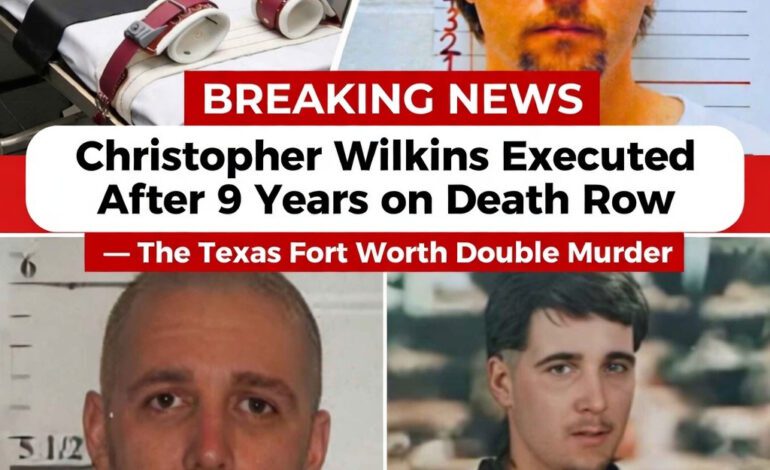

This headline is nearly a decade out of date. Christopher Wilkins was executed on January 11, 2017 — not tonight, not this week. There is no ‘renewed attention.’ The case involves a $20 gravel scam, three actual murders, a candid confession, and one of the most unusual defendants in Texas death row history. Here is everything that actually happened — and why recycled news disguised as breaking coverage is a problem worth understanding.
The Biggest Problem: This Headline Is 8+ Years Old
Let’s start with the most important fact of all. Christopher Wilkins was executed on January 11, 2017. Not tonight. Not recently. January 11, 2017.
The phrase ‘JUST IN’ in this headline is completely false. It is not a minor inaccuracy or a loose interpretation — it is a fabrication. Whatever platform or account circulated this story presented an 8-year-old event as breaking news to manufacture clicks, shares, and emotional responses from people who had no reason to suspect they were being misled.
This is a specific and increasingly common form of misinformation: recycled true crime and execution coverage stripped of dates, repackaged with urgency language, and distributed as if it were current. The underlying event is real. The framing is fraudulent.
| ⚠️ RECYCLED NEWS ALERT — This Is Not Breaking News
Christopher Wilkins was executed on January 11, 2017, at 6:29 p.m. at the Walls Unit in Huntsville, Texas. This was covered by the Texas Tribune, CBS News, NBC News, Associated Press, UPI, and every major Fort Worth news outlet on the same night. It is not new. It is not ‘just in.’ Any account, page, or platform presenting this story as current news in 2025 or 2026 is distributing deliberately misleading content. |
|
The Victims: Who Were Willie Freeman, Mike Silva, and Gilbert Vallejo?
Willie Freeman — The Man Who Sold Wilkins Gravel
Willie Freeman was 40 years old in October 2005. He was described in court records as a local drug dealer in Fort Worth, Texas. He was not a wealthy man, and he was not a stranger to Wilkins. After the scam, he and Wilkins actually spent several weeks together using drugs. Freeman apologized and gave Wilkins actual narcotics to make up for the deception.
That apology was not enough. By the time Freeman offered it, Wilkins had already decided he was going to kill him. Freeman died on October 28, 2005, shot in the back of the head on a deserted stretch of road on the west side of Fort Worth. He never saw it coming — in the most literal possible sense.
Mike Silva — The Man Who Was ‘Just There’
Mike Silva was 33 years old. He had driven Freeman and Wilkins to the location Wilkins had identified. He had no part in the original drug scam. Court records and Wilkins’s own testimony confirm this point bluntly.
When asked why he killed Silva, Wilkins explained that Silva was there. That was the entirety of the reasoning. Silva tried to escape when Freeman was shot — but he was tangled in his seatbelt. Wilkins shot him once in the neck and twice in the head.
A pentagram matching one of Wilkins’s many tattoos was later found carved into the hood of Silva’s SUV. Wilkins’s fingerprints were found inside the vehicle. These details were confirmed at trial and are part of the public record.
Gilbert Vallejo — The Third Victim the Headline Ignores
The headline describes this as a ‘double murder.’ That framing is technically correct in legal terms — Wilkins was convicted of and executed for the murders of Freeman and Silva. But it ignores that Wilkins also killed Gilbert Vallejo, 47, the day before.
Vallejo was shot dead outside a bar in south Fort Worth after an argument with Wilkins over a payphone. At trial, Wilkins confessed to this killing. He explained that Vallejo had been cursing at him in Spanish while he was trying to use the phone, and that this made him angry enough to shoot him.
Three men were dead in approximately 36 hours. The headline’s ‘double murder’ framing gives the false impression that Wilkins committed a single two-victim crime. In reality, he was a one-man killing spree.
| The Three Victims — At a Glance
Gilbert Vallejo, 47 — killed October 26, 2005 outside a Fort Worth bar in a payphone dispute. Willie Freeman, 40 — killed October 28, 2005, shot in the back of the head after a $20 drug scam. Mike Silva, 33 — killed October 28, 2005, shot three times while trying to escape. He had nothing to do with the drug scam. Wilkins was convicted only of the Freeman/Silva murders. He confessed to Vallejo’s killing at his own trial. |
The $20 Gravel Scam: Understanding the Crime
October 2005: Out of Prison, Into Fort Worth
In 2005, Christopher Wilkins was released from federal prison after serving time for a gun possession conviction. He left a halfway house in Houston, stole a truck, and drove to Fort Worth. He had no job, no home, and no plan beyond surviving day to day.
There, he met Willie Freeman. Freeman offered to sell him crack cocaine. He handed Wilkins a piece of gravel, took his $20, and laughed.
Twenty dollars. That is the financial value at the center of this case. Two men died because someone laughed at being caught in a $20 drug scam. The disproportion is one of the things that makes this case so disturbing — and so difficult to explain to anyone who hasn’t encountered the violent logic of addiction-fueled street life.
The Weeks Between the Scam and the Murders
What happened next is less often reported. Freeman and Wilkins continued to spend time together after the scam. Freeman apologized and gave Wilkins actual drugs. By any ordinary measure, the incident appeared to be resolved.
But Wilkins testified at trial that by the time the apology came, he had already decided to kill Freeman. The reconciliation was irrelevant. The decision had been made. This premeditation — laid out in Wilkins’s own words, in open court — was crucial to the capital murder charge.
October 28: The Execution
On October 27, Wilkins told Freeman he had guns and drugs stashed on the west side of Fort Worth. Freeman asked Silva to drive them. On October 28, Silva drove the three of them to a deserted stretch of road.
Wilkins shot Freeman in the back of the head. When Silva tried to flee, Wilkins shot him three times. He then dumped both bodies and fled in Silva’s vehicle. The pentagram carving on the hood was likely done before or after the murders — the exact timing was not definitively established at trial.
Full Crime Record: Everything Wilkins Did in October 2005
| Date | Victim | What Happened |
| Oct. 26, 2005 | Gilbert Vallejo, 47 | Shot and killed outside a Fort Worth bar after arguing with Wilkins over a payphone. Wilkins confessed to this murder at trial. |
| Oct. 28, 2005 | Willie Freeman, 40 | Shot in the back of the head on a deserted stretch of road. Wilkins had planned this killing for weeks after Freeman sold him gravel instead of crack. |
| Oct. 28, 2005 | Mike Silva, 33 | Shot three times (once in the neck, twice in the head) when he tried to flee after Freeman was killed. He had nothing to do with the drug scam but was ‘just there.’ |
| ~Nov. 3, 2005 | Two unnamed individuals | Wilkins used a stolen car to attempt to run over two people because he believed one had taken his sunglasses. Both survived. |
The crimes table above reflects what Wilkins admitted to — in his own testimony at trial. Prosecutors noted he also confessed to other crimes in other states that could not be corroborated. His defense argued these additional confessions actually weakened the credibility of the confessions that could be verified.
The Trial: A Defendant Unlike Most Death Row Cases
He Explained Exactly What He Did and Why
Most capital murder trials involve defense attorneys arguing their client didn’t do it, or didn’t intend the outcome. Christopher Wilkins took the stand and did something almost unprecedented: he explained, in detail, what he did, why he did it, and why he didn’t particularly care what the jury decided.
He told the jury: “I tend to want to take the easy way out. I make bad decisions. I know they’re bad decisions when I’m making them. I make them anyway.”
On his short fuse: “When I get wound up, I have a fuse that is short. I don’t think about what I am doing. I don’t care.”
On his desire to live or die: “I guess, subconsciously, I’ve been trying to get myself killed since I was 12 or 13 years old. I don’t have nothing to live for.”
His Lawyer’s Strategy — and Why It Backfired
Wes Ball, one of Wilkins’s trial attorneys, believed that putting his candid, self-aware client on the stand might humanize him to the jury. The strategy backfired. A jury that might have liked Wilkins as a person could not overlook what he said. He told them he had killed three men. He told them he knew his decisions were bad. He told them he made them anyway.
The jury deliberated for 90 minutes before recommending death. Wilkins told them: “You tell the judge, get a rope or not.” He was sentenced to death on March 12, 2008.
The Tarrant County Prosecutor’s Assessment
| Kevin Rousseau — Tarrant County Assistant DA, Lead Prosecutor
“This guy was a lifelong criminal. He was just an outlaw, in the classic sense of the word… He’s the classic outlaw in the model of Billy the Kid, an Old West-style outlaw.” |
The Appeals: Why Did It Take 9 Years?
The 2015 Execution Date Withdrawal
Wilkins was originally scheduled to be executed on October 28, 2015 — the 10th anniversary of his arrest. That date was withdrawn by Tarrant County prosecutors themselves, not by courts ruling in Wilkins’s favor.
The reason: the Texas Forensic Science Commission had raised concerns about DNA statistics and the interpretation of mixed DNA evidence in Texas cases. Prosecutors sought the delay to ensure the evidentiary record was sound before proceeding with the execution.
The Conflict-of-Interest Appeal
Wilkins’s most significant legal challenge — the one that came closest to stopping his execution — was based on his appellate attorney. That attorney, it emerged, had accepted a job with the Tarrant County District Attorney’s Office while still representing Wilkins on his death penalty appeals.
Wilkins’s final legal team argued this was a fundamental conflict of interest that denied him effective legal representation. If you are being prosecuted by Tarrant County and your own lawyer is simultaneously being hired by Tarrant County, how can your lawyer fight hard for you?
The attorney in question, Strickland, denied the conflict was material. He argued he did not enter a binding agreement with the DA’s office until after finishing Wilkins’s case, and that the boundaries between his roles were clearly maintained.
The Brain Damage Question That Was Never Examined
Judge Elsa Alcala, a sitting member of the Texas Court of Criminal Appeals and a known critic of the death penalty, dissented from the majority decision that denied Wilkins’s appeal. She wrote that his appellate attorney had ‘wholly failed’ him, meaning Wilkins had never gotten a genuine habeas appeal — the fundamental legal mechanism that allows death row inmates to raise constitutional claims.
Wilkins’s lawyers also pointed to possible cognitive deficiencies and potential brain damage from multiple head injuries — issues that were never fully examined at trial or in appeals. Without an adequate habeas process, these questions could not be properly investigated.
The U.S. Supreme Court denied Wilkins’s final appeal on the afternoon of January 11, 2017 — hours before the execution. The questions Judge Alcala raised went unresolved.
Execution Day: What Actually Happened on January 11, 2017
The Scene Outside the Prison
The Walls Unit in Huntsville is a red-brick facility in the center of town, visible from the main street. On January 11, 2017, a small number of death penalty abolitionists gathered outside in the January cold. Texas winter is mild compared to northern states, but evenings in Huntsville are dark and quiet.
The execution was the first in the United States in 2017. Twenty executions had occurred across the U.S. in 2016 — the lowest total since the early 1980s. Texas had carried out seven of them, the fewest in the state since 1996. The downward trend in executions was a major news story in itself that January.
Inside the Chamber
Witnesses included relatives of the victims. The chamber was described as quiet. Wilkins was strapped to the gurney and given a lethal injection of pentobarbital at 6:16 p.m. He was pronounced dead at 6:29 p.m. — 13 minutes after the drug began to flow.
He gave no verbal final statement. He did not speak.
But before the drug was administered, he turned his head toward the viewing window where the victims’ family members were seated. He looked at them. And he mouthed — silently — the words ‘I’m sorry.’ Twice.
| What Christopher Wilkins Said in His Final Moments
Christopher Wilkins gave no verbal final statement. He declined to speak aloud. Before the lethal injection was administered, he looked through the viewing window toward the relatives of his victims and mouthed the words ‘I’m sorry’ — twice. No spoken words were recorded. TDCJ lists his final statement as ‘None.’ The mouthed apology was observed by multiple witnesses including AP reporters inside the chamber. |
Why the ‘What He Said’ Framing Is Misleading
The viral headline says: ‘What he chose to say is now drawing renewed attention to the case.’ This implies he made a memorable verbal declaration — a confession, an apology, a final argument. He made none.
He mouthed two silent words. That is the entirety of his final communication. The headline’s framing implies drama that was not there. And ‘renewed attention to the case’ implies something new has emerged. Nothing has. The case was fully reported in January 2017 and has not produced any new information since.
Fact-Check Table: Every Claim in the Headline Verified
A complete, sourced breakdown of every significant claim in the viral framing — rated for accuracy.
| Viral Claim | Verdict | The Facts |
| JUST IN | FALSE | The execution of Christopher Wilkins took place on January 11, 2017 — more than 8 years before this article was circulated. There is nothing ‘just in’ about this story. |
| After 9 years on death row | TRUE | Wilkins was sentenced to death on March 12, 2008 and executed January 11, 2017 — exactly 8 years and 10 months. ‘Nearly 9 years’ is accurate. |
| Texas executed Christopher Wilkins | TRUE | Wilkins, 48, was executed by lethal injection at the Walls Unit, Huntsville, at 6:29 p.m. on January 11, 2017. First U.S. execution of that year. |
| Fort Worth double murder | INCOMPLETE | It was actually a triple murder. Wilkins killed Gilbert Vallejo the day before killing Freeman and Silva. He was convicted of, and executed for, the double murder of Freeman and Silva. |
| Chilling details | TRUE | A $20 gravel scam. Premeditated execution-style shootings. A pentagram carved into the victim’s car. Wilkins confessing calmly at trial. The details are, by any measure, disturbing. |
| Years of appeals | TRUE | Wilkins had an October 2015 execution date withdrawn due to DNA evidence concerns. His final appeal, focused on ineffective counsel, was denied by SCOTUS hours before his death. |
| What he said in final moments | MISLEADING | Wilkins gave NO verbal final statement. He mouthed ‘I’m sorry’ to victims’ family through the window. No spoken words. Framing this as ‘what he chose to say’ is technically true but deceptive. |
| Renewed attention to the case | FALSE | There is no new development in this case. The execution occurred in 2017. The viral headline manufactures urgency about an event nearly a decade old. |
The Broader Picture: Texas Executions and Declining Numbers
Texas in 2017 — A State Executing Fewer People
Wilkins was the first execution in the United States in 2017. That distinction matters as context. In 1999, Texas alone carried out 35 executions. By 2016, the entire United States executed only 20 people. Texas’s seven executions in 2016 were the fewest in the state in two decades.
Multiple factors drove the decline: fewer death sentences being issued, more successful appeals, growing judicial skepticism of forensic evidence, and sustained public debate about wrongful convictions. Wilkins was executed against this backdrop of a shrinking death penalty, not an expanding one.
Tarrant County’s Execution Pipeline
Tarrant County — which encompasses Fort Worth — had three additional executions scheduled in the early months of 2017 at the time of Wilkins’s death. As the prosecutor noted, the county’s cases moved at different speeds depending on their individual appellate histories.
This is a meaningful detail for understanding why ‘nearly 9 years on death row’ is entirely normal and not unusual. The average time between sentencing and execution in Texas at this period was more than 10 years. Wilkins actually moved relatively quickly through the system.
People Also Ask: Key Questions Answered
What were Christopher Wilkins’s last words?
Wilkins gave no verbal final statement. He declined to speak. Before the lethal injection was administered, he turned toward the viewing window and mouthed the words ‘I’m sorry’ — twice — to the relatives of his victims. TDCJ’s official record lists his final statement as ‘None.’ This distinction is important: mouthing words silently is not the same as making a final statement.
Why did Christopher Wilkins kill Willie Freeman and Mike Silva?
Wilkins killed Freeman because Freeman had sold him a piece of gravel for $20, claiming it was crack cocaine, and then laughed at being caught. Despite Freeman later apologizing and giving Wilkins actual drugs, Wilkins had already decided to kill him. He killed Silva because Silva was present. In his own words at trial: ‘He was just there.’ There was no other stated reason.
Did Wilkins also kill other people?
Yes. Wilkins killed Gilbert Vallejo, 47, the day before the Freeman and Silva murders — in a dispute over a payphone outside a Fort Worth bar. He was convicted of and executed for the Freeman/Silva double murder. He also attempted to run over two people with a stolen car approximately a week after the murders because he believed one of them had taken his sunglasses. He confessed to additional crimes in other states at trial, though many could not be corroborated.
Why was Wilkins’s first execution date in 2015 cancelled?
His October 28, 2015 execution date was withdrawn by Tarrant County prosecutors — not by court order — after the Texas Forensic Science Commission raised concerns about DNA statistics and the interpretation of mixed DNA evidence in Texas cases more broadly. Prosecutors sought the delay to ensure the evidentiary foundation of his case was on solid ground before proceeding.
What was the conflict-of-interest appeal about?
Wilkins’s appellate attorney accepted a job with the Tarrant County District Attorney’s Office — the very office prosecuting Wilkins — while still representing him on his death penalty appeals. His final legal team argued this was an irreconcilable conflict of interest that denied him effective representation. Texas’s CCA and the U.S. Supreme Court both declined to halt the execution on this basis, though Judge Elsa Alcala wrote a notable dissent calling the original appellate representation a complete failure.
Was Wilkins mentally ill or brain-damaged?
His defense team argued Wilkins suffered from possible cognitive deficiencies and brain damage from multiple head injuries that were never fully examined at trial or in appeals. Judge Alcala’s dissent specifically noted that because his appellate attorney had ‘wholly failed’ him, the courts had never properly examined these questions. The execution proceeded before they could be resolved.
Key Takeaways
- ‘JUST IN’ is completely false — the execution of Christopher Wilkins occurred on January 11, 2017, more than 8 years before this story was recirculated
- Wilkins killed THREE people, not two — Gilbert Vallejo was shot the day before Freeman and Silva; the ‘double murder’ label is accurate only in legal terms
- He gave NO spoken final statement — he mouthed ‘I’m sorry’ silently through the window; TDCJ lists his final words as ‘None’
- The crime began with a $20 gravel scam — Freeman sold him a rock instead of crack cocaine, then laughed; Wilkins decided to kill him before any apology was offered
- Wilkins confessed openly at trial — he told jurors exactly what he did and why, described his short fuse, and said he made bad decisions knowing they were bad
- His 2015 execution date was cancelled by prosecutors themselves — over DNA concerns in Texas cases broadly, not due to a court ruling in his favor
- A sitting Texas appeals judge dissented, arguing Wilkins never received a genuine habeas appeal due to his appellate attorney’s conflict of interest
- He was the first U.S. execution of 2017 — a year that would see only 23 total U.S. executions, reflecting a nationwide historic decline
Conclusion: The Execution Was Real. The ‘Breaking News’ Is a Lie.
Christopher Wilkins was executed. That is true. He killed three people in 36 hours. That is also true. He sat on death row for nearly nine years, fought a genuine legal battle over attorney conflict-of-interest, and died silently, mouthing an apology he had 12 years to think about. That is all true.
What is not true is the headline. ‘JUST IN.’ There is nothing ‘just in’ about an execution from January 2017. No new development has emerged. No new information is available. The case has not been reopened. A social media account or website stripped the date from a decade-old story, added urgency language, and distributed it to people who had every reason to believe they were reading news.
This is a specific, documented pattern in online misinformation: execution and true crime coverage is recycled because it generates emotional engagement. It works. People click, share, and argue about events that are ancient history, believing them to be current. The correction is simple but requires active effort: check the date before you share.
Wilkins’s case also raises questions that deserved serious attention when they were current in 2017 — questions about the conflict-of-interest, about whether his appellate representation truly failed him, about cognitive deficiencies that were never properly examined. Those questions were not answered. They are simply old now. Manufactured urgency cannot make them new again.
Sources and Further Reading
- Texas Tribune — “Texas executes first person of the year,” January 11, 2017. texastribune.org
- CBS News — “Christopher Wilkins dead: Texas carries out nation’s first execution in 2017,” January 12, 2017. cbsnews.com
- Texas Coalition to Abolish the Death Penalty — “State of Texas executes Christopher Wilkins,” January 12, 2017. tcadp.org
- NBC News — “Supreme Court Refuses to Block Execution of Texas Killer Christopher Wilkins,” January 11, 2017. nbcnews.com
- UPI — “Wilkins execution in Texas first in United States in 2017,” January 11, 2017. upi.com
- Wikipedia — “Christopher Chubasco Wilkins” (sourced from TDCJ, court records, Texas Tribune). en.wikipedia.org
- TxExecutions.org — Execution Report: Christopher Wilkins #539. txexecutions.org
This article is published for informational and fact-checking purposes. All claims are sourced from verified court records, official TDCJ records, and credible news organizations.
Discover more from MatterDigest
Subscribe to get the latest posts sent to your email.