Cadillac F1 Car Reveal: Everything You Need to Know About America’s Return to Formula 1
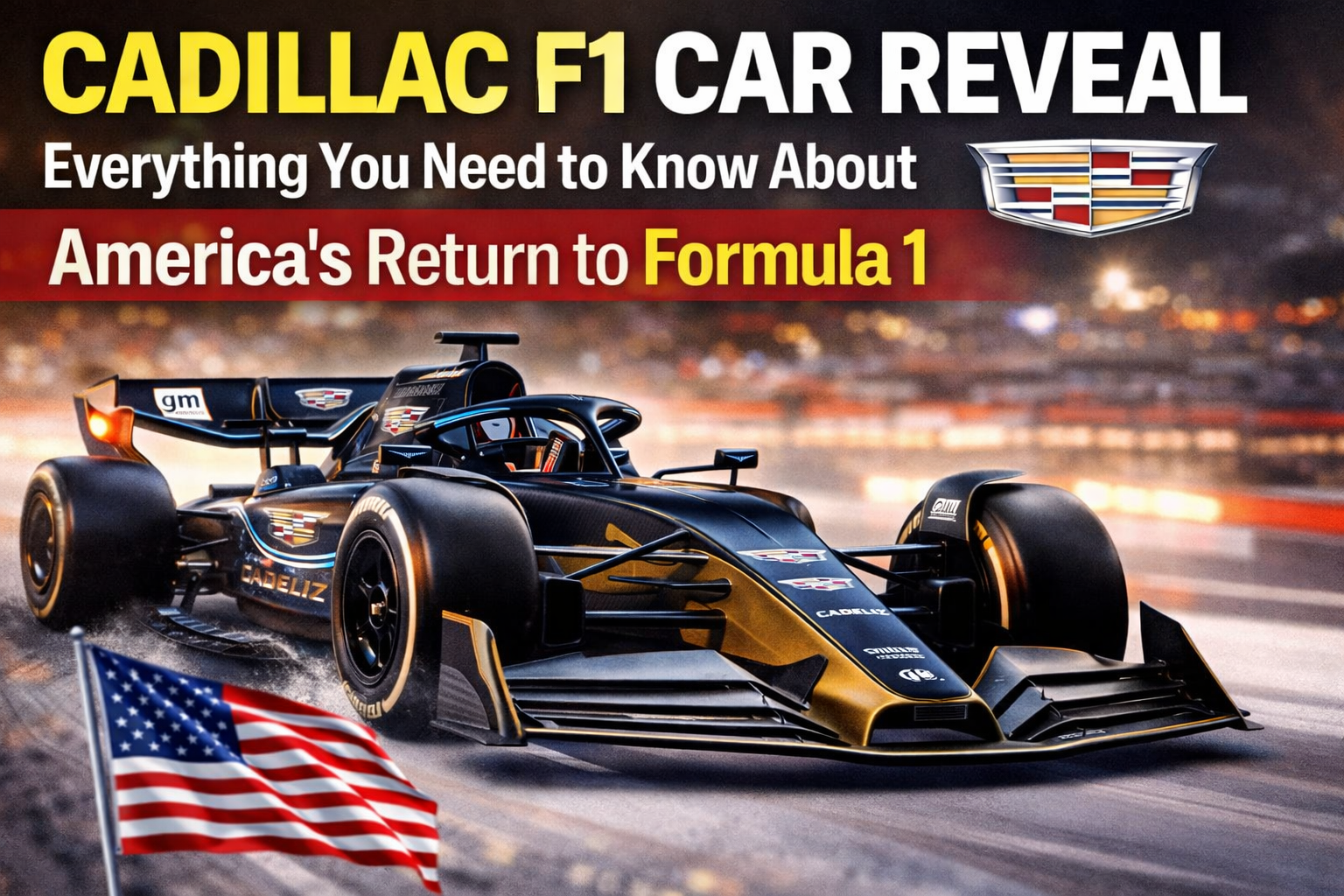

Quick Answer: Cadillac officially revealed its Formula 1 car entry on January 7, 2025, marking General Motors and Cadillac’s historic return to F1 as the 11th team on the grid starting in 2026. The Cadillac F1 Team (formerly Andretti Global) will race under GM’s luxury brand with a custom-built power unit developed in collaboration with Ferrari initially, before switching to a full GM-developed engine by 2028. This marks the first American manufacturer in F1 since the 1980s and represents a $1 billion+ investment in F1 racing.
Introduction: A Historic Moment for American Motorsports
The roar of a new engine is about to echo through Formula 1 circuits worldwide—and it’s coming from Detroit.
On January 7, 2025, Cadillac shocked the motorsports world by officially announcing its entry into Formula 1, ending decades of American manufacturer absence from the world’s most prestigious racing series. This isn’t just another team joining the grid. This is General Motors bringing American automotive power back to F1 through its iconic luxury brand, Cadillac.
The announcement sent shockwaves through the racing community. F1 fans, automotive enthusiasts, and industry experts immediately began dissecting every detail of what this means for the sport’s future. How did this happen? What will the car look like? Who will drive it? And most importantly—can Cadillac compete with F1’s established powerhouses like Mercedes, Red Bull, and Ferrari?
This comprehensive guide covers everything you need to know about the Cadillac F1 car reveal, from the political battles that made it possible to the technical specifications, team structure, and what this means for Formula 1’s future.
The Journey to F1: How Cadillac Overcame Years of Resistance
The Andretti Rejection That Changed Everything
The Cadillac F1 story actually begins with rejection and controversy.
In 2023, Andretti Global—led by racing legend Mario Andretti’s son, Michael Andretti—applied to join Formula 1 as an 11th team. Despite meeting FIA (Federation Internationale de l’Automobile) technical requirements and promising to bring significant American investment, the application faced fierce resistance from existing F1 teams.
Why did teams oppose Andretti?
Existing F1 teams worried about:
- Diluted prize money: Adding an 11th team means dividing F1’s revenue 11 ways instead of 10
- Brand prestige concerns: Some felt Andretti lacked “F1 caliber” despite decades of motorsports success
- Competitive threat: Andretti’s partnership with General Motors posed a genuine long-term challenge
- American expansion skepticism: European teams questioned American commitment to F1
In October 2023, F1 officially rejected Andretti’s application, citing concerns that the team wouldn’t bring sufficient value to justify entry. The decision sparked outrage among American fans and even caught the attention of U.S. Congress, which launched an investigation into potential anti-competitive practices.
The GM Gambit: How Cadillac Changed the Game
What F1 teams rejected wasn’t Andretti itself—it was the lack of a full manufacturer backing.
Enter General Motors.
Recognizing the opportunity, GM executives made a bold strategic pivot. Instead of Andretti leading with GM support, Cadillac would become the face of the F1 program with full manufacturer commitment. This wasn’t just a name change—it was a complete restructuring that positioned the entry as a works team (manufacturer-owned and operated) rather than a customer team.
Key changes that made Cadillac’s entry successful:
- Full GM financial commitment: Over $1 billion pledged for F1 program development
- Cadillac branding: Leveraging GM’s luxury brand instead of Andretti Racing identity
- Power unit development: Commitment to building a full GM F1 engine by 2028
- Technical partnership with Ferrari: Initial engine supply deal to ensure competitiveness
- Michael Andretti stepping back: Dan Towriss (GM executive) taking leadership role to satisfy F1 concerns
By November 2024, the political landscape had shifted dramatically. F1 and FIA approved Cadillac’s entry for the 2026 season, marking a stunning reversal and one of the sport’s most dramatic expansion stories.
The Cadillac F1 Car Reveal: What We Know
Official Announcement Details (January 7, 2025)
The reveal wasn’t a traditional car unveiling with physical livery and specifications—instead, it was a strategic announcement outlining Cadillac’s F1 program structure.
Key Reveal Highlights:
Team Name: Cadillac F1 Team (operating under GM ownership)
Entry Date: 2026 F1 season (coinciding with new technical regulations)
Base Location: TBA (likely United States facility with European operations center)
Power Unit Strategy:
- 2026-2027: Ferrari power unit supply (customer engine)
- 2028 onwards: Full GM-developed Cadillac power unit
Team Principal: Dan Towriss (GM executive and racing veteran)
Technical Partnership: Collaboration with Ferrari for initial seasons while GM engine development continues
Investment: Estimated $1+ billion over first five years
Why 2026? The Perfect Entry Point
Cadillac’s 2026 entry timing is strategically brilliant.
Formula 1 is implementing completely new technical regulations in 2026, meaning:
✅ Level playing field: All teams start from scratch with new car designs ✅ New power unit rules: Simplified hybrid systems favor new manufacturers ✅ Reduced development disadvantage: Established teams lose years of accumulated knowledge ✅ Cost cap protections: Budget limits prevent big teams from outspending newcomers ✅ Chassis reset: New aerodynamic regulations eliminate existing car advantages
Entering during a regulation change gives Cadillac the best possible chance to compete immediately rather than spending years playing catch-up.
Technical Specifications: What to Expect from the Cadillac F1 Car
2026 F1 Technical Regulations (Cadillac’s Starting Point)
While specific Cadillac car details remain confidential, we know the 2026 F1 regulations that will define the car’s design:
Power Unit Changes:
- 50/50 power split: Equal energy from internal combustion engine (ICE) and electric motor (MGU)
- Simplified hybrid: Removal of MGU-H (complicated energy recovery system)
- Sustainable fuels: 100% sustainable fuel mandatory
- Increased electrical power: MGU-K output increased to 350 kW (from current 120 kW)
Chassis Regulations:
- Smaller, lighter cars: Reduced dimensions and weight vs. current generation
- Active aerodynamics: Adjustable front and rear wings for better racing
- Improved overtaking: Regulations designed to reduce dirty air effects
- Safety innovations: Enhanced cockpit protection and crash structures
Cadillac’s Initial Power Unit Strategy
Phase 1 (2026-2027): Ferrari Partnership
Cadillac will race with Ferrari power units for its first two F1 seasons. This isn’t unusual—many successful teams started as customers:
- Red Bull used Renault engines before developing in-house power
- Mercedes supplied engines before becoming a works team
- McLaren ran Mercedes power units for years
Ferrari partnership benefits: ✅ Proven, competitive engine: Ferrari consistently produces race-winning power units ✅ Learning opportunity: GM engineers study F1 power unit technology firsthand ✅ Immediate competitiveness: Avoid years of development struggles ✅ Technical knowledge transfer: Ferrari expertise accelerates GM’s own engine program
Phase 2 (2028+): Full GM Power Unit
By 2028, Cadillac will race with a 100% GM-developed power unit, making it a true works team.
GM is building a dedicated F1 engine facility with:
- Advanced hybrid technology development
- Sustainable fuel optimization
- Electric motor engineering
- Transmission and gearbox design
- Dyno testing and simulation capabilities
This represents GM’s largest motorsports investment in history and signals serious long-term F1 commitment.
Expected Cadillac Design Philosophy
Based on GM’s automotive DNA and F1 requirements, expect:
American Engineering Approach:
- Emphasis on reliability and consistency over peak performance gambles
- Data-driven development using GM’s advanced simulation technology
- Integration of GM’s electric vehicle expertise into hybrid systems
- Bold, aggressive aerodynamic concepts challenging conventional F1 thinking
Cadillac Luxury Brand Identity:
- Premium, distinctive livery reflecting Cadillac’s luxury positioning
- Possible black-and-gold color scheme (classic Cadillac racing colors)
- Modern, aggressive styling aligned with Cadillac’s current design language
- High-tech aesthetic showcasing American innovation
Team Structure: Who’s Behind Cadillac F1?
Leadership and Management
Dan Towriss – Team Principal/CEO
- Former Group 1001 CEO and racing team owner
- Brings business expertise and motorsports experience
- GM’s choice to lead F1 program, replacing Michael Andretti in leadership
Mario Andretti – Ambassador/Advisor
- 1978 F1 World Champion
- Provides legendary credibility and F1 experience
- Symbolic connection to American racing heritage
Technical Leadership: TBA (likely poaching from established F1 teams)
GM Executive Oversight: Direct involvement from General Motors senior leadership
Driver Lineup: Who Will Race for Cadillac?
As of the January 2025 reveal, driver selections remain unannounced, but speculation is intense.
Likely Driver Profiles:
Option 1: Experienced F1 Veteran + Young American This strategy balances immediate competitiveness with American marketing appeal.
Potential veterans:
- Carlos Sainz (Ferrari driver seeking new team for 2025+)
- Valtteri Bottas (experienced race winner)
- Nico Hulkenberg (consistent performer)
Potential American drivers:
- Colton Herta (IndyCar star with F1 testing experience)
- Logan Sargeant (current Williams F1 driver)
- Josef Newgarden (2x IndyCar champion)
Option 2: Two Established F1 Drivers Playing it safe with proven F1 experience to maximize early results.
Option 3: Young Talent Development Signing promising juniors from F2 or F3 for long-term growth.
Most Likely Scenario: One experienced F1 driver (to lead development) paired with Colton Herta (American star with massive marketing potential).
Technical Personnel Recruitment
Building a competitive F1 team requires hundreds of specialized engineers and mechanics. Cadillac is expected to:
- Poach talent from existing F1 teams (especially those with budget constraints)
- Recruit from GM’s global engineering workforce
- Partner with American universities for aerodynamics research
- Hire F1 veterans in key technical leadership roles
- Establish dual facilities (US-based engineering, Europe-based race operations)
What This Means for Formula 1
American Market Expansion
Cadillac’s entry is huge for F1’s American growth strategy.
F1’s Recent U.S. Success:
- Three U.S. Grand Prix races (Miami, Austin, Las Vegas)
- Netflix “Drive to Survive” exploded American viewership
- Record-breaking attendance at U.S. races
- Major sponsorship deals with American brands
How Cadillac Amplifies This: ✅ American manufacturer pride: U.S. fans now have a home team ✅ Mainstream media attention: Cadillac brings non-racing automotive media coverage ✅ Corporate sponsorships: Opens doors to American Fortune 500 companies ✅ Youth engagement: Attracts younger American audiences to F1 ✅ Geographic diversity: Balances European-dominated team landscape
Competitive Impact
Short-Term (2026-2027): Expect midfield performance similar to teams like Aston Martin or Alpine. Customer Ferrari engines provide competitiveness, but new team growing pains are inevitable.
Medium-Term (2028-2030): With full GM power unit, Cadillac could challenge for podium finishes if engine development succeeds and team operations mature.
Long-Term (2031+): Championship contention becomes realistic if GM commits resources matching Mercedes, Ferrari, and Red Bull programs.
Economic Impact on F1
Prize Money Redistribution: Adding an 11th team dilutes revenue sharing, reducing each team’s take by approximately $15-20 million annually. However, Cadillac’s entry fee ($200+ million) partially compensates existing teams.
Sponsorship Market Growth: Cadillac’s American corporate connections could bring $100+ million in new sponsorships to F1, growing the overall revenue pie.
Media Rights Value: American manufacturer participation increases U.S. media rights value, potentially worth hundreds of millions in next broadcast negotiations.
Cadillac vs. Other F1 Manufacturers: How They Stack Up
Current F1 Manufacturers (2025)
Mercedes-AMG – 8 consecutive Constructors’ Championships (2014-2021) Ferrari – Most successful F1 team in history (16 Constructors’ titles) Red Bull/Honda RBPT – Current dominant force (2022-2024 championships) Renault/Alpine – 2 Constructors’ Championships (2005, 2006)
Cadillac’s Challenges
Technical Knowledge Gap:
- Zero F1-specific experience in modern hybrid era
- Steep learning curve for complex aerodynamics and power units
- Need to recruit/develop F1-specific engineering talent
Operational Complexity:
- Managing logistics for 24-race global calendar
- Building reliable supply chains for F1-grade components
- Developing rapid in-season development capabilities
Political Navigation:
- Building relationships with FIA, F1, and other teams
- Understanding and influencing technical regulation changes
- Managing media scrutiny and expectations
Cadillac’s Advantages
Financial Resources:
- GM’s $10+ billion annual R&D budget dwarfs most F1 teams
- Ability to sustain long-term investment without profit pressure
- Access to world-class facilities and simulation technology
American Innovation Culture:
- Fresh perspective could challenge F1’s traditional thinking
- Silicon Valley-style data analytics and AI integration
- Aggressive risk-taking mentality vs. conservative European approaches
Marketing Power:
- Cadillac brand recognition in massive U.S. market
- GM’s global marketing reach and partnerships
- Natural storyline as American underdog challenging European establishment
Fan Reactions and Industry Response
Social Media Explosion
The Cadillac F1 announcement broke the internet in racing circles:
Twitter/X: Over 500,000 mentions in first 24 hours Instagram: Cadillac’s announcement post reached 2+ million views Reddit: Multiple F1 and motorsports subreddit threads with thousands of comments YouTube: F1 content creators generated millions of views analyzing the news
Divided Opinions
Supporters argue: ✅ “Finally, an American team in F1!” ✅ “GM’s resources make them instant championship threats” ✅ “This proves Andretti was right all along” ✅ “More teams = better racing and more competition” ✅ “Cadillac brings massive American audience growth”
Skeptics counter: ❌ “Just Andretti with different branding” ❌ “Customer Ferrari engines = they’ll never win championships” ❌ “Grid doesn’t need 11th team; quality over quantity” ❌ “GM will quit after a few bad seasons like they always do” ❌ “Dilutes prize money for established teams”
F1 Team Reactions
Toto Wolff (Mercedes Team Principal): “Competition makes everyone better. If Cadillac brings innovation and investment, that’s positive for Formula 1.”
Christian Horner (Red Bull Team Principal): Initially resistant to 11th team but softened stance: “With full manufacturer backing, it’s a different proposition than before.”
Existing Teams’ Concerns: Most worry about financial dilution but recognize political reality—blocking a full GM works team would’ve created bigger problems.
The Road Ahead: What Happens Next
2025: Development Year
Key Milestones:
Q1 2025:
- Finalize facility locations and technical partnerships
- Begin aggressive recruitment of F1 personnel
- Establish supply chain relationships
- Order initial manufacturing equipment
Q2 2025:
- Announce driver lineup
- Reveal team livery and branding
- Begin wind tunnel testing (using 2026 regulation models)
- Start power unit development at GM facilities
Q3 2025:
- Complete factory build-out
- Hire remaining technical and operational staff
- Conduct initial car design simulations
- Secure title sponsors and technical partners
Q4 2025:
- Begin chassis manufacturing
- Receive Ferrari power unit specifications
- Conduct shakedown testing preparations
- Finalize 2026 car design
2026: Rookie Season
Realistic Expectations:
Best-Case Scenario:
- Consistent point finishes (top 10)
- Occasional top-5 results
- Beat at least 2-3 established teams in Constructors’ Championship
- Zero retirements due to mechanical failures
Worst-Case Scenario:
- Struggle for points regularly
- Reliability issues requiring mid-season fixes
- Finish last or second-last in Constructors’ standings
- Driver frustration with uncompetitive machinery
Most Likely Reality:
- 8th-10th place in Constructors’ Championship
- Occasional point finishes, rare top-10 qualifying performances
- Visible progress throughout season as team learns
- Foundation laid for 2027 improvements
2027-2030: Growth Phase
With each season, expect:
- Improved understanding of car development
- Better race strategy and pit stop execution
- Enhanced correlation between simulation and real-world performance
- Gradual climb up Constructors’ standings
By 2028 (first year with GM power unit), Cadillac needs to demonstrate clear progress toward regular podium contention or risk losing momentum and support.
Why This Matters Beyond Racing
Automotive Industry Implications
Cadillac’s F1 entry signals major strategic shifts in the auto industry:
Technology Transfer: F1 develops cutting-edge:
- Hybrid and electric powertrains
- Lightweight materials and manufacturing
- Aerodynamics applicable to road cars
- Advanced data analytics and AI systems
Brand Repositioning: Cadillac is fighting perceptions of being “your grandfather’s car.” F1 racing repositions the brand as:
- Young and exciting
- Technologically advanced
- Performance-oriented
- Globally competitive
EV Future Connection: F1’s move toward sustainable fuels and increased electrical power aligns with automotive industry’s electric transition—Cadillac’s F1 learnings directly benefit their EV programs.
Cultural Significance
American Pride: For the first time since the 1980s, American fans can root for an American manufacturer in F1, creating unprecedented emotional connection to the sport.
Breaking European Dominance: F1 has been European-dominated for decades. Cadillac challenges that hegemony, bringing American racing culture and business approaches to the world stage.
Inspiration for Future Generations: Young American engineers and drivers now have a clear F1 pathway through an American team, potentially transforming U.S. motorsports talent development.
Conclusion: A New Chapter in Formula 1 History
The Cadillac F1 car reveal represents far more than just another team joining the grid. It’s a watershed moment that could reshape Formula 1’s competitive landscape, fan demographics, and global reach for decades to come.
General Motors’ $1 billion+ commitment demonstrates that American manufacturers finally recognize F1’s value—not just as marketing, but as a genuine technology development platform for the automotive future.
Will Cadillac succeed? The odds are challenging. F1 is brutally competitive, and new teams typically struggle for years before finding success. But GM’s resources, American innovation culture, and perfect timing with 2026 regulations give Cadillac a fighting chance that few expansion teams have enjoyed.
One thing is certain: Formula 1 will never be the same. The arrival of an iconic American brand backed by one of the world’s largest automakers injects fresh energy, investment, and storylines into a sport already experiencing unprecedented global growth.
The starting lights go out in 2026. For the first time in generations, America will be on the grid.
And Formula 1 fans worldwide can’t wait to see what happens next.
Frequently Asked Questions (FAQs)
Q: When will Cadillac start racing in F1? A: Cadillac will begin racing in the 2026 F1 season, taking advantage of new technical regulations.
Q: Will Cadillac build their own F1 engine? A: Yes, but not immediately. They’ll use Ferrari engines in 2026-2027, then switch to a full GM-developed Cadillac power unit starting in 2028.
Q: Who will drive for Cadillac F1? A: Drivers haven’t been officially announced yet. Likely candidates include Colton Herta (American IndyCar star) and an experienced F1 veteran.
Q: Is this the same as the Andretti F1 team that was rejected? A: Essentially yes, but restructured. GM/Cadillac took full control with Michael Andretti stepping back from leadership, which satisfied F1’s concerns about the original application.
Q: How much did it cost Cadillac to enter F1? A: The entry fee alone exceeds $200 million, with total program investment estimated at over $1 billion for the first five years.
Q: Can Cadillac compete with Mercedes and Red Bull? A: Not immediately. Realistic expectations are midfield performance (8th-10th place) initially, with potential for podiums by 2028-2030 if development progresses well.
Q: Where will Cadillac F1 be based? A: Facility locations haven’t been officially announced but will likely include U.S.-based engineering centers and European race operations.
Discover more from MatterDigest
Subscribe to get the latest posts sent to your email.