
Bob Dylan — Quick Facts
| Category | Details |
| Full Name | Robert Allen Zimmerman |
| Born | May 24, 1941, Duluth, Minnesota |
| Professional Name | Bob Dylan |
| Career Span | 1961 – Present (65+ years) |
| Estimated Net Worth (2026) | ~$500 million |
| Nobel Prize | Nobel Prize in Literature, 2016 |
| Catalog Sale | Sold song catalog to Sony Music for ~$150–$200 million (2022) |
| Primary Income | Catalog royalties (historical), touring, merchandise, publishing |
The Most Unlikely Fortune in Music History
He never played stadiums just for money. He changed his sound repeatedly, alienating fans on purpose. He turned down interviews for decades and accepted a Nobel Prize by sending someone else in his place.
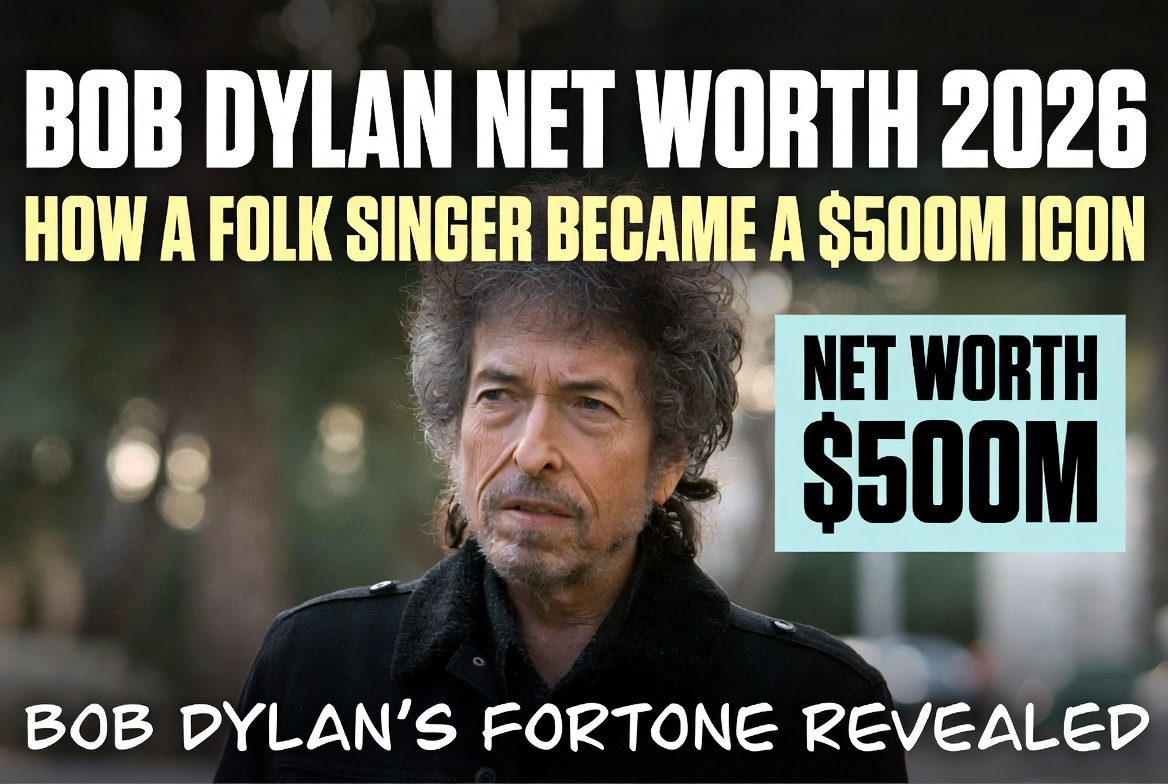
And yet Bob Dylan has accumulated one of the most extraordinary fortunes in music history, with a net worth estimated at approximately $500 million in 2026.
Dylan’s wealth didn’t come from selling out. It came from something more durable: owning his art, never stopping touring, and making a series of brilliant financial moves — including a catalog sale that set the music industry on fire.
This article breaks down every layer of Bob Dylan’s net worth — how he built it, what drives it today, and why his financial story is as fascinating as his music.
1. What Is Bob Dylan’s Net Worth in 2026?
|
Estimating Dylan’s net worth requires some nuance. He is notoriously private about finances. Published estimates from Forbes and Celebrity Net Worth have ranged from $375 million to $500 million in recent years. Most credible current analyses settle around the $500 million mark when accounting for the catalog sale proceeds and continued income streams.
What makes Dylan’s wealth unique is its source. He’s not wealthy because of a streaming deal or a brand partnership. He’s wealthy because 60 years of songwriting generated a catalog of intellectual property worth hundreds of millions of dollars — and he was smart enough to hold onto it for most of his career before selling at the peak.
2. The Catalog Sale That Changed Everything
In February 2022, Bob Dylan sold his entire recorded music catalog to Sony Music Entertainment for a sum reported to be between $150 million and $200 million. This came roughly a year after he had already sold his songwriting catalog — the publishing rights to over 600 songs — to Universal Music Publishing Group in late 2020 for an estimated $300 million to $400 million.
In total, Dylan received somewhere between $450 million and $600 million across both deals. It was one of the largest music catalog transactions in history.
What Did Dylan Sell, Exactly?
| Sale | What Was Included |
| 2020 – Universal Music (Publishing) | Songwriting rights to 600+ songs: “Blowing in the Wind,” “Like a Rolling Stone,” “Mr. Tambourine Man,” and hundreds more |
| 2022 – Sony Music (Masters) | Recorded master recordings of Dylan’s albums and songs |
| Combined Estimated Value | $450M – $600M across both transactions |
Why did he sell? Dylan was 79 at the time of the publishing deal. Catalog sales are a way for aging artists to monetize decades of work in a single transaction, convert uncertain future royalty streams into guaranteed cash, and simplify estate planning.
The timing was also excellent. Ultra-low interest rates in 2020–2021 pushed up valuations for stable income-producing assets like music catalogs. Dylan sold near the top of the market.
3. How Bob Dylan Built His Fortune: Decade by Decade
The 1960s: Art Over Commerce
Dylan arrived in New York in 1961 with $10 in his pocket. His early folk albums sold modestly. But “Blowing in the Wind” (1963) and “The Times They Are a-Changin’” (1964) made him the voice of a generation.
In 1965 and 1966, he released “Bringing It All Back Home,” “Highway 61 Revisited,” and “Blonde on Blonde” — a creative trifecta now considered among the greatest rock albums ever made. Record sales grew, but the real value was in the publishing rights he retained.
The 1970s: Creative Reinvention and ‘Blood on the Tracks’
“Blood on the Tracks” (1975) is widely considered his masterpiece. The decade also produced the Rolling Thunder Revue tour, one of rock’s legendary live events. Touring income grew as stadium rock became a commercial force.
The 1980s: Commercial Dip, But Catalog Growth Continues
Dylan’s commercial standing dipped in the 1980s. But his back catalog continued generating royalties. The songs he wrote in the 1960s appeared in films, commercials, and covers that produced licensing income throughout the decade and beyond.
The 1990s–2000s: The Never Ending Tour Becomes a Machine
In 1988, Dylan launched what became known as the “Never Ending Tour.” He performed an average of 100 shows per year for the next three decades. At $5–10 million per year in touring revenue, that’s $150–$300 million in touring income across 30 years.
“Time Out of Mind” (1997) won three Grammy Awards including Album of the Year, restoring critical credibility and boosting catalog sales.
The 2010s–2020s: Nobel Prize, Catalog Sales, and Legacy Secured
The 2016 Nobel Prize in Literature made Dylan a singular figure in cultural history. In 2020 and 2022, the catalog sales converted decades of intellectual property into immediate cash wealth. “Rough and Rowdy Ways” (2020), his first album of original material in eight years, debuted at #1 in multiple countries.
4. Bob Dylan’s Music Royalties and Publishing Empire
Before the catalog sales, Dylan’s publishing empire was his most valuable asset. Over 600 original compositions generate royalties through radio play, streaming, sync licensing (film and TV), cover recordings, and live performance.
Songs like “Blowing in the Wind” alone have been covered by thousands of artists and used in hundreds of films and commercials. Each use generates a royalty payment.
Major Dylan Songs and Their Cultural Footprint
- “Blowing in the Wind” (1963) — covered 1,000+ times, used in countless films and commercials
- “Like a Rolling Stone” (1965) — frequently ranked the greatest rock song ever made (Rolling Stone magazine #1)
- “Mr. Tambourine Man” (1965) — The Byrds’ cover hit #1 and made it a standard
- “Knockin’ on Heaven’s Door” (1973) — covered by Guns N’ Roses, Eric Clapton, and many others
- “Forever Young” (1974) — widely licensed for film, TV, and advertising
- “The Times They Are a-Changin’” (1964) — a protest anthem used across generations of advertising and film
5. Touring Income: The Never Ending Tour
Since 1988, Dylan has performed over 3,000 concerts worldwide. He has never truly stopped touring, performing well into his 80s.
At his commercial peak in the 1990s and 2000s, Dylan commanded $2–5 million per show for major venues. For smaller theater and club tours, gross revenue per show was lower but profit margins higher. Industry estimates suggest his touring income over the Never Ending Tour era exceeded $200 million.
| Era | Estimated Annual Touring Revenue |
| Late 1980s–1990s | $5–10 million/year |
| 2000s (peak) | $15–25 million/year |
| 2010s | $10–20 million/year |
| 2020s (post-pandemic) | $8–15 million/year (fewer dates) |
Estimates based on public concert grosses and industry averages. Exact figures not publicly disclosed.
6. The Nobel Prize and Its Financial Impact
In October 2016, Bob Dylan was awarded the Nobel Prize in Literature — the first musician to receive the honor. The Swedish Academy cited his “creation of new poetic expressions within the great American song tradition.”
The prize itself carries a monetary award of 8 million Swedish kronor (approximately $900,000 USD at 2016 exchange rates). Modest by Dylan’s standards. But the financial ripple effects were enormous.
Nobel Prize Financial Ripple Effects
- Immediate surge in album and streaming sales globally — catalog sales spiked by an estimated 400–500% in the week following the announcement
- Dramatic increase in licensing inquiries and sync deals for his songs
- Increased valuation of his song catalog, directly contributing to the premium prices achieved in the 2020 and 2022 sales
- Book royalties surged for “Chronicles: Volume One” (his 2004 memoir) as new audiences discovered his work
- His Nobel lecture, delivered in June 2017, itself became a widely cited cultural document
7. Bob Dylan’s Art, Books, and Side Ventures
Visual Art
Dylan is a serious visual artist. His paintings, drawings, and metal sculptures have been exhibited at major galleries including the Gagosian Gallery in New York and London. His “Asia Series” sold pieces for $100,000–$500,000 each. His metalwork sculptures have sold to private collectors worldwide.
Art sales are difficult to estimate in aggregate but likely total in the tens of millions of dollars across his career.
Books and Writing
“Chronicles: Volume One” (2004) became a New York Times bestseller and has sold over 1 million copies worldwide. At standard royalty rates, this likely generated $3–5 million for Dylan directly. A second volume has been anticipated for years but not yet published as of 2026.
Heaven’s Door Whiskey
In 2018, Dylan launched Heaven’s Door Spirits, a premium whiskey brand. The line has expanded to include multiple expressions and has been well-received by critics. Premium celebrity spirits brands have proven to be highly lucrative — George Clooney sold his Casamigos tequila for $1 billion in 2017. Dylan’s brand is smaller but represents a meaningful and growing revenue stream.
The Bob Dylan Archive
Dylan donated his personal archive — manuscripts, letters, recordings, films — to the University of Tulsa, which established the Bob Dylan Center in 2022. While not a direct revenue source, the archive increases his cultural legacy value and supports the licensing ecosystem around his name and work.
8. Real Estate and Lifestyle
Dylan is notoriously private about his personal life and finances. Known properties include a compound in Malibu, California; a farm in Minnesota near his Hibbing hometown; and a historic property in Woodstock, New York, tied to his legendary mid-1960s retreat there.
Unlike many celebrities, Dylan has generally avoided the trophy property market. His spending appears focused on privacy and comfort rather than status. He has maintained a relatively low-profile lifestyle for a figure of his stature.
9. Bob Dylan vs. Other Music Legends: Net Worth Comparison
| Artist | Estimated Net Worth (2026) |
| Bob Dylan | ~$500 million |
| Paul McCartney | ~$1.3 billion |
| Mick Jagger | ~$500 million |
| Keith Richards | ~$500 million |
| Bruce Springsteen | ~$1.1 billion (after catalog sale) |
| Neil Young | ~$200 million |
| Elton John | ~$550 million |
| Taylor Swift | ~$1.1 billion (for comparison) |
Sources: Forbes, Celebrity Net Worth, Bloomberg. All figures are estimates.
Dylan sits comfortably among rock and folk music’s wealthiest figures. He trails McCartney and Springsteen, largely because their catalogs command premium valuations tied to more mainstream commercial appeal. But by any measure, Dylan’s financial achievement is extraordinary for an artist who never prioritized commercial success.
10. Key Takeaways
- Bob Dylan’s net worth in 2026 is estimated at approximately $500 million
- The 2020 sale of his songwriting catalog to Universal Music Publishing Group netted an estimated $300–$400 million
- The 2022 sale of his recorded music masters to Sony Music added an estimated $150–$200 million
- The Never Ending Tour (1988–present) has generated an estimated $200M+ in touring income across 3,000+ concerts
- The 2016 Nobel Prize in Literature dramatically increased his catalog’s value and mainstream visibility
- Additional income streams include visual art sales, Heaven’s Door Whiskey, book royalties, and merchandise
- Dylan’s wealth is a testament to owning intellectual property and never stopping working
11. Frequently Asked Questions (FAQs)
What is Bob Dylan’s net worth in 2026?
Bob Dylan’s net worth is estimated at approximately $500 million in 2026, primarily built through catalog sales totaling $450–$600 million, decades of touring, and various business ventures.
How much did Bob Dylan sell his catalog for?
Dylan sold his songwriting publishing rights to Universal Music Publishing Group in 2020 for an estimated $300–$400 million, and his recorded masters to Sony Music in 2022 for an estimated $150–$200 million, totaling approximately $450–$600 million across both deals.
Did Bob Dylan win the Nobel Prize?
Yes. Dylan won the Nobel Prize in Literature in 2016, making him the first musician to receive the honor. The prize carried approximately $900,000 USD but significantly boosted the value and visibility of his catalog.
What is the Never Ending Tour?
The Never Ending Tour is the informal name for Bob Dylan’s continuous touring schedule that began in 1988 and has continued for over 35 years, encompassing more than 3,000 concerts worldwide.
Does Bob Dylan own a whiskey brand?
Yes. Dylan co-founded Heaven’s Door Spirits in 2018, a premium American whiskey brand. The brand has expanded to multiple expressions and is sold internationally.
Is Bob Dylan a billionaire?
No. Dylan’s estimated net worth of $500 million falls short of the $1 billion threshold. He is, however, one of the wealthiest musicians in history who built his fortune primarily through artistic output rather than mainstream commercial strategies.
How does Bob Dylan make money today?
Dylan’s current income comes from touring (still active into his 80s), Heaven’s Door Whiskey sales, art sales, book royalties, merchandise, and income from the catalog sale proceeds invested elsewhere.
Sources & References
- Forbes — Music Rich List and Celebrity Net Worth Estimates, 2025–2026
- The New York Times — Bob Dylan Catalog Sale Reporting (2020, 2022)
- Rolling Stone — “500 Greatest Songs of All Time” and Dylan Profile Coverage
- Nobel Prize Committee — Official Nobel Prize in Literature 2016 Citation
- Billboard — Music Catalog Valuation and Touring Revenue Analysis
Discover more from MatterDigest
Subscribe to get the latest posts sent to your email.