Bitcoin Crashed 40% in 2025 — But Wall Street Is Still Going All In. Here’s Why That Should Terrify You.

The Crash Nobody Saw Coming (Or Did They?)
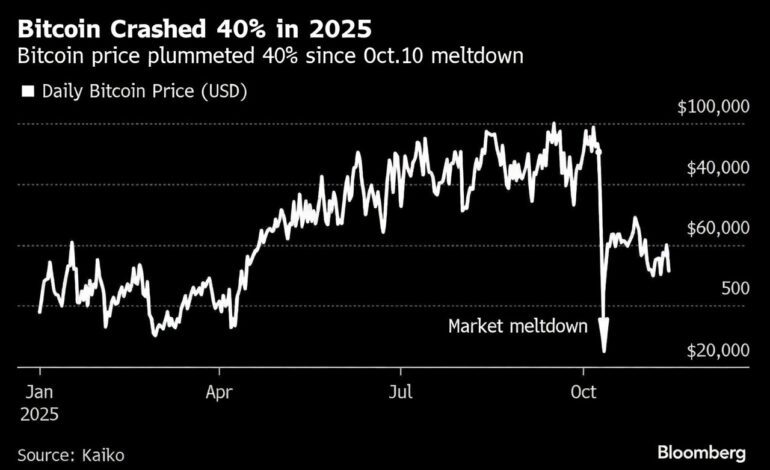
Imagine waking up one morning to find that your investment has lost nearly half its value — seemingly overnight. That’s exactly what happened to Bitcoin holders in 2025. The world’s most famous cryptocurrency shed roughly 40% of its value in a dramatic market correction that sent shockwaves through the crypto world.
But here’s the strange part: Wall Street barely flinched.
While retail investors panicked and sold, major financial institutions — BlackRock, Fidelity, Goldman Sachs, and others — actually increased their Bitcoin exposure. They kept buying. They kept building. And that behavior, on the surface, looks reassuring. It looks like a vote of confidence.
It isn’t. Or at least, it’s not that simple.
In this article, we’re going to pull back the curtain on what’s really happening in the Bitcoin market. You’ll learn why Wall Street’s bullish posture during a 40% crash should make you deeply uncomfortable — not because they’re wrong about Bitcoin’s future, but because of what their dominance means for everyone else.
Quick Answer: Wall Street continued investing in Bitcoin after the 2025 crash because institutional investors operate on long time horizons, hedge their positions with derivatives, and stand to profit from market structure changes regardless of short-term price swings. This creates systemic risks that ordinary investors rarely understand.
How Bad Was It? The 2025 Bitcoin Crash, By the Numbers
Let’s start with the facts, because numbers tell a story that headlines often distort.
Bitcoin entered 2025 riding a wave of post-halving optimism. After the April 2024 halving event — which cut the block reward from 6.25 BTC to 3.125 BTC — many analysts predicted a run toward $150,000 or even $200,000 per coin. Some of those predictions looked prescient in early 2025, when Bitcoin briefly touched new highs.
Then the selling started.
The Timeline of the Drop
| Period | Bitcoin Price (Approx.) | Change |
| Early 2025 Peak | $108,000 – $110,000 | ATH |
| March 2025 | $85,000 – $90,000 | -18% from peak |
| May 2025 | $70,000 – $72,000 | -34% from peak |
| August 2025 (Low) | $62,000 – $65,000 | -40% from peak |
| Q4 2025 Recovery | $78,000 – $85,000 | Partial rebound |
The triggers were multiple. Rising U.S. Treasury yields made risk assets less attractive. Regulatory uncertainty — particularly around stablecoin legislation stalling in Congress — spooked some institutional players. A major crypto lending platform faced liquidity issues, and the contagion spread. Sound familiar? It should. The script wasn’t entirely new.
But here’s what was different this time: the institutional response.
Wall Street’s Surprising Response: Buy the Dip — Hard
During the 2022 crypto winter, institutional players mostly stood on the sidelines. Some quietly reduced exposure. The narrative was still “crypto is speculative.” Fast forward to 2025, and the playbook had completely changed.
Bitcoin ETF Inflows Tell the Real Story
The Bitcoin spot ETFs — launched in the U.S. in January 2024 — became the key vehicle for institutional accumulation. During the peak of the 2025 crash, Bloomberg and CoinShares data showed net ETF inflows remaining positive or turning only briefly negative. Meaning: institutions were still net buyers even as prices collapsed.
BlackRock’s iShares Bitcoin Trust (IBIT) alone reportedly crossed $20 billion in assets under management by mid-2025 and continued accumulating during the dip. Fidelity’s FBTC showed similar patterns.
Corporate treasuries also continued their Bitcoin purchases. Companies following MicroStrategy’s lead — now rebranded as “Strategy” — used equity raises and convertible note offerings to keep buying BTC through the correction.
Why Didn’t They Sell?
Three core reasons explain the institutional buy-the-dip mentality:
- Long investment mandates: Most institutional funds operate on 5–10 year horizons. A 40% drawdown is uncomfortable, not catastrophic, when your thesis is decade-long.
- Dollar-cost averaging programs: Many institutions run systematic accumulation programs that aren’t sensitive to short-term price movements.
- Relative performance benchmarking: Once Bitcoin ETFs were available, fund managers who avoided BTC risked underperforming benchmarks that included crypto. Holding through a dip beats missing the recovery.
Why Institutional Investors Are Doubling Down
To understand Wall Street’s logic, you need to think like a portfolio manager — not like a trader.
Bitcoin as a Macro Hedge
The fundamental institutional thesis for Bitcoin hasn’t changed: it’s a non-sovereign, fixed-supply asset that behaves differently from traditional financial instruments. In a world where U.S. national debt has surpassed $36 trillion and central banks continue expanding balance sheets, the appeal of a hard-capped asset is real.
Even after a 40% crash, Bitcoin’s long-term purchasing power narrative remains intact. Institutions don’t need Bitcoin to go up next month. They need it to be worth more in 2030 than it is today.
The Correlation Trade
Here’s something most retail investors miss entirely: many institutional players aren’t just holding Bitcoin outright. They’re using it as part of complex multi-asset strategies — combining spot BTC with Bitcoin futures, options, and volatility products. A crash isn’t purely bad for them. It can be an opportunity to:
- Reset long positions at lower cost basis
- Profit from short volatility strategies (selling options premium)
- Exploit funding rate arbitrage in perpetual futures markets
In other words, Wall Street has tools to make money during Bitcoin crashes that ordinary investors simply don’t have access to.
Regulatory Clarity Is Coming (They Think)
Institutional confidence in Bitcoin also reflects a bet on regulatory clarity. The 2025 crash occurred against a backdrop of pending U.S. crypto legislation. Institutions believe clear rules — even imperfect ones — will ultimately legitimize the asset class and unlock further capital inflows. So they’re positioning ahead of that potential inflection point.
The Hidden Risks Wall Street Doesn’t Want You to See
Here’s where we need to get uncomfortable. Wall Street’s confidence in Bitcoin doesn’t mean Bitcoin is safe for you. Their involvement creates risks that didn’t exist in crypto’s early years.
Risk #1: Concentration and Systemic Fragility
When a small number of large players control a significant portion of Bitcoin’s liquid supply (through ETFs, corporate treasuries, and custodians), the market becomes structurally fragile. If one major institution faces a liquidity crisis — think 2008’s Lehman moment — forced selling of Bitcoin holdings could trigger cascading price drops far more severe than anything we’ve seen.
In traditional markets, we call this “concentration risk.” In crypto, we haven’t truly experienced it at institutional scale yet. The 2025 crash was a rehearsal, not the main event.
Risk #2: The Correlation Problem
Here’s the dirty secret of institutional Bitcoin adoption: as more traditional finance players enter crypto, Bitcoin increasingly moves with traditional markets. The very thing that made Bitcoin attractive as a hedge — its low correlation to stocks and bonds — is being eroded by the entities buying it as a hedge.
During the 2025 crash, Bitcoin sold off sharply alongside tech stocks when the Nasdaq experienced its own correction. The correlation coefficient between BTC and the Nasdaq 100 briefly spiked above 0.7 during volatile periods — dangerously high for an asset people hold as an “uncorrelated diversifier.”
Risk #3: The Retail vs. Institutional Information Asymmetry
Wall Street has risk management teams, proprietary data feeds, and sophisticated derivatives to protect their positions. You don’t. When institutions decide the Bitcoin trade is over — and eventually they will reduce their exposure, just as they did with gold ETFs at various points — they’ll execute more efficiently than retail investors can react.
History is littered with examples of retail investors being the last to know and the last to exit.
Risk #4: ETF Mechanics and “Paper Bitcoin”
Bitcoin ETFs don’t require fund managers to buy actual Bitcoin for every dollar invested. Through various rebalancing, hedging, and in-kind creation mechanisms, the relationship between ETF demand and actual BTC demand is complex. This creates a potential scenario where ETF inflows look bullish while actual Bitcoin price pressure is more muted — masking underlying weakness.
| Risk Factor | Impact Level | Who Is Most Exposed |
| Concentration risk (few large holders) | HIGH | All Bitcoin holders |
| Rising BTC-equity correlation | MEDIUM-HIGH | Diversified portfolio holders |
| Retail information asymmetry | HIGH | Individual / retail investors |
| ETF mechanics vs. spot demand | MEDIUM | ETF investors |
| Regulatory reversal risk | MEDIUM | All institutional positions |
Bitcoin’s Crash vs. Wall Street’s Behavior: A Dangerous Disconnect
Let’s be direct: Wall Street’s buying during a crash does NOT guarantee Bitcoin will recover. It does NOT mean the crash is over. And it absolutely does NOT mean retail investors should blindly follow institutional money.
Institutional investors have been wrong before — spectacularly so. They held mortgage-backed securities confidently right up until the 2008 collapse. They poured money into dot-com stocks in 1999. Smart money isn’t infallible money.
What’s particularly dangerous about the current Bitcoin moment is the narrative it creates. When major institutions keep buying through a 40% crash, it generates a powerful psychological signal: “the pros aren’t worried, so why should I be?” That’s exactly the mindset that sets retail investors up for maximum pain.
The most dangerous investment environment is one where confident, well-capitalized buyers make poorly diversified retail investors feel safe. Safe feelings and safe positions are very different things.
What Happens When Institutional Money Controls Crypto?
This is the question the crypto community has largely avoided asking. Bitcoin was born from a libertarian impulse — a currency free from government control, free from banks, free from Wall Street. Satoshi Nakamoto wrote the Bitcoin whitepaper in the wake of the 2008 financial crisis as a direct response to institutional failure.
So what happens when the very institutions Bitcoin was designed to circumvent become its largest holders?
The Irony of Bitcoin’s Institutional Capture
When BlackRock, Fidelity, and State Street are among Bitcoin’s largest beneficial owners — through their ETFs — the asset becomes subject to the same dynamics as any other institutional product. Price movements get driven by:
- Macro fund flows (risk-on vs. risk-off sentiment)
- Options expiration dates and derivatives positioning
- Institutional quarterly rebalancing cycles
- Regulatory actions aimed at traditional finance (which now includes Bitcoin ETFs)
The decentralized dream increasingly operates within a centralized financial ecosystem. And that ecosystem has its own crises, its own failure modes, and its own conflicts of interest.
The Volatility Paradox
Institutional involvement was supposed to reduce Bitcoin’s volatility. More liquidity, more sophisticated players, more efficient price discovery — in theory, that should smooth out the wild swings. In practice, the 2025 crash showed that institutions can amplify volatility when they all move in the same direction. Algorithmic trading programs, correlated risk management triggers, and ETF rebalancing can create synchronized selling pressure that accelerates price declines.
Real-World Examples: How Past Crashes Changed the Game
The 2017–2018 Crash
Bitcoin fell nearly 85% from its December 2017 peak. Retail investors who bought near the top waited years to break even. Institutional investors who entered in 2020–2021 captured massive gains. The lesson: timing and entry point matter enormously, and institutions have patience retail investors often lack.
The 2022 Crypto Winter
The collapse of the Terra/LUNA ecosystem and the subsequent failure of FTX decimated the crypto market and erased an estimated $2 trillion in total crypto market cap. Even Bitcoin — not directly connected to these failures — fell over 75% from its 2021 peak. The contagion showed how interconnected the crypto ecosystem had become, even for assets with strong fundamentals.
Gold’s Institutional Journey
Gold provides an instructive parallel. When gold ETFs launched in 2004, they democratized gold ownership and drove a massive price run. But they also tied gold’s price more closely to financial market flows. During the 2008 crisis, gold initially sold off sharply — not because gold was worthless, but because institutional investors needed to sell liquid assets to cover losses elsewhere. Bitcoin may face the same dynamic in a future financial crisis.
What Retail Investors Should Know Right Now
If you’re an individual investor watching Wall Street pile into Bitcoin through a 40% crash, here’s what you actually need to understand.
Do Not Mistake Confidence for Safety
Institutional confidence reflects institutional risk tolerance, institutional hedging capabilities, and institutional time horizons. None of those are yours. A hedge fund that can absorb a 40% drawdown without blinking cannot tell you whether you can afford to do the same.
Position Sizing Is Everything
If you believe in Bitcoin’s long-term thesis — and there are legitimate arguments for it — the question isn’t whether to own it. The question is how much. Most financial advisors suggest that highly volatile assets like Bitcoin represent no more than 1–5% of a diversified portfolio for most investors. That position size lets you participate in upside without catastrophic downside exposure.
Understand What You Actually Own
If you hold Bitcoin through an ETF, you own a share of a fund that holds Bitcoin — not Bitcoin itself. You cannot move it to a self-custody wallet, you cannot use it in DeFi protocols, and your exposure is mediated by financial intermediaries. If you hold actual Bitcoin on an exchange, your asset is only as safe as that exchange. Self-custody (hardware wallets) eliminates exchange risk but introduces its own complexity and risks.
Five Questions to Ask Before Buying Bitcoin Right Now
- Can I afford to lose 50% of this investment without affecting my financial security?
- Do I understand why I’m buying — fundamental belief or fear of missing out?
- Am I buying because Wall Street is buying, or because I’ve done my own analysis?
- What’s my exit strategy if Bitcoin falls another 30%?
- Am I using money earmarked for near-term needs or emergency funds?
Expert Opinions: What the Analysts Are Actually Saying
The Bitcoin analyst community is deeply divided about what the 2025 crash and Wall Street’s response actually mean.
The Bull Case
Proponents of continued institutional adoption argue that we’re in the early stages of Bitcoin becoming a legitimate global reserve asset. They point to sovereign wealth funds quietly exploring Bitcoin exposure, nation-state adoption (building on El Salvador’s precedent), and the fact that the 2025 crash’s recovery was faster than previous cycles. Their argument: each crash creates a higher low, indicating strengthening structural demand.
The Bear Case
Skeptics — including respected macro investors and behavioral economists — warn that institutional FOMO (fear of missing out) could be creating a self-reinforcing bubble. When every major financial institution feels compelled to have Bitcoin exposure for competitive reasons, not because of fundamental conviction, that’s a behavioral bubble dynamic. They also flag Bitcoin’s ongoing energy consumption debate and potential regulatory crackdowns as structural risks.
The Middle Ground
The most measured analysis suggests Bitcoin is transitioning from a speculative asset to a risk asset — like tech stocks, not like gold. That’s a meaningful distinction. It means Bitcoin’s bull markets and bear markets will increasingly rhyme with broader risk-asset cycles. Wall Street’s presence ensures this convergence.
Frequently Asked Questions
Why did Bitcoin crash 40% in 2025?
Bitcoin’s 40% decline in 2025 resulted from multiple converging factors: rising U.S. Treasury yields reducing risk appetite, stalled stablecoin legislation creating regulatory uncertainty, contagion from a major crypto lender’s liquidity crisis, and algorithmic selling pressure amplified by institutional derivatives positions. The post-halving euphoria also meant prices had run significantly ahead of near-term fundamentals.
Is Bitcoin a good investment after a 40% crash?
Whether Bitcoin is a good investment depends entirely on your financial situation, risk tolerance, and investment horizon — not on recent price movements. A 40% crash can represent a buying opportunity OR a warning signal depending on the underlying causes. Past Bitcoin crashes were eventually followed by new highs, but that historical pattern is not a guarantee of future performance. Never invest more than you can afford to lose completely.
Why is Wall Street still buying Bitcoin despite the crash?
Institutional investors operate on different time horizons and with different tools than retail investors. They view a 40% crash as a potential accumulation opportunity rather than a reason to exit. They also use hedging strategies — options, futures, correlation trades — that can generate returns during volatile periods. Additionally, their Bitcoin allocations are typically small enough relative to total assets under management that a 40% Bitcoin drop doesn’t materially damage portfolio performance.
What is a Bitcoin ETF and should I use one?
A Bitcoin ETF is an exchange-traded fund that holds Bitcoin and trades on traditional stock exchanges like any other stock or ETF. It gives you Bitcoin price exposure without requiring you to set up a crypto wallet or use a cryptocurrency exchange. ETFs are convenient and regulated but add a layer of financial intermediaries between you and the underlying asset. Whether to use one depends on your preferences around custody, cost, and access.
Could Bitcoin fall another 40-50% from here?
Bitcoin has historically experienced multiple 70-85% drawdowns in its history. Nothing about its current price level or institutional adoption makes further large declines impossible. Anyone claiming certainty about Bitcoin’s price floor is not being intellectually honest. Scenario planning — including a scenario where Bitcoin falls significantly further — should be part of any Bitcoin investment decision.
Key Takeaways and What to Do Next
Let’s bring this home. Here’s what the 2025 Bitcoin crash and Wall Street’s response actually tells us:
- Bitcoin’s 40% crash in 2025 was significant but not unprecedented — and did not derail institutional adoption.
- Wall Street’s continued buying reflects long-term conviction, hedging capability, and competitive pressure to have crypto exposure — not necessarily a signal that Bitcoin is “safe” right now.
- Institutional domination of Bitcoin introduces systemic risks — concentration, rising correlations with equities, and information asymmetry — that retail investors need to understand.
- Bitcoin is transitioning from a speculative asset to a risk asset, increasingly correlated with broader market cycles.
- Retail investors should evaluate Bitcoin based on their own financial situation, risk tolerance, and investment thesis — not based on what BlackRock is doing.
- Position sizing, honest self-assessment of risk tolerance, and understanding what you actually own are the most important factors in any Bitcoin investment decision.
What Should You Do Next?
If you want to dig deeper, here are your next steps:
- Read the original Bitcoin whitepaper (freely available at bitcoin.org) to understand what you’re actually investing in.
- Research Bitcoin’s historical drawdown periods and recovery timelines before making any allocation decisions.
- Speak with a fee-only financial advisor (one who doesn’t earn commissions) about appropriate portfolio allocation.
- Follow on-chain analytics (Glassnode, CryptoQuant) to understand institutional flow dynamics in real time.
- Read our related analysis: “How Bitcoin ETFs Actually Work” and “The Case For and Against Bitcoin as a Portfolio Diversifier.”
Authoritative Sources and Further Reading
- CoinShares Digital Asset Fund Flows Report (coinshares.com) — Weekly institutional flow data
- Glassnode On-Chain Analytics (glassnode.com) — Bitcoin holder behavior and market structure analysis
- Federal Reserve Economic Data / FRED (fred.stlouisfed.org) — Macro context for Bitcoin market movements
- Bitcoin Whitepaper by Satoshi Nakamoto (bitcoin.org/bitcoin.pdf) — Primary source for Bitcoin fundamentals
- Bloomberg Intelligence Crypto Research — Institutional-grade market analysis
About the Author
This article was produced by a financial markets research team with combined experience spanning traditional equities, fixed income, and digital assets. The team has covered crypto market cycles since 2017, including the 2018 crypto winter, the 2020 COVID crash, the 2021 bull market, and the 2022 bear market. Analysis draws on publicly available market data, on-chain analytics, institutional filing data, and macroeconomic research. This content is for informational purposes only and does not constitute financial advice. Always consult a qualified financial professional before making investment decisions.
Discover more from MatterDigest
Subscribe to get the latest posts sent to your email.