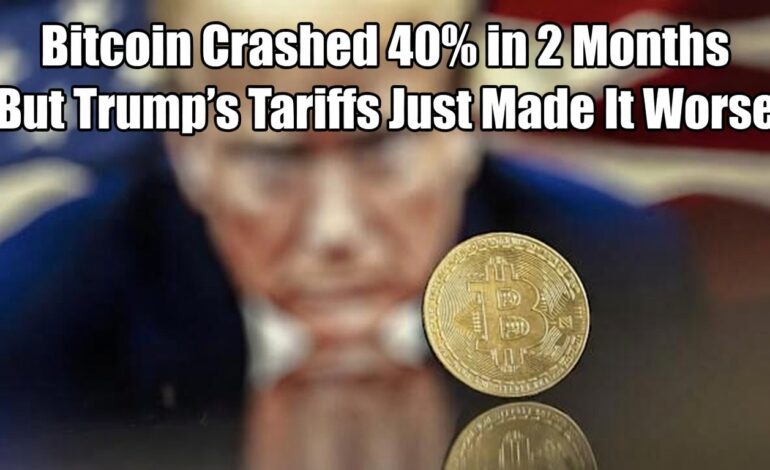
Bitcoin Crashed 40% in 2 Months But Trump’s Tariffs Just Made It Worse.

| ₿ CRYPTO MARKET ANALYSIS • FEBRUARY 2026
Bitcoin Crashed 40% in 2 Months But Trump’s Tariffs Just Made It Worse. Here’s the Timeline That Should Scare You. The full breakdown: what happened, why it happened, and what you should do about it. |
|
- The Quick Answer: What Happened to Bitcoin?
| DIRECT ANSWER
Bitcoin fell roughly 40% between late December 2024 and late February 2025. It peaked near $108,000 — an all-time high — then collapsed to around $78,000–$82,000. Tariffs raised inflation fears, hurt risk appetite, and accelerated the decline. |
Bitcoin fell roughly 40% between late December 2024 and late February 2025. It peaked near $108,000 in December 2024 — an all-time high — then collapsed to around $78,000–$82,000 by late February 2025.
The crash had multiple causes: profit-taking after a massive bull run, rising macro uncertainty, and a fresh wave of fear triggered by President Trump’s escalating tariff announcements. The tariff war spooked global markets, and Bitcoin — increasingly tied to risk sentiment — got caught in the crossfire.
This isn’t just a crypto story. It’s an economics story, a geopolitics story, and for many investors, a very personal financial story. Let’s walk through exactly what happened.
- The Full Timeline: How Bitcoin’s 40% Crash Unfolded
Let’s walk through what happened, event by event. This is the timeline that connects all the dots.
December 2024: The Peak
- Mid-December 2024: Bitcoin hits an all-time high near $108,000. Euphoria is everywhere. Retail investors flood back in. Influencers call for $150,000 — even $200,000 — by early 2025.
- Late December 2024: Profit-taking begins. Completely normal after any major rally. Bitcoin drifts to $95,000–$98,000. Most analysts call it a “healthy correction.” Nobody’s scared yet.
January 2025: The Cracks Appear
- Early January: Bitcoin stabilizes briefly around $94,000–$97,000. Hope persists. Markets expect a post-inauguration “Trump bump” for crypto.
- January 20 — Inauguration Day: Trump takes office. Some pro-crypto executive orders arrive. But the bigger story is the administration’s aggressive stance on trade. The word “tariffs” starts dominating every financial headline.
- Late January: Trump announces plans for 25% tariffs on Canadian and Mexican imports, with Chinese tariffs escalating further. Stock markets wobble. Bitcoin drops toward $91,000. The mood visibly shifts.
February 2025: The Acceleration
- Early February: Tariffs on Canada and Mexico go into effect. Global markets react badly. The S&P 500 drops. The Nasdaq falls harder. Bitcoin follows — tumbling toward $85,000.
- Mid-February: Escalation continues. A 10% blanket tariff on Chinese goods is announced. China, Canada, and the EU all announce retaliatory measures. Fear spikes. Risk assets sell off hard.
- February 20–24: Bitcoin tests the $78,000–$80,000 range. The 40% decline from the December peak is now official. The headlines that were euphoric two months ago now read like obituaries.
| CHART RECOMMENDATION
Insert: Bitcoin price chart (Dec 2024–Feb 2025) annotated with key tariff announcement dates. This visual is essential for reader comprehension and time-on-page engagement. |
- What Are Trump’s Tariffs, and Why Do They Matter to Crypto?
If you’re wondering why a trade policy affects a digital currency with no physical supply chain, you’re asking exactly the right question.
What Are Tariffs, in Plain English?
A tariff is a tax on imported goods. When the U.S. places a 25% tariff on Canadian goods, American companies importing those goods pay 25% more. They typically pass that cost to consumers. Prices rise. Inflation increases. It sounds simple — but the ripple effects are enormous.
The Chain Reaction That Hits Bitcoin
Here’s exactly how tariffs become a Bitcoin problem:
|
Step 1 |
Tariffs raise import prices → overall inflation expectations climb |
|
Step 2 |
Higher inflation expectations → the Federal Reserve may hold rates high or raise them |
|
Step 3 |
Higher interest rates → investors shift toward safer, yield-bearing assets like bonds |
|
Step 4 |
Risk appetite shrinks → investors sell speculative assets, including Bitcoin |
|
Step 5 |
Bitcoin falls |
The Uncertainty Multiplier
Trade wars also create business uncertainty. Companies don’t know what import costs will be in six months. They delay hiring and investment. This slows economic growth. Slow growth is bad for asset prices everywhere — and crypto is not immune.
| “Why do Trump’s tariffs affect Bitcoin?”
Trump’s tariffs raise inflation fears and slow economic growth — a combination that reduces investor appetite for risky assets like Bitcoin. As institutional investors cut risk across portfolios, Bitcoin falls alongside stocks due to their increasing correlation. |
- The Bitcoin-Stock Market Connection Nobody Warned You About
For years, the crypto community insisted Bitcoin was “uncorrelated” to traditional markets. A digital safe haven. Gold for the internet age. A hedge against the system.
That narrative largely died in 2022. And it was buried in 2025.
What the Data Shows
During the February 2025 selloff, Bitcoin’s 30-day correlation with the Nasdaq 100 spiked above 0.75 — meaning the two were moving almost in lockstep. When tech stocks fell, Bitcoin fell. When markets bounced, Bitcoin bounced.
Why Has Bitcoin Become So Correlated With Stocks?
Two structural changes explain this shift entirely.
- Institutional ownership changed the game. The approval of Bitcoin ETFs in January 2024 opened the floodgates. Billions of dollars from hedge funds, pension funds, and family offices flowed into Bitcoin. These investors manage diversified portfolios. When they need to reduce overall risk, they sell across the board — stocks, bonds, and Bitcoin together.
- Leverage amplifies everything. A large portion of crypto trading involves borrowed money. When prices drop, leveraged traders face margin calls — forced selling that accelerates the decline. This same dynamic plays out in equity markets simultaneously, spiking the correlation.
What This Means for Your Portfolio
| KEY INSIGHT
If you own Bitcoin as a hedge against stock market risk, this crash is a reality check. It’s not behaving like a hedge right now. It’s behaving like a high-beta tech stock — great when markets are up, brutal when they’re down. |
| INFOGRAPHIC RECOMMENDATION
Insert: Side-by-side correlation chart — Bitcoin vs. Nasdaq in 2020 (low correlation) vs. 2025 (high correlation ~0.75). Strong visual for featured snippet potential. |
- Macro Fear Is the Real Villain Here
The tariff announcements were the match. But the room was already full of gas.
The Conditions Going Into 2025
- The Fed was more cautious than expected. After cutting rates modestly in late 2024, the Federal Reserve signaled a slow, cautious approach to further cuts. Markets had priced in aggressive reductions. They didn’t get them.
- Inflation hadn’t fully died. Core inflation remained stubbornly above the Fed’s 2% target entering 2025, limiting the central bank’s room to maneuver.
- Bitcoin was priced for perfection. At $108,000, Bitcoin had priced in an enormous amount of good news — ETF flows, the halving, the pro-crypto administration. Any bad news was going to hit hard, because there was almost no margin for disappointment.
The Stagflation Specter
When tariff news hit, it didn’t just change trade math — it changed the emotional temperature of global markets. GDP growth forecasts were revised down. Inflation forecasts were revised up. That combination — slower growth, higher prices — is called stagflation risk. It’s the economic bogeyman. And it was suddenly back in serious financial publications.
The Sentiment Collapse
The Crypto Fear & Greed Index — which measures market sentiment on a scale from 0 (Extreme Fear) to 100 (Extreme Greed) — swung from “Greed” territory in December 2024 to “Extreme Fear” by mid-February 2025. Sentiment shifts like this become self-fulfilling: fear → selling → lower prices → more fear.
- What History Tells Us About Bitcoin After Big Crashes
Here’s some context that might recalibrate your perspective — in either direction.
Bitcoin is famous — or infamous — for violent boom-bust cycles. A 40% crash feels catastrophic. By Bitcoin’s historical standards, it’s almost modest.
|
Cycle |
Peak |
Trough |
% Drop |
Recovery Time |
|
2013 |
$1,200 |
$150 |
-87% |
~3 years |
|
2017–18 |
$20,000 |
$3,100 |
-84% |
~3 years |
|
2021 |
$69,000 |
$15,500 |
-77% |
~2 years |
|
2024–25 |
$108,000 |
~$78,000+ |
-40% (so far) |
TBD |
The Bull Case for Recovery
Bitcoin’s halving cycle — the programmatic reduction in new supply that last occurred in April 2024 — has historically preceded strong price appreciation over the following 12–18 months. The 40% pullback fits the pattern of mid-cycle shakeouts seen in every previous bull market. Long-term on-chain holders largely did not sell during this crash — a historically positive sign for market structure.
The Bear Case for More Pain
But here’s the honest counterargument. If the tariff war escalates into a full-blown global recession, Bitcoin is not immune to deeper losses. In the 2022 bear market — triggered by aggressive Fed rate hikes and the Terra/Luna collapse — Bitcoin fell over 75% from its peak. The 40% drop you see today could, in a worst-case scenario, be just the opening act.
- Should You Be Scared? What Experts Are Saying
The Cautious Camp
| JPMorgan Strategists, Early 2025:
“Bitcoin’s increasing correlation with equities makes it particularly vulnerable to macro shocks, including trade policy uncertainty. Further tariff escalation could push Bitcoin below $70,000.” |
Mohamed El-Erian, chief economic adviser at Allianz and one of the most respected macro voices in finance, has consistently warned that trade wars create a toxic combination of inflation and slowing growth — exactly the environment that punishes risk assets.
The Optimistic Camp
ARK Invest, led by Cathie Wood, maintained long-term Bitcoin price targets well above current levels as of early 2025, arguing that macro disruptions are temporary and that Bitcoin’s fundamental value proposition — provable scarcity, decentralization, permissionless transactions — remains intact and growing.
Several crypto-native analysts pointed to on-chain data showing that long-term holders were not capitulating. “The hands that matter haven’t moved,” as one widely-followed analyst put it. The implication: conviction investors are sitting tight and waiting for the storm to pass.
The Honest Middle Ground
| BALANCED ASSESSMENT
The truth sits between the two camps. Short-term pain is real and may not be over. Long-term, Bitcoin’s track record of recovery is also very real. Your personal answer depends on your time horizon, risk capacity, and how deep the tariff-driven disruption ultimately goes. Nobody — not JPMorgan, not ARK Invest — knows exactly where this ends. |
- What Comes Next: 3 Scenarios for Bitcoin in 2025
Forecasting is inherently uncertain. But thinking through scenarios helps you make smarter decisions regardless of which one plays out.
| SCENARIO 1: Trade War De-Escalation BULLISH
Probability: Probability: Moderate What Happens: Trump uses tariffs as a negotiating chip — consistent with his style — and deals are struck with Canada, Mexico, and China. Inflation fears recede. The Fed resumes rate cuts. Risk assets rally. Bitcoin Outlook: Bitcoin Price Outlook: $95,000–$120,000 by end of 2025 Key Note: The halving tailwind remains in play. Historical precedent strongly supports new all-time highs within 18 months of the April 2024 halving. |
| SCENARIO 2: Tariff Stalemate NEUTRAL
Probability: Probability: Moderate to High What Happens: Tariffs remain in place but don’t escalate dramatically further. The economy slows but avoids recession. The Fed holds rates steady. Markets trade sideways with elevated volatility. Bitcoin Outlook: Bitcoin Price Outlook: $70,000–$95,000 through mid-2025 Key Note: Choppy, frustrating for short-term traders. Manageable for long-term holders who dollar-cost average during dips. |
| SCENARIO 3: Full Trade War / Recession 📉 BEARISH
Probability: Probability: Lower — but real What Happens: Tariff escalation continues in multiple rounds. Major economies enter recession. U.S. unemployment rises. Financial stress spreads. The Fed is caught between fighting inflation and supporting growth. Bitcoin Outlook: Bitcoin Price Outlook: $45,000–$65,000 or lower Key Note: This is the scenario most people are hoping to avoid. The conditions for it exist. Don’t dismiss it entirely. |
- Key Takeaways and What to Do Now
Let’s cut through the noise and focus on what actually matters for you.
What We Know for Certain
- Bitcoin fell ~40% from its December 2024 ATH of ~$108,000 to $78,000–$82,000 by late February 2025.
- Trump’s tariff announcements in January and February 2025 were the key catalyst for the sharpest drops.
- Bitcoin now closely correlates with equity markets — especially tech stocks — making it vulnerable to macro shocks.
- Historical precedent shows Bitcoin can recover from mid-cycle corrections of this magnitude — but it can also go much lower if conditions deteriorate.
- Long-term on-chain holders largely did NOT sell during this crash — a historically positive market structure signal.
Practical Guidance Based on Your Situation
|
Long-Term Holder (3–5+ year horizon) Don’t make emotional decisions based on a 2-month price move. The fundamental case — scarcity, halving cycle, growing institutional adoption — has not changed. Volatility is the price of admission for long-term Bitcoin returns. If you believed in the asset at $50,000 or $80,000, a 40% pullback from an all-time high is not a reason to abandon your thesis. |
|
Active or Short-Term Trader This is a high-uncertainty macro environment. Tariff headlines, Fed statements, and economic data are currently driving Bitcoin more than crypto-specific fundamentals. Trade smaller, use tighter risk management, and be very cautious about leverage. |
| Thinking About Buying Now
Nobody knows if this is the bottom — anyone who says otherwise is guessing. Buying in equal tranches over 3–6 months (dollar-cost averaging) removes the pressure of calling the exact low. History shows this approach has worked well in previous Bitcoin downturns. |
| Losing Sleep at Night
Your position is probably too large for your actual risk tolerance. That’s valuable self-knowledge. Reducing to a level where market movements don’t affect your sleep or daily decisions is always valid — regardless of where you think prices are going. |
|
THE ONE THING TO REMEMBER Markets cycle. Fear and greed alternate with remarkable consistency. The investors who tend to do well in Bitcoin over long periods are not the ones who perfectly call tops and bottoms. They’re the ones who have conviction in the long-term thesis, size their positions appropriately, and refuse to let short-term headlines override long-term thinking. |
- Frequently Asked Questions (FAQ)
These are the questions readers — and search engines — most want answered.
|
Q: Why did Bitcoin crash in early 2025? A: Bitcoin fell roughly 40% from its December 2024 peak of ~$108,000 due to a combination of natural profit-taking after a major bull run and escalating macro uncertainty driven by Trump’s tariff announcements. The tariffs raised inflation and recession fears, which pushed institutional investors to reduce exposure to risky assets including Bitcoin. |
|
Q: How much did Bitcoin drop because of Trump’s tariffs? A: It’s difficult to isolate tariffs as a standalone cause. However, the sharpest drops — from approximately $91,000 to ~$78,000 — coincided directly with major tariff announcements in late January and February 2025. Tariffs accelerated a decline that was already beginning. |
|
Q: Is Bitcoin still a good investment after this crash? A: This depends entirely on your time horizon and risk tolerance. Long-term holders who rode out the 2018 and 2022 crashes were ultimately rewarded. Short-term, significant uncertainty remains. This is not financial advice — consult a qualified financial advisor for guidance specific to your situation. |
|
Q: Will Bitcoin recover from this crash? A: Based on historical precedent, Bitcoin has recovered from every major crash in its history. However, recovery timelines have ranged from several months to multiple years. Past performance does not guarantee future results. |
|
Q: How do tariffs affect cryptocurrency prices? A: Tariffs raise inflation expectations and slow economic growth — a combination that reduces investor appetite for risky investments like cryptocurrency. When institutional investors reduce risk exposure across their portfolios, Bitcoin tends to fall alongside stocks due to their increasing correlation. |
|
Q: What is Bitcoin’s key support level after this crash? A: Technical analysts have identified key support around $70,000–$75,000. Below that, $60,000 is frequently cited as the next major support zone. These are technical reference points and should be considered alongside broader market conditions. |
|
Q: Is this the start of a Bitcoin bear market? A: As of late February 2025, this is actively debated. A 40% decline is within the range of mid-cycle corrections seen in previous bull markets. Whether it becomes a full bear market depends primarily on how the global tariff dispute and resulting macro conditions evolve. |
SOURCES & FURTHER READING
CoinGecko: Bitcoin historical price data — coingecko.com
Federal Reserve (FRED): U.S. inflation and interest rate data — fred.stlouisfed.org
Glassnode: On-chain Bitcoin analytics, long-term holder data — glassnode.com
Reuters: Tariff announcement coverage and market reaction — reuters.com
ARK Invest Big Ideas 2025: Long-term Bitcoin price analysis — ark-invest.com
| DISCLAIMER
This article is for informational and educational purposes only. It does not constitute financial, investment, or legal advice. Cryptocurrency investments carry significant risk, including the possible loss of all invested capital. Always conduct your own research and consult a qualified financial advisor before making investment decisions. |
Discover more from MatterDigest
Subscribe to get the latest posts sent to your email.