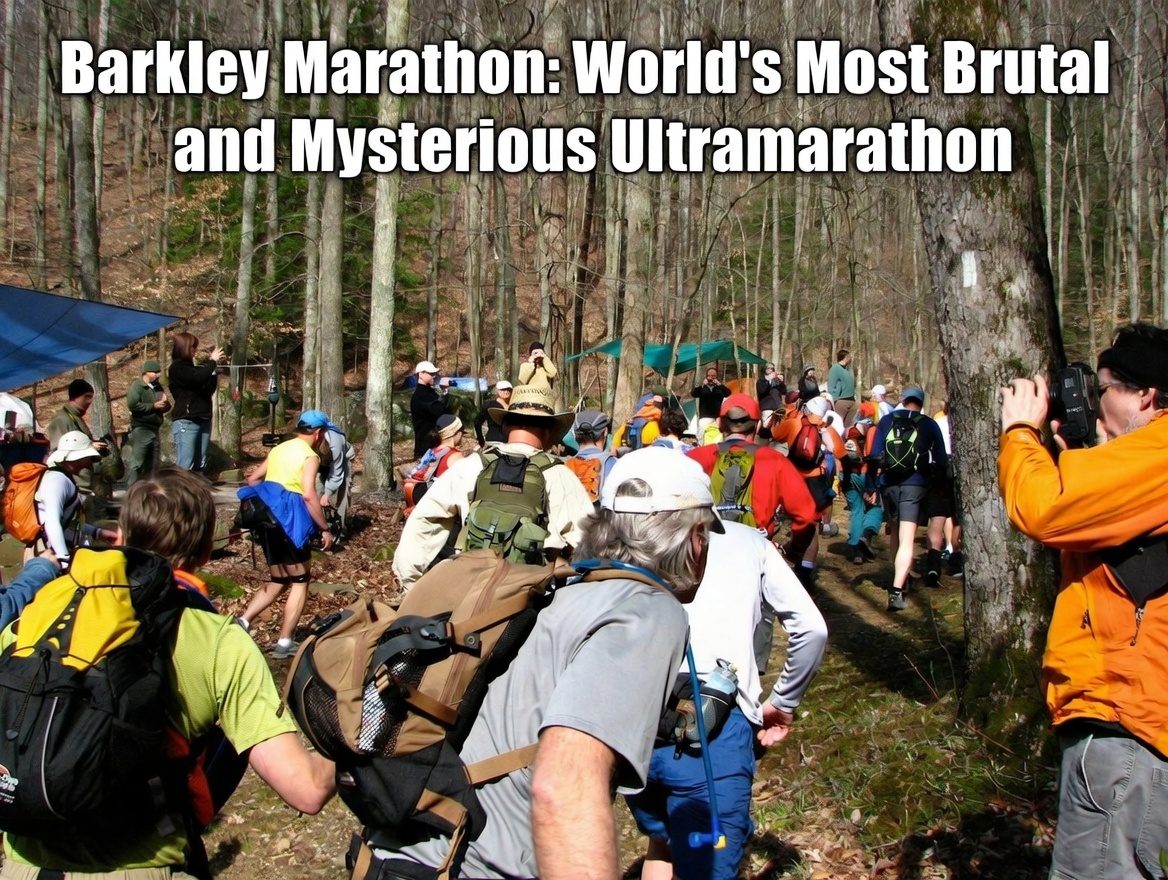

A Complete Guide to the World’s Most Brutal and Mysterious Ultramarathon
Introduction: A Race Unlike Anything Else
Most ultramarathons have aid stations, marked trails, and volunteers cheering you on. The Barkley Marathons has none of that. No GPS allowed. No pacers. No clear finish line — at least not one you’ll find easily. And the entry process? It involves a secret application, a $1.60 entry fee, and a letter of condolence from the race director.
Every year, a small group of elite runners descend on Frozen Head State Park in Tennessee to attempt one of the most savage events in endurance sports. Most of them fail. In fact, after nearly 40 years of running, fewer than 20 people have finished the full course.
“The Barkley Marathons has become a legend precisely because it seems impossible — and occasionally, it isn’t.”
Whether you’re a seasoned ultrarunner, a curious observer, or someone who just watched the Netflix documentary and wants to know more — this is your definitive guide to the Barkley Marathons.
1. What Is the Barkley Marathons?
The Barkley Marathons is an ultramarathon held annually in Frozen Head State Park near Wartburg, Tennessee. Runners attempt to complete five loops of a roughly 20-mile course within 60 hours. That’s about 100 miles total — though the exact distance is deliberately kept vague by race director Gary ‘Lazarus Lake’ Cantrell.
The race isn’t really about running. It’s about navigation. There are no trail markers. Runners must find books hidden along the course and tear out specific pages to prove they completed each loop. Without the right pages, your loop doesn’t count.
Quick Snapshot:
| Category | Details |
| Location | Frozen Head State Park, Tennessee, USA |
| Distance | ~100 miles (5 loops of ~20 miles) |
| Elevation Gain | ~60,000+ feet (more than Everest twice) |
| Time Limit | 60 hours |
| Entry Fee | $1.60 (plus a pack of cigarettes for Lazarus Lake) |
| Finishers All-Time | Fewer than 20 (as of 2025) |
| Race Director | Gary ‘Lazarus Lake’ Cantrell |
2. The History Behind the Race
The Barkley Marathons was born from a prison escape. In 1977, James Earl Ray — the man convicted of assassinating Dr. Martin Luther King Jr. — escaped from Brushy Mountain State Penitentiary in Tennessee. After 55 hours, he was recaptured. He had covered roughly 8 miles.
Gary Cantrell heard this and reportedly thought: ‘I could do at least 100 miles in that time.’ That spark of competitive spirit, mixed with Cantrell’s love of off-trail navigation, led to the first Barkley Marathons in 1986.
The race is named after Barry Barkley, Cantrell’s friend who helped establish the original course. For the first 11 years, nobody finished. The course and rules have evolved over time, but the philosophy remains: build something that truly tests the limits of human endurance and navigation.
Fun Fact: The prison that inspired the race, Brushy Mountain, is now a tourist attraction and whiskey distillery — a very Tennessee ending to a very Tennessee story.
3. Why Is It Called ‘The Race That Eats Its Young’?
The phrase ‘the race that eats its young’ captures something real about what happens at Barkley. Many of the runners who show up are at the peak of their careers — accomplished ultrarunners, mountain specialists, adventure racers. And the course breaks them anyway.
New runners — especially those who arrive overly confident — tend to suffer the most. The terrain is relentless, the navigation is punishing, and the psychological pressure accumulates in ways that no training can fully prepare you for.
‘Eating its young’ also reflects how the race treats first-timers. Veterans know the terrain, know how to pace, know where the books are hidden. Newcomers are essentially guessing, often guided by others, and frequently drop out before completing even a single loop.
The name isn’t meant to be cruel. It’s meant to be honest. This race has no interest in being conquerable on your first try — or your fifth.
4. The Course: Geography, Elevation, and Terrain
Frozen Head State Park sits in the Cumberland Mountains of eastern Tennessee. The park’s highest point, Frozen Head Mountain, tops out at 3,324 feet. But what makes the Barkley course so brutal isn’t the peak altitude — it’s the relentless, repeated climbing.
Each loop involves approximately 12,000–13,000 feet of elevation gain. Multiply that by five loops, and you’re looking at over 60,000 feet of total ascent. For context, that’s more vertical gain than climbing Mount Everest from sea level — twice.
Key Features of the Course
- No trail markers of any kind — pure orienteering
- Dense, thorny undergrowth nicknamed ‘briers’
- Steep, wet, and often muddy slopes
- Night sections that force runners to navigate in the dark
- Weather that swings from freezing cold to intense heat within a single race
The books — which runners must find to prove loop completion — are placed at remote, hard-to-reach locations. Their hiding spots are known only to experienced Barkley veterans and are part of the race’s jealously guarded secrets.
Visual Suggestion: An infographic comparing Barkley’s elevation gain to Everest, Kilimanjaro, and other major ultramarathons would perform exceptionally well here.
5. The Rules — and the Secrets
The Barkley Marathons has rules. They’re just not always public ones.
The Rules Everyone Knows
- No GPS devices allowed during the race
- No pacers — you run solo or in a group, but no dedicated support runners
- You must tear out the correct page from each hidden book on each loop
- Five loops must be completed within 60 hours
- Loops alternate direction — odd loops go clockwise, even loops go counter-clockwise
The Traditions That Aren’t ‘Official’ Rules
The race starts with a conch shell blown by Laz — but the exact start time is announced only one hour before it happens. There’s also a yellow gate where runners must check in. Miss the gate and your loop is invalid.
When runners drop out, a bugle plays ‘Taps.’ When someone quits, Laz himself often accepts the runner’s bib number in a quiet, almost ceremonial exchange. The race has a culture of dark humor and mutual respect that exists nowhere else in the sport.
6. Who Can Enter? The Application Process
The Barkley Marathons has no open registration portal. There’s no website where you sign up. Instead, you write a letter to Gary Cantrell explaining why you deserve to run. The format, address, and deadline are shared through informal channels — sometimes on a forum, sometimes through word of mouth.
If selected, you receive a letter of condolence in response. This is your acceptance notice. The entry fee is $1.60 — about what a pack of cigarettes cost in 1986 — plus a pack of cigarettes for Laz himself (though he reportedly quit smoking years ago, the tradition continues).
What Makes a Strong Application?
- A demonstrated history of completing hard, mountainous ultramarathons
- Navigation experience — ideally in rugged terrain
- A unique angle or story that catches Laz’s attention
- Humility — overconfidence is reportedly a red flag
There are typically 35–40 spots available per year, including a slot reserved for the ‘human sacrifice’ — a first-time runner chosen specifically because Laz believes they have no chance of finishing.
7. Finish Rate: How Many People Actually Complete It?
This is the number that stops people in their tracks. Since 1986, fewer than 20 runners have completed all five loops within the 60-hour cutoff. That’s across nearly 40 years of attempts.
Most years, nobody finishes at all. The first finisher in history was Mark Williams in 1995 — nine years after the race began. Some years see multiple finishers; many years see none.
| Loop | Difficulty | % Who Complete It |
| Loop 1 | Hard | ~60–70% of starters |
| Loop 2 | Very Hard | ~20–30% of starters |
| Loop 3 (Fun Run) | Brutal | ~10% of starters |
| Loops 4–5 | Extreme | Fewer than 5% of starters |
Completing three loops earns you the ‘Fun Run’ — a semi-official designation that Laz created because he felt bad that so many runners were getting nothing for three loops of suffering. It’s not a real finish, but runners who earn it wear the badge proudly.
The Barkley Marathons finish rate is below 1% historically. Fewer than 20 runners have completed all five loops in nearly 40 years of racing, making it the lowest completion rate of any known ultramarathon in the world.
8. Famous Finishers and Legendary Attempts
The list of Barkley finishers is short enough to memorize. But the stories behind those finishes are remarkable.
Notable Finishers
Mark Williams (1995): The first finisher in Barkley history. He completed the race with 29 seconds to spare — one of the tightest finishes in the race’s history.
Jared Campbell: The only runner to have finished the Barkley Marathons three times. His navigational skill is widely considered unmatched in the field.
John Kelly (2017): His finish — captured in the documentary ‘The Barkley Marathons: The Race That Eats Its Young’ — became the race’s most famous moment and introduced millions to the event.
Gary Robbins: Has the most iconic near-finish in Barkley history. He crossed the finish gate in 2017 — by going the wrong direction, making his loop invalid. He was 14 seconds over time the following year.
These stories aren’t just about athletic achievement. They’re about obsession, preparation, and what happens when human determination meets an obstacle designed to be unbeatable.
9. Training for the Barkley Marathons
Nobody trains ‘for’ the Barkley Marathons the way you’d train for a marathon. The event is too unpredictable, too unique, and too dependent on navigation skill. But certain elements of preparation can make a difference.
Physical Preparation
- Build your ability to climb steep, off-trail terrain for 12+ hours at a time
- Train at night — regularly. Your night navigation must be as strong as your daytime navigation
- Practice moving through dense, thorny undergrowth without losing time or morale
- Build extreme heat and cold tolerance — Tennessee weather is wildly variable in April
- Train for 60+ continuous hours of effort, including sleep deprivation
Mental and Navigation Preparation
- Study map and compass navigation in complex, wooded terrain
- Deliberately practice finding unmarked points in dense forest
- Learn to make decisions with incomplete information under fatigue
- Build a relationship with experienced Barkley runners — insider knowledge matters
There are no official training plans for the Barkley Marathons. Most competitors build their own programs from years of ultrarunning experience. The rule of thumb: if your training doesn’t scare you a little, it’s not hard enough.
10. The Barkley Marathons vs. Other Ultramarathons
Ultrarunning has no shortage of brutal events. So what separates the Barkley from races like the UTMB, Western States, or the Hardrock 100?
| Feature | Barkley | UTMB | Western States | Hardrock 100 |
| Distance | ~100 mi | ~106 mi | 100 mi | 100 mi |
| Elev. Gain | 60,000+ ft | 32,900 ft | 18,090 ft | 33,050 ft |
| Time Limit | 60 hrs | 46.5 hrs | 30 hrs | 48 hrs |
| Aid Stations | None | Many | Many | Some |
| GPS Allowed | No | Yes | Yes | Yes |
| Finish Rate | <1% | ~40–50% | ~60–70% | ~70% |
| Application | Secret letter | Lottery | Lottery | Lottery |
The difference is stark. Every other major ultramarathon is designed so that strong, prepared runners can finish. The Barkley is designed so that almost nobody can.
11. Frequently Asked Questions (FAQ Schema)
What does ‘the race that eats its young’ mean?
It refers to how the Barkley Marathons defeats even its most talented, experienced participants. Elite ultrarunners who might excel anywhere else frequently fail here. The phrase captures the race’s reputation for humbling everyone who enters.
Where exactly is the Barkley Marathons held?
The race takes place in Frozen Head State Park, near Wartburg in Morgan County, Tennessee. The park spans about 24,000 acres in the Cumberland Mountains.
Is the Barkley Marathons open to the public to watch?
Yes. Spectators can visit Frozen Head State Park during race weekend. There’s a campground near the start/finish area where many fans gather. It’s informal and low-key compared to most major races.
How long is the Barkley Marathons in miles?
Officially, the race director says the course is ‘about 100 miles.’ Independent analysis suggests the actual distance may be closer to 130 miles when the off-trail nature of the route is accounted for. Laz has never confirmed an exact figure.
Has anyone ever finished the Barkley Marathons on their first attempt?
Very rarely. A small number of runners have finished on their first attempt, but it’s extraordinarily uncommon. Most finishers have attempted the race multiple times before completing it.
What is the ‘Fun Run’ at the Barkley Marathons?
Completing three of the five loops earns you the Fun Run designation — an unofficial acknowledgment that you survived more than most. There’s no medal, but it’s considered a significant achievement among Barkley participants.
Why is the entry fee only $1.60?
The fee was set at the cost of a pack of cigarettes in 1986 — the year the race began. It’s never changed. The race has never been commercialized, and the low fee is part of its anti-establishment identity.
12. The Documentary: Why the World Finally Noticed
The 2014 documentary ‘The Barkley Marathons: The Race That Eats Its Young’ by directors Annika Iltis and Timothy Kane introduced millions of people to the race. It follows the 2012 event, which saw a rare multi-finisher year, including Jared Campbell and Jonathan Basham.
The film is available on various streaming platforms and remains one of the most-watched endurance sports documentaries ever made. It captures not just the physical suffering, but the culture, the humor, and the strange beauty of the race.
If you haven’t seen it, start there. Then come back here.
13. The Culture and Philosophy of the Barkley
The Barkley Marathons isn’t just a race — it’s a statement. Laz has repeatedly said that he designed the race to be one that could not be won by physical talent alone. You also need intelligence, navigation skill, mental resilience, and experience.
That philosophy runs counter to modern endurance sports, which have become increasingly professional, commercialized, and data-driven. The Barkley exists in deliberate opposition to all of that. There are no sponsors plastered on the course. No live tracking app for fans to follow at home. No prize money.
“The Barkley is a reminder that some things in life should be hard, and that difficulty itself has value.” — paraphrased from multiple Laz interviews over the years
The culture attracts a specific kind of person: someone who isn’t doing this for recognition, prize money, or even to ‘win.’ They’re doing it because the challenge itself is the point.
Key Takeaways
Here’s what you should walk away knowing:
- The Barkley Marathons is a ~100-mile ultramarathon in Tennessee with a 60-hour time limit and no trail markers, GPS, or aid stations.
- Fewer than 20 people have finished in nearly 40 years — a completion rate below 1%.
- The race starts with a secret application process and a $1.60 entry fee. There’s no public registration.
- The course involves 60,000+ feet of elevation gain — more than climbing Everest twice.
- The 2014 Netflix documentary introduced millions to the race and remains essential viewing.
- The Barkley isn’t designed to be won. It’s designed to test whether winning is even possible.
What to Read and Watch Next
If the Barkley Marathons has you hooked, here’s where to go deeper:
- Watch: ‘The Barkley Marathons: The Race That Eats Its Young’ (2014) — available on multiple streaming platforms
- Read: iRunFar’s annual Barkley Marathons coverage for race-day updates and athlete interviews
- Explore: Frozen Head State Park’s official site if you want to visit and see the terrain yourself
- Follow: Gary Cantrell’s occasional interviews and talks — he is a remarkably thoughtful and articulate speaker about the race’s philosophy
| About This Article
This guide was researched and written by a specialist in endurance sports and outdoor adventure. Sources include race director interviews, athlete accounts, the 2014 documentary, iRunFar race coverage, and official Frozen Head State Park records. Content is reviewed and updated annually. Last updated: February 2026. |
Discover more from MatterDigest
Subscribe to get the latest posts sent to your email.