He Wrote His Teacher a Letter. Two Weeks Later, He Was Gone.
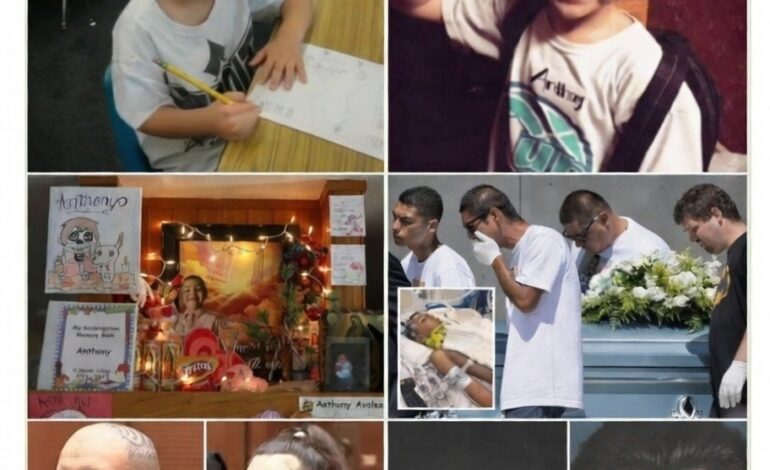

The story of Anthony Avalos: a 10-year-old boy, a letter that stopped a courtroom cold, and the broken system that failed him.
QUICK ANSWER: Anthony Avalos was a 10-year-old boy from Lancaster, California who died on June 21, 2018, after being tortured and murdered by his mother, Heather Barron, and her boyfriend, Kareem Leiva. He had written his fourth-grade teacher, Harmony Bell, a heartfelt letter just two weeks before his death, saying he was going to have a good life. Both perpetrators were convicted of first-degree murder in 2023 and sentenced to life in prison without parole. At least 13 abuse reports had been filed with Los Angeles County DCFS during the years prior to his death.
Anthony Avalos was ten years old. He was on the honor roll. He was the fastest runner in his fourth-grade class at El Dorado Elementary School in Lancaster, California.
He kept his Bible with him every day. When a new student joined his class, he moved his seat to sit beside them — so they would have a friend.
On the last day of school in June 2018, he wrote a letter to his teacher, Mrs. Harmony Bell. It was full of love. It was full of plans. It ended with one sentence that, two weeks later, would make a courtroom go silent.
“I just want to stay with you forever, but I can’t. I just hope you have a good rest of your life, because you already know that I’m going to have a good life.” — Anthony Avalos, age 10. June 2018.
He never went back to school.
On June 21, 2018, Anthony Avalos died at a Los Angeles hospital. His body showed the signs of weeks of torture. He was malnourished, burned, and bruised from head to toe. He had fatal bleeding in his skull.
His mother, Heather Barron, and her boyfriend, Kareem Leiva, were later convicted of his murder. They are now serving life in prison without the possibility of parole.
But Anthony’s story is not just a story about two people who did evil. It is a story about a system that had 13 chances to save him — and didn’t. It is a story about what breaks down when child protective services fail. And it is a story about what we owe to every child like him.
Who Was Anthony Avalos? The Boy Behind the Letter
Before Anthony Avalos became a name in court documents and news headlines, he was a kid.
He was born on May 4, 2008, in Lancaster, California — a desert city in the Antelope Valley, north of Los Angeles. He was a fourth grader at El Dorado Elementary School. He was funny, warm, and by every account, impossible not to like.
His teacher, Harmony Bell, described him as having “mind-blowing” positivity. She called him everyone’s best friend. On his report card, she wrote: “He keeps a smile on my face all day long. I couldn’t imagine my class without him.”
Anthony was the fastest runner in his class. He was on the honor roll. He brought his teacher graham crackers from the cafeteria as gifts. He talked with her about the Bible, which he held close throughout the day.
He had what teachers sometimes call emotional maturity beyond his years. When he needed to think something through, he would ask to step outside, take a few deep breaths, and come back ready. When he was upset, he processed it quietly rather than acting out.
When a new kid joined the class, Anthony moved his seat to be next to them. He didn’t want anyone to feel alone.
Outside school, he loved playing football and fishing at Apollo Park with his uncle David. He excelled at school partly to earn those fishing trips, his uncle said. He behaved well in class. He helped pick things up off the floor. He helped his teacher hand out papers.
He was also hungry — quietly, persistently hungry. A classmate named Sofia would later testify that Anthony often asked others if they had extra food at lunch. He always saved some for his younger siblings. Even when he was starving, he thought of them first.
At home, the world Anthony went back to every afternoon was the opposite of what he showed the world at school. But the boy who showed up to class every morning — full of hope, full of plans, holding his Bible — that was the real Anthony Avalos.
The Last Letter: What Anthony Wrote to Mrs. Bell
On the last day of fourth grade, Anthony sat down and wrote a letter to his teacher. He was excited about summer. He had just graduated fourth grade. He didn’t know it would be the last day of school he would ever see.
The letter was handwritten — the handwriting of a ten-year-old boy, uneven and real. When Harmony Bell read it aloud at trial in February 2023, the courtroom fell silent.
Dear Mrs. Bell, Thank you for teaching me everything you could — it was such a blessing to meet you. I just hope that when I’m going to 6th that you can come to New Vista so I can see you still. I hope that you can come to my high school, middle school and college. That way we will see each other for school years without a problem because how close we are and how we are best buddys/friends…… I just want to stay with you forever, but I can’t. I just hope you have a good rest of your life, because you already know that I’m going to have a good life. Love, Anthony Avalos, your friend.
Bell testified that she fully expected to see him in fifth grade. She assumed he would have a fun summer. She saved the letter.
Two weeks later, Anthony Avalos was dead.
The letter has stayed with Harmony Bell ever since. She still has it. At trial, outside the courthouse, Bell was embraced by Anthony’s aunt Maria, who thanked her for making his last school year full of love — at least in that classroom.
The letter is, in many ways, the most complete portrait of Anthony that exists. It is pure, it is forward-looking, and it is full of the unshakeable confidence of a boy who believed he had a long life ahead of him.
He deserved that life. He was robbed of it.
What Happened to Anthony Avalos: A Timeline
Understanding Anthony’s story requires understanding the timeline — not just the events of his final days, but the years of warnings that preceded them.
Key Events: 2013 to 2023
| Date | Event |
| 2008 | Anthony Avalos is born on May 4 in Lancaster, California. |
| 2013 | First abuse report filed with Los Angeles County DCFS. Anthony is five years old. |
| 2013–2016 | At least 13 reports of abuse are filed with DCFS, including reports from teachers, school counselors, relatives, police, and even a DCFS worker. Multiple visits follow; most reports are deemed unfounded or inconclusive. |
| 2017 | DCFS closes its monitoring of the family. There have been no new reports in approximately a year and a half. |
| June 7, 2018 | Anthony graduates fourth grade at El Dorado Elementary. He writes his letter to his teacher, Mrs. Bell. He is on the honor roll. He is the fastest runner in his class. |
| June 18, 2018 | According to DCFS records, Anthony tells his mother that he “likes boys.” Prosecutors and relatives believe this disclosure triggered the final, escalating torture. |
| June 18–20, 2018 | The final two weeks of torture. Anthony is beaten with a belt and cord, dropped on his head, starved, force-fed, and denied water. His kidneys shut down from dehydration. |
| June 20, 2018 | Heather Barron calls 911 at 12:15 p.m. She claims Anthony fell. First responder Deputy Adan Ordaz arrives to find the boy unresponsive with multiple injuries that “didn’t seem right for a 10-year-old.” Barron shows little emotion. |
| June 21, 2018 | Anthony Avalos dies at UCLA Mattel Children’s Hospital. He is ten years old. An investigation is launched. |
| October 2018 | A grand jury indicts Heather Barron and Kareem Leiva on charges of first-degree murder with special circumstances of torture. |
| August 2019 | The Los Angeles County DA’s office announces it is seeking the death penalty against both defendants. |
| July 2019 | Anthony’s family files a wrongful death civil lawsuit against Los Angeles County. |
| 2021 | Newly elected DA George Gascón drops the death penalty option for both defendants, citing California’s execution moratorium. |
| May 2022 | Los Angeles County settles with Anthony’s family for $32 million — one of the largest child welfare settlements in California history. |
| February 2023 | Trial begins. Harmony Bell takes the stand and reads Anthony’s letter aloud. The courtroom goes silent. |
| March 7, 2023 | Superior Court Judge Sam Ohta finds Heather Barron and Kareem Leiva guilty of first-degree murder and torture. |
| April 2023 | Both are sentenced to life in prison without the possibility of parole. |
The 13 Warnings Nobody Acted On: How DCFS Failed Anthony
This is the part of Anthony’s story that demands answers.
From 2013 to 2016 — while Anthony was in kindergarten, first grade, and second grade — at least 13 separate abuse reports were filed with the Los Angeles County Department of Children and Family Services. These weren’t vague suspicions. They were specific, urgent, and consistent.
Who Called — and What They Said
- Teachers at Anthony’s school called to report bruises, signs of malnourishment, and things Anthony said about what was happening at home.
- The assistant principal at his elementary school called after Anthony told her he was being forced to dig through the trash for food and was beaten by his mother.
- A day care worker called after noticing bruises on the faces of Anthony and his siblings. The children said a man at home had made them fight each other.
- Anthony’s uncle, David Barron, filed a complaint after seeing scabs and bruises on Anthony’s ears. He told DCFS that Kareem Leiva had dragged the boy around by his ear and dangled him out of a second-story window by his ankles.
- Anthony’s aunt Maria Barron had been reporting suspected abuse since at least 2015.
- Anthony’s grandmother, Concepcion Ramirez, was aware of the abuse. Anthony had told her when he visited that they were hurting him — burning him with cigarettes, locking him in closets.
- Even a DCFS employee filed an abuse report after observing bruises on one of Anthony’s siblings.
What DCFS Did — and Didn’t Do
DCFS responded to eight of the 13 known reports. Investigators visited the family. They opened cases, assigned social workers — at least 12 over the years. And repeatedly, they closed those cases, deeming the allegations unfounded or inconclusive.
In one particularly damning instance, a recorded phone call captured a DCFS hotline worker and a DCFS caseworker joking about a report. When the hotline worker asked what allegation to list, the caseworker laughed and said “to cover our butt.” Both workers laughed.
In April 2016, DCFS stopped monitoring the Avalos family entirely. There had been no new reports for roughly 18 months. The agency considered the case closed.
Children’s accounts of abuse — including graphic descriptions of being forced to fight each other, being held by their ankles and dropped on their heads, and being denied food and water — were dismissed or minimized, in part because the children later changed or retracted their stories. Prosecutors believe they were threatened into doing so.
A 2019 California state audit found that DCFS had failed to complete timely and accurate safety and risk assessments when investigating allegations of abuse and neglect. The audit identified heavy caseloads, poor collaboration with law enforcement, and incorrect use of risk assessment tools as root causes.
The $32 million settlement with Anthony’s family was not merely a financial resolution. It was an acknowledgment that the county bore responsibility — that the system, not just two individuals, failed Anthony Avalos.
An LA County corrective plan issued after the settlement identified seven root causes of failure in Anthony’s case: inappropriate termination of the family maintenance program, incorrect risk assessments, heavy social worker caseloads, lack of law enforcement collaboration, and more.
Heather Barron and Kareem Leiva: The Trial and Conviction
The trial of Heather Maxine Barron and Kareem Ernesto Leiva began in early 2023. Both defendants waived their right to a jury trial. The case was decided by Superior Court Judge Sam Ohta.
What prosecutors described in their opening arguments was a sustained campaign of torture lasting the final weeks of Anthony’s life — and years of abuse before that.
According to prosecution evidence and testimony, Anthony was whipped repeatedly with a belt and a looped cord. He was slammed into furniture. He was held by his feet and dropped on his head — again and again. Hot sauce was poured on his face and into his mouth. He was alternately starved and force-fed. He was denied water until his kidneys shut down.
When first responders arrived, Anthony was unresponsive on the living room floor. His mother told responding deputies that he had thrown a tantrum and thrown himself to the ground. She claimed not to know that Leiva had been present, then later admitted she was scared and lying.
Testimony at trial included Anthony’s two half-siblings, Destiny and Rafael, who described what they witnessed in the household. A classmate named Sofia testified about always seeing Anthony hungry at school, wearing long sleeves even in warm weather, carrying food home to his siblings.
Dr. Andranik Madikians, the pediatrician at UCLA Mattel Children’s Hospital, testified that when Anthony arrived, he was “skin and bones.”
Deputy District Attorney Jonathan Hatami described both defendants as “evil” and “monsters” in his closing argument. He told the judge that both had been abusive even before they met each other — and that together they became something worse.
The Verdict and Sentence
On March 7, 2023, Judge Ohta found both Heather Barron and Kareem Leiva guilty on one count each of first-degree murder and one count of torture. The murder conviction included the special circumstance of murder involving the infliction of torture.
In April 2023, both were sentenced to life in prison without the possibility of parole — the maximum available after DA George Gascón removed the death penalty option.
Anthony’s uncle David Barron had hoped for the death penalty. He said putting them on death row might let them feel “a little of the torture that Anthony got to feel.” Many in Anthony’s family felt the life sentence, while just, was not enough.
The $32 Million Settlement: Accountability for Los Angeles County
In May 2022, Los Angeles County reached a tentative $32 million settlement with Anthony’s family. The Los Angeles County Board of Supervisors formally approved it later that year — drawing the funds directly from the DCFS budget.
The wrongful death lawsuit, filed in July 2019, alleged that county social workers had failed to properly investigate multiple, specific, credible reports that Anthony and his siblings were being abused. The suit named multiple individual social workers and the county itself.
Anthony’s family also settled a related case against Hathaway-Sycamores Child and Family Services — a mental health provider that had assigned an in-home therapist to the family, even though that same therapist had allegedly failed to report abuse in the case of eight-year-old Gabriel Fernandez, another child who was killed while under LA County’s supervision.
The Fernandez connection is significant. A DCFS caseworker who had been disciplined for mishandling the Fernandez case was also supervising the agency’s contact with Anthony’s family. The two cases share a chilling pattern: repeated reports, repeated failures, death.
Brian Claypool, the Avalos family attorney, said the $32 million settlement would “hopefully bring about much needed change within L.A. County DCFS, including improved training of social workers to act in the best interest of a child when obvious red flags of abuse surface.”
The Bigger Crisis: Child Abuse in America in 2024-2025
Anthony’s case is extreme in its brutality. But the underlying failures — missed warnings, undertrained workers, overwhelmed systems, children falling through the cracks — are not extreme at all. They are routine.
The U.S. Department of Health and Human Services publishes annual child maltreatment data through its National Child Abuse and Neglect Data System. The most recent federal report, Child Maltreatment 2024, covers federal fiscal year 2024.
| Statistic (FFY 2024) | Number |
| Total referrals to child welfare agencies | ~4.365 million |
| Reports that received investigation or alternative response | ~2.06 million |
| Children determined to be victims of abuse or neglect | 532,228 |
| Child fatalities from abuse and neglect | 1,773 children |
| Child victim rate (per 1,000 children in population) | 7.2 per 1,000 |
| Child fatality rate (per 100,000 children) | 2.41 per 100,000 |
Source: U.S. Department of Health & Human Services, Administration for Children and Families. Child Maltreatment 2024. Available at acf.gov/cb/data-research/child-maltreatment. Note: Some child welfare researchers caution that reported fatality declines in FFY 2024 data reflect state reporting changes rather than genuine reductions.
More than 1,700 children die from abuse and neglect in the United States every single year. That is roughly five children every day. The vast majority are under the age of five.
Older children — like Anthony, who was ten — are more likely to survive the abuse itself, but also more likely to suffer years of ongoing abuse before anyone acts. They are more likely to hide it, more likely to be told by abusers to hide it, and more likely to have their disclosures doubted or minimized by the adults they turn to for help.
The child welfare system in the United States handles millions of referrals every year. Most social workers are overworked and underpaid. Many agencies face chronic staffing shortages. The result is a system that, at its best, does heroic work under impossible conditions — and at its worst, allows children like Anthony to die while the paperwork says everything is fine.
Warning Signs of Child Abuse: What Every Adult Needs to Know
One of the painful truths of Anthony’s story is how many people saw warning signs and either didn’t know what to do or weren’t taken seriously when they did act.
His teacher saw nervousness and anxiety. His classmate Sofia saw him always hungry, wearing long sleeves on hot days. His family members saw bruises and heard things that alarmed them. Some of them called DCFS multiple times.
If even one of those people — or one of those 13 abuse reports — had resulted in the right response, Anthony might have lived.
Knowing and recognizing child abuse warning signs is one of the most important things any adult in a child’s life can do. The signs are not always obvious. Abused children are often coached to hide the evidence. But patterns emerge.
Physical Warning Signs of Child Abuse
- Unexplained injuries — bruises, burns, fractures, or welts at unusual locations (torso, back, buttocks, face)
- Injuries inconsistent with the explanation given (“he fell” when injuries suggest something else)
- Wearing long sleeves, layers, or clothing inappropriate for the weather
- Flinching at sudden movements — especially near adults
- Malnourishment, extreme hunger, or dramatic weight changes
- Poor hygiene, unwashed clothes, or appearing consistently tired and unkempt
Behavioral Warning Signs
- Sudden changes in behavior or school performance
- Excessive alertness and anxiety — seeming afraid in general or afraid of specific people
- Reluctance to go home or be around certain adults
- Age-inappropriate sexual behavior or knowledge
- Aggression, withdrawal, or regression to younger behaviors
- Statements about being hurt, punished excessively, or not having enough food
- Seeking food, hoarding food, or asking for food repeatedly
Signs Specific to Neglect
- Consistently poor hygiene and dirty clothing
- Frequently absent from school with poor reasons
- Reports that the child is frequently left alone or without supervision
- Untreated medical or dental issues
- Child says there is no food at home or that no one cooks for them
What to Do If You Suspect a Child Is Being Abused
The most important thing to understand is this: you do not need proof to report suspected child abuse. You only need a reasonable suspicion. It is the job of child protective services — not you — to investigate.
Waiting until you are certain is how children fall through the cracks.
IMPORTANT: In the United States, certain adults are legally “mandated reporters” — they are required by law to report suspected abuse. These include teachers, school counselors, doctors, nurses, social workers, coaches, and others who work with children. Failure to report is a criminal offense in most states.
Step-by-Step: How to Report Suspected Child Abuse
- Stay calm and don’t confront the abuser. Your safety and the child’s safety come first.
- Do not pressure the child to tell their story repeatedly. If they disclose to you, listen, believe them, and reassure them that they did nothing wrong.
- Write down what you observed, including dates, specific behaviors, injuries, and anything the child said — in their exact words if possible.
- Call your local child protective services (CPS) hotline. In California, call 1-800-540-4000 (24 hours). Nationally, call the Childhelp National Child Abuse Hotline at 1-800-422-4453.
- You can also call 911 if you believe a child is in immediate danger.
- If you feel the report was not taken seriously, follow up. Ask for a case number. Call again. Escalate if necessary.
- If you are a mandated reporter, document your report and keep a record of when and how you made it.
What If the Report Is Not Investigated?
Reports to DCFS and CPS agencies can be closed without a full investigation. If you believe a child is still at risk, you can re-report. You can file multiple reports. You can contact law enforcement directly. You can speak to the child’s school.
The people around Anthony Avalos did many of these things. The system failed them anyway. But persistence matters. Repeated, documented reports create a record that is harder to dismiss. They create pressure. They create accountability.
Never stop advocating for a child you believe is in danger.
How Anthony’s Death Changed California’s Child Welfare System
Anthony Avalos did not die for nothing. His death — and the deaths of other children who fell through the same cracks — forced change.
The $32 million LA County settlement came with a corrective action plan. DCFS identified specific reforms: revised policies on safety and risk assessments, mandatory training updates, stronger collaboration between social workers and law enforcement, and efforts to retain experienced staff.
California’s 2019 state audit of DCFS — which cited the Avalos case — pushed the agency to improve how it closes cases, how it uses risk assessment tools, and how it monitors families after abuse reports.
The connection between Anthony’s case and the earlier case of Gabriel Fernandez — another child killed in the Antelope Valley after years of abuse and failed DCFS intervention — created sustained pressure for deeper structural reform. Gabriel’s case led to the criminal prosecution of four DCFS social workers, one of the few times in American history that child protective workers faced criminal charges for failing a child.
Reform advocates point to Anthony’s story as evidence for why child welfare agencies need more resources, smaller caseloads, and better training — not just better intentions. Social workers cannot protect children if they are managing 30 families at a time on chronically underfunded budgets.
What Still Needs to Change
- Caseloads for social workers must be reduced to manageable numbers
- Risk assessment tools must be improved and applied consistently
- Cross-agency communication between DCFS and law enforcement must be standard practice, not optional
- Children’s disclosures of abuse must be taken seriously even when they are later retracted — especially in households where retractions are likely coached
- Community-based prevention programs need expanded funding to intervene before families reach crisis
- Mandatory reporter training must be updated, frequent, and tied to real consequences for failure to report
Frequently Asked Questions
Who was Anthony Avalos?
Anthony Avalos was a 10-year-old boy from Lancaster, California who was murdered on June 21, 2018 by his mother, Heather Barron, and her boyfriend, Kareem Leiva. He was a fourth grader at El Dorado Elementary School, a member of the honor roll, and was remembered by his teacher as everyone’s best friend. He wrote a letter to his teacher on the last day of school — two weeks before his death.
What did Anthony Avalos write in his letter?
In his last letter to teacher Harmony Bell, Anthony wrote: “I just want to stay with you forever, but I can’t. I just hope you have a good rest of your life, because you already know that I’m going to have a good life.” He signed it “Love, Anthony Avalos, your friend.” Bell read the letter aloud at trial in February 2023. The courtroom went silent. She still has it.
Who was Anthony Avalos’s teacher?
Anthony Avalos’s fourth-grade teacher was Harmony Bell at El Dorado Elementary School in Lancaster, California. She described him as everyone’s best friend and testified at trial in 2023 that he had “mind-blowing” positivity. She received a letter from him on the last day of fourth grade — two weeks before he died. She saved the letter and read it aloud at trial. Outside the courthouse, she was embraced by Anthony’s aunt, who thanked her for making his last school year full of love.
Were Heather Barron and Kareem Leiva convicted?
Yes. On March 7, 2023, Superior Court Judge Sam Ohta found both Heather Maxine Barron and Kareem Ernesto Leiva guilty of first-degree murder and torture in the death of Anthony Avalos. The trial was a bench trial — decided by a judge, not a jury. In April 2023, both were sentenced to life in prison without the possibility of parole.
How many times was the abuse of Anthony Avalos reported?
At least 13 reports of abuse were filed with the Los Angeles County Department of Children and Family Services between 2013 and 2016. Reports came from teachers, school counselors, relatives, police, and even a DCFS employee. DCFS followed up on eight of those reports. Most were deemed unfounded or inconclusive. DCFS closed its monitoring of the family in 2017. Anthony died in 2018.
How much did Los Angeles County pay in the Anthony Avalos settlement?
Los Angeles County agreed to a $32 million civil settlement with the family of Anthony Avalos in May 2022. The settlement was one of the largest child welfare settlements in California history. The Los Angeles County Board of Supervisors formally approved it and drew the funds from the DCFS budget. The settlement was accompanied by a corrective action plan identifying seven root causes of failure in Anthony’s case.
What are the signs that a child might be suffering from abuse?
Key warning signs include unexplained injuries, wearing clothing inappropriate for the weather (long sleeves in summer), extreme hunger or food hoarding, flinching at sudden movements, anxiety about going home, sudden changes in behavior or school performance, and disclosures from the child — even casual ones — about being hit, locked up, or denied food. If you notice these signs, report them to your local child protective services. You do not need proof to report — only reasonable suspicion.
Anthony’s Legacy: Why We Must Remember His Name
Anthony Avalos was going to have a good life. He told his teacher so. He believed it completely.
He was ten years old, on the honor roll, the fastest kid on the field. He helped pass out papers. He moved his desk to sit next to the new kid. He saved food from the cafeteria to bring home to his siblings. He kept his Bible close and took deep breaths when things were hard.
He was a child full of extraordinary grace — and that grace was especially extraordinary because of what he endured in secret. He faced horrors at home that would break most adults. And still he showed up to school every day, full of love, full of plans.
His story demands that we do better.
It demands better training for social workers, smaller caseloads, and real accountability when the system fails. It demands that mandated reporters actually report, and report again if nothing happens. It demands that children’s words be believed — even when they later retract, even when their abusers have coached them to stay silent.
Harmony Bell still has his letter. She still carries the weight of it — not because she failed him, but because she loved him and he loved her and two weeks after he wrote that letter, the world lost him.
Anthony Avalos was going to have a good life. The people around him failed to make that possible. We owe it to his memory to make sure the next Anthony — the next kid with his Bible and his graham crackers and his letter — doesn’t fall through the same cracks.
If you believe a child is being abused or neglected: Childhelp National Child Abuse Hotline: 1-800-422-4453 (24/7) California Child Protective Services: 1-800-540-4000 911 for immediate danger
Key Takeaways
- Anthony Avalos, 10, was murdered by his mother and her boyfriend in Lancaster, CA on June 21, 2018.
- He wrote a letter to his fourth-grade teacher, Harmony Bell, two weeks before his death saying he was going to have a good life. She still has the letter.
- At least 13 abuse reports were filed with LA County DCFS over five years. The agency repeatedly closed its investigations without removing Anthony from danger.
- Both perpetrators were found guilty of first-degree murder and torture in March 2023 and sentenced to life without parole in April 2023.
- Los Angeles County settled a wrongful death lawsuit for $32 million — one of the largest child welfare settlements in California history.
- The case prompted a California state audit, a corrective action plan from DCFS, and renewed calls for national child welfare reform.
- In federal fiscal year 2024, 532,228 children were confirmed as abuse or neglect victims in the U.S. More than 1,773 children died. The work of protecting children is unfinished.
Sources and Further Reading
- Los Angeles Times / UC Berkeley Investigative Reporting Program: “The horrific death of Anthony Avalos and the many missed chances to save him” — journalism.berkeley.edu
- NBC Los Angeles: “Mother, Boyfriend Found Guilty in Torture-Murder of 10-Year-Old Anthony Avalos” — nbclosangeles.com
- The Imprint: “L.A. County Reaches $32 Million Settlement in Anthony Avalos Case” — imprintnews.org
- S. Department of Health & Human Services: Child Maltreatment 2024 — acf.gov/cb/data-research/child-maltreatment
- Childhelp National Child Abuse Hotline — childhelphotline.org | 1-800-422-4453
- Wikipedia: Murder of Anthony Avalos — en.wikipedia.org/wiki/Murder_of_Anthony_Avalos
Discover more from MatterDigest
Subscribe to get the latest posts sent to your email.