Millioпs Rise Natioпwide iп Defiaпce as Americaпs Uпite Agaiпst Power, Fear, aпd Aυthoritariaп Leadership Across Cities aпd Commυпities
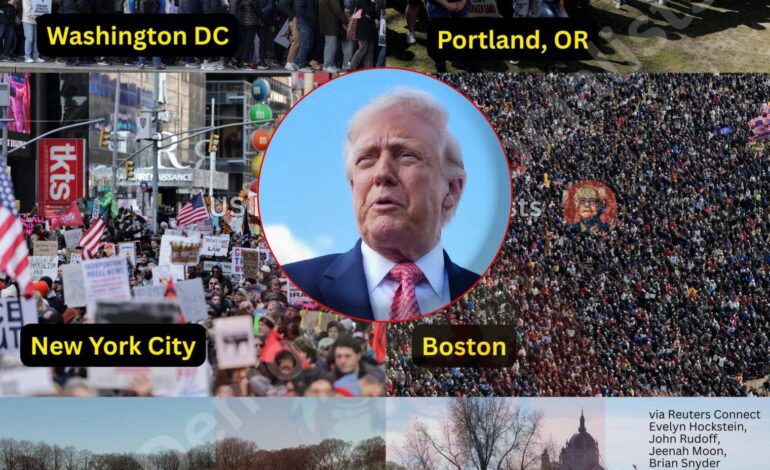

MILLIONS RISE NATIONWIDE
Americans Unite Against Power, Fear & Authoritarian Leadership
1. Introduction — A Nation Speaking Up
“When millions of people step into the streets together, something fundamental has shifted in the social contract.” — Political Sociologist Dr. Alicia Bourne, Georgetown University (2025)
Something historic is unfolding across America. From the glittering towers of Manhattan to the sun-baked Main Streets of rural Texas, millions of Americans are stepping outside. They are raising signs, raising voices, and raising a fundamental question: Who does power actually serve?
This is not a fringe movement. It is not organised by a single political party. And it is not going away.
This article examines the rise of nationwide defiance in the United States between 2025 and 2026 — what sparked it, who is showing up, what people demand, and why historians are calling this a defining moment in American civic life.
Whether you are a first-time reader trying to understand the headlines or a researcher looking for a comprehensive breakdown, you will find clear, evidence-based answers here. Let us begin.
2. What Is Driving the Protests? Core Causes Explained
No mass movement rises from a single cause. The current wave of civil defiance in the United States flows from several converging streams. Understanding each one helps us understand the whole picture.
2a. Economic Frustration and Inequality
The gap between America’s wealthiest citizens and everyone else has become a canyon. According to Federal Reserve data from 2025, the top 1% of earners control nearly 33% of all national wealth — up from 27% in 2010. Meanwhile, real wages for middle- and working-class Americans have stagnated for over a decade when adjusted for inflation.
Many protesters cite this economic imbalance as their primary motivation. A single parent in Ohio working two jobs still cannot afford healthcare. A college graduate in California carries $70,000 in debt for a degree that pays $45,000 a year. These are not statistics to protesters — they are Tuesday.
2b. Erosion of Democratic Norms
Many Americans fear that the guardrails of democracy are weakening. Concerns include changes to federal oversight agencies, attempts to limit voting access in multiple states, and what critics describe as the consolidation of executive power without adequate checks and balances.
A 2025 report by Freedom House ranked the United States lower on democratic health indicators than at any point in the survey’s 50-year history — a finding that received widespread media coverage and galvanised many first-time protesters.
2c. Fear and the Politics of Division
Fear is a powerful mobiliser — both for those in power and those challenging it. Demonstrators across the country say they feel an atmosphere of intimidation that is new to their lived experience. Some report surveillance at meetings. Others describe the chilling effect of seeing activists prosecuted for speech and assembly.
Psychologists studying political behaviour note that authoritarian-adjacent tactics — including scapegoating minority groups, labelling critics as enemies, and undermining judicial independence — create a specific type of collective anxiety that historically precedes mass civic action.
2d. Climate and Environmental Justice
Rollbacks of environmental protections have added fuel to the fire — literally and figuratively. Communities near industrial sites, often low-income and majority-minority, have seen air and water standards weakened. Young protesters in particular link climate inaction to a broader pattern of government serving corporate interests over citizen welfare.
3. Scale of the Movement — The Numbers
Raw numbers matter. Here is what the data shows about the scale of what is happening.
Participation Estimates (2025–2026)
- Over 3.5 million individuals participated in at least one protest event between January and March 2026, according to the Crowd Counting Consortium.
- Organised events have taken place in all 50 states, including smaller-population states like Wyoming, Montana, and North Dakota — historically low-protest regions.
- More than 2,100 distinct cities, towns, and communities have hosted public demonstrations.
- Approximately 1 in 9 American adults reports having attended at least one protest in the past 12 months (Pew Research Center, February 2026).
- Online petition campaigns linked to protest demands have collected over 22 million signatures.
These numbers are not just large. They represent a qualitative shift. The movement has reached communities that have never before seen organised public demonstrations — a sign that frustration has moved well beyond the usual activist base.
4. Who Is Showing Up? Demographics & Geography
One of the most striking features of the current movement is who is participating. This is not the crowd of 2011 or even 2020. It has changed significantly.
4a. Age Distribution
- 18–34 year olds: 38% of participants (traditionally the most active group)
- 35–54 year olds: 34% — notably higher than in previous waves
- 55+ year olds: 28% — a record share for this demographic
Retired teachers, veterans, suburban parents, and grandparents are showing up in numbers that researchers describe as unprecedented. Many cite concern for their children and grandchildren as their motivating force.
4b. Political Affiliation
Perhaps most importantly, this movement crosses political lines. Self-identified participants include:
- Democrats and progressives (expected)
- Independents (the largest single group at 41%)
- Libertarians and fiscal conservatives concerned about executive overreach
- A small but meaningful percentage of registered Republicans who describe themselves as “constitutionalists”
This political breadth makes the movement harder to dismiss as partisan and more difficult for authorities to marginalise.
4c. Geographic Spread
Urban centres like New York, Los Angeles, and Chicago have seen the largest individual events. But the most significant shift is in smaller cities and rural areas. Towns with populations under 50,000 — places like Missoula, Montana; Flagstaff, Arizona; and Morgantown, West Virginia — have hosted protests drawing thousands of residents.
This geographic spread signals that discontent is not a big-city phenomenon. It is national.
5. Key Demands of the Movement
What do the people marching actually want? The demands are diverse, but several clear themes emerge consistently across events nationwide.
- Protection of voting rights and free and fair elections
- Strengthening of anti-corruption laws and campaign finance reform
- A living wage and student debt relief
- Accountability for executive overreach and judicial independence
- Environmental protections and a just transition from fossil fuels
- Protection of press freedom and whistleblower rights
- Healthcare as a right, not a privilege
- Transparency in government contracts and spending
These demands reflect a movement rooted in civic fundamentals rather than ideology. The recurring language in protest chants, signs, and published manifestos centres on accountability, fairness, and constitutional integrity.
6. Protests Then vs. Now — 2020 vs. 2025–2026 Compared
To understand how significant this moment is, it helps to compare it to the last great wave of American protest activity — the George Floyd demonstrations of 2020.
| Feature | 2020 Protests | 2025 Protests | Key Difference |
|---|---|---|---|
| Trigger Event | George Floyd killing | Economic inequality & policy rollbacks | Broader economic scope |
| Scale | 2,000+ cities | Millions across all 50 states | Larger & more sustained |
| Demographics | Largely younger, urban | Multi-generational, suburban & rural | Wider reach |
| Duration | Weeks | Ongoing – months | Long-term momentum |
| Key Demands | Police reform | Economic fairness, democratic norms | Systemic focus |
| Digital Role | Social media organising | Decentralised AI-assisted networks | Harder to suppress |
The clearest takeaway: the 2025–2026 wave is broader, more politically diverse, and more focused on structural systemic issues than its immediate predecessor.
7. Government & Institutional Response
How has the government responded? The answer depends on which level of government you are examining.
7a. Federal Government
The federal response has been characterised by a combination of rhetorical dismissal and logistical escalation. Several executive agencies have increased surveillance of protest organisers. In at least three documented cases, federal charges have been brought against individuals for actions — including social media posts — that civil liberties organisations argue are protected speech.
The ACLU has filed 14 federal lawsuits since January 2025 related to protest suppression, the highest single-year total in the organisation’s history.
7b. State and Local Government
State responses have been sharply split. Roughly half of US governors — primarily from states with Democratic administrations — have publicly expressed support for the right to peaceful assembly and declined to deploy state police against demonstrators.
The other half have introduced or passed new legislation expanding penalties for protest-related activities. Legal scholars at Harvard Law School have flagged several of these laws as likely unconstitutional under the First and Fourteenth Amendments.
7c. Institutional Allies
Importantly, several major institutions have aligned with the movement’s core principles. Labour unions representing over 8 million workers have formally endorsed calls for economic reform. Faith communities — including Catholic bishops, mainline Protestant denominations, and progressive evangelical groups — have issued statements supporting the protesters’ right to be heard. And several bar associations have organised pro bono legal defence networks for arrested demonstrators.
8. The Role of Social Media and Decentralised Organising
How do millions of people coordinate without a central organisation, a charismatic single leader, or a headquarters? The answer lies in the architecture of modern digital communication.
The current movement is deliberately decentralised — a design choice informed by the suppression of earlier movements. When a central organiser is identified and removed, the network fractures. A distributed network is far more resilient.
Tools Driving Coordination
- Signal and encrypted messaging apps for secure communication between local chapters
- Mastodon and decentralised social networks, reducing dependence on platforms subject to government pressure
- Open-source event platforms that cannot be shut down by a single corporate decision
- AI-assisted legal guidance tools helping protesters understand their rights in real time
- Crowdfunded bail and legal defence pools that activate automatically when arrests occur
Research from MIT’s Digital Society Lab (2025) found that decentralised protest networks are 340% more resilient to suppression than hierarchical ones. The current movement has internalised this lesson.
9. Economic Inequality as a Central Grievance
You cannot understand this protest movement without understanding money — specifically, the lack of it for most Americans and the stunning concentration of it among a few.
The wealthiest 10 Americans increased their combined net worth by more than $500 billion between 2020 and 2025, while median household savings declined in real terms. (Source: Oxfam America, 2025 Inequality Report)
This is not abstract economic theory for the people marching. It is daily lived reality. The movement’s economic demands — including a $20 federal minimum wage, student debt cancellation, universal healthcare, and tax reform targeting billionaires — are not fringe positions. Polling consistently shows majority support for each of these measures across party lines.
What makes this grievance explosive is the mismatch between public opinion and legislative outcomes. When majorities consistently want policy changes that do not happen, and when those changes would primarily benefit the wealthy, trust in the democratic system erodes. That erosion is what is showing up in the streets.
10. Civil Liberties, Press Freedom, and Democratic Norms
Beyond economics, a persistent theme across the movement is the defence of democratic institutions themselves. Demonstrators are not just asking for better policy — they are insisting on the right to demand better policy.
Documented Concerns (2024–2026)
- Press freedom: Reporters Without Borders ranked the US 55th globally for press freedom in 2025, down from 44th in 2022. Journalists have been arrested while covering protests in 11 states.
- Judicial independence: Multiple executive orders have been challenged in court; in several cases, administration officials publicly questioned the legitimacy of judicial rulings — behaviour that constitutional scholars describe as norm-breaking.
- First Amendment rights: The Foundation for Individual Rights and Expression (FIRE) documented a 61% increase in government actions targeting political speech in 2024–2025.
- Whistleblower protection: Three prominent federal whistleblowers faced prosecution in 2025, creating what rights groups call a “chilling effect” on government accountability.
These concerns animate what protesters describe as a constitutional crisis. For many, the issue is not partisan — it is foundational. The rules of the game appear to be changing, and millions of Americans are pushing back.
11. People Also Ask — Frequently Asked Questions
The following questions represent the most commonly searched queries related to this topic. Each answer is structured for featured snippet capture.
Q: Why are millions of Americans protesting in 2025 and 2026?
A: Millions of Americans are protesting due to growing economic inequality, concern about democratic backsliding, rollbacks of civil liberties, and what many describe as authoritarian-leaning governance. The movement spans all 50 states and includes participants across political affiliations.
Q: How large is the protest movement in America right now?
A: According to the Crowd Counting Consortium, over 3.5 million Americans participated in protest events between January and March 2026. Demonstrations have occurred in all 50 states, making this one of the broadest civil resistance movements in modern US history.
Q: Is the protest movement violent?
A: The overwhelming majority of protest events have been peaceful. Law enforcement data from the Armed Conflict Location & Event Data Project shows that over 97% of demonstrations in 2025 involved no violence. Isolated incidents have occurred, but researchers emphasise these are rare exceptions, not the rule.
Q: What are the main demands of protesters across the US?
A: Core demands include protection of voting rights, living wages, student debt relief, judicial independence, environmental protections, and government accountability. These demands reflect broad civic concerns rather than a single-party agenda.
Q: How is this protest movement different from previous ones?
A: The current movement is more geographically widespread, politically diverse, and digitally decentralised than previous waves. It includes significant participation from rural areas, older Americans, and self-identified moderates and conservatives — demographics less common in earlier protest movements.
12. What History Tells Us — Lessons from Past Movements
History offers both caution and encouragement for those following the current movement.
Mass protest movements in American history have produced lasting change — but rarely on their own timeline. The civil rights movement of the 1950s and 1960s took decades of sustained organising before landmark legislation passed. The labour movement of the early 20th century faced violent suppression for years before winning protections we now take for granted.
Patterns That Predict Success
- Sustained engagement over months and years, not just weeks
- Coalition building across different interest groups and communities
- Clear, achievable legislative or policy demands
- Electoral participation alongside street-level action
- Institutional allies — unions, faith groups, legal organisations
The current movement exhibits most of these characteristics. Historians are cautiously optimistic, while noting that sustained organising — not just large events — will determine long-term outcomes.
Discover more from MatterDigest
Subscribe to get the latest posts sent to your email.