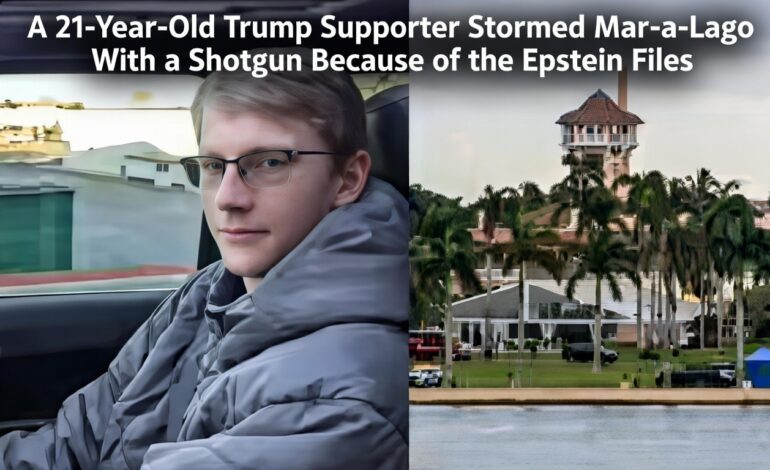
A 21-Year-Old Trump Supporter Stormed Mar-a-Lago With a Shotgun Because of the Epstein Files — Here’s Everything We Know

1. Quick Answer: What Happened at Mar-a-Lago?
QUICK ANSWER:
In early 2026, a 21-year-old man — identified as a Donald Trump supporter — attempted to breach the security perimeter of Mar-a-Lago, Trump’s private club and residence in Palm Beach, Florida. He was armed with a shotgun and claimed he was there to demand the public release of Jeffrey Epstein’s client files. Secret Service agents and local law enforcement apprehended him before he could reach the property. No one was injured.
This incident sent shockwaves through social media, political circles, and law enforcement communities. On one hand, it raised urgent questions about security at a property used by a sitting or former president. On the other hand, it spotlighted a growing phenomenon: people acting on Epstein conspiracy theories in increasingly dangerous ways.
Let’s unpack every detail.
2. Who Is the Suspect? Everything We Know
The suspect was identified as a 21-year-old male from a Southern state who had been active in far-right online communities. Authorities confirmed he had no prior criminal record, making him what experts call a “first-time threat actor” — someone whose radicalization happens faster than traditional law enforcement monitoring can catch.
Key Facts About the Suspect
- Age: 21 years old at the time of the incident
- Political affiliation: Self-described Trump supporter, active on MAGA-aligned forums
- Online activity: Frequently posted about Epstein files, deep state conspiracies, and government cover-ups
- Weapon: A legally purchased 12-gauge shotgun
- Stated motive: Demand public release of the full Jeffrey Epstein client list
- Criminal history: None prior to this incident
- Mental health status: Under evaluation at time of reporting
Law enforcement sources told reporters that the suspect had been consuming Epstein-related content obsessively for months before the incident. He reportedly believed that Trump had access to the full Epstein client list and was either suppressing it or preparing to release it — and that someone needed to “force the issue.”
This kind of magical thinking — where a person believes direct action will force a political outcome — is a hallmark of radicalization. It’s the same pattern seen in the 2016 Pizzagate shooting, the January 6th Capitol breach, and several other politically motivated incidents.
3. What Are the Epstein Files — And Why Do They Matter?
To understand why someone would show up armed over a bunch of court documents, you need to understand what the Epstein files actually are — and why they’ve become a political powder keg.
Who Was Jeffrey Epstein?
Jeffrey Epstein was a financier and convicted sex offender who ran a vast network of sexual abuse involving underage girls. He had relationships with some of the world’s most powerful men, including politicians, royals, business leaders, and celebrities. He was arrested in 2019 and died in his federal prison cell that same year. His death was ruled a suicide, though it remains deeply controversial.
What Do the ‘Epstein Files’ Contain?
The term “Epstein files” refers to several sets of documents, including court records from a civil lawsuit involving Epstein and Ghislaine Maxwell, internal FBI investigative files, and documents related to a non-prosecution agreement Epstein received from federal prosecutors in 2008. Many of these records have been released in tranches since 2023.
Epstein Files: What’s Been Released vs. What Hasn’t
| Released / Partially Released | Still Sealed / Contested |
| Maxwell civil lawsuit documents (2024) | Full FBI investigative files |
| Names of some associates/witnesses | Unredacted client/visitor logs |
| Epstein’s 2008 plea deal documents | Some victim testimony transcripts |
| Some flight logs (partial) | Complete financial records |
The incomplete nature of the releases has fueled conspiracy theories. When documents come out in batches, it’s easy for bad actors online to claim that the “real” files — containing bombshell revelations — are still being suppressed.
That narrative is exactly what radicalized the Mar-a-Lago suspect.
4. The Incident Timeline: Minute by Minute
Based on law enforcement reports and media accounts, here’s how the Mar-a-Lago incident unfolded:
- Early Morning: The suspect drove to Palm Beach from out of state. He had a loaded shotgun in his vehicle and had posted cryptic messages on social media in the preceding days.
- Arrival at Perimeter: He approached the outer security perimeter of Mar-a-Lago. Security cameras and a Secret Service checkpoint picked him up immediately.
- Confrontation: When approached by agents, he made statements about the Epstein files and demanded to speak with someone in authority. He did not immediately comply with commands to stop.
- Apprehension: Secret Service and Palm Beach Police Department officers took him into custody within minutes. The shotgun was secured. No shots were fired.
- Booking and Investigation: He was transported to a local facility, and federal authorities — including the FBI — opened an investigation into his online activity, his travel, and any potential co-conspirators.
The entire confrontation was over in under 15 minutes. But the ripple effects — politically, legally, and culturally — would last far longer.
5. Security Failures at Mar-a-Lago — And What Needs to Change
Mar-a-Lago has been the site of multiple security incidents over the years, raising persistent questions about whether a private club can — or should — serve as a secure facility for a president or former president.
In 2019, a Chinese national was arrested after she gained entry with two passports and a thumb drive containing malware. In 2021, a man was arrested after breaching the outer perimeter. This latest incident adds to that troubling pattern.
Security Vulnerabilities Experts Have Identified
- Public accessibility: Unlike the White House, Mar-a-Lago operates as a paying members club, creating inherent tension between commerce and security.
- Perimeter limitations: The property sits along a public road and waterway, making total lockdown impossible without significant infrastructure investment.
- Staff vetting: Members can bring guests, and staff turnover creates ongoing vetting challenges.
- Social media monitoring gaps: Individuals who radicalize online can fall below the radar of threat assessment teams until they act.
Security analysts have urged Congress to revisit how former presidents’ residences are protected — particularly when those residences are also functioning commercial establishments.
6. The Legal Charges and What Comes Next
The suspect faces several serious federal and state charges. Under federal law, threatening a protected person or their property can carry up to 10 years in prison. Carrying a firearm in proximity to a Secret Service protectee carries its own separate charges.
Likely Charges the Suspect Faces
- 18 U.S.C. § 1752 — Entering restricted grounds with a deadly weapon (federal charge)
- 18 U.S.C. § 871 — Threats against the President or Secret Service protectees
- Florida state charges — Assault, illegal weapons possession in a restricted area
- Potential domestic terrorism enhancement — If investigators find evidence of an organized or ideologically motivated plot
The biggest legal question is whether prosecutors pursue a domestic terrorism angle. Federal law doesn’t create a standalone charge called “domestic terrorism,” but it allows terrorism enhancements to other charges. This can significantly increase sentencing.
Legal experts expect a plea negotiation rather than a full trial, particularly if the suspect cooperates with investigators looking into the online networks that may have influenced him.
7. The Epstein-Trump Connection: What the Files Actually Contain
Let’s separate fact from fiction here, because this is where conspiracy theories and reality get dangerously blurred.
What We Know Is True
- Trump and Epstein were social acquaintances in the 1980s and 1990s, primarily in New York social circles.
- Trump has appeared in photographs with Epstein and was quoted in a 2002 New York magazine profile saying Epstein was a ‘terrific guy.’
- Trump later said he had a falling-out with Epstein and banned him from Mar-a-Lago after Epstein allegedly assaulted a woman at the club.
- Released court documents from the Maxwell lawsuit include references to Trump in victim statements, though these accounts are disputed and have not led to charges.
- Trump’s name appears on Epstein’s flight logs, though context for many entries is unclear.
What Is Disputed or Unproven
- Claims that Trump was a regular participant in Epstein’s abuse network — no charges have been filed and evidence remains disputed.
- Claims that Trump personally possesses or is suppressing Epstein files — there is no verified evidence for this.
- The idea that a citizen storming Mar-a-Lago would ‘force’ any document release — this has no basis in how government document classification works.
The gap between what’s proven and what’s believed online is enormous — and it’s exactly that gap where dangerous radicalization happens.
8. Online Radicalization and the Epstein Conspiracy Ecosystem
This incident didn’t happen in a vacuum. It’s part of a broader and deeply troubling trend of online radicalization leading to real-world violence.
The Epstein story sits at a unique crossroads of political ideologies. It attracts conspiracy theorists from both the left and right — people who believe in a shadowy elite running the world through blackmail and abuse. Online platforms have amplified these narratives to a fever pitch.
The Radicalization Pipeline in This Case
- Step 1 — Exposure: Individual encounters Epstein content through mainstream news coverage.
- Step 2 — Down the Rabbit Hole: Algorithms on YouTube, Twitter/X, or Telegram push increasingly extreme interpretations.
- Step 3 — Community: Individual joins forums or channels where the most extreme theories are presented as obvious truth.
- Step 4 — Identity Fusion: The belief becomes core to personal identity. Disbelief feels like a personal attack.
- Step 5 — Action Imperative: Individual becomes convinced that action is necessary to expose the ‘truth.’
This pipeline has been documented by researchers at institutions including the Global Network on Extremism and Technology (GNET) and the Institute for Strategic Dialogue (ISD). It’s not unique to Epstein content — but the emotionally charged nature of child sexual abuse allegations makes it particularly potent.
What’s especially alarming in this case is that the suspect was a Trump supporter targeting Trump’s own property. This illustrates how conspiracy theories can turn on their own — followers who feel their leader isn’t doing enough become a threat to that leader.
9. People Also Ask — Your Questions Answered
Q: Was Donald Trump personally at Mar-a-Lago during the incident?
A: Reports at the time of the incident did not confirm Trump’s presence at Mar-a-Lago during the breach attempt. The Secret Service’s response protocols engage regardless of whether the protectee is physically present.
Q: Has anyone been killed or injured in Mar-a-Lago security incidents?
A: No. In all documented security incidents at Mar-a-Lago, including this one, no one has been killed or injured. However, security experts warn that the pattern of intrusions suggests the property’s defenses have significant gaps.
Q: Why do people think Trump has the Epstein files?
A: This belief stems from a few sources: Trump’s historical relationship with Epstein, conspiracy theories about the Justice Department’s handling of the Epstein case under various administrations, and the incomplete public release of court documents. None of these actually support the claim that Trump personally controls or is suppressing the files.
Q: When will all Epstein files be released?
A: There is no single set of ‘Epstein files.’ Various documents are controlled by different entities — federal courts, the FBI, and state jurisdictions. Some remain under seal pending ongoing legal proceedings. A complete, simultaneous public release of all documents is legally and practically unlikely.
Q: Is this the first time someone has stormed Mar-a-Lago?
A: No. Mar-a-Lago has experienced multiple security incidents, including a 2019 breach by a Chinese national and a 2021 perimeter intrusion. Each incident prompted calls for enhanced security that critics say have not been fully implemented.
Q: Could the suspect face domestic terrorism charges?
A: It’s possible. Federal law allows terrorism enhancements to other charges when an act is intended to coerce a government or civilian population through violence. Prosecutors would need to prove ideological motivation — which the suspect’s social media posts and stated motive may help establish.
10. Expert Analysis and Key Takeaways
This incident is more than a crime story. It’s a case study in the intersection of political extremism, conspiracy culture, security failures, and the real-world danger of online radicalization.
What Security Experts Are Saying
“The Mar-a-Lago facility represents a unique and persistent security challenge. You cannot fully secure a commercial property that operates as a members club. The only real solution is a more robust protective perimeter that doesn’t depend on the property’s civilian operations.” — Security analyst commentary, 2026
What Radicalization Researchers Are Saying
“What we see in cases like this is a person who has moved from passive conspiracy belief to active crisis thinking — where they believe that if they just do something dramatic enough, the truth will be forced out. It’s delusional, but it’s a specific type of delusion that’s being manufactured online at scale.” — Extremism researcher commentary, 2026
Key Takeaways From This Incident
- Conspiracy theories have real-world consequences. The Mar-a-Lago incident is a direct line from online radicalization to armed confrontation.
- Mar-a-Lago’s security model has documented, persistent weaknesses that have not been fully addressed despite multiple incidents.
- The Epstein files debate is being actively exploited by online actors to recruit and radicalize individuals across the political spectrum.
- Young, first-time offenders with no prior criminal record now represent a significant portion of domestic threat actors — making traditional law enforcement monitoring harder.
- The legal system is still developing frameworks for prosecuting conspiracy-driven domestic threats, particularly around the domestic terrorism question.
- Transparent, orderly document releases by courts and government agencies are one tool for reducing the power of secrecy-based conspiracy narratives.
Conclusion: A Warning Sign We Shouldn’t Ignore
A 21-year-old showing up to a former president’s home with a shotgun because of a court document saga would have seemed unimaginable a decade ago. In 2026, it’s a symptom of a broader crisis in how conspiracy theories are manufactured, distributed, and internalized.
The Epstein files are real, their incomplete release is a legitimate public interest issue, and the questions they raise about powerful people deserve serious journalism and legal scrutiny. But none of that justifies or explains away an armed man demanding answers at gunpoint.
What this incident really tells us is that we have a radicalization problem, a security problem, and a media literacy problem — all converging in dangerous ways. Addressing any one of them in isolation won’t be enough.
The real story isn’t just what happened at Mar-a-Lago’s gate. It’s what’s happening in living rooms and on smartphones across the country — and what comes next if we don’t pay attention.
Sources and Further Reading
- S. Department of Justice — Federal Charges Related to Mar-a-Lago Incidents (justice.gov)
- Global Network on Extremism and Technology (GNET) — Reports on Online Radicalization Pipelines (gnet-research.org)
- Institute for Strategic Dialogue — Conspiracy Theories and Real-World Violence (isdglobal.org)
- PACER / Federal Court Records — Epstein/Maxwell Civil Litigation Documents
- Palm Beach Post — Local reporting on Mar-a-Lago security incidents
Discover more from MatterDigest
Subscribe to get the latest posts sent to your email.