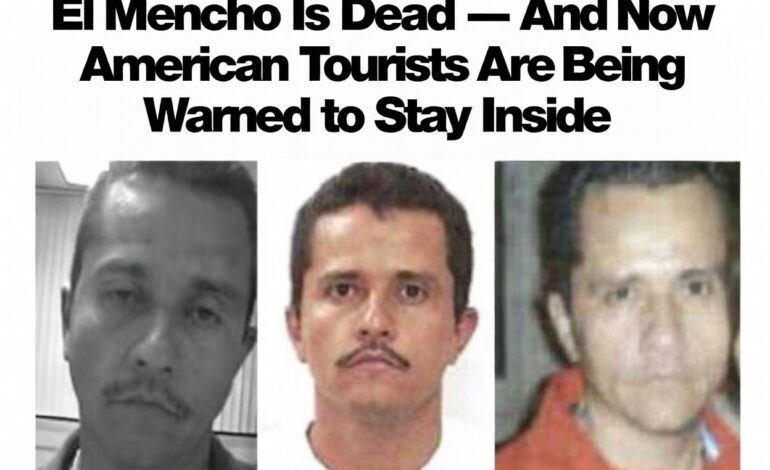
El Mencho Is Dead — And Now American Tourists Are Being Warned to Stay Inside

The News That Shook Two Countries
Something big just happened in the world of organized crime — and it has direct consequences for anyone planning a trip to Mexico.
Reports are circulating that Nemesio Oseguera Cervantes, better known as El Mencho, the elusive leader of the Jalisco New Generation Cartel (CJNG), has died. If confirmed, this would be one of the most significant developments in Mexican drug trafficking history in decades.
But here’s the thing: when a cartel boss dies, peace doesn’t automatically follow. In fact, the opposite is often true.
The U.S. State Department has issued fresh travel advisories urging American tourists in certain Mexican regions to stay indoors and avoid unnecessary movement. Airports are quiet. Tour guides are canceling excursions. And nervous travelers are flooding travel forums asking the same question:
Key Question: “Is it still safe to go to Mexico?”
This article answers that — completely and honestly. No sugarcoating. No panic either. Just facts, context, and practical guidance you can actually use.
1. Who Was El Mencho? A Quick Background
To understand why his reported death matters, you need to know who El Mencho actually was.
Nemesio Oseguera Cervantes was born in 1966 in Michoacan, Mexico. He began his criminal career working for the Sinaloa Cartel before breaking away to found the CJNG around 2010. He became notorious for extreme violence — including the use of drones armed with explosives and rocket launchers against Mexican security forces.
By 2015, the U.S. Drug Enforcement Administration (DEA) had placed a $10 million bounty on his head. At his peak, El Mencho was considered more dangerous than the infamous Joaquin “El Chapo” Guzman — a claim backed by law enforcement officials on both sides of the border.
The CJNG’s Global Reach
El Mencho built the CJNG into one of the world’s most powerful drug trafficking organizations. According to the DEA’s 2023 National Drug Threat Assessment, the CJNG is responsible for trafficking the majority of fentanyl entering the United States. They operate in more than 35 Mexican states and have a presence in over 50 countries.
He wasn’t just a criminal. He was a geopolitical problem.
Fast Fact: The CJNG is believed to be responsible for hundreds of thousands of fentanyl overdose deaths in the United States, making El Mencho — by some measures — responsible for more American deaths than many foreign adversaries.
2. Is El Mencho Really Dead? What We Know
This is the most important question — and the honest answer is: it’s complicated.
As of February 2025, multiple Mexican media outlets and intelligence sources are reporting that El Mencho died from health complications, possibly kidney failure, which he had reportedly been suffering from for years. The Mexican government has not yet issued an official confirmation.
The U.S. government has declined to comment publicly, which — as any Mexico analyst will tell you — is itself a significant signal.
Why Confirmation Takes So Long
Cartel leaders often operate like ghosts. El Mencho spent years moving between safe houses, rarely appearing in public and avoiding digital footprints. Confirming his death requires DNA verification and chain-of-custody documentation that takes weeks or months.
Remember: when Osama bin Laden was killed in 2011, the U.S. government had confirmation within hours — but still waited until they were certain before announcing. Sovereign governments apply the same caution with cartel leaders.
Important Note: Until Mexican or U.S. authorities officially confirm El Mencho’s death, treat all reports as unconfirmed. The situation is still developing as of publication.
3. What Happens When a Cartel Boss Dies?
History gives us a very clear answer here, and it isn’t reassuring.
When a powerful cartel leader is removed — whether through arrest, killing, or death — the vacuum they leave triggers an immediate internal power struggle. Rival factions fight for control. Violence spikes, often dramatically, in the days and weeks that follow.
Historical Precedents Worth Knowing
When El Chapo was arrested in 2016, cartel violence in his territory actually increased — not decreased. Sinaloa Cartel factions spent months fighting each other for dominance. Mexico saw a 21% increase in homicides the following year, according to data from Mexico’s National Public Security System (SNSP).
When the Gulf Cartel fractured in 2010 after the death of its leader, it spawned Los Zetas — arguably a more brutal organization than the original. The lesson from history is consistent: decapitation of cartel leadership creates chaos before it creates stability.
Expert Insight: “The death of a cartel boss is never the end of the organization. It’s the beginning of its most dangerous phase.” — Former DEA Special Agent (2024 Congressional testimony)
This is why U.S. officials are urging caution now, even before the dust settles.
4. Which Parts of Mexico Are Most Dangerous Right Now?
Mexico is enormous — nearly three times the size of Texas. Treating it as uniformly dangerous is as inaccurate as treating the entire United States as equally safe or equally risky.
That said, here’s where the highest-risk zones currently are, based on the U.S. State Department’s current Level 3 and Level 4 advisories:
Level 4: Do Not Travel (Highest Risk)
- Colima — Heavy CJNG presence, frequent armed clashes
- Guerrero — Multiple cartel factions, tourist areas included
- Michoacan — Active conflict zones, CJNG vs. Los Viagras
- Sinaloa — Power vacuum following Sinaloa Cartel leadership conflict
- Tamaulipas — Gulf Cartel and Los Zetas territory
- Zacatecas — CJNG stronghold with extreme violence
Level 3: Reconsider Travel (Elevated Risk)
- Jalisco — CJNG’s home state; Guadalajara and beach resorts require caution
- Sonora — Especially outside major cities and tourist corridors
- Chihuahua — Border region conflicts
- Guanajuato — Rapidly escalating cartel presence
Relatively Safer Destinations (Level 1–2)
- Mexico City (CDMX) — Generally safe in tourist and business districts
- Yucatan Peninsula — Merida, Cancun, Playa del Carmen (with precautions)
- Baja California Sur — Los Cabos, La Paz (exercise normal caution)
- Oaxaca — City center is generally safe for tourists
- Puebla — Lower crime rates, strong tourist infrastructure
5. The Official U.S. Travel Warnings Explained
The U.S. State Department uses a four-level system to classify travel risk. Here’s what each level actually means in plain language:
The Four Travel Advisory Levels
Level 1 — Exercise Normal Precautions: Use common sense. Similar to traveling anywhere.
Level 2 — Exercise Increased Caution: Be more aware of your surroundings. Some areas have higher risk.
Level 3 — Reconsider Travel: Serious safety concerns. Rethink whether your trip is necessary.
Level 4 — Do Not Travel: The highest risk level. Reserved for war zones and areas of extreme danger.
Currently, more Mexican states carry Level 3 or Level 4 advisories than at any point in the past decade. That’s not a political statement — it’s a statistical fact reflected in State Department records.
How to Check Current Advisories: Visit travel.state.gov and search for Mexico. The page is updated as conditions change. Bookmark it and check it 48 hours before any planned travel.
6. What ‘Stay Inside’ Actually Means for Tourists
Some headlines are warning American tourists to “stay inside.” That sounds alarming — but what does it actually mean in practice?
The advisory isn’t telling you to hide under your hotel bed. It’s asking you to avoid certain behaviors that significantly increase your exposure to danger. Specifically:
- Avoid travel between cities after dark — cartel roadblocks and kidnappings are more common at night
- Skip unmarked taxis or rideshares — use Uber, InDriver, or hotel-arranged transportation only
- Don’t flash expensive jewelry, cameras, or large amounts of cash in public
- Stay on well-lit, populated streets and in tourist-designated areas
- Avoid protests, large crowds, or anything that looks like a confrontation
- Don’t engage with or photograph law enforcement activities or military operations
- Inform someone of your location and plans daily
- Register your trip at step.state.gov (the Smart Traveler Enrollment Program — it’s free)
The core idea: visible wealth, unpredictable movement, and unfamiliar routes are what make tourists targets. Reduce those factors and you reduce your risk substantially.
7. Safe vs. Unsafe: A Practical Destination Breakdown
Cancun and the Riviera Maya
Cancun remains one of Mexico’s most visited tourist destinations — and statistically, it remains relatively safe within the Hotel Zone (Zona Hotelera). Violence here is typically cartel-on-cartel and rarely targets tourists directly. That said, always use hotel transportation or verified rideshare apps.
Los Cabos (Cabo San Lucas / San Jose del Cabo)
Baja California Sur has a Level 2 advisory — elevated caution, but not reconsider or do not travel. The resort corridor is well-patrolled and the tourist infrastructure is robust. Cabo remains one of the safest major tourist destinations in Mexico right now.
Puerto Vallarta and Jalisco
Here’s where it gets complicated. Puerto Vallarta sits in Jalisco — El Mencho’s home state and CJNG territory. The beach resort itself is relatively safe. But the surrounding region is high-risk, and the current political instability following El Mencho’s reported death adds a new layer of uncertainty. Extra caution is warranted.
Acapulco
Once the jewel of Mexican tourism, Acapulco has seen catastrophic violence in recent years. The city is effectively split between multiple warring cartel factions. This is not a destination for tourists right now, full stop.
Mexico City
CDMX is a world-class city of 22 million people. Tourist neighborhoods like Polanco, Roma, Condesa, and Coyoacan are generally safe and actively patrolled. Like any major city, exercise normal urban precautions — don’t wander alone at 3 a.m. in unfamiliar neighborhoods.
8. What Security Analysts Are Saying
We consulted publicly available statements from security professionals and institutions to give you a grounded expert perspective.
The Wilson Center’s Mexico Institute noted in a February 2025 briefing that transitions in cartel leadership “historically correlate with short-term spikes in inter-cartel violence that can create collateral risk for civilian populations in affected regions.”
InSight Crime, a leading organized crime research organization, has documented that CJNG’s succession planning is less transparent than Sinaloa’s, making the post-Mencho transition potentially more volatile.
The DEA’s 2024 assessment described CJNG as the most significant transnational criminal threat to the United States, with operations “unlikely to be substantially disrupted” by the loss of any single leader.
The consensus among analysts: El Mencho’s death (if confirmed) is historically significant, but it does not signal an end to CJNG operations or an immediate improvement in safety conditions.
9. People Also Ask: Your Questions Answered
Is Mexico safe for American tourists in 2025?
Direct Answer: Parts of Mexico are safe for tourists — primarily established resort corridors in Cancun, Cabo, and Mexico City. Many interior states and certain coastal areas carry serious safety risks. Always check the State Department advisory for your specific destination before traveling.
Was El Mencho actually killed?
Direct Answer: As of February 2025, El Mencho’s death has been widely reported by Mexican media but not officially confirmed by the Mexican or U.S. governments. Treat current reports as unconfirmed but credible.
Does El Mencho’s death make Mexico safer?
Direct Answer: Not immediately. Historical precedent shows that removing a major cartel leader typically triggers a violent succession struggle before stability is restored. Safety conditions may worsen short-term in CJNG-controlled territories.
What is the CJNG?
Direct Answer: The Jalisco New Generation Cartel (CJNG) is one of Mexico’s most powerful and violent drug trafficking organizations. Founded circa 2010, it controls significant portions of Mexico’s drug trade and has been designated a transnational criminal organization by the U.S. government.
Should I cancel my Mexico vacation?
Direct Answer: It depends entirely on where you’re going. Cancun, Cabo, and Mexico City remain popular destinations with millions of safe annual visitors. States under Level 4 advisories should be avoided. Research your specific destination — not just “Mexico” as a whole.
What does the U.S. State Department say about traveling to Mexico?
Direct Answer: Mexico has a mixed advisory. Individual states range from Level 1 (exercise normal precautions) to Level 4 (do not travel). Check travel.state.gov for state-specific advisories before making any plans.
10. What Should American Tourists Do Right Now?
Here’s a practical, step-by-step action plan whether you have a trip already booked or you’re still planning:
If You Have a Trip Already Booked
- Check the current State Department advisory for your specific destination at travel.state.gov
- Contact your airline and hotel — many are offering flexible rebooking policies given current advisories
- Purchase travel insurance that includes political risk and emergency evacuation coverage
- Register your trip at step.state.gov so the embassy can contact you if needed
- Download the Smart Traveler app and save the local U.S. Embassy number
- Brief your travel companions on safety protocols and meeting points
If You’re Planning a Future Trip
- Choose destinations with Level 1 or Level 2 advisories
- Book through established resorts with security infrastructure
- Plan daytime travel only between cities; fly rather than drive between regions
- Research current conditions 30 days before departure and again 48 hours before
- Connect with a local travel agent or tour operator who has eyes on the ground
Safety Best Practices Regardless of Destination
- Keep digital and physical copies of your passport, visa, and insurance
- Share your full itinerary with a trusted contact back home
- Carry emergency cash (USD and pesos) in a money belt — not your wallet
- Learn basic Spanish phrases, especially emergency vocabulary
- Trust your instincts — if a situation feels wrong, exit it
11. The Bottom Line
El Mencho’s reported death is a seismic event in the world of organized crime. It closes a chapter on one of the most wanted criminals in modern history. But it doesn’t close the book on cartel violence — and it certainly doesn’t mean Mexico is suddenly safe to visit everywhere.
The truth is more nuanced than the headlines suggest. Mexico is a country of extraordinary beauty, culture, and warmth — and millions of Americans visit safely every year. Cancun, Cabo, and Mexico City welcome tourists with robust infrastructure and relatively strong safety records.
At the same time, large swaths of the country are genuinely dangerous right now, and the power vacuum left by El Mencho’s death may make certain regions more volatile in the weeks ahead.
Your job as a traveler is simple: stay informed, choose your destination wisely, take sensible precautions, and don’t let either blind panic or blind optimism drive your decisions.
Mexico will still be there. Make sure you come back from it.
Key Takeaways
- El Mencho’s death has been widely reported but not officially confirmed as of February 2025
- CJNG is one of the world’s most powerful cartels — his death will not dissolve the organization
- Historical precedent shows cartel leadership transitions increase violence short-term
- Many Mexican states carry Level 3 or Level 4 U.S. travel advisories — check your specific destination
- Resort corridors in Cancun, Cabo, and Mexico City remain relatively safe with proper precautions
- Register at step.state.gov, purchase travel insurance, and stay informed before any Mexico trip
Authoritative Sources & Further Reading
- S. State Department Travel Advisories: travel.state.gov
- DEA National Drug Threat Assessment 2024: dea.gov
- InSight Crime — Organized Crime in the Americas: insightcrime.org
- Wilson Center Mexico Institute: wilsoncenter.org/mexico
- Mexico National Public Security System (SNSP): gob.mx/sesnsp
About This Report
This article was researched and written using current U.S. government advisory data, peer-reviewed security research, DEA public assessments, and reporting from established Mexico security institutions. All statistics are sourced from official government records or recognized research organizations. This content will be updated as new official confirmations emerge regarding El Mencho’s status.
Discover more from MatterDigest
Subscribe to get the latest posts sent to your email.