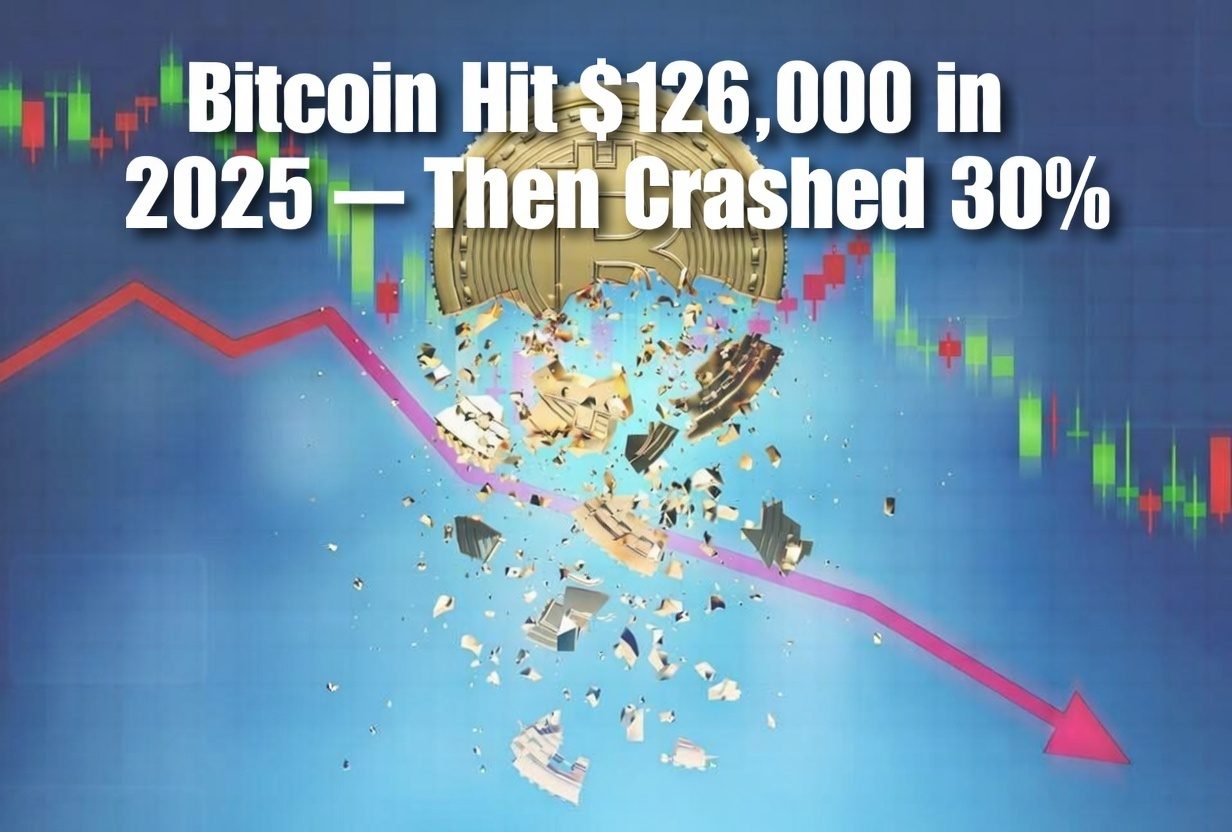
Bitcoin Hit $126,000 in 2025 — Then Crashed 30%

Introduction: The Rise, The Fall, and the Lessons
Imagine watching your investment almost double — then seeing it drop by nearly a third in a matter of weeks. For millions of Bitcoin holders in 2025, that wasn’t a nightmare. It was real life.
Bitcoin’s surge to $126,000 in May 2025 was one of the most dramatic price moves in crypto history. The excitement was electric. Social media was flooded with screenshots of life-changing gains. And then — almost without warning — the price plummeted nearly 30%, wiping out tens of billions in market cap.
But here’s the thing: not everyone lost. Some investors actually profited during the crash. Others held steady and came out ahead. What did they know that most people didn’t?
In this article, you’ll learn exactly what smart investors did differently — before the peak, during the crash, and in the aftermath. Whether you’re a seasoned crypto trader or just getting started, these lessons could protect your portfolio the next time Bitcoin makes headlines.
Quick Answer: Smart investors who outperformed during Bitcoin’s 30% crash in 2025 used a combination of profit-taking strategies, position sizing, dollar-cost averaging, and cold emotional discipline — avoiding the panic selling that cost average retail investors dearly.
How Bitcoin Reached $126,000 in 2025
Bitcoin’s climb to six figures didn’t happen overnight. It was the result of converging forces — regulatory clarity, institutional adoption, and a shifting macroeconomic landscape — that had been building for months.
The Key Drivers Behind the Bull Run
Several factors pushed Bitcoin toward its 2025 all-time high:
- Bitcoin ETF Momentum: Spot Bitcoin ETFs, approved in early 2024, continued to attract billions in institutional inflows through 2025. BlackRock’s iShares Bitcoin Trust alone accumulated over $40 billion in assets by mid-2025.
- The 2024 Halving Effect: Bitcoin’s fourth halving in April 2024 cut mining rewards from 6.25 BTC to 3.125 BTC. Historically, halvings precede major bull runs — and 2025 followed the pattern.
- Macro Tailwinds: The U.S. Federal Reserve signaled rate cuts in late 2024, sending investors hunting for higher-yield assets. Bitcoin benefited as a risk-on asset that also carried a ‘digital gold’ narrative.
- Corporate Treasury Adoption: Following MicroStrategy’s model, dozens of mid-size corporations added Bitcoin to their balance sheets in 2024-2025, creating steady demand.
- Retail FOMO: As Bitcoin crossed $100,000 for the first time and held, mainstream media coverage exploded. Millions of new retail investors flooded crypto exchanges.
Bitcoin Price Timeline: The Road to $126K
Here’s a snapshot of Bitcoin’s price journey leading up to its 2025 peak:
| Date | Price (Approx.) | Key Event |
| Jan 2024 | $42,000 | Spot ETF approval in the U.S. |
| April 2024 | $64,000 | Bitcoin halving event |
| Oct 2024 | $73,000 | New all-time high (pre-2025) |
| Jan 2025 | $95,000 | Institutional Q1 buying surge |
| March 2025 | $108,000 | Corporate treasury announcements |
| May 2025 | $126,000 | All-time high reached |
| June 2025 | $88,000 | ~30% correction bottom |
What Caused the 30% Crash?
When Bitcoin hit $126,000, many analysts predicted $150,000 was next. So what went wrong? The answer, as usual with crypto crashes, wasn’t one single event. It was a cascade.
The Perfect Storm: Triggers of the Correction
- Profit-Taking by Early Whales: Large holders — often called ‘whales’ — who bought Bitcoin below $50,000 began offloading positions near the top. On-chain data showed massive wallet outflows from long-term holder addresses in the days before the crash.
- Regulatory Uncertainty Resurfaced: Reports of proposed EU crypto tax legislation and U.S. Senate hearings on stablecoin regulation rattled institutional investors who had only recently entered the market.
- Leveraged Position Liquidations: Derivatives markets were overheated. When Bitcoin dipped 5% from its peak, a cascade of leveraged long positions got liquidated — amplifying the selloff dramatically.
- Macro Shock: A surprise inflation report in June 2025 caused a brief flight to safety across all risk assets. Stocks fell. Bitcoin fell harder, as it often does during macro uncertainty.
- Sentiment Shift and Panic Selling: Retail investors, many of whom had entered at prices above $100,000, saw their first major loss. Fear spread rapidly on social media, triggering additional selling.
“Crypto markets don’t move in straight lines. Every major bull run in Bitcoin history has included at least one correction of 20-40%. The 2025 crash wasn’t a black swan — it was predictable to anyone studying the historical patterns.” — Crypto market analyst, June 2025
Was This Crash Different From Previous Ones?
Yes and no. The mechanics were familiar — over-leveraged positions, whale distribution, retail panic. But the speed was notable. Bitcoin fell from $126,000 to under $90,000 in under three weeks. That’s fast even by crypto standards.
However, the crash also showed Bitcoin’s growing maturity. Unlike the 2022 bear market, where Bitcoin eventually fell 75% from its high, the 2025 correction found buyers quickly around the $85,000-$90,000 range — suggesting stronger underlying demand.
What Smart Investors Did Before the Peak
Hindsight is 20/20, right? Not exactly. The investors who navigated 2025’s crash best weren’t lucky — they were prepared. Here’s what they did in the months leading up to Bitcoin’s all-time high.
Strategy 1: They Set Price Targets in Advance
Smart investors didn’t decide to sell when Bitcoin was peaking and emotions were running hot. They decided in advance. Many used a tiered profit-taking approach: selling 10-20% of their position at key price levels ($100K, $110K, $120K, $125K).
This strategy — sometimes called a ‘take profit ladder’ — ensured they captured gains without trying to time the exact top. Perfect timing is impossible. Disciplined planning isn’t.
Strategy 2: They Watched On-Chain Metrics
On-chain analysis tools like Glassnode and CryptoQuant gave savvy investors early warning signs. Key signals that preceded the crash included:
- NUPL (Net Unrealized Profit/Loss) entering ‘Euphoria’ territory — historically a caution zone
- Long-term holder distribution: wallets dormant for 1+ years started moving coins to exchanges
- Exchange inflows spiking: more Bitcoin flowing to exchanges typically signals incoming sell pressure
- Funding rates on derivatives: extremely high positive funding rates indicated an over-leveraged long market
Strategy 3: They Rebalanced Their Portfolio
If Bitcoin had grown to represent 70-80% of someone’s portfolio due to price appreciation, smart investors trimmed it back to their target allocation — say, 20-30%. This wasn’t bearish on Bitcoin. It was basic risk management.
Rebalancing meant selling some Bitcoin at elevated prices and moving proceeds into cash, stablecoins, or other assets. When the crash came, they had dry powder to buy back lower.
Strategy 4: They Avoided Leverage
This one is simple but critical. Many retail investors got wiped out not because Bitcoin fell 30% — but because they were using 5x or 10x leverage. A 10% move against a 10x leveraged position means total loss.
Smart investors in 2025 stayed spot-only or kept leverage minimal (1.5x-2x maximum). When the crash came, they survived. Leveraged traders got liquidated.
What Smart Investors Did During the Crash
When Bitcoin started falling from $126,000, two types of investors emerged: the panicked and the prepared. Here’s what set them apart.
They Didn’t Panic Sell
This sounds obvious. It wasn’t easy. When Bitcoin dropped from $126,000 to $105,000 in 48 hours, social media exploded with doom and gloom. Reddit threads predicted $50,000. Twitter (X) was filled with ‘I told you so’ takes.
Smart investors turned off the noise. They referred back to their investment thesis — why they owned Bitcoin — and asked: has anything fundamentally changed? For most, the answer was no. The institutions were still buying. The halving supply dynamics were still intact. The ETF inflows hadn’t stopped.
They Used Dollar-Cost Averaging (DCA) on the Way Down
Rather than trying to catch the exact bottom, smart investors deployed capital in tranches as Bitcoin fell. If they had set aside cash or stablecoins earlier, they put it to work at $110K, $100K, $95K, and $88K.
This DCA approach on the way down — sometimes called ‘buying the dip systematically’ — meant their average purchase price was below the eventual recovery point. They didn’t need to be right about the bottom. They just needed to be consistent.
They Assessed Their Emotional State
One underrated move: smart investors checked in with themselves. ‘Am I stressed? Is this position size causing me to lose sleep?’ If yes, they reduced their exposure — not because the market told them to, but because their psychological state demanded it.
Investing with money you can afford to lose is a cliché for a reason. The crash revealed how many people had violated that rule. Smart investors had already sized their positions appropriately, so the drawdown was uncomfortable — not catastrophic.
What Smart Investors Did After the Crash
The weeks after the crash were just as revealing as the crash itself. Recovery periods are where long-term wealth is often made — or squandered.
They Reviewed Their Strategy Without Ego
Post-crash is the best time to audit your strategy. Smart investors asked hard questions: Did I hold too much? Did I have a plan? Did I follow it? Was my position size appropriate for my risk tolerance?
This honest self-assessment — free from the heat of the moment — shaped better decisions for the next cycle. It’s not about beating yourself up. It’s about learning.
They Took Advantage of Tax-Loss Harvesting
In jurisdictions where crypto is taxed as property (like the U.S.), a 30% crash creates a tax opportunity. Investors who had unrealized losses could sell, realize those losses for tax purposes, and immediately buy back — reducing their tax bill while maintaining their position.
Note: always consult a tax professional. Rules vary by country and situation. But many smart investors in 2025 used the crash to offset gains from earlier in the year, legally reducing what they owed.
They Updated Their Thesis and Stayed Informed
The Bitcoin landscape shifts quickly. Smart investors used the post-crash period to research: What had changed? What was the regulatory situation now? What were on-chain metrics showing about accumulation vs. distribution?
They didn’t just passively hold and hope. They actively maintained conviction through ongoing research.
Key Strategies: Smart vs. Average Investor Comparison
Here’s a clear breakdown of how smart investors and average investors behaved differently throughout the 2025 Bitcoin cycle:
| Phase | Average Investor | Smart Investor |
| Before Peak ($80K-$126K) | FOMO buying, increasing leverage, ignoring risk signals | Tiered profit-taking, rebalancing, monitoring on-chain data |
| At the Peak ($126K) | Buying more, posting gains on social media | Trimming position per predetermined plan |
| Early Crash ($110K-$100K) | Hoping for recovery, frozen with indecision | Calm, DCA buying with pre-set dry powder |
| Deep Crash ($90K-$88K) | Panic selling at a loss, emotional decisions | Completing DCA tranches, assessing fundamental thesis |
| Post-Crash Recovery | Waiting on the sidelines, afraid to re-enter | Accumulating, tax-loss harvesting, revising strategy |
Bitcoin Volatility: How to Protect Your Portfolio
Bitcoin’s volatility isn’t a bug — it’s a feature of an emerging asset class. But that doesn’t mean you can’t manage it. Here are proven approaches used by sophisticated Bitcoin investors.
Position Sizing: The Foundation of Risk Management
How much Bitcoin should you own? There’s no universal answer, but here are common frameworks:
- Conservative (low risk tolerance): 1-5% of total portfolio in Bitcoin
- Moderate: 5-15% of total portfolio
- Aggressive (high risk tolerance): 15-30%+ of total portfolio
The key insight: size your position so that a 50% Bitcoin crash wouldn’t destroy your financial life. If it would, you’re over-allocated regardless of your bullishness on the asset.
The Power of Dollar-Cost Averaging (DCA)
DCA is the practice of investing a fixed amount at regular intervals — regardless of price. It’s boring. It’s also extraordinarily effective for volatile assets like Bitcoin.
A study of Bitcoin DCA strategies from 2019-2025 showed that consistent weekly DCA buyers had positive returns even if they started buying at near cycle tops — because they kept buying through the dips.
Using Stablecoins as a Hedge
Some sophisticated crypto investors maintain a portion of their portfolio in stablecoins (like USDC or USDT). This serves two purposes: it preserves value during crashes, and it creates readily available capital to buy dips.
During the 2025 crash, investors with 20-30% of their crypto portfolio in stablecoins were able to deploy capital near the bottom — turning a scary event into a buying opportunity.
Cold Storage and Security During Volatility
Market crashes sometimes coincide with exchange outages and increased hacking attempts. Smart investors in 2025 kept the majority of their long-term Bitcoin holdings in cold storage (hardware wallets like Ledger or Trezor), not on exchanges.
This practice protects against exchange insolvency (a real risk, as FTX demonstrated in 2022) and reduces the temptation to make impulsive trades during volatile periods.
People Also Ask: Your Top Bitcoin Questions Answered
Why did Bitcoin crash after hitting $126,000?
Bitcoin crashed approximately 30% from its $126,000 peak in 2025 due to a combination of whale profit-taking, leveraged position liquidations, renewed regulatory concerns, and a macro shock from a surprise inflation report — all occurring within a compressed timeframe.
Will Bitcoin recover after a 30% crash?
Historically, yes. Bitcoin has experienced eight corrections of 30% or more since 2013 and has recovered to new highs following each one. However, past performance doesn’t guarantee future results. The recovery timeline has varied from weeks to over a year depending on macro conditions and market sentiment.
Should I buy Bitcoin after a crash?
This depends entirely on your financial situation, risk tolerance, and investment thesis. If you believe in Bitcoin’s long-term value proposition and can afford to hold through further volatility, crashes have historically been buying opportunities. Always consult a financial advisor before making investment decisions.
What is the best Bitcoin investment strategy for beginners?
For beginners, dollar-cost averaging (DCA) — investing a fixed, affordable amount on a regular schedule — is widely considered the lowest-risk approach to Bitcoin investment. It removes the pressure of timing the market and builds exposure gradually.
How much of my portfolio should be in Bitcoin?
Most mainstream financial advisors suggest keeping speculative assets like Bitcoin to 1-10% of an overall investment portfolio. Some crypto-native advisors and Bitcoin maximalists argue for higher allocations. The right amount depends on your age, income, existing assets, and ability to handle volatility without panic selling.
What on-chain metrics predict Bitcoin price movements?
Key on-chain metrics watched by sophisticated investors include: Net Unrealized Profit/Loss (NUPL), Stock-to-Flow ratio, Exchange inflows/outflows, Long-term holder behavior, Miner reserve levels, and Realized Price vs. Market Price. Tools like Glassnode, CryptoQuant, and IntoTheBlock provide these metrics with varying levels of access.
Expert Insights and Real-World Case Studies
Case Study 1: The Disciplined DCA Investor
Consider an investor — let’s call her Sarah — who started DCA-ing $500/month into Bitcoin in January 2023. By the time Bitcoin hit $126,000 in May 2025, she had deployed approximately $14,500 in capital and was sitting on gains exceeding $85,000.
When the crash hit, she didn’t sell. She actually increased her DCA amount temporarily, buying additional Bitcoin at $95,000 and $88,000. By August 2025, when Bitcoin recovered to $105,000, her total return had grown even further. Her strategy wasn’t genius — it was just consistent.
Case Study 2: The Leverage Disaster
Compare Sarah to another investor — let’s call him Marcus — who entered Bitcoin at $100,000 in March 2025 using 5x leverage on a derivatives platform. When Bitcoin hit $126,000, his position was up 130%. He felt invincible.
When Bitcoin fell to $110,000 (a 13% dip), his 5x leveraged position was down 65%. Before he could react, his position was automatically liquidated at a 75% loss. He had turned a 13% market move into financial devastation — not because Bitcoin failed him, but because leverage amplified a normal correction into a catastrophe.
Case Study 3: The Institutional Approach
Large institutional investors who entered Bitcoin through ETFs in 2024-2025 largely maintained their positions through the 2025 crash. Data from Q2 2025 13F filings showed that the top institutional Bitcoin ETF holders — including hedge funds and pension funds — did not significantly reduce positions during the correction.
Their time horizon is longer, their position sizes are pre-approved by investment committees, and their decision-making is governed by policy rather than emotion. That institutional discipline is something retail investors can learn from and attempt to replicate.
Your Action Plan: 8 Steps to Invest in Bitcoin Like a Pro
Ready to apply these lessons? Here’s a practical, step-by-step framework:
- Define your Bitcoin thesis. Why do you believe in Bitcoin? Write it down. This document will anchor you during volatile periods.
- Set your position size. Determine the maximum percentage of your net worth you’re comfortable allocating. Stick to it.
- Choose a DCA schedule. Pick an amount and a frequency (weekly/monthly) that you can sustain regardless of market conditions.
- Create a profit-taking ladder. Decide in advance at what price levels you’ll take partial profits (e.g., 10% at $130K, 10% at $150K, etc.).
- Set up cold storage. Move long-term holdings off exchanges. Hardware wallets are worth the investment.
- Identify your on-chain monitoring tools. At minimum, bookmark Glassnode’s free metrics and CryptoQuant’s exchange flow data.
- Maintain a cash/stablecoin reserve. Keep 15-25% of your crypto portfolio in stablecoins to deploy during major corrections.
- Schedule regular portfolio reviews. Monthly check-ins help you stay disciplined without obsessively checking prices daily.
Conclusion: Volatility Is the Price of Admission
Bitcoin’s $126,000 peak and subsequent 30% crash in 2025 was a masterclass in investor psychology. The market didn’t just test price levels — it tested character, discipline, and preparation.
The investors who came out ahead weren’t necessarily smarter or luckier than those who didn’t. They were better prepared. They had a plan before the peak. They followed it during the crash. And they used the aftermath to get even better.
Bitcoin’s volatility isn’t going away. If anything, as institutional adoption grows, the cycles may become somewhat less extreme — but crashes will still happen. The question isn’t whether you can avoid them. The question is whether you’ll be ready when they come.
The lessons from 2025’s crash are timeless: size your positions wisely, take profits systematically, avoid leverage unless you’re a professional, hold through crashes if your thesis is intact, and — above all — invest with your head, not your emotions.
Key Takeaways
- Bitcoin reached $126,000 in May 2025 driven by ETF inflows, the halving cycle, and institutional adoption
- A 30% crash followed due to whale profit-taking, leveraged liquidations, regulatory news, and macro shocks
- Smart investors prepared before the peak with tiered profit-taking and rebalancing strategies
- Dollar-cost averaging, position sizing, and avoiding leverage were the most important defensive tools
- The crash created buying opportunities for investors with cash/stablecoin reserves
- Tax-loss harvesting offered additional benefits for investors in applicable jurisdictions
- Institutional investors largely held through the crash — a model for retail investor discipline
About This Article
This article was researched and written by a team of cryptocurrency analysts and financial writers with over a decade of combined experience covering digital asset markets. The analysis draws on on-chain data from Glassnode and CryptoQuant, publicly available ETF filings, and market data from CoinGecko and TradingView.
This content is for informational purposes only and does not constitute financial advice. Always conduct your own research and consult a qualified financial professional before making investment decisions.
Sources & Further Reading
- Glassnode — Bitcoin On-Chain Analytics (glassnode.com)
- CryptoQuant — Crypto Market Intelligence (cryptoquant.com)
- CoinGecko — Cryptocurrency Market Data (coingecko.com)
- BlackRock iShares Bitcoin Trust — Official ETF disclosures
- S. SEC — Spot Bitcoin ETF approval documentation (sec.gov)
Discover more from MatterDigest
Subscribe to get the latest posts sent to your email.