Jeep Wrangler EV: The Complete Guide (2026)
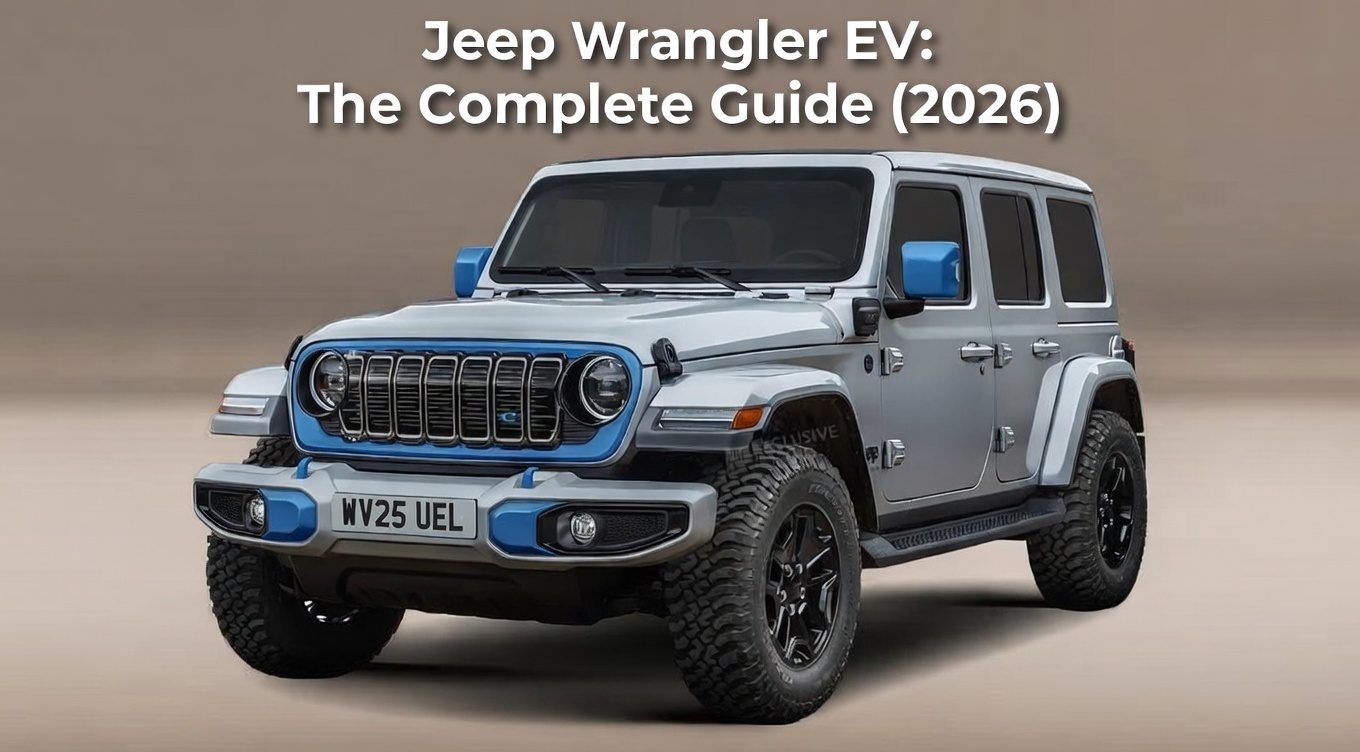

Is a Fully Electric Wrangler Coming? What We Know, What to Expect, and How It Compares to the 4xe — Updated February 2026
Quick Answer: Is There a Fully Electric Jeep Wrangler?
As of February 2026, there is no fully electric (BEV) Jeep Wrangler in production. Jeep currently offers the Wrangler 4xe — a plug-in hybrid with 25 miles of EPA electric range and a 2.0-liter turbocharged engine. Jeep and Stellantis have confirmed they are developing a fully electric Wrangler for future production, but no official launch date, pricing, or specifications have been announced. The Jeep Recon is the brand’s current purpose-built electric off-road SUV and is the closest production equivalent to a BEV Wrangler.
Introduction: The Question Every Wrangler Fan Is Asking
The Jeep Wrangler has survived for over 80 years by refusing to compromise. Body-on-frame construction when everyone went unibody. Solid axles when everyone switched to independent suspension. Removable doors and roof when every rival sealed theirs shut. The Wrangler is defined by its stubbornness. Its refusal to become something else.
So when the question becomes ‘will there be a fully electric Wrangler?’, it cuts to something fundamental. Can you electrify the Wrangler without losing what makes it a Wrangler? Can a battery survive a river crossing? Can you run a winch off a BEV’s pack without stranding yourself in the backcountry? Can you take doors off a car with complex electrical systems threaded through every panel?
These are real questions — not obstacles, but genuine engineering challenges that Jeep has been working through. This guide gives you the full picture: what exists right now with the Wrangler 4xe plug-in hybrid, what Jeep has actually confirmed about a future BEV Wrangler, why it is a difficult vehicle to electrify correctly, and how the Jeep Recon fits into the picture as the brand’s current answer to electric off-road driving.
Whether you are shopping today or waiting for the future, this is the most complete guide to the electric Wrangler landscape available in 2026.
Visual suggestion: Open with a side-by-side of the Wrangler 4xe badge on the fender and the Jeep Recon charging at a trail-side station — establishing both the current reality and the future direction in a single image.
1. The State of the Electric Wrangler in 2026
Let us be clear about what exists and what does not, because confusion on this point is widespread.
What Currently Exists
- Wrangler 4xe: A plug-in hybrid Wrangler with 25 miles of EPA electric range. Available in 2-door and 4-door (Unlimited) body styles. This is a real vehicle you can buy today.
- Jeep Recon: A fully electric off-road SUV built on Stellantis’s STLA Large platform. Purpose-built for off-road use with Trail-Rated certification. Available for purchase in 2026. This is NOT a Wrangler — it is a separate model.
What Does Not Currently Exist
- A fully battery-electric (BEV) Jeep Wrangler with no combustion engine. This vehicle does not exist in production as of February 2026.
- An official launch date for a BEV Wrangler — Jeep has not confirmed one.
- Official specifications for a BEV Wrangler — any specs circulating online are speculation or early concept data.
Why does this matter? Because a significant portion of Wrangler EV search traffic consists of buyers who believe such a vehicle exists or is imminent. Understanding the current reality helps you make the right purchase decision now — rather than waiting for a vehicle without a confirmed launch date.
2. Wrangler 4xe: The Current Electric Wrangler — Complete Specs
If you want an electric Wrangler right now, the Wrangler 4xe is your vehicle. Here is the complete specification breakdown.
| Specification | Wrangler 4xe (2-Door) | Wrangler 4xe Unlimited (4-Door) |
| Powertrain Type | Plug-In Hybrid (PHEV) | Plug-In Hybrid (PHEV) |
| Engine | 2.0L turbocharged inline-4 | 2.0L turbocharged inline-4 |
| Engine Output | 270 hp / 295 lb-ft | 270 hp / 295 lb-ft |
| Electric Motors | Two integrated motors | Two integrated motors |
| Combined System Power | 375 hp / 470 lb-ft | 375 hp / 470 lb-ft |
| 0-60 mph | ~6.0 seconds | ~6.3 seconds |
| Battery Capacity (gross) | 17.3 kWh | 17.3 kWh |
| Battery Capacity (usable) | ~14.1 kWh | ~14.1 kWh |
| EPA Electric Range | 25 miles (40 km) | 25 miles (40 km) |
| EPA Combined (charge depleted) | 20 MPG | 20 MPG |
| EPA MPGe (combined) | 49 MPGe | 49 MPGe |
| AC Charging (max) | 7.2 kW Level 2 | 7.2 kW Level 2 |
| Level 2 Full Charge Time | ~2 hours | ~2 hours |
| Level 1 Charge Time | ~8.5 hours | ~8.5 hours |
| DC Fast Charging | Not supported | Not supported |
| 4WD System | Selec-Trac II / Rock-Trac (Rubicon) | Selec-Trac II / Rock-Trac (Rubicon) |
| Ground Clearance (Rubicon) | 10.8 inches (274 mm) | 10.8 inches (274 mm) |
| Water Fording Depth | 30 inches (762 mm) | 30 inches (762 mm) |
| Approach Angle (Rubicon) | 44 degrees | 44 degrees |
| Departure Angle (Rubicon) | 37 degrees | 35.2 degrees |
| Breakover Angle (Rubicon) | 27.8 degrees | 22.6 degrees |
| Max Towing (4-door) | N/A | 3,500 lb (1,588 kg) |
| Trail-Rated Badge | Yes | Yes |
| Removable Doors/Roof | Yes | Yes |
| Fold-Flat Windshield | Yes | Yes |
| V2L (Vehicle-to-Load) | Yes — up to 3.3 kW | Yes — up to 3.3 kW |
The Wrangler 4xe’s 25-mile EPA electric range is lower than the newer Wagoneer 4xe (38 miles) — this reflects the Wrangler’s smaller 17.3 kWh battery, constrained by the body-on-frame architecture and the need to preserve off-road capability and weight distribution. A larger battery would compromise the Wrangler’s approach angles, departure angles, and center of gravity.
3. How the 4xe PHEV System Works Off-Road
The Wrangler 4xe’s plug-in hybrid system is not just an engine with a battery bolted on. It is a purpose-integrated parallel hybrid system that has specific behaviors in off-road conditions that matter significantly for trail use.
Electric Advantage on the Trail
The two electric motors deliver torque instantly — from the moment the vehicle begins to move. On technical terrain, this means:
- Rock crawling precision: Electric torque can be applied in extremely fine increments, allowing the driver to creep over obstacles at walking speed without the engine stalling or lurching
- Silent operation: Hearing the terrain is a genuine safety and navigation advantage. Experienced off-road drivers prefer listening to rock contact, water depth changes, and spotter instructions
- No torque interruption: Manual transmission Wranglers require clutch management on steep climbs. The 4xe’s electric motors maintain continuous torque delivery without interruption
- Traction control synergy: The electric motors work with Jeep’s electronic sway bar disconnect and axle lock systems more quickly than a combustion system can respond
4xe Off-Road Drive Modes
- E-Mode: Electric only — available at low speeds for silent, precise trail use. Limited to approximately 25 mph
- Hybrid: Auto-blend of engine and motors — standard mode for mixed trail and road
- 4WD E-Mode: Full electric power with 4WD Low engaged — the purest electric off-road experience currently possible in a Wrangler
- eSave: Preserves battery charge while engine handles propulsion — saves electric range for technical trail sections
- Max Regen: Increases regenerative braking during descent — supplements Hill Descent Control on steep grades
Water Fording: What Happens to the Electronics
The 30-inch water fording rating is the same as the combustion Wrangler Rubicon. Jeep has engineered the 4xe’s battery, motor controllers, and high-voltage connections to IP68 waterproofing standards. All high-voltage components are sealed to withstand full submersion at the rated depth for the rated time.
However, there are important operating rules for water fording in a 4xe. Jeep specifies that the high-voltage system should not be actively charging during water crossings. Charging port covers must be fully closed and latched. The battery thermal management system may temporarily reduce performance immediately after deep water crossings while sensors verify system integrity.
Winch Operation from the 4xe System
This is one of the most frequently asked questions about electric Wranglers: can you run a winch? The answer for the 4xe is: carefully, yes.
The Wrangler 4xe’s 12-volt electrical system powers the winch, as it does in a standard Wrangler — not the high-voltage traction battery directly. The electric motors can charge the 12V system while stationary, but sustained high-amp winch use will draw from the 12V battery. Jeep recommends running the engine during extended winch operations to maintain 12V system charge — the same recommendation that applies to combustion Wranglers.
4. Is a Fully Electric Wrangler Coming? What Jeep Has Confirmed
This is the question that brings most readers to this guide. Let us separate confirmed information from speculation.
What Jeep Has Officially Confirmed
- Stellantis CEO Carlos Tavares stated in 2023 that an all-electric Wrangler is planned as part of Stellantis’s Dare Forward 2030 electrification strategy
- Jeep brand CEO Antonio Filosa confirmed in 2024 that Jeep is working on electrifying the Wrangler nameplate beyond the current 4xe system
- Stellantis confirmed the STLA Frame platform — a body-on-frame EV platform — is in development and is specifically designed for vehicles like the Wrangler that cannot easily use a traditional skateboard-style battery architecture
- Jeep has confirmed the fully electric Wrangler would retain the Wrangler’s core DNA: removable doors, removable roof, Trail-Rated certification, and body-on-frame construction
What Has NOT Been Confirmed
- Launch date: No year has been officially confirmed. Industry analysts project 2027-2028 as likely based on STLA Frame platform development timelines
- Pricing: No pricing information is official
- Range: No EPA or manufacturer range estimate has been released
- Charging speed: No DC fast charging specifications have been confirmed
- Battery capacity: No kWh figure has been released
- Trim structure: No information on whether it replaces or supplements combustion Wranglers
Transparency note: Any online source claiming specific range, price, or specifications for the BEV Wrangler is reporting speculation, leaks, or concept data — not confirmed manufacturer information as of February 2026. This guide will be updated as official information is released.
The STLA Frame Platform: Why It Matters for the BEV Wrangler
The reason a BEV Wrangler is taking longer than some electric SUVs is the platform challenge. Most electric vehicles use a ‘skateboard’ architecture — a flat battery pack that forms the floor of the vehicle, with motors at each axle. This works well for road cars and crossovers.
The Wrangler’s body-on-frame construction, required for its off-road geometry and solid axle suspension, is fundamentally incompatible with the standard skateboard approach. A flat battery floor raises the vehicle’s ride height unacceptably, reduces approach and departure angles, and creates battery-to-rock exposure risks that defeat the vehicle’s core purpose.
STLA Frame — Stellantis’s body-on-frame EV platform — is specifically engineered to mount the battery within the frame rails and floor structure rather than as a flat skateboard beneath them. This preserves the ground clearance geometry and solid axle suspension that define the Wrangler. It is the right approach. It just takes more engineering time than adapting an existing EV skateboard.
5. Why a BEV Wrangler Is Hard to Build Right
If electrifying the Wrangler were straightforward, it would already be done. The engineering challenges are real, and understanding them helps explain why the BEV Wrangler is taking time — and why a rushed version would be worse than waiting.
Challenge 1: Water Fording at 30 Inches
The Wrangler Rubicon is rated for 30 inches of water fording. A large battery pack submerged in water creates immediate safety and engineering concerns. Lithium-ion cells exposed to water can short-circuit, generate heat, and in worst cases, experience thermal runaway.
Solving this requires not just waterproof sealing (which exists — Tesla vehicles have been documented fording water), but waterproofing that survives the mechanical stress of off-road use: rock impacts, flexing frame members, and vibration levels that exceed anything a road car experiences. The certification standards Jeep uses are significantly more demanding than consumer EV water-resistance ratings.
Challenge 2: Removable Doors and Open Electrical Architecture
The Wrangler’s removable doors route electrical connections — for mirrors, windows, speakers, and door-mounted electronics — through connectors that get disconnected every time a door comes off. Scaling this to a high-voltage vehicle introduces new complexity. High-voltage systems cannot have exposed connectors. Safety interlocks must ensure the vehicle cannot be driven if high-voltage wiring is improperly connected.
Jeep solved a version of this problem for the 4xe’s 12V system. The BEV version will require more sophisticated solutions, since the entire drivetrain is high-voltage.
Challenge 3: Winch and Recovery Gear Power
A serious off-road winch draws 400-500 amps at 12 volts during heavy pulls. In a combustion Wrangler, the alternator replenishes the 12V battery during recovery operations. In a BEV, a DC-DC converter steps voltage down from the main pack to the 12V system. The question is whether this converter can sustain the power demands of a 12,000-pound winch for extended periods while the vehicle is stationary and the traction battery is also powering motor heat management systems.
This is a solvable engineering problem. Several EV truck platforms have addressed it. But it requires deliberate engineering rather than an adaptation of existing road-car EV architecture.
Challenge 4: Multi-Day Remote Expedition Range
The Wrangler’s most dedicated users are not weekend trail drivers. They are overlanders who spend 5-10 days in remote backcountry with no charging infrastructure. A combustion Wrangler can carry extra fuel in jerry cans. A BEV cannot carry extra kWh in a portable container.
Jeep must either accept that the BEV Wrangler serves a different buyer than the hardcore overlander — or engineer a solution such as a range extender, solar charging supplement, or generator integration. The Wrangler 4xe’s approach (keeping a combustion engine for range extension) is actually the most practical solution for this specific use case, which is why some Wrangler loyalists prefer PHEV to BEV for their usage pattern.
Challenge 5: Battery and Rock Impacts
A Wrangler Rubicon with solid axles and significant suspension articulation puts the underside of the vehicle in positions that road cars never experience. Rock sliders protect the frame rails. Skid plates protect the transfer case and fuel tank. A battery pack sitting beneath the frame rails — even within them — faces rock strike risks during extreme off-road use.
Battery protection engineering for off-road use requires significantly more robust solutions than the typical EV underbody armor designed for speed bumps and road debris. This is not impossible, but it adds weight, cost, and engineering complexity.
6. Jeep Recon: The Current BEV Off-Road Alternative
While the BEV Wrangler is in development, Jeep has launched the Recon as its fully electric, Trail-Rated off-road SUV. It is important to understand both what the Recon is and what it is not.
How the Recon Differs From the Wrangler
- Platform: Recon uses STLA Large — a unibody EV platform, not body-on-frame like the Wrangler
- Suspension: Independent front suspension vs. Wrangler’s solid front axle
- Body: Unibody construction vs. Wrangler’s body-on-frame
- Off-road character: The Recon is highly capable but optimized for a different type of off-road use — fast, stable trail driving rather than extreme rock crawling
- Doors/Roof: Freedom Panels are removable, doors are removable — this IS shared with the Wrangler approach
- Trail-Rated: The Recon carries the Trail-Rated badge — it has passed the same five-category certification
Where the Recon Excels vs. the Wrangler
- Electric range: Recon offers approximately 250 miles EPA vs. Wrangler 4xe’s 25 miles of electric range
- On-road refinement: The unibody platform is noticeably more comfortable on paved roads
- Charging speed: Recon supports 150 kW DC fast charging — the 4xe does not support DC fast charging at all
- Power output: Recon delivers 443 hp vs. Wrangler 4xe’s 375 hp combined
- Technology: More modern infotainment and driver assistance systems
Where the Wrangler 4xe Holds an Edge
- Body-on-frame construction: Still more capable for extreme flex-intensive rock crawling
- Solid axle suspension: More articulation at extremes than the Recon’s independent front suspension
- Departure angle: Wrangler Rubicon’s shorter wheelbase gives superior departure geometry
- Combustion backup: The 4xe’s gasoline engine eliminates range anxiety on multi-day remote trips
- Cultural identity: For many buyers, the Wrangler nameplate is non-negotiable
7. Wrangler 4xe vs. Wrangler Rubicon ICE vs. Jeep Recon vs. Rivian R1S
A comprehensive comparison of your current off-road electric (or near-electric) options alongside the traditional combustion benchmark.
| Feature | Wrangler 4xe Unlimited Rubicon | Wrangler Rubicon 392 (V8) | Jeep Recon Summit | Rivian R1S Adventure |
| Powertrain | PHEV (2.0T + 2 motors) | 6.4L V8 combustion | Dual motor BEV | Quad motor BEV |
| Starting Price (est.) | ~$62,000 | ~$82,000 | ~$82,000 | ~$79,900 |
| Power Output | 375 hp combined | 470 hp | 600 hp | 835 hp |
| 0-60 mph | ~6.0 sec | ~4.5 sec | ~4.0 sec | ~3.0 sec |
| Electric Range | 25 mi (then gasoline) | None | ~250 mi EPA est. | 270 mi EPA |
| DC Fast Charging | No | N/A | 150 kW | 220 kW |
| Fuel/Range on Long Trip | Gas tank = unlimited range | Gas tank = unlimited range | Plan charging stops | Plan charging stops |
| Ground Clearance | 10.8 inches | 10.8 inches | 11.2 inches (Summit) | 14.9 inches |
| Water Fording | 30 inches | 32.5 inches | 30 inches (Summit) | ~24 inches (unofficial) |
| Approach Angle | 44 degrees | 44 degrees | 45 degrees (Summit) | 35 degrees |
| Solid Front Axle | Yes (Dana 44) | Yes (Dana 44) | No (IFS) | No (IFS) |
| Body-on-Frame | Yes | Yes | No (unibody) | No (unibody) |
| Removable Doors | Yes | Yes | Yes | No |
| Removable Roof | Yes | Yes | Yes (Freedom Panels) | No |
| Fold-Flat Windshield | Yes | Yes | No | No |
| Trail-Rated Badge | Yes | Yes | Yes | No (no cert) |
| Tow Rating | 3,500 lb | 3,500 lb | 3,500 lb | 11,000 lb |
| V2L Capability | 3.3 kW | No | 9.6 kW | 9.6 kW |
| Off-Road Modes | 5 Selec-Terrain modes | 5 Selec-Terrain modes | 6 modes incl. Rock Crawl | 6 modes |
| Fed. EV Credit Eligible | Yes (PHEV, $7,500 est.) | No | Confirm with dealer | No (over income/MSRP) |
The comparison reveals something important. No single vehicle is the clear winner across every category. The Wrangler 4xe leads on removable-everything open-air experience, Trail-Rated certification with solid axle geometry, and gasoline range backup. The Recon leads on electric range, charging speed, and raw power. The Rivian R1S leads on performance, towing, ground clearance, and charging speed — but lacks Trail-Rated certification, removable doors and roof, and body-on-frame capability. The V8 Wrangler remains the benchmark for water fording and raw low-speed torque feel.
8. Wrangler 4xe Electric Range and Charging: The Honest Reality
Twenty-five miles of electric range. That is the EPA figure. Here is what it means in actual Wrangler 4xe ownership.
Real-World Electric Range by Use Case
- Urban and suburban driving under 45 mph: 23-28 miles — often meets or slightly exceeds EPA estimate
- Highway driving at 65-70 mph: 16-20 miles — aerodynamic drag on the upright Wrangler body is significant
- Off-road trail use in E-Mode: 8-15 miles — rock crawling, hill climbs, and four-wheel-drive low-range use are energy intensive
- Cold weather below 32 degrees F (0 degrees C): 16-22 miles — expect meaningful reduction in electric capacity
- With hard top on vs. soft top: Minor aerodynamic difference — negligible effect on off-road range
The honest use case for 25 miles of range: The Wrangler 4xe’s electric range genuinely covers the average American’s 37-mile daily driving pattern — but only in E-Mode under moderate speeds. Most owners report completing daily errands and short commutes on electricity while using gasoline for highway and off-road use. This is the design intent, and it works well for that specific pattern.
Charging the Wrangler 4xe
| Charging Type | Power Level | Full Charge Time | Miles Added per Hour |
| Level 2 EVSE (240V / 32A) | 7.2 kW | ~2 hours | ~12-14 miles/hour |
| Level 2 EVSE (240V / 20A) | 4.8 kW | ~3 hours | ~8-10 miles/hour |
| Level 1 Standard Outlet (120V) | 1.4 kW | ~8.5 hours | ~3 miles/hour |
| DC Fast Charging | Not supported | N/A | N/A |
| V2L Output (power external devices) | Up to 3.3 kW export | N/A | Powers camp equipment |
The Wrangler 4xe’s 2-hour Level 2 charge time is one of its most practical features. If you have access to a 240V outlet at a trail head, parking area, or campsite, you can recover meaningful electric range during a lunch break. Many Wrangler 4xe owners carry a portable Level 2 adapter for exactly this purpose.
V2L: The Trail Camping Power Advantage
The Wrangler 4xe’s 3.3 kW Vehicle-to-Load output is a genuine quality-of-life feature for trail camping. It powers LED lighting systems, air compressors, electric coolers, camera charging setups, and small appliances. The output is accessible via a 120V outlet in the cargo area — no generator required.
9. Wrangler 4xe Off-Road Performance Deep Dive
The Wrangler 4xe carries the same Trail-Rated hardware as the combustion Wrangler Rubicon. Here is what that means in practice.
Rock-Trac 4WD System
The Wrangler 4xe Rubicon uses Rock-Trac — Jeep’s most capable 4WD system. It includes:
- 4:1 low-range transfer case: One of the highest crawl ratio systems available on any production vehicle
- Selectable locking front and rear axle: Both Dana 44 solid axles can be locked for maximum traction — the electric motors work in concert with the locks
- Electronic sway bar disconnect: Disconnects the front stabilizer bar for maximum suspension articulation — allows the axle to droop further for better wheel contact on uneven terrain
- Tru-Lok electric locking differentials: Standard on Rubicon trim — the system locks both front and rear axles simultaneously
Approach, Departure, and Breakover Angles
These three numbers define a vehicle’s ability to clear obstacles without high-centering or dragging body panels. The Wrangler 4xe Rubicon’s numbers are among the best of any production vehicle:
- Approach angle: 44 degrees — the front of the vehicle can clear obstacles at steep angles without the bumper touching
- Departure angle: 37 degrees (2-door), 35.2 degrees (4-door) — the shorter 2-door wheelbase gives a clear departure advantage
- Breakover angle: 27.8 degrees (2-door), 22.6 degrees (4-door) — measures the vehicle’s ability to crest a hill without the frame bottoming
These are essentially the same numbers as the combustion Wrangler Rubicon. The 4xe’s PHEV battery is integrated into the belly of the Jeep between the axles and packaged carefully to minimize ground clearance impact. Jeep achieved 10.8 inches of ground clearance — matching the combustion Rubicon — through careful battery placement engineering.
Altitude and Off-Road Performance
One electric advantage that rarely gets discussed: at high altitude, combustion engines lose power due to thin air. A turbocharged engine partially compensates, but significant power loss still occurs at 8,000-10,000 feet. Electric motors are unaffected by altitude — they produce the same torque at 10,000 feet as at sea level. For Wrangler users in Colorado, Utah, or other high-altitude trail destinations, the 4xe’s electric motors maintain consistent performance regardless of elevation.
10. Wrangler 4xe Trim Levels and Pricing
The Wrangler 4xe is available in multiple trim levels. All share the same 4xe PHEV powertrain. Rubicon and above are the trims most relevant for serious off-road use.
Wrangler 4xe Sahara — Starting at ~$55,000
- Power: 375 hp combined, Selec-Trac II 4WD
- Standard: 12.3-inch Uconnect 5, leather seats, heated front seats, 17-inch alloy wheels
- 4WD: Full-time 4WD with auto mode — not the most off-road-focused configuration
- Best for: Urban and suburban buyers who want the 4xe electric advantage with Wrangler styling
Wrangler 4xe Rubicon — Starting at ~$62,000 (Most Popular for Off-Road)
- Power: 375 hp combined, Rock-Trac 4WD with 4:1 low range
- Standard: Locking front and rear Dana 44 axles, electronic sway bar disconnect, 33-inch mud terrain tires, rock rails, skid plates
- Standard: High-clearance fender flares, LED off-road lighting
- Best for: Buyers who will genuinely use the Wrangler’s off-road capability regularly
Wrangler 4xe Rubicon 392 — Not Available in 4xe
The Rubicon 392 — which uses a 6.4-liter V8 — is not available in 4xe configuration. The V8’s physical size and drivetrain architecture are incompatible with the 4xe’s electric motor integration. If you want maximum combustion performance, the 392 remains a separate product.
Wrangler 4xe High Altitude — Starting at ~$67,000
- Adds to Rubicon base: Premium leather upholstery, 17-inch polished wheels, body-color fender flares, dual-door group
- Best for: Buyers who want Rubicon off-road capability with more interior comfort and exterior styling
Key Options
- Sky One-Touch Power Top: Retractable soft top — $3,495
- Dual-Door Group: Adds half-doors and full doors — $1,595
- Auxiliary Switch Bank: 4 or 7 switches for aftermarket accessories and lights — $595
- Warn Winch Package: Factory-installed winch — $1,995
- 33-inch vs. 35-inch tires: 35-inch upgrade available on Rubicon — $1,200 (requires additional lift clearance)
- Alpine Premium Audio: 9-speaker premium sound — $1,095
11. People Also Ask: Jeep Wrangler EV FAQ
Is there a fully electric Jeep Wrangler?
No. As of February 2026, there is no fully battery-electric (BEV) Jeep Wrangler in production. Jeep offers the Wrangler 4xe plug-in hybrid with 25 miles of EPA electric range. Stellantis has confirmed a fully electric Wrangler is in development on the STLA Frame platform, but no launch date or specifications have been officially released.
What is the Jeep Wrangler 4xe electric range?
The Jeep Wrangler 4xe has an EPA-rated all-electric range of 25 miles. Real-world range in suburban driving is typically 23-28 miles. At highway speeds of 65-70 mph, expect 16-20 miles. Off-road in Rock mode, expect 8-15 miles per charge. After the battery depletes, the 2.0-liter turbocharged engine continues powering the vehicle normally.
When will the fully electric Jeep Wrangler be released?
Jeep and Stellantis have not confirmed a release date for a fully battery-electric Wrangler as of February 2026. Industry analysts project a 2027-2028 timeframe based on STLA Frame platform development. The vehicle must overcome significant engineering challenges including 30-inch water fording, removable door high-voltage safety, and body-on-frame battery packaging before production.
Can the Jeep Wrangler 4xe go off-road?
Yes. The Jeep Wrangler 4xe carries the Trail-Rated badge on Rubicon trims and includes the full Rubicon off-road package: Rock-Trac 4:1 low-range 4WD, locking front and rear Dana 44 axles, electronic sway bar disconnect, 10.8-inch ground clearance, and 30-inch water fording depth. The electric motors provide instant torque for rock crawling and work with the electronic axle locks for maximum traction.
Does the Wrangler 4xe qualify for a federal tax credit?
The Jeep Wrangler 4xe is expected to qualify for the federal plug-in vehicle tax credit of up to $7,500 under the Inflation Reduction Act, subject to battery sourcing requirements, buyer income limits, and MSRP caps. Confirm current eligibility with your Jeep dealer or at fueleconomy.gov before purchase, as IRA requirements are updated annually.
How does the Wrangler 4xe compare to the Jeep Recon?
The Wrangler 4xe is a plug-in hybrid with 25 miles of electric range and a 2.0-liter gasoline engine. The Jeep Recon is a fully electric SUV with approximately 250 miles of range. The Wrangler 4xe has body-on-frame construction, solid axles, and unlimited range via gasoline. The Recon has a unibody platform, independent front suspension, and 150 kW DC fast charging. Both are Trail-Rated.
Does the Jeep Wrangler 4xe support DC fast charging?
No. The Jeep Wrangler 4xe does not support DC fast charging. The maximum charging speed is 7.2 kW via a Level 2 AC EVSE, which fully charges the 14.1 kWh usable battery in approximately 2 hours. At a standard 120V outlet, a full charge takes approximately 8.5 hours. The Wrangler 4xe is designed for overnight home charging.
What is the V2L capability of the Wrangler 4xe?
The Jeep Wrangler 4xe supports Vehicle-to-Load (V2L) output at up to 3.3 kW through a 120V outlet in the cargo area. This powers camp lighting, air compressors, electric coolers, and small appliances. The output draws from the traction battery and can be sustained until the battery reaches a minimum threshold, at which point the engine starts to maintain output.
12. Final Verdict: What Should You Buy Right Now?
The Jeep Wrangler EV question does not have a single answer in 2026. It has three answers, depending on what you actually need.
Buy the Wrangler 4xe If…
You are a committed Wrangler person. The seven-slot grille. The removable doors. The solid axles. The fold-flat windshield. The culture. If those things are non-negotiable, the 4xe is your vehicle. It gives you 25 miles of electric range for daily errands, genuine Trail-Rated off-road capability, and gasoline for everything else. The $7,500 federal tax credit sweetens a price point that is strong for what you get. This is the best version of the Wrangler available in 2026.
Buy the Jeep Recon If…
You care about electric range and fast charging more than Wrangler nameplate heritage. The Recon is genuinely Trail-Rated, genuinely off-road capable, and genuinely electric. 250 miles of range, 150 kW charging, removable roof and doors. If you can accept independent front suspension and a unibody platform in exchange for real EV capability, the Recon is the better choice for modern electric driving.
Wait If…
You absolutely must have a fully electric Wrangler with solid axles and body-on-frame construction. That vehicle is coming — Jeep has confirmed it. But it is not here yet. Waiting means potentially 1-2 more years before a confirmed launch, plus initial production ramp-up time. If you can wait and your current vehicle handles that span, patience may be rewarded.
What we know for certain: Jeep is not abandoning the Wrangler to electrification’s lowest-common-denominator approach. The STLA Frame platform being purpose-built for this vehicle signals that Jeep intends to do it right rather than do it fast. When the BEV Wrangler arrives, it will have earned the badge it wears.
Key Takeaways
- There is no fully electric (BEV) Jeep Wrangler in production as of February 2026. The Wrangler 4xe plug-in hybrid is the current electric Wrangler option.
- The Wrangler 4xe delivers 25 miles of EPA electric range, 375 hp combined, and full Rubicon off-road capability including 30-inch water fording and Rock-Trac 4:1 low range.
- Jeep has confirmed a BEV Wrangler is in development on the STLA Frame platform, designed to preserve body-on-frame construction, solid axles, and removable doors and roof.
- Key BEV Wrangler engineering challenges include 30-inch water fording with a large battery pack, removable door high-voltage safety interlocks, remote expedition range without a combustion backup, and battery protection from rock impacts.
- The Jeep Recon is the current fully electric off-road alternative — Trail-Rated, with 250 miles of range and 150 kW DC charging, but unibody with independent front suspension.
- The Wrangler 4xe does not support DC fast charging — it is a home-charging PHEV designed for overnight Level 2 charging (2 hours to full).
- The Wrangler 4xe is eligible for up to $7,500 federal PHEV tax credit — confirm current eligibility at fueleconomy.gov.
- Electric motors have genuine off-road advantages: instant torque for rock crawling, altitude-independent power output, and V2L capability for trail camping power.
Sources and Further Reading
- Jeep and Stellantis Official STLA Frame Platform Announcement and Dare Forward 2030 Strategy — stellantis.com/en/technology
- Jeep Wrangler 4xe Official Specifications and EPA Certification — fueleconomy.gov and media.stellantis.com
- Trail-Rated Certification Program Details — jeep.com/trail-rated
- US DOE Alternative Fuels Data Center — PHEV Tax Credit Information — afdc.energy.gov
- Stellantis CEO Dare Forward 2030 Electrification Commitment — press.stellantis.com
About This Guide
This article was researched using Stellantis and Jeep official press releases, EPA fuel economy certification data, STLA platform technical documentation, and real-world owner data from the Wrangler 4xe owner community. Specifications for the future BEV Wrangler reflect only confirmed Stellantis public statements — no speculative range, pricing, or specification figures have been included. This guide will be updated as official information is released. Confirm all current specifications, pricing, and tax credit eligibility with your local Jeep dealer before purchase.
Ready to act? If you want an electric Wrangler today, visit your Jeep dealer to test drive the Wrangler 4xe Rubicon — ask specifically to try it in 4WD E-Mode off-road if they have an evaluation course available. If you want fully electric, the Jeep Recon is available now. And if you are waiting for the BEV Wrangler: bookmark this page. We will update it the moment Jeep releases official information.
Discover more from MatterDigest
Subscribe to get the latest posts sent to your email.