43-Year Cold Case Solved: Man Convicted of 1982 Rape and Murder of 13-Year-Old Cloverdale Girl — Thanks to a Cigarette
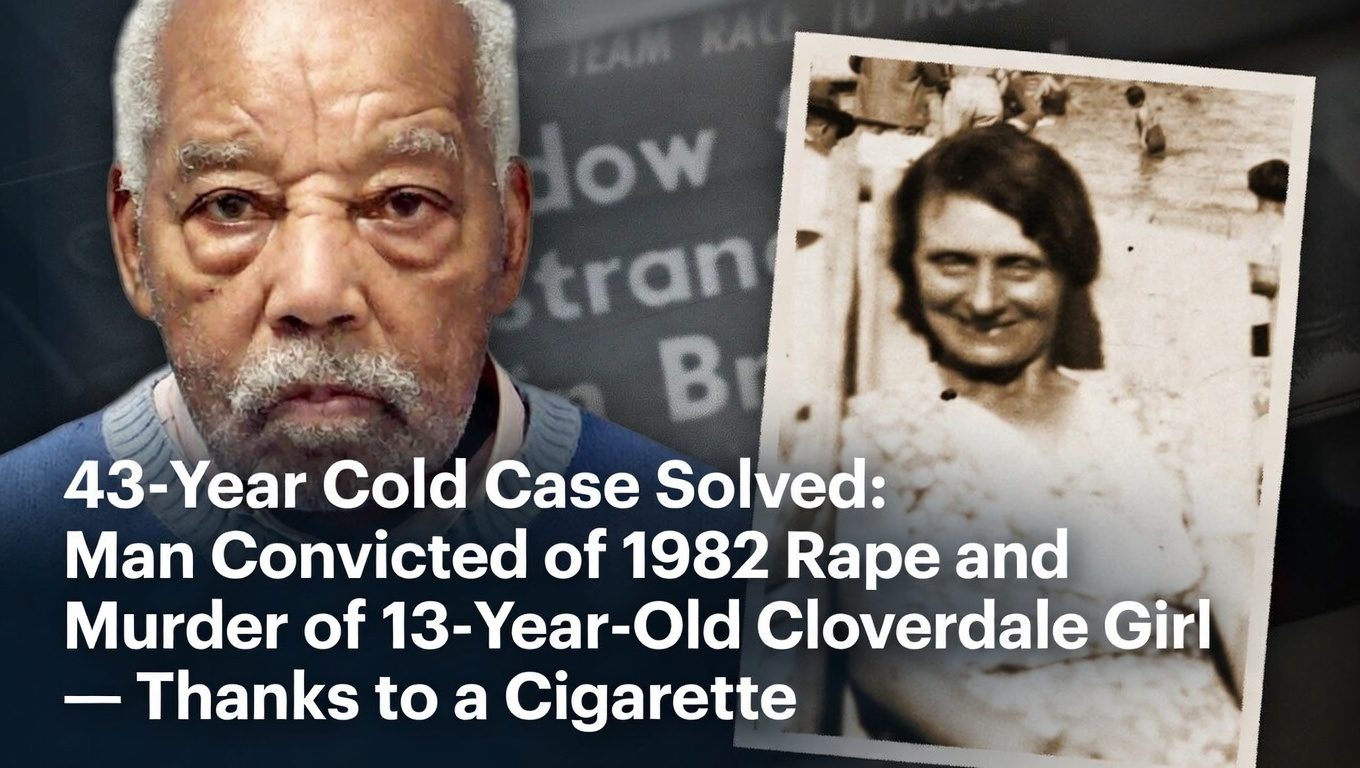

Raymond Lee Rude, 78, convicted of the 1982 rape and murder of Kellie Poppleton in Cloverdale, California — 43 years after the crime — after genealogical DNA from a cigarette butt cracked the case wide open
1. What Happened: The Quick Answer
|
| Key Detail | Confirmed Information |
| Victim | Kellie Poppleton, 13 years old |
| Crime Date | September 1982 |
| Crime Location | Cloverdale, Sonoma County, California |
| Convicted | Raymond Lee Rude, 78, of Cloverdale |
| Charges | Murder; rape |
| Verdict | Guilty on all counts |
| Conviction Date | February 2026 (jury deliberated approx. 2.5 hours) |
| Case Duration | 43 years — among the longest cold cases solved by DNA in California |
| Key Evidence | Cigarette butt found at original crime scene; DNA matched via investigative genetic genealogy |
| DNA Method | Investigative genetic genealogy (IGG) — public genealogy database upload |
| Prosecuting Agency | Sonoma County District Attorney’s Office |
| Rude at Time of Crime | Mid-30s; resided in Cloverdale area |
| Sentencing | Pending (as of Feb. 2026) |
2. Who Was Kellie Poppleton? The Victim’s Story
Kellie Poppleton was 13 years old in September 1982. She lived in Cloverdale — a small city of roughly 8,000 people in northern Sonoma County, about 90 miles north of San Francisco. Cloverdale sits at the northern tip of the Alexander Valley wine country, a quiet, close-knit community where a child’s disappearance sent shockwaves through every household on every street.
Kellie’s story did not make national headlines when she disappeared in 1982. There was no viral outrage, no 24-hour news cycle demanding answers. She was a child in a small town, and then she was gone — and for four decades, her case file sat in a box while her family waited.
Details about Kellie’s family, her life, and her personality have not been extensively reported in the available coverage of this case. What is known is that her family waited 43 years for this verdict. That is 43 years of every September arriving without justice. That is the weight that the conviction of Raymond Lee Rude finally lifted.
Sonoma County District Attorney Carla Rodriguez, speaking after the verdict: “Justice has been served for Kellie Poppleton and her family. This verdict demonstrates our unwavering commitment to solving cold cases and bringing closure to victims’ families, no matter how much time has passed.”
In an era when cold cases are often resolved through sensational media attention, Kellie Poppleton’s case was solved the quiet way — by investigators who preserved evidence meticulously and by a technology that didn’t exist when she died.
3. The 1982 Crime: What Investigators Found
In September 1982, Kellie Poppleton’s body was discovered in Cloverdale. She had been raped and murdered. She was 13 years old.
The Sonoma County Sheriff’s Office investigated. Investigators collected physical evidence from the scene, including biological samples and, critically, a cigarette butt. The significance of that cigarette would not be understood for more than four decades.
In 1982, DNA profiling did not exist. The double-helix structure of DNA had been known since Watson and Crick’s 1953 paper, but forensic DNA analysis — using genetic material to identify criminals — was not developed until 1984 by British geneticist Alec Jeffreys. It was not used in a U.S. criminal case until 1987. The investigators who processed Kellie Poppleton’s crime scene in 1982 could not have known that the cigarette they bagged and tagged would one day identify her killer.
Without a DNA match — and without any other evidence sufficient to charge a suspect — the case went cold. Investigators had a crime. They had physical evidence. They did not have a name.
4. 43 Years of Silence: The Case Goes Cold
Cold cases are defined differently across jurisdictions, but the general understanding is simple: a case that has gone inactive because investigators lack sufficient leads to move forward. The Poppleton case became one of these — officially open, practically stalled.
Sonoma County maintained the physical evidence from the case. This is not universal. Many jurisdictions have lost or destroyed decades-old evidence. The decision to preserve it — in whatever form it was maintained across three sheriff’s administrations, multiple evidence rooms, and 43 years — made the eventual resolution possible. Evidence preservation is one of the least glamorous but most consequential decisions in cold case management.
What Kept the Case Alive
- The original evidence was preserved, including the cigarette butt
- DNA technology advanced — from basic blood typing in 1982, to RFLP DNA profiling in the late 1980s, to STR (short tandem repeat) analysis in the 1990s, to investigative genetic genealogy in the 2010s
- The Sonoma County Sheriff’s Office maintained an active cold case unit
- The Sonoma County DA’s office committed resources to review unsolved homicides using emerging forensic technologies
The case received renewed attention as genetic genealogy tools became available to law enforcement in the late 2010s. California was among the first states to formalize guidelines for investigative genetic genealogy (IGG) use in criminal investigations — guidelines that shaped how this case was ultimately solved.
5. The Cigarette That Changed Everything: How DNA Cracked the Case
A cigarette butt. That’s what broke a 43-year-old case.
Investigators from the Sonoma County Sheriff’s Office submitted the cigarette butt from the 1982 crime scene for advanced DNA analysis. The lab extracted a genetic profile from cells left on the cigarette — saliva deposited by whoever smoked it.
That profile was then uploaded to a public genealogy database — GEDmatch is the database most commonly used in law enforcement IGG cases, though the specific database used in the Poppleton case has not been confirmed in published reports. The goal is to find partial DNA matches to relatives of the unknown suspect — cousins, aunts, uncles, second cousins — and use those family trees to triangulate toward the individual the DNA actually belongs to.
In the Poppleton case, the genealogy match led investigators to Raymond Lee Rude. His own DNA was then collected — through a process that typically involves obtaining a discarded item (a cup, a straw, a cigarette) or via a court-ordered swab — and compared to the crime scene profile. It matched.
The cigarette butt preserved from 1982 was not just evidence of the crime. It was a time capsule of Raymond Lee Rude’s DNA — waiting 43 years for science to catch up to the truth.
6. How Investigative Genetic Genealogy Works — Explained Plainly
Investigative genetic genealogy (IGG) is one of the most significant developments in forensic science in the past 30 years. It has solved dozens of cold cases — including the identification of the Golden State Killer, Joseph James DeAngelo — and continues to crack cases that seemed permanently unsolvable.
Step 1: Extract DNA from Evidence
The process begins with biological material from a crime scene — blood, semen, saliva (from a cigarette or envelope), hair roots, or skin cells. A lab extracts and profiles the DNA, building a genetic picture of the unknown person.
Step 2: Upload to a Public Genealogy Database
The DNA profile is uploaded to a public genealogy database — most commonly GEDmatch, which allows law enforcement uploads under a specific opt-in consent framework established after the Golden State Killer case. The database searches for partial matches: people who share segments of DNA with the unknown individual, suggesting a family relationship.
Step 3: Build the Family Tree
Once partial matches are found — even distant ones, like second or third cousins — forensic genealogists begin building family trees for those matches. The goal is to find the common ancestor shared between the match and the unknown DNA, and then trace all descendants of that ancestor forward to identify who might be the right age and in the right geographic area.
Step 4: Confirm Through Traditional Investigation
Genetic genealogy narrows the field to a suspect or small group of suspects. Traditional investigation — background checks, interviews, geographic analysis, and ultimately a confirmatory DNA sample — closes the circle. The confirmatory sample (not the genealogy database match) is what produces admissible courtroom evidence.
| Stage | What Happens |
| 1. DNA Extraction | Crime scene DNA profiled in forensic lab |
| 2. Database Upload | Profile uploaded to GEDmatch or similar; partial matches identified |
| 3. Genealogy Research | Family trees built from partial matches to narrow to suspect |
| 4. Suspect Identification | Traditional investigation confirms likely suspect |
| 5. Confirmatory DNA | Separate DNA sample obtained from suspect; compared to crime scene |
| 6. Arrest & Prosecution | Confirmatory match used as courtroom evidence; arrest follows |
In the Poppleton case, this process took years — not because it’s slow by design, but because genealogy research is painstaking work, and confirming a cold case suspect requires legal precision. The result, after all that work: a 78-year-old man sitting in a Sonoma County courtroom being found guilty of a crime he committed 43 years ago.
7. Who Is Raymond Lee Rude?
Raymond Lee Rude was approximately 35 years old when Kellie Poppleton was murdered in September 1982. He lived in Cloverdale — the same community where the crime occurred. He was, in other words, a neighbor. Possibly known to the family. Certainly present in the tight geography of a town that had roughly 3,000 residents in the early 1980s.
Rude was 78 years old at the time of his conviction in February 2026. Few details about his personal life — his occupation, his family, or any prior criminal history — have been reported in available coverage. This is not unusual for cold case conviction stories, where the public interest centers on the victim and the forensic resolution rather than the biography of the perpetrator.
He was arrested after investigators obtained his DNA from a discarded item and confirmed the match to the 1982 crime scene profile. He was charged with first-degree murder and rape. He was tried in Sonoma County Superior Court.
|
8. The Trial: Evidence, Verdict, and What Comes Next
The trial was held in Sonoma County Superior Court in early 2026. The prosecution, led by the Sonoma County District Attorney’s office under DA Carla Rodriguez, presented the DNA evidence as the cornerstone of its case.
The key evidence the jury evaluated:
- DNA extracted from the cigarette butt collected at the 1982 crime scene
- Investigative genetic genealogy analysis that led investigators to Rude
- Confirmatory DNA sample obtained from Rude and matched to the crime scene profile
- Physical evidence and witness testimony from the original investigation
The Jury’s Deliberation
The jury deliberated for approximately two and a half hours. That is a short deliberation for a murder case — suggesting the DNA evidence, when combined with the overall prosecution case, was persuasive enough to produce a rapid consensus.
The Verdict
Guilty on all counts. Raymond Lee Rude was convicted of the 1982 rape and murder of Kellie Poppleton.
Sentencing
Sentencing had not yet occurred as of the time of publication (February 2026). Under California law, first-degree murder carries a sentence of 25 years to life. Given Rude’s age — 78 — any significant prison sentence is effectively a life sentence. Sentencing is expected to follow in subsequent court proceedings.
9. Justice for Kellie: Reactions from Family and Officials
District Attorney Carla Rodriguez: “Justice has been served for Kellie Poppleton and her family. This verdict demonstrates our unwavering commitment to solving cold cases and bringing closure to victims’ families, no matter how much time has passed.”
The reaction from Kellie Poppleton’s family has not been reported in detail in available sources — a reminder that the people most affected by crimes like this one often choose privacy over public statement. After 43 years of waiting, the verdict speaks louder than any press statement.
Law enforcement officials emphasized the role of evidence preservation and investigative persistence. The Sonoma County Sheriff’s Office, which maintained the cold case evidence across decades and multiple administrations, was credited alongside the DA’s office and the forensic genetics teams that conducted the genealogy analysis.
The case generated significant media coverage nationally — from the Associated Press to People magazine — because of the combination of factors: the age of the case, the victim’s age, the specific evidence (a cigarette butt), and the 43-year gap between crime and conviction. All of these elements together make it one of the most striking cold case resolutions in recent California criminal justice history.
10. Cold Cases and DNA: A Revolution in Criminal Justice
The Poppleton case is one of dozens — possibly hundreds — of cold cases that have been solved in the past decade through investigative genetic genealogy. Understanding the scale of this revolution helps put the Cloverdale case in context.
The Golden State Killer Precedent
The pivotal moment for IGG was the 2018 arrest of Joseph James DeAngelo, the Golden State Killer. DeAngelo was responsible for 13 murders and at least 50 sexual assaults across California between 1974 and 1986. He was identified through the same genealogy database process used in the Poppleton case. When the arrest was announced, it was described as a breakthrough in forensic science. It was also a template: hundreds of investigators across the country began reviewing cold case evidence to see if IGG could be applied.
How Many Cold Cases Has IGG Solved?
|
Why CODIS Wasn’t Enough
The FBI’s Combined DNA Index System (CODIS) contains DNA profiles of convicted offenders and arrestees across the country. But CODIS only works if the suspect’s DNA is already in the system — meaning they’ve been previously convicted of or arrested for a qualifying offense. Raymond Lee Rude apparently had no prior qualifying criminal record that would have placed his DNA in CODIS. The cigarette butt evidence would have been tested against CODIS repeatedly over the years — and found no match.
IGG changes the equation entirely. Instead of requiring the suspect’s DNA to already be in a law enforcement database, it works backward from partial family matches to identify people who’ve never been in any criminal database. It’s a fundamentally different approach — and it’s the approach that finally gave Kellie Poppleton’s family a name.
The Privacy Debate
IGG’s power comes with genuine ethical complexity. When a person uploads their DNA to a genealogy database like 23andMe, AncestryDNA, or GEDmatch, they are consenting to share their own genetic information. But their DNA also contains information about their relatives — people who never consented to anything. Law enforcement use of these databases effectively searches the genetic information of millions of people who never chose to be part of a criminal investigation.
GEDmatch addressed this by creating a specific law enforcement opt-in option after the Golden State Killer case generated controversy. Users who opt in consent to their profiles being searched in homicide and sexual assault investigations. But the broader debate — about genetic privacy, familial surveillance, and the limits of consent — continues in both legal scholarship and public policy.
In the Poppleton case, as in most IGG cases, this tension is held in check by the outcome: a conviction in a 43-year-old murder of a child. The moral weight of that outcome makes the privacy tradeoff feel worth it to most observers — but the debate remains important for future policymaking.
| Notable Cold Case Solved by IGG | Year Solved | Years Cold |
| Golden State Killer (Joseph DeAngelo) | 2018 | 40+ years |
| Kellie Poppleton murder (Raymond Rude) | 2026 | 43 years |
| Christy Mirack murder (Raymond Rowe) | 2018 | 26 years |
| Tanya Van Cuylenborg / Jay Cook murders | 2018 | 31 years |
| Lisa Jensen ‘Baby Jane Doe’ case | 2022 | ~50 years (identity) |
| Angie Dodge murder (Brian Dripps) | 2019 | 23 years |
11. Frequently Asked Questions (FAQ)
Who killed Kellie Poppleton?
Raymond Lee Rude, 78, of Cloverdale, California, was convicted in February 2026 of the rape and murder of Kellie Poppleton in September 1982. He was identified through investigative genetic genealogy — DNA extracted from a cigarette butt found at the original crime scene matched Rude’s genetic profile. He was convicted after a jury deliberated for approximately 2.5 hours.
How was the 1982 Cloverdale murder solved?
The case was solved through investigative genetic genealogy (IGG). Investigators submitted a cigarette butt preserved from the 1982 crime scene for advanced DNA analysis. The resulting genetic profile was uploaded to a public genealogy database, which identified partial matches to relatives of the suspect. Forensic genealogists built family trees from those matches and identified Raymond Lee Rude. A confirmatory DNA sample from Rude matched the crime scene profile, leading to his arrest and conviction.
What is investigative genetic genealogy?
Investigative genetic genealogy (IGG) is a forensic technique that uploads DNA from a crime scene to genealogy databases to find partial matches with relatives of the unknown suspect. By building family trees from those matches, investigators can identify individuals who share the crime scene DNA — even if that person has never been in a law enforcement DNA database. IGG gained national attention after the 2018 identification of the Golden State Killer.
How long was the Poppleton case unsolved?
The murder of Kellie Poppleton occurred in September 1982. Raymond Lee Rude was convicted in February 2026 — approximately 43 years after the crime. This makes it one of the longest-standing cold cases in Sonoma County history to be resolved through DNA evidence.
What charges was Raymond Rude convicted of?
Raymond Lee Rude was convicted of first-degree murder and rape in connection with the 1982 death of Kellie Poppleton in Cloverdale, California. The jury deliberated for approximately 2.5 hours before returning a guilty verdict on all counts. Sentencing had not occurred as of the publication of this article.
What sentence could Raymond Rude face?
Under California law, first-degree murder carries a sentence of 25 years to life. Rude was 78 years old at the time of his conviction. Any substantial prison sentence is, as a practical matter, a life sentence given his age. Sentencing proceedings were expected to follow the verdict in subsequent court appearances.
What database was used to find Raymond Rude?
Published reports confirm that DNA from the cigarette butt was uploaded to a genealogy database as part of investigative genetic genealogy analysis. The specific database was not named in available sources at time of publication. GEDmatch is the most commonly used database in law enforcement IGG cases, but it is not confirmed as the database in this case.
What happened to the DNA evidence over 43 years?
The cigarette butt and other physical evidence from the 1982 crime scene were preserved by the Sonoma County Sheriff’s Office. Evidence preservation was identified as a critical factor in the case’s resolution. The DNA technology needed to use that evidence effectively did not exist when the crime occurred — investigative genetic genealogy became practically available to law enforcement only in the mid-2010s and gained widespread use after the 2018 Golden State Killer case.
12. Key Takeaways
- Kellie Poppleton, 13, was raped and murdered in Cloverdale, California, in September 1982. Her case went unsolved for 43 years.
- Raymond Lee Rude, 78, was convicted of her rape and murder in February 2026 — after investigators used investigative genetic genealogy to link DNA from a cigarette butt at the 1982 crime scene to Rude.
- The jury deliberated approximately 2.5 hours before returning a guilty verdict on all counts.
- The case is one of the longest-running cold cases in Sonoma County history to be resolved through DNA evidence.
- The DNA evidence alone did not produce the conviction — it was the combination of the IGG process, traditional investigative confirmation, and a second DNA sample matched directly to Rude.
- Investigative genetic genealogy has now been used in more than 700 criminal cases in the U.S. since the technique gained widespread use after the 2018 Golden State Killer arrest.
- Evidence preservation was identified as a decisive factor: the cigarette butt survived 43 years in evidence storage and yielded DNA that the technology of 1982 could not have analyzed.
- Sonoma County DA Carla Rodriguez: ‘Justice has been served for Kellie Poppleton and her family. This verdict demonstrates our unwavering commitment to solving cold cases.’
- Sentencing was pending as of February 2026. Rude faces 25 years to life — which, at 78, constitutes a de facto life sentence.
Sources
- Associated Press: Wire report on Raymond Rude conviction (February 2026)
- New York Post: ’43-year-old cold case of 13-year-old’s rape and murder solved by cigarette DNA’ (February 2026)
- Sacramento Bee: Coverage of Sonoma County DA statement and trial details (February 2026)
- People Magazine: Cold case coverage and victim background (February 2026)
- NBC News: National cold case coverage (February 2026)
- San Francisco Chronicle: Northern California regional coverage (February 2026)
- Sonoma County District Attorney’s Office: Official statement from DA Carla Rodriguez
- Parabon NanoLabs: IGG case statistics (referenced for 700+ cases figure)
| About This Article
This article was researched using wire reporting from the Associated Press, the New York Post, Sacramento Bee, People Magazine, NBC News, and San Francisco Chronicle coverage of the Raymond Rude conviction (all February 2026), as well as the official statement from Sonoma County District Attorney Carla Rodriguez. Investigative genetic genealogy technical information is drawn from publicly available explanations of the IGG process as used in the Golden State Killer case and subsequent law enforcement applications. The specific genealogy database used in the Poppleton investigation was not confirmed in available sources and is noted as unconfirmed. The specific database used in this case was not named in published reports. Last updated: February 19, 2026. |
Discover more from MatterDigest
Subscribe to get the latest posts sent to your email.