Supreme Court Strikes Down Trump’s Tariffs in Historic 6–3 Ruling
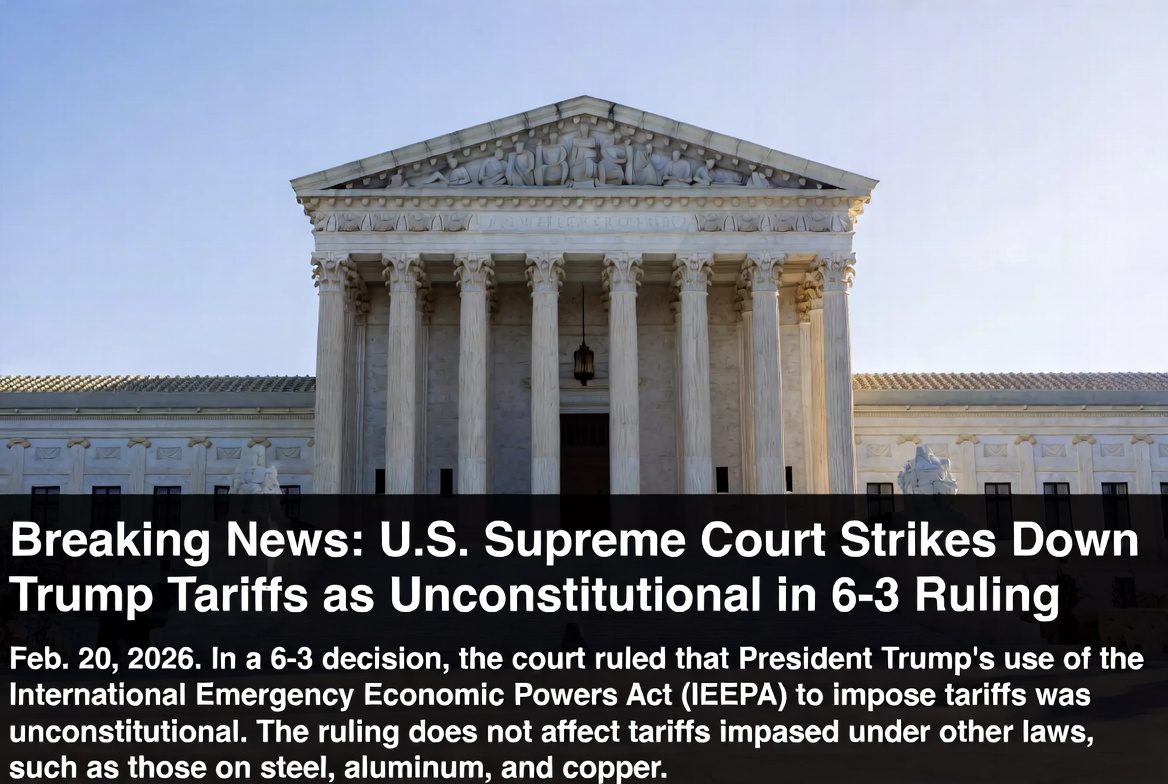

| BREAKING — February 20, 2026: U.S. Supreme Court rules 6–3 in Learning Resources, Inc. v. Trump. IEEPA-based tariffs struck down. $175B+ in potential refunds unresolved. |
The Supreme Court Just Rewrote the Rules of Presidential Trade Power
For more than a year, President Donald Trump reshaped the global economy with a single tool: tariffs. He used them as leverage against China. As punishment for fentanyl flows from Mexico. As pressure on allies across Europe and Asia. At their peak, his tariffs touched nearly every nation on earth.
On Friday morning, February 20, 2026, the Supreme Court took that tool away.
In a 6-to-3 ruling, the justices held that Trump exceeded his authority when he used a 1977 emergency law to impose sweeping import taxes on countries around the world. The law — the International Emergency Economic Powers Act, or IEEPA — does not authorize the president to impose tariffs, the court ruled. That power belongs to Congress.
The decision is one of the most significant checks on presidential power in a generation. It strikes down the bulk of Trump’s tariff agenda, potentially triggers more than $175 billion in refunds, and forces a furious White House back to the drawing board.
1. What the Supreme Court Ruled — The Short Version
|
The ruling was authored by Chief Justice John Roberts, a conservative whom Trump himself nominated as an associate justice under his first term (though Roberts was elevated to Chief Justice under George W. Bush). Roberts was joined by justices Neil Gorsuch and Amy Coney Barrett — both Trump appointees — along with all three liberal justices.
The dissenters were Justices Samuel Alito, Clarence Thomas, and Brett Kavanaugh. Their dissents argued, in different ways, that IEEPA’s text and history supported the president’s authority to impose tariffs as a trade regulatory measure.
2. Complete Ruling at a Glance: Key Facts Table
| Category | Details / Figures |
| Law used by Trump | International Emergency Economic Powers Act (IEEPA), 1977 |
| Tariffs struck down | Near-global ‘reciprocal’ tariffs; fentanyl-linked tariffs on Canada, China, Mexico |
| Tariffs NOT struck down | Steel, aluminum, copper tariffs (use separate legal authority) |
| Vote | 6–3 (Roberts majority; Alito, Thomas, Kavanaugh dissented) |
| Revenue collected under IEEPA tariffs | $175B+ (Penn Wharton Budget Model estimate); $289B total tariff revenue |
| Potential refunds owed | $175B+ (unresolved — lower courts must decide) |
| Case name | Learning Resources, Inc. v. Trump |
| Arguments heard | November 5, 2025 |
| Decision date | February 20, 2026 |
| Trump’s reaction | Called the ruling a ‘disgrace’ |
| Market reaction | Stocks soared after ruling was announced |
3. What Is IEEPA? The 1977 Law at the Center of Everything
The International Emergency Economic Powers Act was passed by Congress in 1977 to give the president tools to respond to national emergencies that originate outside the United States. Before Trump, every president who used IEEPA used it to freeze assets, block transactions, or impose targeted sanctions.
No president before Trump had ever used IEEPA to impose tariffs. The law allows the president to “regulate… importation” of foreign goods during a declared emergency. The Trump administration argued that “regulate importation” implicitly included the power to levy tariffs.
The Supreme Court disagreed. Chief Justice Roberts pointed out that IEEPA’s authorization rests on two words — “regulate” and “importation” — separated by 16 others, and that building a sweeping tariff power on that basis stretched the law far beyond what Congress intended.
|
The court also noted that the Constitution “very clearly” gives Congress, not the president, the power to tax. “The Framers did not vest any part of the taxing power in the Executive Branch,” Roberts wrote.
4. How the Justices Voted — Full 6-3 Breakdown
| Justice | Side | Notes |
| Chief Justice John Roberts | MAJORITY | Wrote the opinion; cited ‘major questions doctrine’ |
| Justice Neil Gorsuch | MAJORITY | Wrote separate concurrence |
| Justice Amy Coney Barrett | MAJORITY | Wrote separate concurrence |
| Justice Sonia Sotomayor | MAJORITY | Joined on statutory grounds (not major questions) |
| Justice Elena Kagan | MAJORITY | Joined on statutory grounds (not major questions) |
| Justice Ketanji Brown Jackson | MAJORITY | Joined on statutory grounds (not major questions) |
| Justice Samuel Alito | DISSENT | Argued tariffs were lawful under IEEPA text/history |
| Justice Clarence Thomas | DISSENT | Argued tariffs were lawful |
| Justice Brett Kavanaugh | DISSENT | Warned refund process will be ‘a mess’ |
The majority opinion was unusual in its coalition. Roberts, Gorsuch, and Barrett — all conservatives — joined with the court’s three liberals on the result, but for different reasons. Roberts’ application of the “major questions doctrine” only garnered three votes (Roberts, Gorsuch, Barrett). The liberals joined a separate portion of the opinion finding IEEPA simply does not authorize tariffs by its text.
The most notable dissenters: Kavanaugh, a Trump appointee, dissented while also warning that the aftermath could be a “mess” — referring specifically to the difficulty of processing refunds for businesses that paid IEEPA tariffs over the past year.
5. Which Tariffs Are Struck Down — and Which Survive
Struck Down by Today’s Ruling
- Near-global ‘reciprocal’ tariffs: Broad duties imposed on trading partners worldwide citing trade deficit emergency
- Fentanyl-linked tariffs: Tariffs on Canada, China, and Mexico justified by citing drug trafficking emergency
- Other IEEPA-based tariffs: Any tariff imposed solely under the IEEPA emergency authority
NOT Struck Down — These Tariffs Survive
- Steel tariffs: Imposed under Section 232 of the Trade Expansion Act of 1962 — a different law with explicit tariff authority
- Aluminum tariffs: Same Section 232 basis — remain in effect
- Copper tariffs: Also based on separate legal authority
- Section 301 tariffs on China: The extensive China-specific tariffs from Trump’s first term and early second term that rely on a different statute
This is a critical nuance. The ruling is sweeping but not total. A significant portion of Trump’s tariff architecture — particularly on China — may survive under other legal authorities. Trade lawyers and businesses will now scramble to understand which of their imports fall under which statute.
6. The $175 Billion Question: Will Businesses Get Refunds?
This is the most consequential unresolved question from today’s ruling. The Supreme Court struck down the IEEPA tariffs but deliberately declined to address how — or whether — refunds should be issued to the businesses that paid them.
Penn Wharton Budget Model economists estimated that IEEPA-based tariffs collected more than $175 billion. The Bipartisan Policy Center put total tariff revenue (across all authorities) at $289 billion as of January 2026. The portion tied specifically to IEEPA is the amount now in question.
Justice Kavanaugh’s dissent predicted the refund process would be “a mess.” He’s not wrong. Courts of International Trade will now need to work through thousands of individual importers’ claims. Some analysts expect the process to take years.
|
Democrats immediately called for the Trump administration to begin processing refunds. The administration has not confirmed any timeline or intention to do so.
7. Trump’s Reaction: ‘A Disgrace’
President Trump was meeting with governors at the White House when he was informed of the ruling. According to a person familiar with his reaction, he called it a “disgrace.”
Trump had spent the days before the ruling attempting to frame the stakes. On Thursday, during a stop in Georgia, he proclaimed that “without tariffs, you know what, everybody would be bankrupt, the whole country would be bankrupt.” He also said he had been “waiting forever” for the court’s decision, insisting his right to impose tariffs should be obvious.
The White House had no formal comment in the immediate aftermath of the ruling. Trump has multiple pathways to reimpose tariffs using other legal authorities — a process that could take months and require congressional engagement.
8. Market Reaction: Stocks Soar
Financial markets responded immediately and enthusiastically to the ruling. Stock indexes surged as the decision was announced, with traders interpreting the end of sweeping IEEPA tariffs as a significant relief for business costs, supply chains, and trade relationships.
The tariffs had been widely blamed by economists, businesses, and trading partners for raising consumer prices, disrupting supply chains, and contributing to a 33% jump in the U.S. trade deficit in December 2025. The U.S. trade deficit totaled $901 billion in 2025 overall — barely moving despite the tariffs’ stated goal of reducing it.
The ruling removes a major source of uncertainty that had been weighing on markets and business investment decisions since Liberation Day in April 2025. Whether the relief is durable will depend on what legal alternatives the Trump administration pursues.
9. Political Reactions: Pence, Democrats, Trading Partners
Former Vice President Mike Pence
|
House Democrats
|
International Analysts
Rachel Ziemba, adjunct senior fellow at the Center for a New American Security, described the ruling as “a big repudiation of Trump’s tariff agenda” and said it would “rein in Trump’s ability to threaten tariffs against any country for any reason.”
Trading partners including Canada, Mexico, the European Union, and China — all of whom faced significant IEEPA-based duties — will now reassess their trade posture with the United States.
10. What Happens Next: Trump’s Options
The ruling is a massive setback, but it is not the end of Trump’s trade agenda. He has several potential paths forward.
Option 1: Congressional Action
Congress could pass legislation explicitly authorizing the president to impose tariffs under specific conditions. This is the cleanest constitutional path but would require bipartisan cooperation that may not exist.
Option 2: Other Existing Statutes
Multiple other trade laws give the president tariff authority. Section 232 (national security), Section 301 (unfair trade practices), and Section 201 (safeguard tariffs) all remain available. Trump could reimpose some IEEPA tariffs through these mechanisms, but each has procedural requirements that take time.
Option 3: Trade Negotiations
The administration has touted bilateral trade deals with multiple countries negotiated under IEEPA tariff pressure. Those deals may or may not remain valid now that the underlying tariff threat has been eliminated.
Option 4: Accept the Ruling and Pivot
Politically unlikely given Trump’s posture, but the administration could focus remaining tariff authority on targeted sectors — steel, aluminum, specific Chinese goods — under existing legal frameworks.
11. The Major Questions Doctrine Explained Simply
Chief Justice Roberts cited the “major questions doctrine” in his opinion — but only three justices fully joined that section. Here’s what it means.
The major questions doctrine says that when a president (or any executive branch agency) claims the power to make a decision with enormous economic or political impact, they need explicit permission from Congress to do so. Courts shouldn’t assume that vague or ambiguous laws give the executive that kind of sweeping power.
Roberts applied this to IEEPA: the power to impose tariffs on the entire world is unquestionably a decision of vast economic significance. Tariffs are a form of taxation. The Constitution gives that power to Congress. Finding that power hiding in two words of a 1977 emergency law would be exactly the kind of assumption the major questions doctrine is designed to prevent.
Interestingly, the court’s three liberals had previously objected to the major questions doctrine when it was used against Biden policies. Here, they joined the ruling on different grounds — simply that IEEPA’s text does not authorize tariffs — without endorsing Roberts’ major questions reasoning.
12. Historical Context: The First Real ‘No’ to Trump
In the roughly 24 months since Trump returned to the White House, the Supreme Court had ruled in his favor in approximately two dozen cases. But as NPR noted, those victories came on the court’s emergency docket — temporary stays and procedural decisions that allowed Trump’s policies to continue while cases developed.
Today was different. The tariff case was fully briefed, fully argued, and fully decided. It is the first time the Supreme Court has looked Trump squarely in the eye on a major second-term policy and said no.
The case was also notable for who brought it. Small businesses — toy companies, furniture retailers, importers — filed the lawsuits, joined by a coalition of 12 states led by Oregon. They argued the tariffs were killing their businesses. The court agreed with them.
|
That final line from Roberts reads like a careful statement of judicial restraint — the court is not saying tariffs are bad policy. It is saying the president does not have the constitutional authority to impose them this way. The distinction matters.
13. Key Takeaways
- The Supreme Court ruled 6–3 in Learning Resources, Inc. v. Trump that Trump’s use of IEEPA to impose tariffs was unconstitutional
- Chief Justice Roberts wrote the opinion, joined by Trump appointees Gorsuch and Barrett, and all three liberal justices
- Justices Alito, Thomas, and Kavanaugh dissented
- Tariffs based on IEEPA are struck down — including ‘reciprocal’ global tariffs and fentanyl-linked tariffs on Canada, China, and Mexico
- Steel, aluminum, copper, and Section 301 China tariffs under separate legal authority are NOT affected
- An estimated $175+ billion in tariff refunds may be owed — but the court did not address how or whether those refunds will happen
- Trump called the ruling a ‘disgrace’; stocks soared on the news
- Former VP Mike Pence called it “a victory for the American people”
- Trump retains other legal paths to reimpose some tariffs but faces procedural delays
- This is the first significant second-term policy the Supreme Court has definitively rejected
14. Frequently Asked Questions (FAQs)
What did the Supreme Court rule on Trump’s tariffs?
On February 20, 2026, the Supreme Court ruled 6–3 that Trump’s use of the International Emergency Economic Powers Act (IEEPA) to impose tariffs was unconstitutional. The court held that IEEPA does not authorize the president to impose tariffs, and that the Constitution clearly grants that taxing power to Congress.
Which tariffs were struck down?
The ruling strikes down tariffs imposed using IEEPA, including Trump’s near-global ‘reciprocal’ tariffs and tariffs on Canada, China, and Mexico linked to fentanyl emergency declarations. Tariffs based on other laws — including steel and aluminum tariffs under Section 232 and China tariffs under Section 301 — are not affected.
Who wrote the Supreme Court’s tariff opinion?
Chief Justice John Roberts wrote the majority opinion. He was joined by Justices Neil Gorsuch and Amy Coney Barrett (also conservatives and Trump appointees) plus the three liberal justices: Sotomayor, Kagan, and Ketanji Brown Jackson.
Who dissented in the tariff ruling?
Justices Samuel Alito, Clarence Thomas, and Brett Kavanaugh dissented. Kavanaugh, notably, also warned in his dissent that the refund process following the ruling would likely be ‘a mess’.
Will businesses get refunds for tariffs already paid?
The Supreme Court did not address the refund question in its ruling. An estimated $175+ billion in IEEPA tariffs has been collected. Whether and how refunds will be paid will be decided in lower courts. Justice Kavanaugh warned the process will be ‘a mess.’
What is IEEPA?
The International Emergency Economic Powers Act (1977) gives the president authority to regulate commerce during national emergencies caused by foreign threats. Before Trump, no president had used it to impose tariffs. The Supreme Court ruled Trump’s use of IEEPA for tariffs exceeded the law’s scope.
Can Trump reimpose the tariffs?
Trump can seek to reimpose some tariffs through other legal authorities, including Section 232 (national security), Section 301 (unfair trade practices), or by seeking explicit congressional authorization. Each path has procedural requirements and timelines that make an immediate reimposition unlikely.
What is the major questions doctrine?
The major questions doctrine holds that when the executive branch claims sweeping authority over matters of vast economic or political significance, it must point to clear congressional authorization. Chief Justice Roberts applied it here, arguing that the power to tariff the entire world cannot be found in an ambiguous 1977 emergency statute.
Sources
All information sourced from verified news reporting published February 20, 2026.
- NBC News — “Supreme Court strikes down most of Trump’s tariffs in a major blow to the president” (Feb. 20, 2026)
- NPR — “Supreme Court strikes down Trump’s tariffs” (Feb. 20, 2026)
- CNBC — “Supreme Court strikes down Trump tariffs, rebuking president’s signature economic policy” (Feb. 20, 2026)
- SCOTUSblog — “Supreme Court strikes down tariffs” — Amy Howe (Feb. 20, 2026)
- The Washington Post — “Supreme Court strikes down Trump’s sweeping tariffs” (Feb. 20, 2026)
- Yahoo Finance — “Supreme Court strikes down Trump’s blanket tariffs” (Feb. 20, 2026)
- Al Jazeera — “In major blow to Trump, US Supreme Court strikes down his global tariffs” (Feb. 20, 2026)
- The Hill — “Supreme Court strikes down bulk of Trump’s tariffs” (Feb. 20, 2026)
- Newsweek — “Supreme Court Strikes Down Donald Trump’s Tariffs: Live Updates” (Feb. 20, 2026)
Note: This is a breaking news story. This article reflects verified information available as of 12:00 PM EST on February 20, 2026. Additional details, White House responses, and lower court proceedings will follow. Refund eligibility and timelines remain legally unresolved.
Discover more from MatterDigest
Subscribe to get the latest posts sent to your email.