Why Stablecoins Are Quietly Becoming the Backbone of the U.S. Financial System

Introduction: The Quiet Revolution in Your Wallet
Here’s something most people don’t know. As of early 2026, the combined market cap of U.S. dollar stablecoins has crossed $220 billion. That’s bigger than the GDP of Portugal. And yet, most Americans have never used one.
That’s about to change.
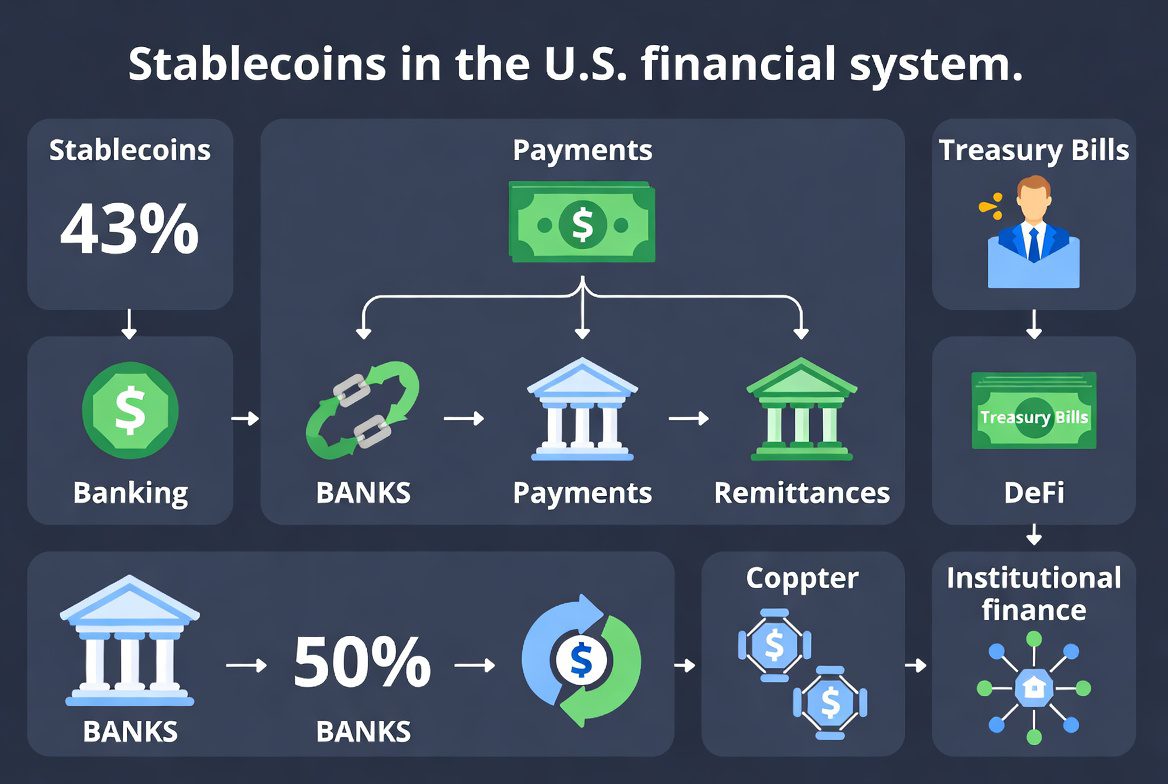
Stablecoins—digital tokens pegged to the U.S. dollar—are moving quietly from the fringes of crypto into the mainstream of global finance. Banks are testing them. The U.S. Senate is debating landmark legislation to govern them. And major corporations like Visa, JPMorgan, and PayPal are either already using them or racing to integrate them into their payment stacks.
This isn’t hype. This is infrastructure. And understanding stablecoins today is as important as understanding the internet in 1995.
In this article, you’ll learn exactly what stablecoins are, why they matter to the U.S. economy, how they’re quietly reshaping Treasury demand, what regulations are coming, and what you should actually do with this information.
1. What Are Stablecoins? (The 60-Second Explainer)
A stablecoin is a cryptocurrency designed to hold a stable value—usually $1.00—by being backed by real-world assets like cash, U.S. Treasury bills, or other collateral.
Think of it like a casino chip. When you walk into a casino, you exchange your dollars for chips. Those chips have a fixed value inside the casino, are easy to transfer between players, and can be redeemed for cash when you leave. Stablecoins work similarly—except the “casino” is the global internet, the “players” are anyone with a smartphone, and the “chip” can travel anywhere in the world in seconds.
The Three Main Types of Stablecoins
Not all stablecoins are built the same. Here’s a quick breakdown:
| Type | How It’s Backed | Examples | Risk Level |
| Fiat-Backed | 1:1 held in cash & T-bills | USDT (Tether), USDC (Circle) | Low-Medium |
| Crypto-Backed | Over-collateralized crypto | DAI (MakerDAO) | Medium-High |
| Algorithmic | Algorithm adjusts supply | UST (collapsed 2022) | Very High |
| Commodity-Backed | Gold or other assets | PAXG (Paxos Gold) | Medium |
The dominant players—Tether (USDT) and USD Coin (USDC)—are fiat-backed. Together they account for roughly 90% of the entire stablecoin market. When we talk about stablecoins becoming “the backbone” of U.S. finance, we’re mostly talking about these two.
2. The Numbers Don’t Lie: How Big Has This Market Become?
Scale matters. And the scale here is staggering.
| Metric | Figure (Early 2026) | Context |
| Total stablecoin market cap | ~$220 billion | Up from $5B in 2019 |
| Daily stablecoin transaction volume | >$40 billion | Rivals Visa on some days |
| Tether (USDT) holdings of U.S. T-bills | ~$100 billion+ | Larger than many central banks |
| Countries using stablecoins for remittances | 40+ | Especially Latin America & SE Asia |
| Stablecoin share of crypto trading volume | ~70% | Most crypto trades settle in stablecoins |
These numbers tell a story. Stablecoins are no longer a niche tool for crypto speculators. They’re settlement infrastructure—the “rails” on which a growing share of digital commerce moves.
Quick Answer: Stablecoins are digital tokens pegged to the U.S. dollar and backed by cash or Treasury bills. The total market exceeds $220 billion as of 2026, with daily transaction volumes that rival major credit card networks.
3. How Stablecoins Actually Work
Let’s go under the hood. Understanding the mechanics helps you understand why some stablecoins are safer than others—and why regulators are paying close attention.
Fiat-Backed Stablecoins: Step by Step
- A user sends $1,000 to Circle (the company behind USDC).
- Circle deposits that money in regulated U.S. banks and short-term Treasury bills.
- Circle mints 1,000 USDC tokens and sends them to the user’s digital wallet.
- The user can now send USDC anywhere in the world instantly, at almost zero cost.
- When the user wants dollars back, they redeem USDC—Circle burns the tokens and wires the cash.
The key insight? At every moment, each USDC token is supposed to be backed 1:1 by a real dollar sitting in a real account. This is fundamentally different from fractional reserve banking, where banks lend out most of the deposits they receive.
The Transparency Problem—and How It’s Being Solved
The biggest historical criticism of stablecoins was: “How do we know the reserves are actually there?” Tether faced years of scrutiny over this. As of 2025–2026, major issuers now publish monthly attestations from major accounting firms, and proposed U.S. legislation would mandate real-time proof of reserves.
Blockchain: Why It Matters Here
Stablecoins run on public blockchains like Ethereum, Solana, and Tron. This means every transaction is recorded on an immutable public ledger. Anyone can verify any transaction. That level of transparency is impossible with traditional bank wires.
4. Why the U.S. Financial System Needs Stablecoins
This is the question that surprises most people. Why would the world’s most powerful financial system need a crypto innovation?
The answer: because the current system is slower, more expensive, and more exclusive than most Americans realize.
The Problem with Traditional Payments
- A domestic wire transfer costs $15–30 and takes hours.
- An international wire can cost $45+ and take 3–5 business days.
- Credit card merchants pay 1.5–3.5% in interchange fees on every sale.
- 4 billion people globally remain “unbanked”—with no access to basic financial services.
Stablecoins solve all four of these problems simultaneously. A $10,000 USDC transfer from New York to Manila takes 5 seconds and costs less than a dollar. No bank account required on either end.
Stablecoins as Payment Rails for U.S. Businesses
American companies are discovering something important: stablecoins let them pay overseas suppliers, contractors, and partners without the friction of traditional banking. Fintech companies like Stripe and Coinbase Commerce now process stablecoin payments for thousands of businesses. PayPal launched its own stablecoin (PYUSD) in 2023 and has been steadily expanding its use.
Dollar Dominance in the Digital Age
Here’s the geopolitical angle most articles miss. As countries like China push their own digital currencies, the U.S. dollar’s global dominance faces a slow-motion challenge. Dollar-backed stablecoins are one of the most powerful tools the U.S. has to maintain financial supremacy. When someone in Argentina or Nigeria or Vietnam uses USDT, they’re choosing the dollar. They’re reinforcing dollar demand globally without the U.S. government having to do anything.
Policy insight: Some U.S. policymakers now see permissively regulated stablecoins as a national security asset—a way to extend dollar hegemony into the digital economy without a government-run CBDC.
5. Stablecoins and U.S. Treasury Demand: The Surprising Connection
This is the angle that financial journalists are just starting to cover seriously—and it has enormous implications.
Tether Is Now One of the Largest Holders of U.S. T-Bills
Tether—the company behind USDT—holds over $100 billion in U.S. Treasury bills and short-term government debt as of early 2026. That makes Tether a larger holder of U.S. Treasuries than the sovereign wealth funds of many countries, including Germany, South Korea, and Australia.
Why does this matter? Because the U.S. government relies on demand for Treasury bonds to fund its debt. As stablecoins grow, they become a structural source of demand for U.S. government debt—a self-reinforcing cycle that benefits both the dollar and the stablecoin ecosystem.
| Entity | Estimated U.S. Treasury Holdings |
| Japan (largest foreign holder) | $1.1 trillion |
| China | $770 billion |
| Tether (USDT) | ~$100+ billion |
| United Kingdom | $740 billion |
| Circle (USDC) | ~$30+ billion |
The Federal Reserve and U.S. Treasury are watching this dynamic carefully. A future where stablecoin issuers collectively hold $500 billion or more in Treasuries would make them systemically important financial institutions—whether we like it or not.
6. Real-World Use Cases You Probably Haven’t Heard About
Beyond crypto trading, stablecoins are already embedded in surprising parts of the global economy.
Remittances: Changing How Migrants Send Money Home
Global remittances total over $700 billion per year. Traditional services like Western Union charge 5–10% fees. Stablecoins are disrupting this. Platforms like Bitso in Latin America and Coins.ph in the Philippines now process hundreds of millions in monthly stablecoin remittances at a fraction of traditional costs. For a migrant worker sending $300 home each month, that’s an extra $15–30 in their family’s pocket.
B2B Cross-Border Payments
Companies importing goods from Asia, paying software developers in Eastern Europe, or managing supply chains across multiple continents are increasingly settling invoices in USDC or USDT. The advantages are speed, cost, and programmability—smart contracts can automate payment on delivery confirmation, without banks, without delays.
DeFi: Earning Yield on Stablecoins
Decentralized finance (DeFi) platforms let users earn interest by lending their stablecoins to borrowers. Yields have ranged from 3% to 20%+ depending on market conditions—often higher than traditional savings accounts. While risks exist (smart contract bugs, platform failures), millions of users globally have used DeFi to access yields unavailable through traditional banking.
On-Chain Treasury Management
A growing number of DAOs (decentralized autonomous organizations) and crypto-native companies hold their operating capital in stablecoins and earn yield on-chain. This is a genuine alternative to traditional corporate treasury management—more transparent, more automated, and increasingly competitive on returns.
7. Risks, Failures, and the Terra Collapse: What History Teaches Us
No honest article about stablecoins can ignore the catastrophic failure of TerraUSD (UST) in May 2022. In a matter of days, a $40 billion stablecoin lost nearly all its value, wiping out billions of dollars of savings and triggering a broader crypto market crash.
What Happened with Terra/Luna?
TerraUSD was an algorithmic stablecoin—it maintained its $1 peg not through real reserves, but through an algorithm that minted or burned a paired token (Luna) to absorb price pressure. When confidence wavered, the algorithm couldn’t keep up with selling pressure. It entered a “death spiral”—the peg broke, Luna collapsed, and billions in value evaporated.
Key lesson: The Terra collapse showed the world that stablecoins without real, audited reserves are existential risks. It also accelerated regulatory attention in Washington by years.
Current Risks to Watch
- Reserve quality: Are issuers actually holding safe assets, or taking on credit risk?
- Concentration risk: If Tether failed, the shockwaves through crypto and possibly traditional finance would be severe.
- Smart contract exploits: Bugs in the code governing stablecoin protocols have led to hundreds of millions in losses.
- Bank counterparty risk: USDC briefly lost its $1 peg in March 2023 when Silicon Valley Bank—which held $3.3 billion of Circle’s reserves—collapsed.
- Regulatory bans: Some countries (China, Nigeria) have banned or restricted stablecoin use.
These risks are real. But they’re also driving the regulation that will ultimately make stablecoins safer and more mainstream.
8. Regulation: What Congress and the Fed Are Doing Right Now (2025–2026)
If there’s one area where the stablecoin story is moving fastest right now, it’s regulation. And for once, Washington seems to be getting it mostly right.
The GENIUS Act and Senate Legislation
The Guiding and Establishing National Innovation for U.S. Stablecoins (GENIUS) Act passed the U.S. Senate in 2025 with bipartisan support—a rare achievement in the current political climate. The bill establishes a federal framework for “payment stablecoin issuers,” requiring 1:1 reserves in cash or short-term Treasuries, monthly public attestations, and federal oversight for large issuers.
Key Regulatory Requirements Under Proposed Rules
- 100% reserve backing in cash, insured deposits, or short-term U.S. Treasuries.
- Monthly reserve attestations from registered public accounting firms.
- Federal licensing for issuers with more than $10 billion in circulation.
- State licensing pathways for smaller issuers.
- Prohibition on algorithmic stablecoins that aren’t fully asset-backed.
The Federal Reserve’s Role
The Fed has been notably cautious about stablecoins—worried about their impact on monetary policy and bank deposits. But the Fed is also realistic: stablecoins are growing with or without a framework. Its focus now is on ensuring that regulated stablecoin issuers don’t create systemic risks—while allowing innovation to continue.
What Good Regulation Means for Adoption
Clear regulation removes one of the biggest barriers to institutional adoption. Banks have been waiting for legal clarity before integrating stablecoins into their services. Once the framework is established, expect to see stablecoin-based savings accounts, business payment solutions, and even government disbursements (like tax refunds) issued in digital dollars.
9. Stablecoins vs. CBDCs: What’s the Difference?
A question that comes up constantly: if the government is interested in digital dollars, why not just create a Central Bank Digital Currency (CBDC)?
| Feature | Stablecoin (USDC/USDT) | CBDC (Digital Dollar) |
| Issuer | Private company | Federal Reserve / U.S. Treasury |
| Privacy | Pseudonymous | Potentially tracked by government |
| Speed to market | Already deployed | Years away (if ever in U.S.) |
| Innovation potential | High (programmable) | Limited by bureaucracy |
| Public trust | Mixed but growing | Concerns about surveillance |
| Interest-bearing | Sometimes (via DeFi) | Proposed in some designs |
The U.S. has been notably reluctant to pursue a CBDC, partly due to privacy concerns from both political parties. Many U.S. policymakers now see regulated private stablecoins as a better path forward—delivering the benefits of digital dollars without government surveillance.
The U.S. strategy appears to be: let private companies build the dollar-backed digital infrastructure, then regulate it. This is very different from China’s top-down CBDC approach.
10. What Happens Next? The Future of Dollar-Backed Digital Money
We’re at an inflection point. Here’s what the next few years likely look like.
Short-Term (2026–2027)
- S. stablecoin legislation becomes law, creating the first comprehensive federal framework.
- Major U.S. banks launch stablecoin products or integrate existing ones into their apps.
- PayPal, Stripe, and Apple Pay integrate stablecoin settlement into mainstream consumer apps.
- Stablecoin market cap crosses $500 billion as institutional adoption accelerates.
Medium-Term (2027–2030)
- Stablecoins become the default settlement layer for B2B international payments.
- Remittance corridors (U.S. to Mexico, Philippines, India) are dominated by stablecoin rails.
- S. federal and state governments experiment with stablecoin-based disbursements.
- DeFi protocols achieve regulatory compliance, unlocking trillions in institutional capital.
Long-Term (2030+)
The distinction between “crypto” and “traditional finance” fades. The dollar, in digital form, flows freely across borders, devices, and financial systems. The backbone of this new system? Dollar-backed stablecoins, running 24/7 on programmable blockchains.
11. Key Takeaways and What You Should Do Now
The 7 Things You Need to Remember
- Stablecoins are digital dollars. They’re not speculative crypto—they’re designed to hold exactly $1.00 in value.
- The market is already $220+ billion and growing. This is not experimental—it’s operational infrastructure.
- Tether alone holds more U.S. Treasuries than most sovereign nations. Stablecoins are now structurally embedded in U.S. government debt markets.
- They solve real problems: slow wires, high remittance fees, lack of banking access for billions.
- The Terra collapse taught us that only fully asset-backed stablecoins are safe. Know what’s backing what you use.
- S. regulation is coming—and it’s likely to be a net positive for adoption and safety.
- Stablecoins, not CBDCs, appear to be America’s answer to maintaining dollar dominance in the digital age.
Actionable Steps
- If you’re a business: Explore stablecoin payment rails for international transactions. Start with Stripe or Coinbase Commerce.
- If you’re an investor: Monitor stablecoin issuers as potential investment targets as the sector matures and potentially goes public.
- If you’re a policy follower: Track the GENIUS Act and its implementation—this is landmark financial legislation.
- If you’re simply curious: Try sending $10 in USDC to a friend. Experience the technology yourself before forming strong opinions.
12. Frequently Asked Questions
Are stablecoins safe?
Fiat-backed stablecoins from regulated issuers (like USDC) are generally considered low-risk for holding short-term. They are not FDIC insured, but they hold assets in regulated banks and Treasuries. Algorithmic stablecoins are significantly riskier, as shown by Terra’s collapse in 2022.
Can I earn interest on stablecoins?
Yes. DeFi lending platforms, centralized crypto exchanges, and increasingly some regulated fintech apps offer interest on stablecoin deposits. Rates vary widely. Always research the platform’s regulatory status and how they generate yield before depositing significant funds.
Are stablecoins taxed in the U.S.?
The IRS treats cryptocurrency (including stablecoins) as property. Using stablecoins for purchases or exchanges may trigger taxable events, though simply holding them typically does not. Consult a tax professional familiar with crypto for guidance specific to your situation.
What’s the difference between USDC and USDT?
Both are dollar-backed stablecoins, but USDC (Circle) is generally considered more transparent and regulated, publishing detailed reserve reports and operating primarily in the U.S. USDT (Tether) is larger by market cap, more widely used globally, but has faced more scrutiny over reserve practices historically.
Will stablecoins replace the U.S. dollar?
No. Stablecoins are denominated in dollars. They extend the dollar’s reach into the digital world—they don’t compete with it. If anything, they strengthen the dollar’s global dominance by making digital dollar transactions frictionless worldwide.
What happens to my stablecoins if the issuer goes bankrupt?
This is a key risk. Under current law, stablecoin holders are not guaranteed priority in bankruptcy proceedings. Proposed legislation aims to fix this by requiring issuers to segregate customer assets. Until that law passes, this remains a meaningful risk for large holders.
Sources and Further Reading
- Federal Reserve: Money and Payments: The U.S. Dollar in the Digital Age (2022) — federalreserve.gov
- Bank for International Settlements: Stablecoins: risks, potential and regulation (2022) — bis.org
- U.S. Senate Banking Committee: GENIUS Act Legislative Text and Analysis (2025) — banking.senate.gov
- Circle Internet Financial: USDC Reserve Reports (Monthly) — circle.com/transparency
- Tether Transparency Report (Quarterly) — tether.to/en/transparency
About This Article
This article was written and fact-checked using sources current as of February 2026. Financial markets, regulatory landscapes, and stablecoin market data change rapidly. Figures cited represent best available estimates at time of publication. This article is for informational purposes only and does not constitute financial, legal, or investment advice.
Discover more from MatterDigest
Subscribe to get the latest posts sent to your email.