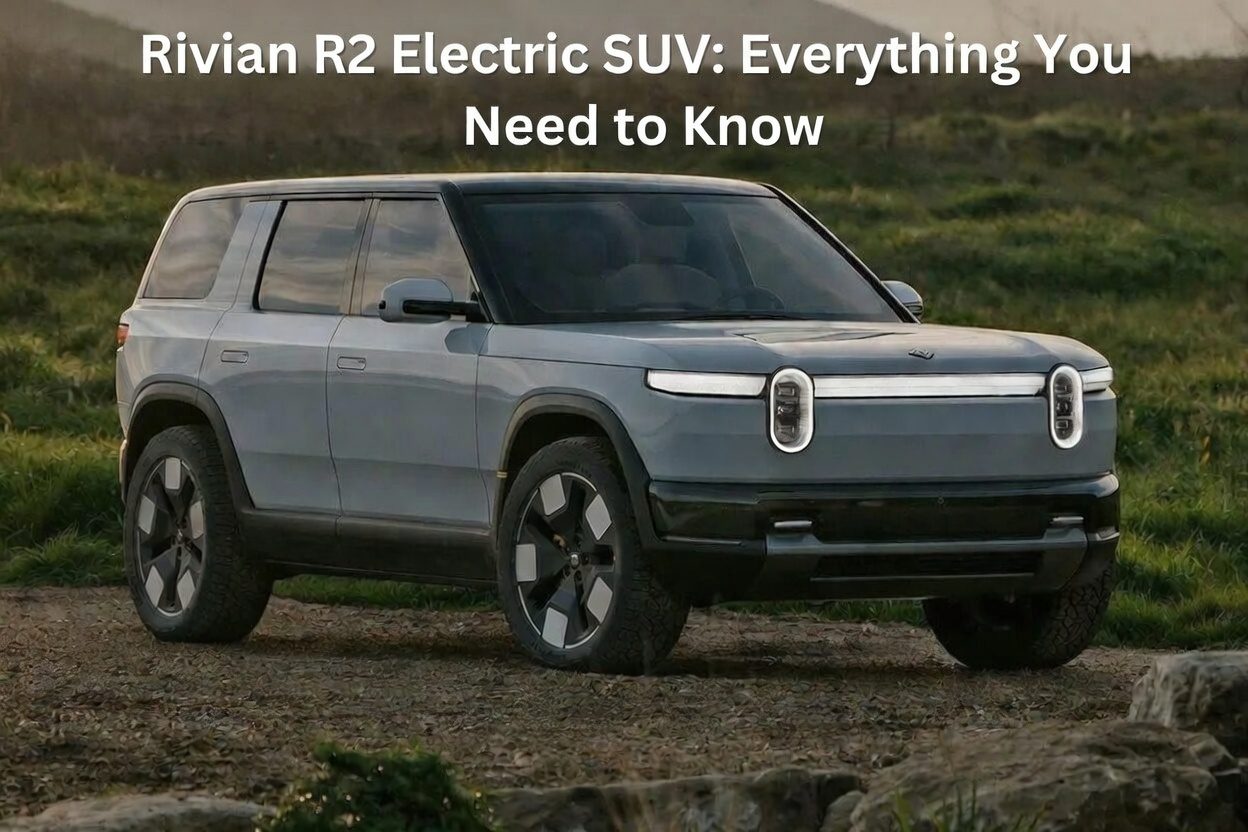
Rivian R2 Electric SUV: Everything You Need to Know About the $45,000 Game-Changer

Specs, range, release date, pricing, competitors, and why this could be Rivian’s most important vehicle ever
Image Suggestion: Rivian R2 electric SUV exterior front view — alt text: ‘Rivian R2 electric SUV in Launch Green at $45,000 starting price’
1. Quick Answer: What Is the Rivian R2?
Quick Answer:
The Rivian R2 is a compact electric SUV starting at $45,000 — the most affordable vehicle Rivian has ever made. It offers an estimated 300+ miles of range, available all-wheel drive, Rivian’s signature adventure-focused design, and is scheduled to begin production at Rivian’s Normal, Illinois factory in 2026.
Let’s be direct: the Rivian R2 is one of the most anticipated electric vehicles of the decade.
It’s not just another EV. It’s Rivian’s attempt to take everything that makes the R1T pickup and R1S SUV so beloved — the adventure capability, the premium feel, the innovative features — and package it all into a vehicle that costs roughly half as much.
When Rivian first unveiled the R2 in March 2024, the response was overwhelming. The company reported over 68,000 pre-orders in just 24 hours. That’s a staggering number that reveals exactly how much pent-up demand exists for a more affordable Rivian.
Here’s the complete story — from specs and pricing to real-world range and how it stacks up against rivals like the Tesla Model Y, Hyundai Ioniq 5, and Ford Mustang Mach-E.
2. Why the Rivian R2 Is a Big Deal
Image Suggestion: Rivian R2 reveal event March 2024 with crowd reaction — alt text: ‘Rivian R2 unveil event showing 68,000 pre-orders in 24 hours’
The Price Problem Rivian Had to Solve
Rivian’s R1S SUV starts around $75,000. The R1T pickup begins at approximately $69,000. Both are outstanding vehicles — award-winning, critically acclaimed, and genuinely capable. But they’re also priced out of reach for the average American car buyer.
The average new vehicle transaction price in the U.S. hovers around $48,000. Rivian needed a product that could compete in that reality. The R2 is that product.
At $45,000 starting price, the R2 enters the heart of the market — the competitive zone where the Tesla Model Y, Hyundai Ioniq 5, and Ford Mustang Mach-E battle daily for buyers. This is where the real volume is. And volume is what Rivian needs to achieve profitability.
The Strategic Importance for Rivian
Rivian posted its first-ever quarterly gross profit in Q2 2024 — a milestone that silenced some critics who had questioned the company’s long-term viability. But the path to sustainable profitability runs directly through the R2.
Higher-volume production means lower per-unit manufacturing costs. The R2 is designed from the ground up to be more efficiently produced than the R1 platform. Rivian’s new “endoskeleton” manufacturing architecture — a major departure from traditional vehicle assembly — is built around the R2 and promises to dramatically reduce production costs and time.
“The R2 isn’t just a cheaper Rivian — it’s a fundamentally different approach to how Rivian builds cars. If it works as designed, the R2 could transform Rivian’s financial trajectory.” — EV industry analyst perspective, 2025
The 68,000 Pre-Orders Signal
When a company announces a new vehicle and receives 68,000 pre-orders in 24 hours, that’s not just excitement — that’s a clear market signal. For context, that’s nearly the number of R1 vehicles Rivian produced in all of 2023.
Those pre-orders represent real interest from real buyers, many of whom couldn’t afford or justify an R1S but have been watching Rivian’s products with envy since the brand launched.
3. Rivian R2 Design: Adventure-Ready Looks at a Mainstream Price
Image Suggestion: Rivian R2 exterior rear 3/4 view showing LED light bar and adventure styling — alt text: ‘Rivian R2 SUV rear exterior with signature light bar design’
Exterior: Unmistakably Rivian
The R2 is instantly recognizable as a Rivian. That’s intentional — and smart. The R1 lineup built one of the most distinctive design languages in the EV industry, and Rivian has carefully translated those cues into the smaller, more affordable R2.
Key design elements include:
- Rivian’s signature “stadium” LED light bar spanning the full width of the front fascia
- A rounded, adventure-friendly silhouette with prominent wheel arches
- Flush door handles and a clean, uncluttered exterior that aids aerodynamics
- A rear light bar mirroring the front, creating strong brand recognition from any angle
- Available in Rivian’s signature colors including Launch Green, Limestone, Red Canyon, and Midnight
- An available roof rack system and accessory ecosystem designed for outdoor adventures
Dimensions: Compact SUV, Not a Tight Squeeze
| Dimension | Rivian R2 | For Reference: R1S |
| Length | ~4,460 mm (175.6 in) | ~5,100 mm (200.8 in) |
| Width | ~1,900 mm (74.8 in) | ~2,008 mm (79.1 in) |
| Height | ~1,680 mm (66.1 in) | ~1,803 mm (71.0 in) |
| Wheelbase | ~2,820 mm (111.0 in) | ~3,075 mm (121.1 in) |
| Cargo (behind 2nd row) | ~600 liters (est.) | ~730 liters |
| Frunk | ~60 liters (est.) | ~330 liters |
| Seating | 5 passengers | 7 passengers |
Note: R2 dimensions are based on official Rivian reveal data and pre-production specifications. Final production dimensions may vary slightly. These figures place the R2 solidly in the compact-to-midsize SUV segment — closer in size to a Toyota RAV4 than a Honda CR-V.
Adventure DNA Is Built In
Don’t mistake the lower price for a lesser adventure capability. The R2 retains Rivian’s DNA with features designed for drivers who want to go beyond the pavement:
- Available all-wheel drive with dual motors
- Ground clearance exceeding most mainstream compact SUVs
- Rivian’s proven all-terrain traction management system
- Tow rating estimated at approximately 3,500 lbs (single motor) to 5,000 lbs (dual motor)
- Available all-terrain tires and off-road-oriented accessory packages
4. Rivian R2 Powertrain & Performance Specs
Quick Performance Answer:
The Rivian R2 is available with a single rear-motor (rear-wheel drive) or dual-motor (all-wheel drive) configuration. The dual-motor AWD version produces an estimated 600 horsepower and accelerates from 0-60 mph in approximately 3.0 seconds — making it one of the quickest vehicles in the compact SUV segment at any price.
Wait — 600 horsepower? In a $45,000 compact SUV?
That’s not a typo. The top-spec dual-motor R2 is expected to produce around 600 hp, which would make it dramatically quicker than most competitors. For context, the dual-motor Tesla Model Y produces 393 hp and does 0-60 in 3.5 seconds. The R2 AWD aims to beat that by half a second.
Of course, peak horsepower isn’t the whole story — real-world performance, range impact, and daily driving feel matter more for most buyers. But the numbers signal that Rivian isn’t compromising on performance to hit a lower price point.
| Spec | Single Motor RWD | Dual Motor AWD |
| Motor Configuration | Single rear motor | Front + rear motors |
| Estimated Horsepower | ~300 hp | ~600 hp |
| Estimated Torque | ~310 lb-ft | ~500+ lb-ft |
| 0-60 mph | ~5.5 seconds (est.) | ~3.0 seconds (est.) |
| Top Speed | TBD | TBD |
| Drive | Rear-wheel drive | All-wheel drive |
| Tow Rating (est.) | ~3,500 lbs | ~5,000 lbs |
| One-Pedal Driving | Yes | Yes |
Important caveat: These performance figures are based on Rivian’s reveal data and pre-production estimates. Official EPA-rated specs and confirmed 0-60 times will be released closer to production launch. Real-world performance may vary based on tire selection, payload, and conditions.
Rivian’s Endoskeleton Platform: Why It Matters
The R2 is built on Rivian’s new “endoskeleton” architecture — a radical rethinking of how electric vehicles are assembled. Traditional vehicles are built on a frame with body panels attached on top. Rivian’s endoskeleton approach integrates structural, mechanical, and electrical systems in a way that significantly reduces the number of parts and assembly steps required.
Why does this matter to you as a buyer? It means Rivian can build the R2 faster, at lower cost, and potentially with higher quality consistency than traditional approaches allow. It’s the same principle that has made Tesla’s manufacturing increasingly efficient — and it could be a major competitive advantage for Rivian going forward.
5. Range & Charging: Real-World Numbers
Image Suggestion: Rivian R2 at charging station with Rivian Adventure Network charger — alt text: ‘Rivian R2 charging at Rivian Adventure Network DC fast charger’
Battery Options & Range
| Variant | Est. Battery Size | Est. EPA Range | Best For |
| Single Motor RWD Standard | ~60-65 kWh (est.) | ~250 miles | Urban/suburban commuters |
| Single Motor RWD Long Range | ~82-85 kWh (est.) | ~300+ miles | Longer daily drivers |
| Dual Motor AWD Long Range | ~82-85 kWh (est.) | ~270 miles | AWD capability + range balance |
Note: Battery sizes and EPA range estimates are based on Rivian’s official presentations and industry analyst projections. Final EPA-rated numbers will be confirmed at production launch. Expect real-world range to be approximately 10-15% lower than EPA ratings in cold weather conditions.
Charging Capability: Rivian’s Network Advantage
This is where the R2 has a genuine competitive advantage over most rivals. Rivian operates its own Rivian Adventure Network (RAN) of DC fast chargers, with a focus on adventure-oriented locations — national park entrances, trailheads, ski resorts, and scenic highways that other networks have ignored.
| Charging Type | Max Power | Est. Time (10-80%) | Miles Added/Hour |
| Level 1 (120V) | 1.2 kW | ~50+ hours | ~4 miles |
| Level 2 (240V home) | 11.5 kW | ~7 hours | ~32 miles |
| Rivian Adventure Network (DC) | 200 kW (est.) | ~25 minutes | ~175 miles/hr |
| Third-party DC Fast (CCS) | 150 kW | ~33 minutes | ~130 miles/hr |
| Tesla Supercharger (NACS adapter) | ~250 kW (V3) | ~22 minutes | ~200 miles/hr |
The R2 will support NACS (Tesla’s North American Charging Standard), which Rivian already adopted for the R1 lineup. This means R2 owners get access to Tesla’s 50,000+ Supercharger stalls — the largest fast-charging network in North America. Combined with the Rivian Adventure Network, R2 owners will have more charging options than nearly any other EV on the market.
Real-world perspective: If you charge at home overnight on Level 2, you’ll start every day with a full battery. The fast-charging network question only matters on road trips — and with NACS + RAN access, the R2 has that covered better than almost any non-Tesla EV.
6. Interior, Technology & Cargo Space
Image Suggestion: Rivian R2 interior showing 12.3-inch touchscreen and premium cabin — alt text: ‘Rivian R2 interior with large touchscreen and Rivian-signature design’
Interior Design: Premium Without the Premium Price
Rivian’s R1 lineup is known for an interior that feels genuinely different from other EVs — thoughtful, adventure-focused, and high-quality. The R2 carries that DNA forward at a lower price point, though with some expected material and feature differences from the flagship vehicles.
The R2 interior highlights include:
- A large central touchscreen (estimated 12.3-15.6 inches based on reveal imagery)
- A full-width panoramic glass roof option — a major selling point for adventure enthusiasts
- Rivian’s signature camping and outdoor utility features including an available integrated air compressor
- Water-resistant interior materials designed for muddy boots and wet gear
- Rear seat that folds flat for expanded cargo versatility
- Multiple USB-C and USB-A charging ports throughout the cabin
Cargo & Practical Space
The R2 offers a meaningful upgrade over compact crossovers in one key area: versatility. The rear seats fold flat, and the frunk provides additional secure storage. Outdoor adventurers will appreciate the thoughtful storage solutions Rivian builds into every vehicle.
Estimated cargo figures put the R2 ahead of the Honda CR-V and near the Toyota RAV4 in total volume — respectable numbers for a vehicle with this powertrain footprint. The frunk, while smaller than the R1S’s generous front storage, handles camping gear, charging cables, and small items neatly.
Technology Features
Rivian has built a strong reputation for over-the-air software updates that genuinely improve the vehicle over time — a practice the brand pioneered alongside Tesla. The R2 will carry forward this commitment, with regular updates adding features, improving efficiency, and addressing any issues that emerge post-launch.
Confirmed or strongly expected technology features:
- Rivian’s in-house operating system with over-the-air update capability
- Wireless Apple CarPlay and Android Auto
- Rivian’s Camp Mode, Dog Mode, and Guard Mode (features beloved by R1 owners)
- Driver assistance suite including highway assist, auto emergency braking, and lane keeping
- Integrated navigation optimized for adventure routes with charging stop planning
- Rivian app integration for remote monitoring, charging control, and vehicle settings
Driver Assistance: What to Expect
Rivian has been developing its own autonomous driving hardware and software stack. The R2 is expected to launch with a capable highway driver assistance system, with more advanced features potentially added via OTA updates. Full self-driving capability is not expected at launch.
Rivian hasn’t confirmed a specific hardware or sensor suite for the R2 as of February 2026. Expect official details as the production launch approaches.
7. Rivian R2 Price & Trim Levels
Quick Price Answer:
The Rivian R2 starts at $45,000 for the base single-motor rear-wheel drive configuration. The dual-motor AWD version is expected to start around $55,000-$60,000. Rivian has confirmed the $45,000 starting price; upper trim pricing is based on analyst estimates and Rivian’s positioning relative to the R1 lineup.
| Trim / Config | Drive | Est. Range | Est. Starting Price | Federal Tax Credit? |
| Base (Standard Range) | RWD | ~250 miles | $45,000 | Likely eligible (TBD) |
| Long Range RWD | RWD | ~300+ miles | ~$50,000 (est.) | Likely eligible (TBD) |
| Dual Motor AWD | AWD | ~270 miles | ~$55,000 (est.) | Likely eligible (TBD) |
| Dual Motor AWD Performance | AWD | ~270 miles | ~$60,000 (est.) | TBD |
Federal EV Tax Credit: The $45,000 Starting Price Gets Even Better
The $7,500 federal EV tax credit under the Inflation Reduction Act could bring the effective starting price of the R2 down to $37,500 — if it qualifies. Eligibility depends on:
- MSRP limits: SUVs must be under $80,000 — the R2 clears this easily.
- Income limits: Single filers earning under $150,000 and joint filers under $300,000 qualify.
- Domestic assembly: Rivian builds vehicles in Normal, Illinois — this requirement should be met.
- Battery component sourcing: This is the variable that determines full vs. partial credit.
Rivian is actively working to ensure its battery supply chain meets IRA domestic content requirements. If it achieves full qualification, a $45,000 R2 becomes a $37,500 R2 — a remarkable price point for a vehicle with this capability profile.
Always verify current eligibility at IRS.gov or through your Rivian account before purchasing, as rules and qualifying vehicle lists can change.
How Does $45,000 Compare to Rivian’s Rivals?
The R2’s starting price positions it as a value leader among purpose-built adventure EVs and as competitive with mainstream EV crossovers. The nearest adventure-oriented competitor, the Ford Bronco Sport, starts lower but isn’t electric. The Tesla Model Y starts around $43,990 but lacks the adventure capability and off-road focus of the R2.
8. How to Reserve or Order the Rivian R2
The Reservation Process
Rivian opened R2 pre-orders immediately following the March 2024 reveal. The reservation process is straightforward:
- Visit Rivian.com/r2 and click ‘Reserve’
- Select your preferred configuration (RWD or AWD, color, options)
- Pay a refundable $100 reservation deposit
- Receive a confirmation email with your place in line
- Monitor your Rivian account for delivery timeline updates as production approaches
The $100 deposit is fully refundable if you change your mind before final order. Rivian will contact you to convert your reservation to a firm order as your production slot approaches.
What to Know Before Reserving
- Reservations are not purchase orders — your configuration and price are locked only when you convert to a firm order.
- Pricing may change between reservation and delivery. Rivian has committed to honoring the announced $45,000 starting price for pre-orders, but verify this with Rivian directly.
- Production priority generally follows reservation order, but Rivian has historically moved some configurations ahead based on manufacturing readiness.
- International availability is not yet confirmed for all markets. Check Rivian.com for availability in your country.
9. Rivian R2 vs. Competitors: Full Comparison
Image Suggestion: Comparison chart: Rivian R2 vs Tesla Model Y vs Hyundai Ioniq 5 vs Ford Mustang Mach-E — alt text: ‘Rivian R2 electric SUV comparison to 2026 competitors’
The Competitive Landscape
| Model | Starting Price | Max Est. Range | Max AWD HP | Fast Charge Speed | Tow Rating |
| Rivian R2 (2026) | $45,000 | ~300 miles | ~600 hp | 200 kW (RAN) | ~5,000 lbs |
| Tesla Model Y (2026) | $43,990 | ~330 miles | 384 hp | 250 kW (SC V3) | 3,500 lbs |
| Hyundai Ioniq 5 (2026) | ~$42,000 | ~310 miles | 320 hp | 350 kW (800V) | 3,500 lbs |
| Ford Mustang Mach-E (2026) | ~$42,995 | ~320 miles | 480 hp | 150 kW | 2,000 lbs |
| Chevy Equinox EV (2026) | ~$35,000 | ~319 miles | 290 hp | 150 kW | 1,500 lbs |
| VW ID.4 (2026) | ~$39,995 | ~275 miles | 295 hp | 135 kW | 2,700 lbs |
Where the Rivian R2 Wins
- Adventure capability: No competitor at this price point matches the R2’s off-road credibility, tow rating, and outdoor ecosystem.
- Charging network: NACS + Rivian Adventure Network gives R2 owners the broadest fast-charging access of any non-Tesla EV.
- Estimated performance: ~600 hp AWD at $55,000 is extraordinary value — nothing else is close.
- Brand community: Rivian has built one of the most passionate EV owner communities in the industry. The culture and ecosystem around Rivian ownership is a genuine differentiator.
- OTA updates: Rivian’s track record of genuinely improving vehicles post-purchase is excellent.
Where Competitors Have Advantages
- Available now: The Model Y, Ioniq 5, and Mach-E are available today. The R2 requires waiting for 2026 production.
- Ultra-fast charging: The Ioniq 5 and EV6’s 800V / 350 kW charging capability significantly reduces charging time on long trips.
- Base price: The Equinox EV starts $10,000 cheaper than the R2.
- Proven production reliability: Rivian has had production challenges — the R2’s new manufacturing platform is unproven at scale.
- Cargo space: The Model Y and ID.4 offer more cargo volume in comparable configurations.
The honest assessment: For buyers who want maximum adventure capability, NACS charging access, and extraordinary performance in a compact SUV — the R2 has no real competitor at $45,000-$55,000. For buyers who prioritize charging speed, cargo, or immediate availability — the Ioniq 5 or Model Y may serve better today.
10. Rivian R2 Production & Release Date
When Will the Rivian R2 Be Available?
Release Date Answer:
Rivian has stated the R2 will begin production in 2026 at its Normal, Illinois manufacturing facility. Initially, R2 production will use existing factory space alongside R1 production. A new, purpose-built factory in Stanton Springs, Georgia — designed specifically for R2 scale production — is planned for later in the decade.
The Production Strategy: Normal First, Georgia Second
Rivian’s production plan for the R2 is intentionally staged. The first R2 vehicles will roll off the line at Rivian’s Normal, Illinois factory — the same facility that produces the R1T and R1S. This approach lets Rivian begin deliveries and generate revenue sooner, without waiting for the Georgia facility to come online.
The Normal factory strategy does come with a constraint: the facility must balance R1 and R2 production simultaneously. This limits initial R2 production volume, which means early deliveries will likely be allocated to the longest-standing pre-order holders.
The Georgia Factory: Built for Scale
Rivian’s Stanton Springs, Georgia facility is designed from the ground up around the R2 and the new endoskeleton manufacturing architecture. When fully operational, it’s projected to have production capacity of up to 400,000 vehicles per year — a scale that would make Rivian a genuine mass-market EV manufacturer.
The Georgia factory represents a massive capital commitment. Rivian has secured significant funding from Volkswagen Group (which agreed to a major investment and technology partnership in 2024) to help finance this expansion. The VW partnership — valued at up to $5 billion — is a strong signal of confidence in Rivian’s long-term direction.
Timeline: What to Realistically Expect
| Period | Expected Milestone |
| Early 2026 | R2 production begins at Normal, IL; first deliveries to pre-order holders |
| Mid-2026 | Broader delivery rollout; reservation conversions continue |
| Late 2026 – 2027 | AWD / dual motor variants enter production |
| 2028+ | Georgia factory begins R2 production; volumes scale significantly |
| 2030+ | Full Georgia capacity reached; potential R3 / R3S production begins |
11. Rivian’s Financial Picture: Can They Actually Deliver?
This is a question many potential buyers are right to ask. Rivian is not a century-old automaker with deep reserves. It’s a growth-stage company that has burned through significant capital building its factory, supply chain, and vehicle lineup.
The Positive Signs
- First gross profit: Rivian achieved its first quarterly gross profit in Q2 2024 — a landmark moment signaling improving manufacturing efficiency.
- VW investment: The $5 billion partnership with Volkswagen Group provides both financial runway and a validation signal from one of the world’s largest automakers.
- Amazon relationship: Rivian’s contract to deliver 100,000 electric delivery vans to Amazon provides a stable revenue stream alongside consumer vehicle sales.
- Pre-order momentum: 68,000 R2 pre-orders in 24 hours represents significant committed demand.
The Risks to Acknowledge
- Production ramp challenges: Rivian has historically struggled with production ramps — the R1 launch was significantly delayed and plagued by supply chain issues. The R2’s new manufacturing platform is unproven at scale.
- Capital requirements: Building and operating the Georgia factory requires billions. Market conditions and investor sentiment could affect Rivian’s access to additional capital.
- Competition intensity: The EV market has become dramatically more competitive since Rivian’s R1 launch. Rivian will face stronger, better-funded rivals by the time R2 production scales.
- Policy uncertainty: Changes to EV incentives, emission standards, or trade policy could affect demand and competitive dynamics.
The bottom line: Rivian’s financial position is stronger than it was in 2022-2023, but it remains a higher-risk investment profile than established automakers. For buyers, this translates to a small but nonzero risk around future service, software support, and company stability. That said, the VW partnership and Amazon contract provide meaningful stability anchors.
12. People Also Ask — Top Questions Answered
Q: What is the Rivian R2 starting price?
Answer:
The Rivian R2 starts at $45,000 for the base single-motor rear-wheel drive configuration. After the potential $7,500 federal EV tax credit, the effective starting price could be as low as $37,500 for qualifying buyers.
Q: When will the Rivian R2 be released?
Rivian has confirmed R2 production begins in 2026 at its Normal, Illinois factory. Exact delivery dates depend on reservation order, configuration, and production ramp pace. Early pre-order holders can expect to hear from Rivian about delivery scheduling in the first half of 2026.
Q: How does the Rivian R2 compare to the Tesla Model Y?
The R2 and Model Y are priced similarly but serve different buyer profiles. The Model Y prioritizes efficiency, cargo space, and access to Tesla’s Supercharger network. The R2 prioritizes off-road capability, towing capacity, adventure features, and (in AWD form) dramatically higher power. Model Y is available now; R2 requires waiting for 2026 production.
Q: What is the range of the Rivian R2?
Rivian estimates the R2 will offer over 300 miles of range in the long-range RWD configuration. The base standard range is estimated around 250 miles, and the dual-motor AWD around 270 miles. These are pre-production estimates; official EPA-rated figures will be confirmed at launch.
Q: Can the Rivian R2 tow?
Yes. The single-motor R2 is estimated to tow approximately 3,500 lbs, while the dual-motor AWD is projected at around 5,000 lbs. This makes the AWD R2 one of the highest-capacity towers in the compact electric SUV segment — a major differentiator for buyers who need towing capability.
Q: Does the Rivian R2 qualify for the federal EV tax credit?
The R2 is expected to qualify for the $7,500 federal EV tax credit, as it is assembled in the U.S. (Normal, IL) and the MSRP falls well below the $80,000 SUV limit. Battery component sourcing requirements must be met. Income limits also apply. Verify current eligibility at IRS.gov or Rivian.com before purchasing.
Q: How many seats does the Rivian R2 have?
The R2 is a 5-passenger vehicle. Unlike the 7-seat R1S, the R2 does not offer a third-row seating option. Families needing seven seats should consider the R1S or other three-row alternatives.
Q: What’s the difference between the Rivian R2 and R3?
Rivian also unveiled the R3 and R3X alongside the R2 in March 2024. The R3 is a smaller, more city-focused crossover hatchback aimed at an even lower price point (rumored under $40,000). The R3X is a performance-tuned version. Both the R3 and R3X are further behind in development than the R2, with production expected after the R2 is established.
13. Who Should Buy the Rivian R2?
The R2 Is Made For…
- Adventure-oriented buyers who want off-road capability and towing at a mainstream EV price
- Current Rivian fans who love the R1 lineup but found it too expensive
- Families or individuals who want a capable daily driver that can also handle weekend trails or camping trips
- Performance enthusiasts seeking AWD acceleration that embarrasses much more expensive vehicles
- Buyers who value OTA software updates and a brand known for innovative feature additions post-purchase
- EV converts from trucks or adventure-oriented vehicles who don’t want to sacrifice capability for electrification
Look Elsewhere If…
- You need a vehicle immediately — the R2 won’t arrive until 2026.
- You need 7 seats — consider the Rivian R1S or another three-row alternative.
- Ultra-fast 350 kW+ charging is essential — the Ioniq 5 or EV6 have a meaningful edge.
- Budget is under $40,000 — the Chevy Equinox EV starts at $35,000.
- You’re uncertain about Rivian’s long-term viability and want the security of an established brand.
The Ideal R2 Buyer
Picture someone who’s been eyeing the Rivian R1S for two years but can’t stretch the budget. They hike on weekends, occasionally tow a small camper or boat, and commute 40 miles round trip daily. They charge at home overnight, rarely worry about range anxiety for daily use, and want their vehicle to feel special — not generic.
For that buyer, the R2 at $45,000 isn’t just a compromise version of what they wanted. It might be exactly the right vehicle.
14. Key Takeaways & Conclusion
The Rivian R2 is arguably the most strategically important electric vehicle launch of 2026. At $45,000, it brings Rivian’s adventure DNA, premium feel, and extraordinary performance into a price range that millions of buyers can actually consider. The 68,000 pre-orders in 24 hours weren’t just enthusiasm — they were a clear market verdict.
It isn’t flawless. Production is yet to begin. Range figures are estimates. Rivian’s manufacturing track record carries some risk. And buyers who need seven seats, ultra-fast charging, or a vehicle today have better options elsewhere.
But for the buyer who wants a capable, beautiful, powerful electric SUV with genuine off-road credibility and access to the best charging networks available — the R2 is a genuinely compelling answer. And at $37,500 effective after federal tax credit? It might be the most exciting value in the EV market.
Rivian R2 Key Takeaways
- Starting price: $45,000; as low as $37,500 with federal EV tax credit
- Dual-motor AWD produces an estimated ~600 hp — class-leading performance
- Estimated range up to 300+ miles (long range RWD)
- Supports NACS (Tesla Supercharger) + Rivian Adventure Network charging
- Production begins 2026 at Normal, Illinois; reservations open with $100 refundable deposit
- Tow rating up to ~5,000 lbs (AWD) — a major differentiator in the segment
- Built on new ‘endoskeleton’ architecture designed for lower cost, higher efficiency production
- VW Group invested up to $5 billion — a significant vote of confidence in Rivian’s future
- Over 68,000 pre-orders in first 24 hours of availability
Call to Action: Ready to reserve your R2? Visit Rivian.com/r2 to place your $100 refundable reservation. Check our related guides on Rivian R1S vs R2 comparison, the complete 2026 electric SUV buyer’s guide, and how to maximize your federal EV tax credit.
Sources & Transparency Note
This article is based on Rivian’s official March 2024 R2 reveal presentation, Rivian’s investor communications and SEC filings, independent automotive analyst reports, and automotive media coverage through February 2026. Performance figures, range estimates, and upper-trim pricing are pre-production projections and will be confirmed as the production launch approaches.
External Sources Referenced: Rivian.com, Rivian SEC filings (SEC.gov), U.S. Department of Energy (fueleconomy.gov), IRS EV Tax Credit guidance (IRS.gov), Euro NCAP ratings database, J.D. Power EV segment studies.
This article is part of a broader electric vehicle content cluster covering 2026 EV launches, EV buying guides, federal EV incentives, and adventure-focused electric vehicle comparisons.
Last Updated: February 19, 2026
Discover more from MatterDigest
Subscribe to get the latest posts sent to your email.