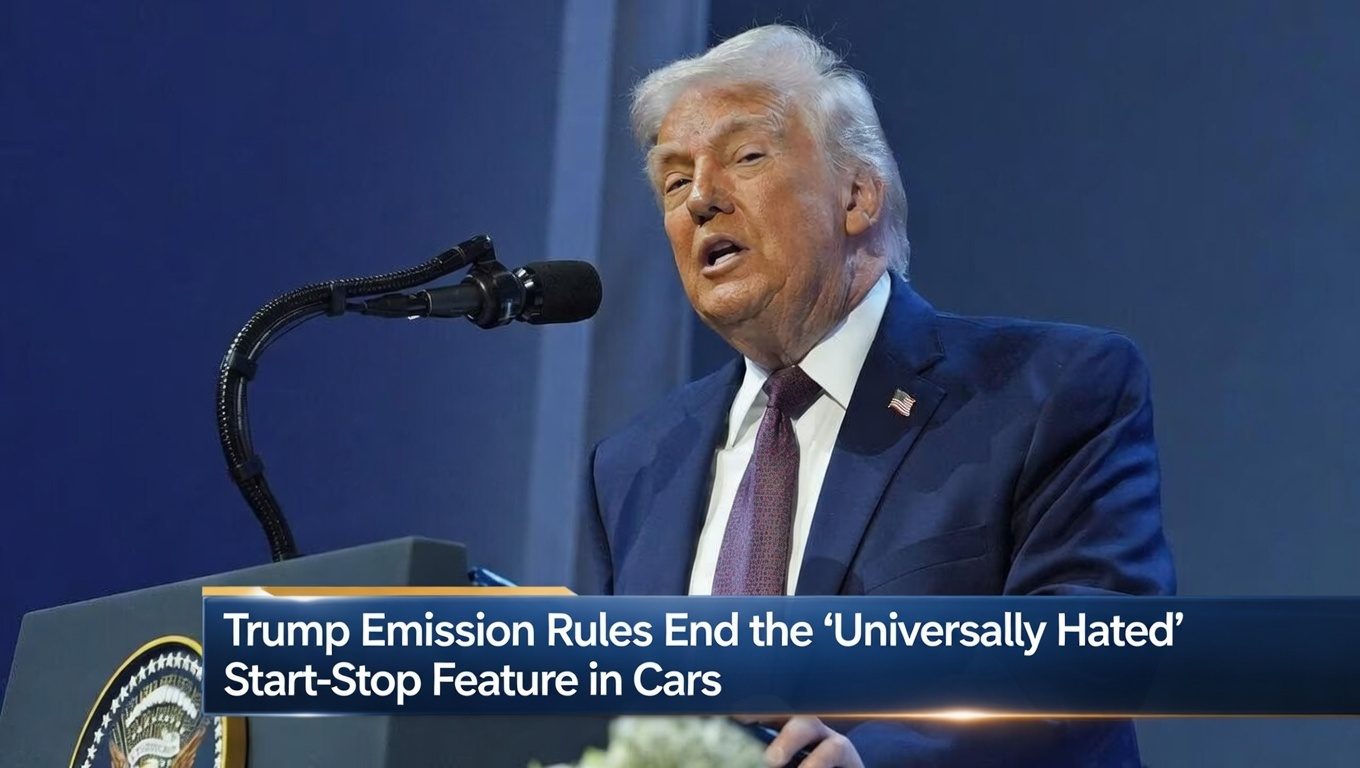
Trump Emission Rules End the ‘Universally Hated’ Start-Stop Feature in Cars

The Feature Millions of Drivers Have Been Complaining About Is Finally Going Away
You’re at a red light. Your engine shuts off. You feel a slight lurch. The light turns green, and your engine restarts with a judder before you can accelerate. Sound familiar?
That’s auto start-stop — the technology that automatically kills your engine at stops to save fuel. It was designed with good intentions. Drivers, however, have called it everything from “annoying” to “dangerous.” Consumer surveys have repeatedly ranked it among the most disliked features in modern vehicles.
Now, under new emission rules from the Trump administration, automakers may no longer need to include start-stop systems in their vehicles. The regulatory change removes a key incentive that made the technology nearly universal in new cars over the past decade.
Here’s everything you need to know — the policy, the science, the industry reaction, and what it means for the car you drive.
1. What Is the Start-Stop System and Why Do Drivers Hate It?
Auto start-stop (also called idle stop, stop-start, or engine stop-start) is a system that shuts off the internal combustion engine when the vehicle comes to a complete stop. When you lift your foot off the brake, the engine restarts instantly — in theory.
In practice, the experience varies widely by vehicle. On some cars, it’s nearly imperceptible. On others, it causes a noticeable shudder, a brief delay in acceleration, and an unsettling feeling that something’s wrong.
|
Why Drivers Dislike Start-Stop
- The engine restart feels jerky or rough, especially in older or cheaper implementations
- It delays throttle response when pulling into traffic, raising safety concerns
- Air conditioning cuts out during stops, reducing comfort in hot climates
- It creates anxiety — drivers worry the car has stalled
- The feature can’t always be permanently disabled without a third-party device
- In stop-and-go traffic, the constant cycling feels intrusive and mechanical
A 2023 J.D. Power Vehicle Dependability Study found that start-stop systems were among the top driver complaints across multiple vehicle segments. The phrase “universally hated” has appeared in consumer reviews, automotive journalism, and even congressional discussions about the feature.
2. What Did Trump’s Emission Rules Actually Change?
In 2025 and into 2026, the Trump administration moved to roll back or revise fuel economy and emissions standards that the Biden administration had significantly tightened. The Biden-era rules, finalized in 2024, set aggressive targets for fleet-wide fuel efficiency and CO2 emissions through 2032.
Under those standards, automakers relied heavily on fuel-saving technologies like start-stop systems to hit their compliance numbers. Start-stop could improve reported fuel economy by 3–8% under EPA testing conditions — a meaningful number when every fraction of an MPG affects regulatory compliance.
Trump’s revised rules relax these targets. With lower fuel economy mandates, automakers no longer need to squeeze every MPG out of their vehicles to avoid penalties. Start-stop becomes optional rather than practically mandatory.
Key Policy Changes at a Glance
| Biden-Era Rules (2024) | Trump-Era Rules (2025–2026) |
| Aggressive MPG targets through 2032 | Relaxed fleet-wide fuel economy targets |
| Strong EV transition incentives | Reduced EV mandates and incentives |
| Start-stop effectively required to comply | Start-stop optional under lower targets |
| Strict CO2 limits per vehicle class | Less stringent CO2 thresholds |
3. Why Was Start-Stop Technology Created in the First Place?
Start-stop technology has been around since the 1970s, but it became mainstream in the 2010s as global fuel economy and emissions regulations tightened. The logic is simple: an engine that isn’t running isn’t burning fuel or producing emissions.
In European cities with frequent traffic and strict emissions zones, start-stop made a lot of sense. Urban driving involves a lot of idling. Cutting idle time reduces both fuel consumption and local air pollution.
The EPA adopted testing cycles that rewarded start-stop systems. When the test protocol counts idling time — and start-stop systems eliminate idling — automakers score better on paper. That made start-stop a cheap compliance tool compared to expensive electrification.
The result: by the early 2020s, start-stop appeared in roughly 50% of new cars sold in the U.S. and far more in Europe. It went from a premium feature to a standard one in just a decade.
4. The Science: Does Start-Stop Actually Save Fuel?
This is where things get complicated. The honest answer is: sometimes, significantly; often, marginally; and occasionally, not at all.
When Start-Stop Works Well
- Heavy urban traffic with frequent, long stops (over 30 seconds)
- Mild climates where the AC system doesn’t need to run constantly
- Newer vehicles with enhanced starter motors designed for frequent cycling
- Drivers who accelerate gently from stops
When Start-Stop Saves Almost Nothing
- Highway driving with infrequent stops
- Short trips where the engine rarely reaches operating temperature
- Hot climates where AC runs continuously even at stops
- Cold weather, when many systems disable start-stop to protect the engine and cabin heat
Real-world fuel savings from start-stop typically range from 2% to 5% in mixed driving. EPA lab tests can show higher numbers. Critics argue the technology is optimized for testing, not for the actual driving conditions most Americans experience.
There’s also a cost side. Start-stop systems require upgraded batteries (AGM or EFB types), reinforced starter motors, and more complex electrical systems. These add cost to the vehicle and can add maintenance costs over time.
5. Automakers’ Reaction: Relief or Concern?
The automotive industry’s reaction to the regulatory shift is nuanced. Publicly, few major automakers have explicitly celebrated the change. Privately, many are relieved.
Start-stop systems add cost to vehicles — estimates range from $150 to $500 per vehicle depending on the implementation. Removing the regulatory pressure to include them saves money. For mass-market vehicles where margins are tight, that matters.
At the same time, automakers have invested heavily in electrification strategies built around the stricter Biden-era rules. A major regulatory reversal creates uncertainty. Do they pivot back? Do they stay the course on EVs? The answer varies by company and market.
Luxury brands and performance-focused manufacturers are quietly pleased. Their customers have complained loudly about start-stop for years. Removing the feature — or making its disabling more permanent and official — is an easy win for customer satisfaction.
6. Environmental Impact: What Does This Mean for Emissions?
This is the central tension of the story. Start-stop was implemented to reduce emissions. Removing the regulatory incentive for it will, by definition, result in more idling and more fuel burned in aggregate.
How much more? The EPA and independent researchers will debate this for years. Rough estimates suggest that removing start-stop from new vehicles could increase fleet-wide CO2 emissions by 1–3% in urban driving scenarios. In absolute terms, across millions of vehicles, that adds up.
Proponents of the rule change argue that the emissions math was always inflated by favorable testing conditions. Real-world savings were lower. And the relaxed targets are offset, they argue, by parallel investments in EV infrastructure and technology.
Opponents — including environmental groups and some state regulators in California — argue that rolling back any emissions-reducing technology is a step backward, regardless of how unpopular that technology is with consumers.
7. What Happens to Your Current Car’s Start-Stop System?
If you already own a car with start-stop, nothing changes immediately. Your vehicle’s system stays in place. Regulatory changes affect new vehicle designs and manufacturing requirements — not existing cars on the road.
How to Disable Start-Stop Right Now (If You Hate It)
Most vehicles with start-stop include a manual disable button, usually labeled with an “A” inside a circle with an arrow. Press it each time you start the car to turn the system off for that drive. The setting typically resets when you restart the vehicle.
For a permanent solution, aftermarket devices like the “Start Stop Eliminator” plug into the OBD-II port or relevant fuse box connection and tell the car the system’s conditions for activation are never met. These typically cost $30–$80 and don’t affect your warranty in most cases, though you should verify with your dealer.
Future Car Buyers: What to Expect
- 2026 and later model year vehicles may begin shipping without start-stop as standard
- Some automakers may offer it as an optional feature or retain it for certain markets
- European models will likely retain start-stop due to stricter EU emissions rules
- Hybrids and EVs are largely unaffected — their systems work differently
8. The Broader Rollback: Trump’s Auto Emission Policy in 2025–2026
The start-stop change is one piece of a much larger regulatory shift. The Trump administration has pursued a systematic rollback of Biden-era environmental rules across energy, transportation, and manufacturing.
On auto emissions specifically, the administration has targeted: the aggressive 2032 fleet MPG targets, EV sales mandates and credits, California’s waiver allowing stricter state-level rules, and heavy-duty vehicle emissions standards.
Supporters frame these changes as pro-consumer and pro-industry — giving Americans the freedom to buy the vehicles they want without being pushed toward EVs or burdened by features they didn’t ask for.
Critics argue the rollbacks prioritize short-term industry comfort over long-term climate commitments and U.S. competitiveness in the global EV market.
Both sides agree on one thing: these are significant changes that will shape the American auto market for years to come.
9. Key Takeaways
- Auto start-stop automatically shuts off the engine at stops to save fuel — and millions of drivers hate it
- Trump’s revised emission rules relax fleet fuel economy targets, making start-stop optional rather than practically mandatory
- Start-stop was never truly required by law — it was just the easiest way for automakers to hit compliance numbers
- Real-world fuel savings from start-stop are modest: typically 2–5% in mixed driving
- Removing start-stop from new cars will increase emissions slightly but is part of a broader regulatory rollback
- If you currently own a car with start-stop, nothing changes for your vehicle
- Most cars have a manual disable button; permanent aftermarket solutions exist for $30–$80
- Future buyers may see start-stop disappear from U.S. market vehicles as soon as 2026 models
10. Frequently Asked Questions (FAQs)
Is Trump’s rule change actually banning start-stop systems?
No. The rule change doesn’t ban start-stop. It removes the regulatory incentive that made automakers include it to meet fuel economy targets. Automakers can still offer it, and some will for certain markets.
Will cars already on the road lose their start-stop systems?
No. Existing vehicles are not affected. Regulatory changes apply to future vehicle designs and production, not cars already sold or on the road.
How much fuel does start-stop actually save?
Real-world savings are typically 2–5% in mixed urban driving. EPA test conditions often show higher numbers because the tests favor city-stop scenarios where start-stop performs best.
Can I disable start-stop in my current car permanently?
Most cars only let you disable it per trip using a dashboard button. For a permanent fix, aftermarket devices like Start Stop Eliminators plug into your car’s diagnostic port and cost around $30–$80.
What does this mean for electric and hybrid vehicles?
Hybrids and EVs operate differently and aren’t primarily affected by this change. Hybrids use regenerative braking and battery systems at stops. Pure EVs have no combustion engine to stop.
Why do automakers include start-stop if drivers hate it?
They included it because it was cost-effective way to improve fuel economy scores under EPA testing. With relaxed targets, the cost-benefit calculation changes, and automakers have less reason to include a feature consumers dislike.
Sources & References
- S. Environmental Protection Agency (EPA) — Fuel Economy Testing and Standards, epa.gov
- National Highway Traffic Safety Administration (NHTSA) — CAFE Standards, nhtsa.gov
- D. Power 2023 Vehicle Dependability Study — Consumer Satisfaction Data
- American Automobile Association (AAA) — Start-Stop Technology Analysis
- International Council on Clean Transportation (ICCT) — Real-World Fuel Economy Reports
Discover more from MatterDigest
Subscribe to get the latest posts sent to your email.