Trump Meets NATO’s Rutte as US Withdrawal Threat Rattles the Alliance

A comprehensive analysis of the April 8, 2026 White House talks — what happened, why it matters, and what comes next for the world’s largest military alliance.
The meeting everyone was watching happened on April 8, 2026 — and it did not go well.
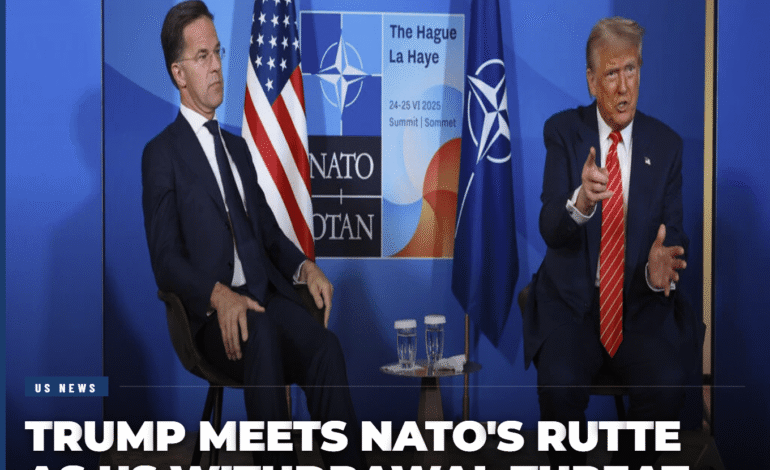
President Donald Trump sat down with NATO Secretary-General Mark Rutte at the White House for roughly two hours. The goal? Smooth over a deepening rift between the United States and its oldest military partners. By evening, Trump was posting in all-caps on Truth Social.
If you want to understand why this moment matters — and what it means for Western security — you’re in the right place. This article covers everything: the trigger, the meeting, the legal roadblocks, and what happens next.
1. What Triggered the Crisis?
The immediate spark was the Iran war — specifically, the Strait of Hormuz.
Trump had suggested the U.S. may consider leaving NATO after member countries ignored his call to help reopen the Strait of Hormuz, a vital shipping waterway that Iran effectively shut down, sending global gas prices soaring.
Iran’s closure of the strait — one of the world’s most critical oil shipping corridors — put enormous economic pressure on the US and its allies. Trump expected NATO partners to step up. They didn’t, at least not in the way he demanded.
Trump criticized France, Germany, Spain, and Britain for their perceived lack of action, even though he had not included them in war planning or attempted to build a coalition before launching the conflict on February 28.
That feels important. Trump launched the Iran conflict without building a coalition first — then turned around and blamed allies for not joining in.
Trump was also angered as NATO allies Spain and France forbade or restricted use of their airspace or joint military facilities for the US in the Iran war. They and other nations, however, agreed to help with an international coalition to open the Strait of Hormuz when the conflict ends.
So allies weren’t entirely absent. They drew a line at active military participation — but signaled willingness to help with post-conflict security. That distinction clearly did not satisfy Trump.
| CONTEXT: The US-Iran two-week ceasefire, agreed late Tuesday, April 7, includes the reopening of the Strait of Hormuz. This removed the most urgent pressure — but the diplomatic damage was already done. |
2. Who Is Mark Rutte?
Mark Rutte is not a new face in this drama. He’s the former Dutch Prime Minister who became NATO Secretary-General in late 2024. And he has a remarkable track record of managing Trump.
Despite Trump’s criticism of the bloc, Rutte has maintained cordial relations with the president, earning the Dutch leader the nickname ‘the Trump whisperer.’ On Monday before the meeting, Trump himself described Rutte as ‘a great person’ and a ‘wonderful guy.’
In January 2026, Rutte successfully calmed a crisis over Greenland during the Davos summit, pushing the president away from threats to seize the Arctic island by force and proposing a negotiation framework instead.
That’s the kind of diplomatic skill that makes Rutte NATO’s most valuable asset right now. He knows how to read Trump. He praises him publicly, engages him directly, and finds face-saving off-ramps.
Rutte has visited the White House multiple times during Trump’s second term, including in March, July, August, and October of last year. But this meeting was different — the Iran war put the relationship under a stress test it hadn’t faced before.
3. What Happened at the Meeting?
Before the Meeting: Setting the Tone
Going in, the White House set a serious tone. White House Press Secretary Karoline Leavitt acknowledged that Trump had discussed leaving NATO and confirmed the president would raise the issue directly with Rutte.
She added: ‘They were tested and they failed, and I would add, it’s quite sad that NATO turned their backs on the American people over the course of the last six weeks, when it’s the American people who have been funding their defence.’
During the Meeting
The meeting lasted about two hours and was held behind closed doors. No joint statement was issued. No press conference followed.
After the Meeting: The Truth Social Post
Then came the all-caps post on Truth Social. Trump wrote: ‘NATO WASN’T THERE WHEN WE NEEDED THEM, AND THEY WON’T BE THERE IF WE NEED THEM AGAIN. REMEMBER GREENLAND, THAT BIG, POORLY RUN, PIECE OF ICE!!!’
That’s not the language of a president who just had his grievances resolved.
Rutte’s Response
In a CNN interview after the meeting, Rutte described the encounter as ‘frank and open.’ He reiterated his support for Trump but added that NATO allies had offered support through logistics and access to bases. When asked directly whether Trump indicated he might withdraw, Rutte replied: ‘There is a disappointment, clearly. But at the same time he was also listening carefully to my arguments of what is happening.’
That’s diplomat-speak for: it didn’t go great, but it wasn’t a total breakdown either.
| FEATURED SNIPPET ANSWER: Trump met NATO Secretary-General Rutte on April 8, 2026 to address US anger over NATO’s role in the Iran war. After the closed-door meeting, Trump posted on Truth Social that ‘NATO wasn’t there when we needed them,’ signaling his frustration remained unresolved. |
4. Can Trump Actually Leave NATO?
This is the question millions of people are searching. Here’s the direct answer: No — not unilaterally. Not without Congress.
Congress passed a law in 2023 that prevents any US president from pulling out of NATO without its approval. Specifically, two-thirds of the Senate must approve any move to withdraw the country from the alliance.
Here’s the remarkable irony: the legislation was spearheaded by Marco Rubio when he served in the Senate. Rubio — now Trump’s own Secretary of State — voted in favor of the measure, which was designed to prevent a president from unilaterally pulling the United States out of NATO. So Trump’s top diplomat helped write the law that now blocks Trump’s NATO exit.
The Legal Uncertainty
It remains unclear if the Trump administration would challenge the law in court. Trump’s first term saw him argue he had the authority to leave unilaterally, suggesting he may push back against Congressional restrictions again.
The More Realistic Risk: Gradual Disengagement
Trump could cut funding, reduce troop deployments, or refuse to treat an attack on an ally as an attack on America — all without triggering the legal threshold for formal withdrawal. This ‘soft exit’ may be the more dangerous near-term risk.
Questioning Article 5 commitments could weaken NATO’s deterrence, with analysts warning it may embolden Russia, particularly around the Baltic states.
| Factor | Detail |
| Legal barrier | 2023 law requires 2/3 Senate approval for NATO withdrawal |
| Ironic twist | Co-authored by Sec. State Marco Rubio when a Senator |
| First term precedent | Trump argued he could leave unilaterally in 2018 |
| Realistic near-term risk | Gradual disengagement without formal withdrawal |
| Security consequence | Could embolden Russia near Baltic states |
5. What NATO Allies Are Saying
European capitals are watching carefully. And even some Republicans are pushing back.
Mitch McConnell’s Warning
Senator Mitch McConnell issued a statement noting that ‘following the September 11th attacks, NATO allies sent their young servicemembers to fight and die alongside America’s own in Afghanistan and Iraq.’ He urged Trump to be ‘clear and consistent’ and said it’s not in America’s interest to ‘spend more time nursing grudges with allies who share our interests than deterring adversaries who threaten us.’
That’s a pointed rebuke from a senior Republican on the Senate defense committee — and a reminder that support for NATO runs deep on both sides of the aisle.
Britain’s Different Posture
British Prime Minister Keir Starmer traveled to the Gulf on April 8 to support the ceasefire. The UK has been working on developing a post-conflict security plan for the Strait of Hormuz — a narrow waterway between Iran and Oman through which about one-fifth of the world’s oil passes.
Rubio’s Reexamination Threat
Secretary of State Marco Rubio said the US would ‘reexamine its relationship with NATO following the end of the conflict in Iran.’ He added: ‘I do think, unfortunately, we are going to have to re-examine whether or not this alliance that has served this country well for a while is still serving that purpose, or has it now become a one-way street where America is simply in a position to defend Europe.’
That ‘one-way street’ framing is central to the Trump administration’s argument — and it resonates with parts of the American public. Whether it reflects the full reality is another matter.
6. Trump and NATO: A Long and Turbulent History
This isn’t new. Trump has been skeptical of NATO for decades.
NATO was founded in 1949 to counter the Cold War threat posed to European security by the Soviet Union. Its 32 member countries are bound by a mutual defense agreement in which an attack on one is considered an attack on all. Critically, the only time Article 5 has ever been invoked was in 2001 — to support the United States in the wake of the September 11 attacks.
That last point is worth sitting with. The one time Article 5 was invoked in NATO’s 75-year history, it was invoked for the United States.
Former NATO Secretary-General Jens Stoltenberg, in his recent memoir, said he feared Trump might walk away from the alliance in 2018, during his first term. That risk was eventually managed — but never truly resolved.
Since returning to power in 2025, Trump has renewed his pressure campaign for NATO’s European partners to step up their defense spending. On that score, he does have a point. For years many members fell short of the 2% of GDP defense spending target — though that gap has narrowed significantly since Russia’s invasion of Ukraine in 2022.
| DATA POINT: The US funds roughly 16% of NATO’s direct budget — similar to Germany. Poland and Lithuania spend a higher percentage of their GDP on defense than the US does. The burden-sharing picture is more nuanced than Trump’s rhetoric suggests. |
7. What Does This Mean for Global Security?
The implications of this moment go well beyond one White House meeting.
Russia Is Watching
A weakened or fractured NATO is Russia’s strategic goal. Any signal from Washington that Article 5 commitments are conditional creates uncertainty — and uncertainty is exactly what emboldens aggressive moves near the Baltic states or Poland.
The Iran Ceasefire Is Fragile
The nascent ceasefire was struck after Trump threatened to strike Iran’s power plants and bridges. A two-week pause is not a peace deal. If it collapses, the NATO rift will deepen fast — and the diplomatic fallout will be severe.
The Strait of Hormuz Remains the Pressure Point
About one-fifth of the world’s oil moves through that narrow waterway. Any renewed disruption would hit global energy prices — including in countries that have nothing to do with this dispute.
European Rearmament Is Accelerating
Ironically, Trump’s sustained pressure may be achieving something no previous president managed: convincing European nations to genuinely invest in their own defense. That’s a long-term outcome Trump might claim as a win — if the alliance survives long enough to see it.
8. Key Takeaways
- The meeting happened April 8, 2026. Trump and Rutte met for about two hours behind closed doors. No breakthrough emerged. Trump’s Truth Social post afterward showed his anger remained unresolved.
- The trigger was NATO’s response to the Iran war — specifically, allies’ refusal to help reopen the Strait of Hormuz and restrictions on US use of their airspace and bases.
- Trump cannot leave NATO alone. A 2023 law requires Congressional approval — ironically co-authored by Trump’s own Secretary of State, Marco Rubio.
- Rutte is still the alliance’s best diplomat with Trump. But even he couldn’t fully defuse this crisis.
- The risk isn’t formal withdrawal — it’s gradual disengagement. Trump could weaken commitments without technically leaving, and that alone could destabilize European security.
- Watch the ceasefire. If the US-Iran two-week truce holds and the Strait of Hormuz reopens smoothly, tensions with NATO may ease. If it collapses, all bets are off.
9. FAQ: People Also Ask
These questions reflect the most common searches around this topic.
| What did Trump say after meeting Rutte? |
| After the two-hour closed-door meeting, Trump posted on Truth Social that ‘NATO WASN’T THERE WHEN WE NEEDED THEM, AND THEY WON’T BE THERE IF WE NEED THEM AGAIN’ — signaling his anger remained fully unresolved despite the talks. |
| Why is Trump threatening to leave NATO in 2026? |
| Trump is angry that NATO members refused to send military forces to support the US-Israel conflict with Iran, and that some allies restricted US access to their airspace and military bases during the war. |
| Can the US president pull out of NATO? |
| No. A 2023 US law requires Congressional approval — specifically two-thirds of the Senate — before any president can formally withdraw from NATO. |
| Who is Mark Rutte and why does he matter? |
| Mark Rutte is NATO’s Secretary-General and former Dutch Prime Minister. Known as ‘the Trump whisperer,’ he has maintained a warm personal relationship with Trump and previously defused crises over Greenland and NATO spending. |
| What is Article 5 of NATO? |
| Article 5 is NATO’s mutual defense clause — an attack on one member is treated as an attack on all. It has only ever been invoked once: after the September 11, 2001 attacks on the United States. |
| What is the Strait of Hormuz and why does it matter? |
| The Strait of Hormuz is a narrow waterway between Iran and Oman through which about one-fifth of the world’s oil passes. Iran’s closure of the strait during the 2026 conflict sent global gas prices soaring and triggered the NATO crisis. |
Sources & Further Reading
All sources accessed April 8–9, 2026
- Associated Press via PBS NewsHour — Trump is expected to meet NATO leader Rutte as he muses about pulling out of the military alliance
- Al Jazeera — Trump administration signals it is mulling NATO withdrawal after Iran war
- The Hill — Trump complains NATO ‘wasn’t there when we needed them’ after talks with Rutte
- Newsweek — Trump expected to raise US withdrawal from NATO at Rutte meeting
- The National News — Trump meets NATO chief amid tension over Iran war
This article is part of a broader content cluster covering US foreign policy, the future of NATO, and the geopolitics of the 2026 Iran conflict.
Related topics: The Iran-US Ceasefire Explained | NATO Defence Spending: Who Pays What | Trump’s Second Term Foreign Policy
Discover more from MatterDigest
Subscribe to get the latest posts sent to your email.