Trump Says U.S. Will Work With Iran’s New Leaders for a Lasting Peace Deal — and Will Remove Nuclear ‘Dust’
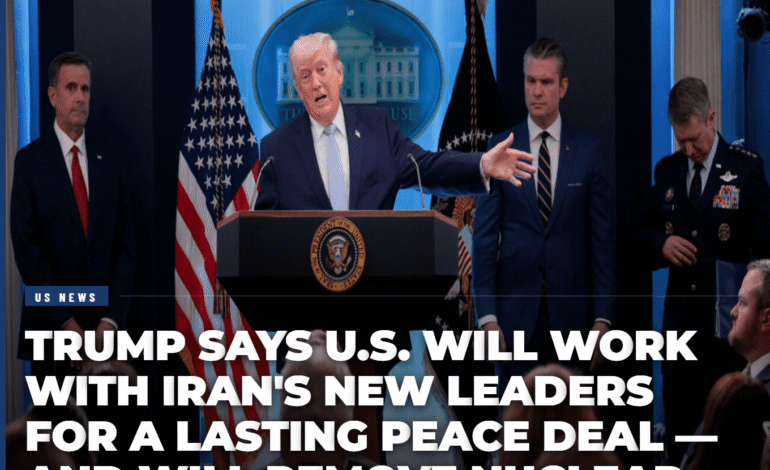

After 40 days of U.S.-Israeli airstrikes and a Pakistan-brokered ceasefire, President Trump declares Iran has undergone “regime change” — and pledges to dig up buried radioactive material left from the bombing of its nuclear sites.
On April 8, 2026, President Trump announced that the U.S. and Iran had agreed to a two-week ceasefire, brokered by Pakistan. Trump said Iran has undergone “regime change,” that there will be “no enrichment of uranium,” and that the U.S. will work with Iran to remove deeply buried radioactive “nuclear dust” left by B-2 bomber strikes on Iran’s nuclear facilities. Peace talks are set for Islamabad on April 10.
The Middle East woke up Wednesday to the most consequential diplomatic announcement in years. After nearly six weeks of U.S. and Israeli airstrikes, a Pakistan-brokered ceasefire paused one of the most dangerous conflicts since the Gulf War. But President Trump wasn’t done talking.
In an early-morning post on Truth Social, Trump declared that Iran had gone through “what will be a very productive Regime Change” and that the United States would now work with Tehran’s new leadership on a lasting peace. The centerpiece of that peace, he said, would be the total elimination of Iran’s nuclear capabilities — including the removal of radioactive debris, which he called “nuclear dust,” buried deep underground by B-2 stealth bombers.
This is a fast-moving story with enormous global implications. Here’s everything you need to know — from what “nuclear dust” actually means, to why the Strait of Hormuz controls oil prices worldwide, to whether this fragile truce will actually hold.
1. What Happened: The Ceasefire Announcement
The ceasefire almost didn’t happen. On Tuesday, April 7, Trump set a hard deadline: Iran had until 8:00 p.m. Eastern Time to fully reopen the Strait of Hormuz — the narrow waterway through which roughly one-fifth of the world’s oil supply flows — or face “obliteration.” He threatened to destroy bridges, power plants, and other civilian infrastructure. Earlier that morning, he had posted on Truth Social that “a whole civilization will die tonight, never to be brought back again.”
Pakistan’s Prime Minister Shehbaz Sharif stepped in as the key mediator. With 90 minutes to spare before Trump’s deadline, an agreement was reached. Iran agreed to reopen the strait. The U.S. agreed to suspend its bombing campaign for two weeks. Both sides called it a starting point, not an endpoint.
“On behalf of the United States of America… it is an Honor to have this long-term problem close to resolution.”
— President Donald Trump, Truth Social, April 7, 2026
Trump then described Iran’s 10-point proposal as a “workable basis on which to negotiate.” The next morning, he added critical details: the U.S. would work with Iran on nuclear material removal, tariff relief, and sanctions relief, and — significantly — declared that Iran had already undergone regime change.
Why the Timing Mattered So Much
Iran had been blocking oil transit through the Strait of Hormuz since late February, when the U.S. and Israel launched coordinated strikes. The resulting supply shock sent global energy prices soaring. Every day the strait stayed closed cost oil-dependent economies billions of dollars. The ceasefire, imperfect as it is, immediately began to ease that pressure. MarineTraffic, an organization that monitors global shipping, confirmed vessel movement in the strait within hours of the announcement.
Caveat: Iran briefly closed the strait again on April 8 after Israel continued strikes on Hezbollah targets in Lebanon — which Iran says violates the truce. The ceasefire’s durability remains in serious question.
2. What Is ‘Nuclear Dust’ — and Why Does It Matter?
Trump’s phrase “nuclear dust” is unusual — and it’s not standard diplomatic or scientific language. But its meaning is fairly clear in context, and the underlying issue is very real.
In June 2025, seven B-2 stealth bombers dropped Massive Ordnance Penetrator (MOP) bombs — the most powerful bunker-busters in the U.S. arsenal — on three of Iran’s most heavily fortified nuclear sites: Fordow, Natanz, and Isfahan. These underground facilities housed thousands of centrifuges used to enrich uranium. The strikes, part of what was called “Operation Midnight Hammer,” were designed to physically destroy those machines.
When a nuclear enrichment facility is bombed, the result is not simply rubble. It creates a mix of radioactive material — pulverized uranium compounds, contaminated equipment, and irradiated soil — buried under collapsed tunnels. That’s what Trump appears to be calling “nuclear dust.” He noted it has been “under very exacting Satellite Surveillance (Space Force!)” since the attacks, meaning the U.S. has been tracking the sites to ensure no material is moved.
Why Removing This Material Is a U.S. Priority
- Buried enriched uranium could theoretically be excavated and repurposed for a weapons program.
- IAEA Director General Rafael Grossi estimated Iran’s pre-war stockpile could have fueled up to 10 nuclear bombs.
- Physical removal — not just monitoring — would make reconstitution of a nuclear program far harder.
- Iran has been barred from IAEA inspections at bombed sites since June 2025, complicating international verification.
In short, digging up the “nuclear dust” is Trump’s way of saying: the bombs destroyed the facilities, but the material still exists underground, and we intend to make sure Iran can’t recover it. It’s a concrete, physical demand — not just a diplomatic abstraction.
3. Trump’s Regime Change Claim: What Does It Mean?
Perhaps the most striking claim in Trump’s Truth Social posts is that Iran has undergone “regime change.” This needs unpacking. No democratic election has taken place. The Islamic Republic has not formally dissolved. So what is Trump actually saying?
The answer lies in the casualties from Operation Epic Fury, the second wave of coordinated U.S.-Israeli strikes launched on February 28, 2026. Those strikes targeted Iranian leadership, missile sites, and remaining nuclear-related facilities. According to multiple reports, early strikes killed Iran’s Supreme Leader as well as other top officials. The Iranian government structure has been significantly disrupted at its highest levels.
Trump has argued that the new officials now running Iran are more pragmatic. He wrote that “different, smarter, and less radicalized minds prevail” — people who, in his assessment, want to deal. Vice President JD Vance offered a more cautious view. He called the ceasefire a “fragile truce” and said its durability would depend on which camp within Iran wins out: those who want to negotiate, or those who are “lying about even the fragile truce that we’ve already struck.”
Not Everyone Agrees
Analysts at JPMorgan warned in a Monday client note that the conflict has actually strengthened Iran’s Revolutionary Guard — the hardline military wing that runs much of Iran’s security apparatus. They wrote that Iran’s strategy is built around outlasting, not outgunning, its opponents. “Iran may have lost its supreme leader and commanders, and suffered severe damage to nuclear facilities and military assets, but there are no signs of capitulation,” they noted.
“Trump’s failed use of force has blunted the credibility of American military threats, introducing a new dynamic into US-Iran diplomacy. Washington can still rattle its sabre. But after a failed war, such threats ring hollow.”
— Trita Parsi, Iran Expert, commenting on the ceasefire announcement, Al Jazeera, April 8, 2026
4. Iran’s 10-Point Plan vs. the U.S. 15-Point Plan
One of the most confusing parts of the ceasefire is the competing sets of “points” being discussed. Here’s a breakdown.
Iran submitted a 10-point plan to the U.S. via Pakistan. Trump called it a “workable basis on which to negotiate.” But he also distanced himself from the version that leaked publicly, saying the real document was different and would be negotiated “behind closed doors.” This has created significant confusion over what was actually agreed to.
The United States, meanwhile, put forward its own 15-point proposal in late March. Iran has previously called several of its provisions “excessive.” Trump says many of those 15 points have already been agreed to.
| Issue | Iran’s Public 10-Point Demands | U.S. 15-Point Position |
|---|---|---|
| Uranium Enrichment | Iran’s right to enrich uranium recognized | No enrichment; complete dismantlement |
| Sanctions | All primary and secondary sanctions lifted | Relief tied to compliance; phased approach |
| U.S. Military Presence | Full withdrawal from the Middle East | Not on the table |
| Frozen Assets | Full release of frozen Iranian assets | Linked to nuclear concessions |
| Reparations | U.S. compensates Iran for war damages | Not mentioned |
| Strait of Hormuz | Iran retains full control; charges per ship | Strait must be free and open |
| Nuclear Material | Not specified in public version | Remove all stockpiles; remove “dust” |
As the table shows, the two plans are very far apart on core issues. The gap between them is why experts are treating this ceasefire as an opening — not a resolution.
5. Full Timeline: From Diplomacy to War to Ceasefire
Iran and the U.S. begin nuclear negotiations, brokered by Oman, after Trump’s letter to Supreme Leader Khamenei sets a 60-day deadline for a deal.
Talks break down. The U.S. demands zero enrichment; Iran refuses. Israel launches large-scale strikes on June 13. The U.S. follows with “Operation Midnight Hammer” — B-2 bombers strike Fordow, Natanz, and Isfahan nuclear sites.
UN “snapback” sanctions reimposed on Iran. Iran blocks IAEA access to bombed sites. Trump says the U.S. is ready for a deal; Iran is not.
Indirect talks resume in Muscat, Oman. Mediator calls them “substantial progress.” Trump says he is “not happy.”
The U.S. and Israel launch “Operation Epic Fury” — targeting Iranian leadership, missile sites, and remaining nuclear facilities. Iran’s Supreme Leader is killed. Iran closes the Strait of Hormuz.
Oil prices spike. Turkey, Egypt, Qatar, and China work to mediate. Pakistan emerges as the key intermediary.
Trump threatens to destroy “a whole civilization” if no deal by 8 p.m. deadline. Pakistan brokers a two-week ceasefire 90 minutes before the deadline. Iran agrees to reopen the Strait of Hormuz.
Trump declares Iran has undergone “regime change” and announces no uranium enrichment and removal of “nuclear dust.” Iran closes strait again briefly after continued Israeli strikes on Lebanon. Talks set for Islamabad on April 10.
6. The Strait of Hormuz: Why the Whole World Is Watching
If you’ve seen headlines about oil prices going haywire since late February, this is why. The Strait of Hormuz is a narrow waterway — at its tightest point, only about 21 miles wide — between Iran and Oman. Nearly 20% of the world’s entire oil and natural gas supply passes through it every day. Before the war, over 100 ships per day transited the strait.
When Iran began blocking or restricting traffic, it triggered what analysts described as a historic oil supply shock. The ripple effects hit consumers at gas pumps worldwide, raised shipping costs across the board, and rattled financial markets from New York to Tokyo.
One of Trump’s central demands throughout the conflict has been that the strait must be “free and open.” Iran, in its 10-point plan, proposed that it retain control over the waterway and charge a $2 million fee for every ship that passes through — a demand the U.S. rejected outright. The ceasefire’s fragile status was demonstrated almost immediately: after Israel continued strikes on Hezbollah in Lebanon on April 8, Iran announced it had closed the strait again, at least temporarily.
7. What the Experts Are Saying
Reactions from foreign policy analysts range from cautious optimism to deep skepticism.
“All sides seem to have basically agreed to disagree and have kicked a lot of their disagreements into the long grass. No one is really clear who has agreed to what for the time being.”
— Iran analyst Richard Pinfold, quoted in Al Jazeera, April 8, 2026
The Arms Control Association, a respected Washington-based think tank, has been sharply critical of how the Trump administration handled the lead-up to war. In a March 2026 analysis, they argued that U.S. negotiators entered talks ill-prepared and made contradictory demands — at one point agreeing that missiles were a “regional issue,” then reversing course and calling them an “imminent threat.” This inconsistency, they argued, damaged U.S. credibility and contributed to the breakdown of diplomacy.
Senator Lindsey Graham, a Republican hawk, expressed concern about Iran’s publicly leaked 10-point plan. He said allowing Iran to enrich uranium in any future deal “would be an affront to all those murdered by the regime since this war started.” He called for the administration to brief Congress on how a negotiated deal would meet U.S. national security objectives.
The Council on Foreign Relations noted that both the 10-point and 15-point plans contain “hard lines” for each country that make a full agreement difficult, but not impossible. Much depends on the Islamabad talks on April 10 and whether Iran’s new leadership holds firm or makes meaningful concessions.
8. What Happens Next: Islamabad and Beyond
Pakistani Prime Minister Sharif has invited delegations from both the U.S. and Iran to Islamabad on Friday, April 10, for “conclusive negotiations to settle all disputes.” Iran’s Supreme National Security Council has confirmed participation. The U.S. has indicated it is considering in-person talks but has not confirmed its delegation.
Vice President JD Vance and envoys Steve Witkoff and Jared Kushner are expected to be involved. The White House press secretary Karoline Leavitt framed the moment as a product of military leverage: “The success of our military created maximum leverage, allowing President Trump and the team to engage in tough negotiations that have now created an opening for a diplomatic solution and long-term peace.”
Three Scenarios to Watch
Scenario 1 — A Comprehensive Deal: Both sides agree on nuclear dismantlement, sanctions relief, and a framework for normalizing relations. Highly ambitious. Requires Iran to accept zero enrichment, which it has repeatedly called a non-starter.
Scenario 2 — A Partial Agreement: The two sides agree on the Strait of Hormuz, some sanctions relief, and nuclear monitoring — deferring the hardest issues for later. Similar in structure to the 2015 JCPOA, which Trump himself abandoned in 2018.
Scenario 3 — Collapse: Talks in Islamabad break down. Iran closes the strait again. The U.S. resumes bombing. This is the scenario markets are most worried about.
9. People Also Ask: Frequently Asked Questions
Trump used the term to describe radioactive debris left underground after U.S. B-2 bombers destroyed Iran’s nuclear facilities at Fordow, Natanz, and Isfahan in June 2025. The material — pulverized uranium, irradiated equipment, and contaminated soil — still exists underground. Trump says the U.S. will work with Iran to physically remove it so it cannot be used to restart a nuclear program.
Not in the traditional sense. Trump is referring to the fact that Iran’s Supreme Leader and other top officials were killed during U.S.-Israeli strikes in February 2026. New officials are now running the government. Trump argues they are more pragmatic. Analysts are divided: some agree the leadership shift opens a window; others say the Revolutionary Guard — which remains intact — is actually stronger than before.
Trump says no. In his April 8 Truth Social post, he was explicit: “There will be no enrichment of Uranium.” However, Iran has consistently called zero enrichment a non-starter. It is one of the biggest gaps between the two sides, and the Islamabad talks will be the first real test of whether a compromise is possible.
The Strait of Hormuz is a narrow waterway between Iran and Oman. Roughly 20% of the world’s oil and gas supply transits it daily. When Iran restricted shipping there in late February 2026, global energy prices spiked dramatically. Keeping it open is a central U.S. demand in any peace deal.
The Joint Comprehensive Plan of Action was signed in 2015 under President Obama. It limited Iran’s uranium enrichment in exchange for sanctions relief. In 2018, Trump withdrew from it, calling it a “giant fiction” that merely delayed — rather than prevented — Iran’s path to nuclear weapons. After the U.S. withdrawal, Iran gradually exceeded the deal’s limits and began enriching uranium to 60% purity — near weapons-grade.
As of April 9, 2026, the situation is fragile. Iran briefly closed the Strait of Hormuz again on April 8 after Israel continued strikes on Hezbollah in Lebanon — which Iran says violates the truce. VP Vance called the ceasefire a “fragile truce.” Whether it holds depends largely on whether Israel suspends operations in Lebanon and whether both sides make progress in Islamabad on April 10.
10. Key Takeaways
What You Need to Remember
- A two-week ceasefire is in place between the U.S. and Iran, brokered by Pakistan — but it is fragile and may not hold.
- Trump declared “regime change” in Iran, pointing to the deaths of the Supreme Leader and top officials in U.S.-Israeli strikes. He says new leadership is more willing to deal.
- “Nuclear dust” refers to radioactive debris from bombed underground nuclear facilities. The U.S. wants to physically remove it so Iran cannot reconstitute its nuclear program.
- Trump insists there will be no uranium enrichment in any deal. Iran has not publicly accepted this.
- Peace talks are scheduled in Islamabad, Pakistan on April 10, 2026. The outcome will go a long way in determining whether the region stabilizes or returns to conflict.
- The Strait of Hormuz remains the key economic leverage point. Iran opened it under the ceasefire — but briefly closed it again amid continued Israeli strikes on Lebanon.
- Experts are divided on whether a comprehensive deal is possible, or whether both sides are using the pause to regroup.
This is one of the most consequential diplomatic moments since the original 2015 nuclear deal. The stakes couldn’t be higher: a failed peace process could restart military strikes, push Iran toward a nuclear weapon, and keep global oil markets in chaos. A successful deal could reshape the Middle East for a generation.
The world is watching Islamabad on Friday.
This article will be updated as the Islamabad talks develop. Bookmark this page for the latest analysis.
Discover more from MatterDigest
Subscribe to get the latest posts sent to your email.