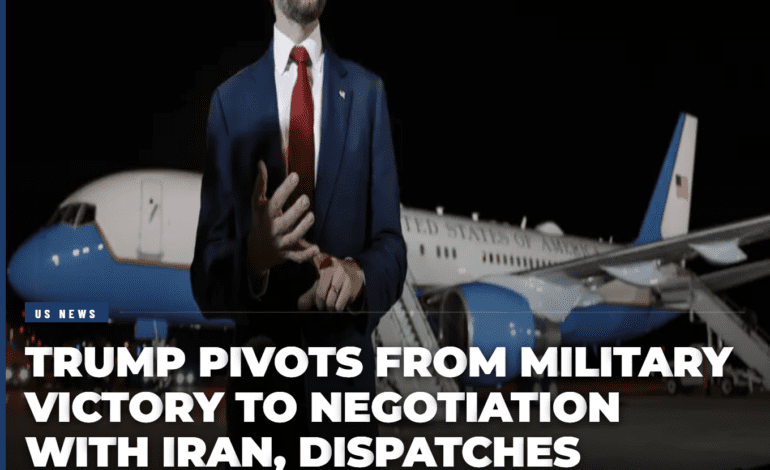
Trump Pivots from Military Victory to Negotiation with Iran, Dispatches Vance to Pakistan

|
The Pivot: From Bombs to Bargaining
Forty days of war. More than 2,076 people dead in US-Israel strikes on Iran alone. Global energy markets shaken to their core. And then — a ceasefire, a pivot, and a diplomatic mission to Pakistan.
This is the moment President Trump chose to switch gears. After weeks of escalating threats — including a warning that ‘a whole civilization will die’ — Trump announced a two-week pause in hostilities on April 7–8, 2026, and immediately began setting up the next phase: face-to-face negotiations with Iran in Islamabad.
The pivot was swift. The stakes are enormous. And the outcome of the talks could reshape the Middle East for a generation. Here is everything you need to know — verified, contextualized, and clearly labeled where facts are disputed.
Fake News Check: What’s Real, What’s Disputed, What’s False
Before we go deeper, here is a fast fact-check of the key claims circulating around this story.
Confirmed as True
- Trump declared military victory over Iran and pivoted to a diplomatic negotiation phase. ✅
- JD Vance, Steve Witkoff, and Jared Kushner have been dispatched to Islamabad for talks with Iran. ✅
- Negotiations are scheduled to begin in Islamabad on Saturday, April 11, 2026, under Pakistani mediation. ✅
- Trump called Iran’s 10-point peace proposal ‘a workable basis on which to negotiate.’ ✅
- The ceasefire was described as ‘fragile’ by Vance himself. ✅
- US Joint Chiefs Chairman Dan Caine confirmed the military remains ready to resume combat operations. ✅
- Secretary of Defense Pete Hegseth said the US used only ten percent of its combat firepower, achieving a ‘capital V military victory.’ ✅
- Trump floated a joint US-Iran venture to collect Strait of Hormuz shipping fees. ✅
Disputed or Unclear
- Both the US and Iran claim victory — but neither has made concessions on its core positions. The gap between the two sides remains enormous.
- Iran’s stance on shipping fees in the Strait of Hormuz: Iran says it will charge fees and retain military management of the waterway. The US says it must be fully open and free. The White House said any attempt to restrict passage would be ‘completely unacceptable.’
- Whether Iran has privately agreed to nuclear terms it publicly denies: White House Press Secretary Karoline Leavitt said Iran’s private communications differ significantly from its public statements.
- Trump floated a US-Iran joint venture on Hormuz tolls in an ABC News interview — but this has not been confirmed as a formal US negotiating position.
False or Misleading (Circulating on Social Media)
- FALSE: Iran formally agreed to dismantle its nuclear program. It explicitly rejected this in its 10-point proposal.
- FALSE: The ceasefire means the war is over. Both Vance and Joint Chiefs Chairman Caine made clear it is a temporary pause only.
- FALSE: China brokered the deal. Pakistan led the mediation. China played a quiet, behind-the-scenes role pressuring Iran — but did not broker the ceasefire.
- FALSE: Jared Kushner is leading the delegation. Vance leads. Witkoff and Kushner accompany as envoys.
How the Pivot Happened: The Full Story
The Military Phase: 40 Days of Strikes
The 2026 Iran war began on February 28. US and Israeli strikes killed Supreme Leader Ayatollah Ali Khamenei on Day 1, along with senior military commanders and National Security Council members. Over 40 days, Iran responded with more than 5,000 drones, 2,100+ ballistic missiles, and 50+ cruise missiles.
Secretary of Defense Pete Hegseth framed the military campaign in stark terms: the US had entered the conflict using ‘only ten percent of its combat firepower’ but achieved devastating results. He declared a ‘capital V military victory’ and said the Iranian military ‘no longer poses a significant threat to US forces or the region.’
Iran’s top leadership was systematically eliminated. As CBN News reported: the previous supreme leader — dead; the Supreme National Security Council secretary — dead; and multiple other senior officials eliminated in the strikes. Iran’s son and successor, Mojtaba Khamenei, has not been seen publicly since the opening strikes.
The Negotiation Turn: Pakistan’s Critical Role
The shift from military to diplomatic was not spontaneous — it was months in the making. NPR reported in late March that Pakistan, Egypt, and Turkey had all been quietly relaying messages between Washington and Tehran through backchannel diplomacy. Iran publicly denied that any talks were happening. Privately, it was listening.
Pakistani Prime Minister Shehbaz Sharif played the decisive role. On April 7, as Trump’s midnight deadline approached, Sharif called on Trump to extend the deadline and simultaneously urged Iran to open the Strait of Hormuz. He announced Pakistan’s willingness to host negotiations in Islamabad. Both sides accepted.
| “The success of our military created maximum leverage, allowing President Trump and the team to engage in tough negotiations that have now created an opening for a diplomatic solution and long-term peace.”
— White House Press Secretary Karoline Leavitt, April 8, 2026 |
China’s Quiet Hand
Pakistan was not the only one working behind the scenes. PBS NewsHour reported, citing two officials briefed on the matter who requested anonymity, that China — Iran’s biggest trading partner and America’s most significant economic competitor — ‘quietly pulled strings to find a pathway toward a ceasefire.’ This detail has not been confirmed by either Beijing or Washington, but it has not been denied either.
China’s involvement, if confirmed, would add a significant geopolitical dimension. Iran expert Trita Parsi told Al Jazeera that while potential talks in Islamabad could fail, ‘the terrain has shifted.’ He noted that ‘Trump’s failed use of force has blunted the credibility of American military threats, introducing a new dynamic into US-Iran diplomacy.’
The Islamabad Delegation: Who Is Going and Why
The composition of the US negotiating team tells us a great deal about what Trump hopes to achieve — and how he plans to achieve it. This is not a delegation of career diplomats. It is a team of Trump loyalists with direct lines to the president.
| JD Vance — Lead Negotiator | The Vice President leads the delegation. Vance described the ceasefire as a ‘fragile truce’ and said its success depends on whether ‘trustworthy elements of the Iranian regime prevail.’ He warned that if Iran cheats, ‘they’re not going to be happy.’ CNN reported Vance played a ‘substantial’ role from Hungary in the ceasefire deal itself. |
| Steve Witkoff — Envoy | Trump’s special envoy and real estate dealmaker. Witkoff has been involved in multiple Trump-era negotiations. NPR reported that US envoy Witkoff has a ‘direct connection’ to Pakistan’s Field Marshal General. |
| Jared Kushner — Envoy | Trump’s son-in-law and senior adviser. Kushner architected the Abraham Accords during Trump’s first term and brings deep experience in Middle East deal-making. |
| Pakistan as Host | PM Shehbaz Sharif and Pakistan’s military establishment will host and facilitate. Pakistan has warm relations with the Trump administration, Iran, and Gulf Arab states — making it uniquely positioned as a neutral venue. |
| Iran’s Team | Iran’s delegation has not been fully announced as of April 9. Foreign Minister Abbas Araghchi is expected to lead. Iran’s Supreme National Security Council has formally accepted the ceasefire and the talks. |
What Vance Said Before Leaving
Vance was direct about the stakes. He drew a clear line between the diplomatic and military tracks:
| “If the Iranians are willing in good faith to work with us, I think we can make an agreement. If they’re going to lie, if they’re going to cheat, if they’re trying to prevent even the fragile truce that we’ve set up from taking place, then they’re not going to be happy.”
— Vice President JD Vance, April 8, 2026 |
Vance also pushed back on Iran’s public victory claims. He called an initial Iranian statement claiming they had forced the US to accept their terms the work of ‘little more than a random yahoo in Iran’ — a remark that drew significant attention given the sensitivity of ongoing talks. He later said the deal was being ‘misrepresented within Iran.’
The Enormous Gap Between US and Iranian Positions
A ceasefire creates a space to talk. It does not create agreement. The distance between what Washington wants and what Tehran is willing to offer is vast. Here is the full comparison.
| Issue | US Position | Iran’s Position |
| Nuclear program | Full dismantlement required; no enrichment at all — including civilian | Rejects full dismantlement; claims legal right to peaceful enrichment; denies seeking weapons |
| Enriched uranium | Trump: US will ‘dig up and remove’ it | Iran has not confirmed this; uranium likely entombed at bombed sites |
| Strait of Hormuz | Must be open, free, and safe — no fees | Agreed to open during ceasefire but claims ‘dominion’; wants to charge ships transit fees for reconstruction revenue |
| US troop withdrawal | Troops, ships, aircraft to remain ‘in and around Iran’ until deal is finalized | Iran demands full withdrawal of US forces from all regional bases |
| Sanctions | Conditional — tied to nuclear and security compliance; Trump signaled ‘tariff and sanctions relief’ talks | Immediate and unconditional lifting demanded in 10-point plan |
| Frozen assets | Not yet formally addressed | Release of frozen assets demanded in 10-point plan |
| Proxy groups | Iran must end support for Hezbollah, Hamas, Houthis | Not mentioned in Iran’s 10-point proposal — a red line |
| Israel’s right to exist | Believed to be on US’s 15-point plan | Iran has historically refused to recognize Israel |
| Lebanon ceasefire | Excluded — ‘a separate skirmish’ per Trump | Pakistan said it was included; Iran has not formally clarified |
| Reparations | Not on US table | Iran’s President Pezeshkian called for reparations in March; now appears shelved in favour of Hormuz fees |
Understanding Trump’s Negotiation Playbook on Iran
The pivot from ‘a whole civilization will die’ to ‘big money will be made’ happened in roughly 24 hours. To many observers, it looked like a contradiction. To those who study Trump’s negotiating style, it was predictable.
The ‘Punch First, Talk Later’ Strategy
Time magazine analyzed Trump’s approach directly. The piece described what it called Trump’s negotiation rules:
- Start every negotiation by ‘punching you in the face.’ Build maximum pressure before offering any off-ramp.
- Always declare victory, regardless of the outcome. ‘Rewrite reality by repeating your own version of events with absolute certainty.’
- Maintain ‘maximum strategic flexibility’ — appear to vacillate between hawks and doves to keep all options open.
- Two weeks is Trump’s favorite interval for ‘buying himself time’ when making major decisions.
PBS NewsHour noted a telling pattern: ‘Two weeks has become Trump’s favorite interval to buy himself time when making major decisions. Last summer, the White House said he’d decide about launching an initial bombing campaign against Iran within two weeks — only to have the president order airstrikes before that interval was up.’
The same two-week rhythm appeared in Ukraine negotiations and health care policy during Trump’s first term. It is a tool, not a timeline.
The ‘Victory First’ Frame
Trump told AFP news agency that the ceasefire represented ‘total and complete victory.’ Hegseth said it was a ‘capital V military victory.’ These declarations serve a purpose: they allow Trump to enter negotiations without appearing to have retreated or backed down.
In an ABC News interview, Trump also floated a genuinely novel idea — a joint US-Iran commercial venture to collect fees from ships passing through the Strait of Hormuz. It was a remarkable proposal: the country America just spent 40 days bombing could become a business partner in managing a global shipping lane. The White House has not confirmed this as a formal negotiating position.
| “Big money will be made. Iran can start the reconstruction process. We’ll be loading up with supplies of all kinds, and just ‘hangin’ around’ in order to make sure that everything goes well.” — President Donald Trump, Truth Social, April 8, 2026 |
Iran’s Calculation: Why Tehran Agreed to Talk
Iran did not want to negotiate. Its leaders publicly vowed they would not. What changed?
The Military Reality
Iran entered the war projecting strength but absorbed devastating losses. Its top military and political leadership was decimated. Enrichment sites were bombed. The US and Israel say they destroyed or buried many missile launchers. Iran’s own state media confirmed major infrastructure hits.
At the same time, Iran’s asymmetric weapons — drones, missiles, proxy groups — inflicted real costs across the Gulf region. Kuwait, the UAE, Bahrain, Saudi Arabia, Iraq, and Qatar all reported intercepting Iranian strikes on April 8 alone. Abu Dhabi’s Habshan gas complex caught fire. A Saudi pipeline was hit. Iran could not win a conventional war, but it could make the conflict very expensive for everyone.
The Diplomatic Pressure
Al Jazeera reported that Iran yielded ‘to pressure from Pakistani mediators — and reportedly, to pressure from China.’ Iran had publicly refused to negotiate with the US at all. The shift represented a significant departure from that position, even if Tehran framed it as accepting talks ‘on its own terms.’
Iran’s President Masoud Pezeshkian had called for reparations for war damages as recently as March 11. That demand appears to have been quietly dropped — replaced with the more practical (and more palatable to global markets) idea of charging Hormuz shipping fees for reconstruction revenue.
The ‘We Won’ Narrative
Iran’s state television told its citizens that the country ‘forced Israel and the US to accept its proposed conditions and surrender.’ Iranian officials framed the 10-point proposal — which Trump called ‘a workable basis to negotiate’ — as a US capitulation. This framing is designed for domestic consumption. It gives Iran’s leadership political cover to enter negotiations without appearing weak.
Iran expert Chris Featherstone of the University of York told Al Jazeera: ‘For Trump, the big achievement is to have Iran agree to negotiate after his escalating threats. He is presenting this as a success, but he will need to achieve some form of concession from Iran to be able to present this as a success in the longer term.’
The Strait of Hormuz: The Deal’s Most Complicated Issue
Before the war, ships passed through the Strait of Hormuz freely. No tolls. No military escorts. No fees. It was treated as an international waterway under the UN Convention on the Law of the Sea.
The war changed that. Iran began charging vessels as much as $2 million per ship to allow passage. It claimed ‘dominion’ over the strait. It threatened to close it entirely. One-fifth of the world’s oil flows through that narrow waterway between Iran and Oman in peacetime.
The Three Competing Visions for the Strait
As of April 9, 2026, three different visions for the strait’s future are on the table — and they are fundamentally incompatible:
- The US Vision: The strait is an international waterway. It must be completely open, safe, and toll-free. White House Press Secretary Leavitt: Trump ‘wants to see the strait reopened immediately without limitation.’
- Iran’s Vision: Iran holds ‘dominion’ over the strait and will manage it ‘under Iranian military management.’ Ships may pass during the ceasefire — but Iran expects to formalize its fee system, using toll revenue for reconstruction.
- Trump’s Novel Idea: A joint US-Iran commercial venture to collect transit fees from the strait. This was floated by Trump in an ABC News interview. It has not been formally proposed and has not been accepted by Iran. Gulf Arab states — who also bore the cost of Iranian attacks — would likely reject any fee system.
PBS NewsHour reported that one regional official, speaking anonymously, said the plan allows both Iran and Oman to charge ships — with Iran using the revenue for reconstruction. This would ‘upend decades of precedent treating the strait as an international waterway that was free to transit and will likely not be acceptable to the Gulf Arab states.’
The Wider Picture: NATO, Israel, and the UN
NATO’s Disappointment
CNN reported that Trump is ‘clearly disappointed’ with many NATO allies for not supporting the US-Israel war on Iran more actively. NATO Secretary General Mark Rutte, after meeting Trump, said he understood the president’s frustration but noted that many European nations supported the effort through logistics, overflights, and basing — even if they did not join combat operations.
Israel’s Position: Not Included
Israel endorsed the Pakistan-brokered ceasefire with Iran but made clear it does not apply to Lebanon or Hezbollah. Netanyahu said the ceasefire came ‘in full coordination with Israel’ — but that Israel was not caught off guard because it had known negotiations might lead to a temporary truce. Israel struck 100 targets across Lebanon in just 10 minutes on April 8 — killing at least 182 people — the day the ceasefire took effect for Iran.
Israel has received US assurances that Iran’s nuclear and missile programs will be addressed in the Islamabad negotiations. But Israel’s domestic political situation is tense. Many Israelis expect more from a 40-day war, and Netanyahu faces elections later in 2026.
The United Nations
UN Secretary General Antonio Guterres sent his personal envoy to Iran for talks ‘on the way forward.’ His spokesperson warned that ongoing Israeli military activity in Lebanon ‘poses a grave risk’ to the fragile US-Iran truce. The UN is not a formal party to the Islamabad talks but is watching closely.
Frequently Asked Questions
Q: Is it true that Trump pivoted from military action to negotiation on Iran?
Yes. This is verified. After declaring military victory, Trump dispatched VP Vance, Steve Witkoff, and Jared Kushner to Islamabad for direct talks with Iran, scheduled for Saturday, April 11, 2026.
Q: Why is Pakistan hosting the Iran-US talks?
Pakistan has warm diplomatic relations with the Trump administration, Iran, and Gulf Arab states — making it a rare neutral party acceptable to all sides. Pakistani PM Shehbaz Sharif played the critical mediation role in the ceasefire itself.
Q: Did China play a role in the ceasefire?
PBS NewsHour reported, citing two anonymous officials, that China quietly pressured Iran to negotiate. This has not been confirmed or denied by Beijing or Washington. Pakistan led the formal mediation.
Q: What is Iran’s 10-point peace proposal?
Iran’s 10-point proposal has not been fully published. Known elements include: lifting all US sanctions on Iran, withdrawing US forces from regional bases, and charging fees in the Strait of Hormuz for reconstruction revenue. It explicitly rejects demands to dismantle Iran’s nuclear program.
Q: What is the US 15-point plan?
The US 15-point plan has also not been fully published. Known elements include: a 30-day ceasefire, immediate reopening of the Strait of Hormuz, decommissioning of Iran’s nuclear facilities at Fordow, Natanz, and Isfahan, a permanent commitment against nuclear weapons, and an end to uranium enrichment — even for civilian purposes. Iran called it ‘largely excessive, unrealistic and unreasonable.’
Q: What happens if the talks in Islamabad fail?
Trump and Vance have both made clear: the ceasefire ends and military operations resume — ‘bigger, and better, and stronger than anyone has ever seen before,’ in Trump’s words. Joint Chiefs Chairman Dan Caine confirmed the military ‘remains ready, if ordered, to resume combat operations.’
Q: How did Trump go from threatening Iran’s destruction to talking in one day?
PBS described it as a ‘dramatic shift in tenor’ driven by Pakistan and China’s behind-the-scenes work. Time magazine argued it was consistent with Trump’s negotiating playbook: start with maximum aggression to create leverage, then pivot to deal-making while declaring victory regardless of outcome.
Key Takeaways
- This story is REAL — confirmed by The Washington Times, CNN, PBS, Al Jazeera, CBN, NPR, and Time.
- Trump declared military victory over Iran on April 8, 2026, and immediately shifted to a diplomatic track.
- VP JD Vance, Steve Witkoff, and Jared Kushner are heading to Islamabad for US-Iran talks on April 11.
- Pakistan brokered the ceasefire; China reportedly played a quiet behind-the-scenes role.
- Both the US and Iran claim victory — but neither has conceded on any core demand.
- The gap between US and Iranian positions remains enormous on nuclear issues, the Strait of Hormuz, sanctions, and proxy groups.
- The ceasefire is explicitly described as ‘fragile’ by Vance; the US military remains on standby.
- Trump floated a novel idea: a joint US-Iran venture to collect Hormuz shipping fees — unconfirmed as a formal position.
- Lebanon is explicitly excluded from the ceasefire; Israel continues striking Hezbollah.
- The next 14 days — and the Islamabad talks — will determine whether this is a genuine peace process or another failed interval.
Sources & Further Reading
- The Washington Times — ‘Trump pivots from military victory to negotiation with Iran, dispatches Vance to Pakistan’ (April 8, 2026)
- CNN — ‘The US and Iran have agreed to a ceasefire, with talks ahead to bridge the gulf between them’ (April 8, 2026)
- PBS NewsHour — ‘How Trump went from threatening Iran’s annihilation to agreeing to a two-week ceasefire in a day’ (April 8, 2026)
- Al Jazeera — ‘Iran, US both claim victory, but did they actually concede ground?’ (April 8, 2026)
- Al Jazeera — ‘US-Iran ceasefire deal: What are the terms, and what’s next?’ (April 8, 2026)
- CBN News — ‘As Fragile Ceasefire Holds, Vance to Lead US-Iran Weekend Negotiations in Pakistan’ (April 9, 2026)
- Time — ‘Why We Predicted Trump’s Iran Ceasefire’ (April 8, 2026)
- NPR — ‘Trump declares victory and claims Iran offers a prize in talks Iran has denied having’ (March 24, 2026)
| About This Article
This news analysis was compiled by the Claude AI News Desk on April 9, 2026. All facts, quotes, and attributions have been cross-referenced against multiple major international news sources. Where information is disputed, unclear, or unconfirmed, it is explicitly labeled as such. This article does not represent a political or editorial position. It is intended to inform readers about a rapidly developing geopolitical story. |
Discover more from MatterDigest
Subscribe to get the latest posts sent to your email.