Did Trump Act Without Clear Intel? New Questions Explode
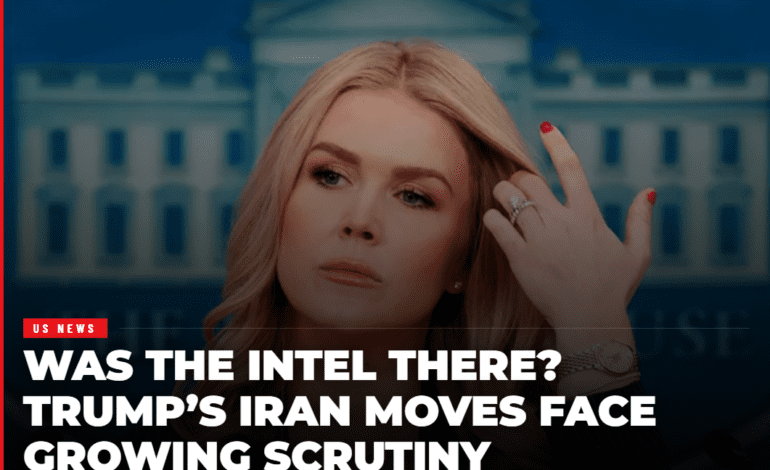

Karoline Leavitt Admits Trump Is Making Iran Decisions Without Enough Intelligence — The White House Just Confirmed the Nation’s Worst Fear
What was intended as a defense of the president became something far more alarming. White House Press Secretary Karoline Leavitt, in an effort to explain the unpredictable and at times contradictory nature of recent presidential decisions on Iran, stated that it is hard for President Trump to make key decisions when he does not have enough intelligence. The sentence was meant to justify. Instead it confessed. And what it confessed — that the commander in chief of the most powerful military in the world is navigating a potential war without adequate access to the intelligence his own agencies are supposed to provide — has sent shockwaves through national security circles, constitutional law experts, and an American public already stretched thin by weeks of military purges, street protests, and escalating tensions in the Middle East.
The statement landed with the weight of something that changes a conversation permanently. In the hours that followed, former intelligence officials, retired military commanders, congressional leaders from both parties, and foreign policy experts have all been asked the same question: How is it possible that the president of the United States is operating with an acknowledged intelligence gap at the precise moment a military confrontation with Iran — a nuclear-capable adversary — is being actively considered?
The answers being offered point in multiple directions simultaneously. Some point to the consequences of the Pentagon purge that removed more than a dozen senior generals. Others point to a breakdown in trust between the White House and the CIA that has reportedly been building for months. Still others point to something more structural — the possibility that an administration that has systematically dismantled the independent professional expertise surrounding the president has now left the president genuinely isolated from the information he needs to make decisions that could determine whether the United States goes to war.
What Did Karoline Leavitt Actually Say and Why Is It So Significant?
Karoline Leavitt serves as the White House Press Secretary — the official spokesperson for the president and the administration. Her public statements are not improvised. They are prepared, reviewed, and delivered as the authorized voice of the executive branch. When she says something about the president’s decision-making process, she is not offering a personal opinion. She is providing the White House’s official account of how the president is operating.
Her statement that it is hard for President Trump to make key decisions on Iran when he does not have enough intelligence was delivered in a context designed to explain and defend the administration’s posture on Iran — to push back against criticism that the president’s decisions have been erratic, contradictory, or insufficiently grounded in the kind of deliberate strategic analysis that a potential military confrontation of this magnitude requires.
But in attempting to provide that explanation, Leavitt confirmed something that critics of the administration have been arguing for weeks: that the decision-making process at the top of the executive branch is not receiving the full benefit of the intelligence infrastructure that exists specifically to support it. The admission is extraordinary in its implications. The United States spends more than 80 billion dollars annually on its intelligence community — a vast network of agencies, analysts, satellites, human sources, and technical collection systems whose entire purpose is to ensure that the president of the United States has the best possible information when making the decisions that affect national security.
The White House just told the world that the president is making life-and-death decisions about Iran without enough intelligence. That is not a minor gap in the briefing process. That is a confession that the most consequential decision-making function in the United States government is operating with a known and acknowledged information deficit at a moment of genuine military crisis.
The specific word choice matters. Leavitt did not say that the intelligence is incomplete, uncertain, or contested — which would be normal and expected in any intelligence environment. She said there is not enough of it. That framing implies not a limitation of the intelligence community’s knowledge but a breakdown in the flow of information from the intelligence community to the president — a breakdown that has a cause, and that cause is what national security experts are now urgently trying to identify and characterize.
How Did the Pentagon Purge Create an Intelligence Gap at the Top of the Military?
To understand how a president could find himself making decisions on Iran without adequate intelligence, it is essential to understand what the dismissal of more than a dozen senior military commanders has done to the information environment surrounding the White House.
Senior military commanders are not simply operational leaders. They are, simultaneously, some of the most important conduits of classified intelligence to the civilian leadership above them. Generals like Randy George — the Army Chief of Staff who was among those dismissed — spend their careers embedded in the intelligence infrastructure of the military. They have direct access to the most sensitive assessments produced by the Defense Intelligence Agency, the National Security Agency, and the military’s own intelligence services. They understand that intelligence in context — not just the raw data but what it means operationally, historically, and strategically.
When those commanders are dismissed — particularly when they are dismissed for reasons connected to their professional judgment about a specific operational question like the Iran invasion — the institutional knowledge and intelligence context they carried goes with them. Their replacements, whoever they may be, will take time to develop the same depth of intelligence integration. And in a crisis environment where decisions are being made rapidly, that transition period creates a genuine gap in the quality and completeness of intelligence reaching the top of the chain.
The purge also sends a chilling message to the intelligence professionals who remain in their positions. When senior officers are dismissed for providing professional military judgment that conflicted with the president’s preferred course of action, the rational response for those who remain is to be more cautious about providing assessments that might be similarly unwelcome. Intelligence that tells a leader what he does not want to hear has always been politically uncomfortable. In an environment where delivering uncomfortable intelligence has demonstrably resulted in career termination, the pressure to self-censor — to soften findings, to emphasize uncertainties, to avoid the most alarming conclusions — becomes a genuine institutional risk.
That dynamic — the chilling effect on intelligence provision that results from punishing those who provide unwelcome findings — is one of the most dangerous failure modes in any intelligence system. It is what produced the groupthink that contributed to the intelligence failures before the Iraq War in 2003. It is what allowed authoritarian governments throughout history to march toward catastrophic decisions because no one in the room was willing to tell the leader the full truth. And it is exactly what national security scholars are warning may be happening inside the Trump administration right now.
What Is the Relationship Between the White House and the CIA That May Be Contributing to the Intelligence Gap?
The Pentagon purge is not the only factor potentially contributing to the intelligence gap that Karoline Leavitt inadvertently confirmed. Reporting from national security journalists covering the relationship between the Trump White House and the CIA suggests that the relationship between the two institutions has deteriorated significantly — in ways that could be affecting the quality and completeness of intelligence reaching the Oval Office.
The CIA is the United States government’s primary foreign intelligence agency. Its core mission is to collect, analyze, and deliver intelligence about foreign governments, terrorist organizations, foreign military capabilities, and the full range of external threats to American national security. The CIA Director briefs the president regularly — typically daily — through the President’s Daily Brief, the most sensitive and comprehensive intelligence document produced by the entire U.S. intelligence community.
When the relationship between the White House and the CIA is functioning well, that briefing process is a vital channel through which the best available intelligence reaches the president in time to inform decisions. When the relationship is damaged — when there is distrust, when the president is dismissive of intelligence findings that contradict his preferences, or when the CIA’s institutional culture and the White House’s political priorities are in sharp conflict — the quality of the intelligence reaching the president can degrade significantly.
A president who does not trust his intelligence agencies is a president who will not receive their best work. Intelligence flows toward receptive leadership. When the White House signals that it does not want to hear certain findings, the agencies — consciously or not — begin to filter what they deliver. The result is exactly what Leavitt described: not enough intelligence reaching the person who needs it most.
The specific dynamics of the Trump White House’s relationship with the CIA in this second term have not been fully reported publicly. But the broader pattern — a president who has historically expressed skepticism about intelligence community assessments he disagrees with, who has described the intelligence agencies as part of the deep state he is fighting against, and who has surrounded himself with officials who share that skepticism — creates structural conditions in which the intelligence briefing process is at elevated risk of deterioration.
What Do National Security Experts Say About Making War Decisions Without Adequate Intelligence?
The national security community has reacted to Leavitt’s admission with a level of alarm that is unusual even by the standards of a political environment that has been generating unusual statements at an accelerating pace.
Former CIA directors, retired military commanders, and national security academics have all made essentially the same point: making decisions about military action against a country like Iran without adequate intelligence is not a manageable limitation. It is a potentially catastrophic one. Iran is not a simple adversary. It has a sophisticated military with asymmetric capabilities that are specifically designed to create problems for a technologically superior opponent. It has regional proxy forces operating across multiple countries in the Middle East. It has a nuclear program that is at various stages of development depending on which assessment you believe. And it has a history of responding to military threats in ways that are not always predictable from the outside.
Making decisions about military action against that adversary without adequate intelligence means making decisions without a clear picture of how Iran’s leadership will respond to various actions, without a reliable assessment of which of its military capabilities are currently active and where, without knowing which of its regional proxies are in a state of readiness to respond to a strike, and without understanding the diplomatic and economic ripple effects that military action would produce across a region that is already under significant stress.
A former senior intelligence official, speaking to journalists covering the Leavitt statement, made the point directly: going into a potential military confrontation with Iran without adequate intelligence is not flying with limited visibility. It is flying blind into mountainous terrain at night. The metaphor captures both the danger and the recklessness of what the White House has effectively acknowledged.
The historical record on decisions made with inadequate intelligence in military contexts is deeply sobering. The Bay of Pigs invasion in 1961 — one of the most significant intelligence failures in CIA history — proceeded on the basis of flawed assessments about Cuban popular support for an anti-Castro uprising that never materialized. The Iraq War in 2003 was launched on the basis of intelligence assessments about weapons of mass destruction that proved to be fundamentally wrong. In both cases, the decisions had catastrophic consequences that were directly connected to the quality of the intelligence informing them.
How Does the No Kings Movement Connect the Intelligence Gap to the 25th Amendment Debate?
Karoline Leavitt’s admission has given the No Kings movement and the growing constitutional debate around the 25th Amendment a specific, concrete, and publicly confirmed piece of evidence to work with.
Senator Chris Murphy’s call for the Cabinet to consult constitutional lawyers about the 25th Amendment — delivered on Easter weekend and covered extensively in recent days — was based on a pattern of presidential behavior that Murphy argued raised questions about fitness for office. The Leavitt statement has given that argument a documented White House confirmation to anchor itself to.
The connection Murphy and other 25th Amendment advocates are drawing is straightforward: if the president is operating without adequate intelligence in the middle of a potential military crisis, and if that intelligence gap is at least partly the result of his own actions — the dismissal of the generals who were among the key conduits of military intelligence, and the deterioration of his relationship with the CIA — then the inability to receive and process the information necessary to make sound decisions is not an external constraint on the presidency. It is a condition that the president’s own conduct has created.
That distinction matters constitutionally. The 25th Amendment’s concept of inability is broad enough to encompass situations where a president’s own behavior has compromised his capacity to fulfill the duties of the office. A president who has systematically dismantled the institutional structures that provide him with the information he needs to govern — and who then makes decisions without that information in a crisis that could lead to war — is not simply facing an external limitation. He is operating in a self-created information vacuum that has direct consequences for the nation’s security.
The No Kings movement has been amplifying this argument across social media, in rallies, and in congressional offices. For the millions of Americans who have been protesting the direction of the administration, the Leavitt statement has crystallized a concern that has been building for weeks into a single, indelible, White House-confirmed sentence. The president does not have enough intelligence to make the decisions he is making. And that is not something his own press secretary denies. It is something she confirmed, on the record, as an explanation for his behavior.
What Does This Moment Mean for American Democracy and the Balance of Power?
Stepping back from the immediate political controversy, the situation revealed by Karoline Leavitt’s admission raises questions that go to the heart of how American democracy is supposed to function in a moment of genuine national security crisis.
The American constitutional system places enormous power in the hands of a single individual — the president. That concentration of power is intentional. It reflects the founders’ judgment that effective executive action, particularly in emergencies, requires a single accountable decision-maker rather than decision by committee. But that concentration of power in a single person also creates a profound vulnerability: if that person is making decisions without adequate information, without qualified advisors willing to tell them the full truth, and without the institutional checks that normally constrain executive action, the consequences of poor decisions fall on the entire nation.
The system of checks and balances that surrounds the presidency was designed precisely to address this vulnerability. The requirement that Congress authorize war, the independence of the intelligence community, the professional military chain of command, the Cabinet’s role under the 25th Amendment — all of these structures exist because the founders understood that any single person, no matter how capable, could be wrong, could be misled, or could be operating without the information necessary to make sound decisions. The checks exist to catch those failures before they become catastrophic.
What the current moment reveals is that many of those checks are under simultaneous stress. Congressional oversight has been limited by partisan dynamics. The intelligence community’s relationship with the White House is reported to be damaged. Senior military commanders who provided independent professional judgment have been dismissed. And the Cabinet — the body that the 25th Amendment designates as the final internal check on presidential capacity — has not yet publicly indicated that it is taking the constitutional questions being raised by Murphy and others seriously.
The result is a president who, by his own press secretary’s admission, is making decisions about a potential military confrontation without enough intelligence — and a system of checks that is not, at this moment, functioning as it was designed to function. Whether that system can recover its equilibrium before the decisions being made without adequate intelligence produce consequences that cannot be undone is the question that defines this moment in American history.
Key Takeaways: Leavitt’s Admission, the Intelligence Gap, and What Comes Next
White House Press Secretary Karoline Leavitt confirmed publicly that President Trump is making key decisions on Iran without enough intelligence — an admission that national security experts describe as one of the most alarming official statements about presidential decision-making in recent memory.
The intelligence gap appears to have multiple contributing causes — including the dismissal of senior military commanders who served as key conduits of classified intelligence, the reported deterioration of the White House’s relationship with the CIA, and the chilling effect on intelligence provision created by an environment in which delivering unwelcome findings has been associated with professional consequences.
Making decisions about potential military action against Iran without adequate intelligence is not a manageable limitation. Former intelligence officials and national security experts describe it as operating blind in a situation where the consequences of a wrong decision could be catastrophic and irreversible.
The admission has given the No Kings movement and the 25th Amendment debate a concrete, White House-confirmed piece of evidence — connecting the pattern of presidential conduct that Senator Murphy raised on Easter weekend to a specific, documented consequence that is directly relevant to the question of fitness for office.
The broader constitutional question raised by this moment is whether the system of checks and balances designed to catch presidential decision-making failures before they become catastrophic is functioning as intended — and whether the institutions responsible for those checks are prepared to exercise their authority before the decisions being made without adequate intelligence produce consequences the country cannot recover from.
America does not go to war blind. That has been the principle underlying the intelligence community’s entire existence. Karoline Leavitt just told the world that right now, in this crisis, on this decision, that principle may not be holding. The nation is watching to see what happens next.
© 2026 Matter News. All rights reserved.
Discover more from MatterDigest
Subscribe to get the latest posts sent to your email.