‘Sore Loser’ & ‘Caveman’: Iran Fires Back at Trump’s Rant
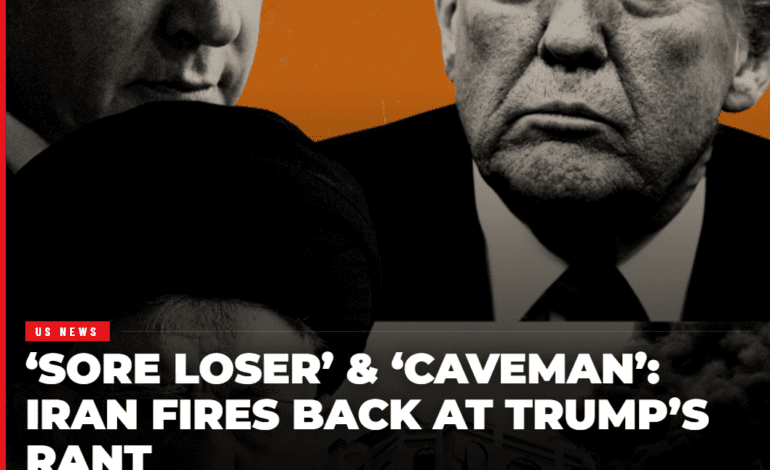

Iran Calls Trump a “Sore Loser Brat” and a “Stone Age Caveman” After His Profanity-Filled War Threats — Here Is What It Means
Nuclear powers do not usually trade playground insults. That is the kind of language reserved for political rivalries and social media arguments — not for moments when two countries are actively at war, when missiles are flying, when a U.S. colonel was just rescued from behind enemy lines, and when global oil prices are shattering records. But that is exactly where the United States and Iran find themselves right now.
On Easter Sunday, President Donald Trump posted what can only be described as one of the most extraordinary messages ever sent from a sitting American president to a foreign government. On Truth Social, he threatened to bomb Iran’s power plants and bridges — then told Tehran’s leaders to “Open the F***in’ Strait, you crazy bastards, or you’ll be living in Hell – JUST WATCH!”
Iran’s response was not a missile strike. It was not a military threat. It was something that, in its own way, hit just as hard — and traveled just as far. Iranian embassies around the world took to social media and called Trump a “sore loser brat.” Iran’s embassy in Austria compared him to a Stone Age caveman “brandishing a club and treating savagery like everyday life.” Meanwhile, Democrats in Congress were raising questions about Trump’s mental fitness, and legal experts were calling his threats potential war crimes.
This article breaks down exactly what was said, why it was said, what it means for the war, and why the shift from military threats to public mockery tells us something important about where both sides stand right now.
The Post That Shocked the World: What Trump Actually Said
To understand Iran’s response, you first need to understand the message it was responding to. On Easter Sunday morning, April 6, 2026 — while millions of Americans were at church — Trump posted a string of messages on Truth Social that immediately dominated global headlines.
In the most widely shared post, he declared that Tuesday would be “Power Plant Day, and Bridge Day, all wrapped up in one, in Iran.” He followed this with a profanity-laced threat telling Iran’s leaders to open the Strait of Hormuz or face hell. He then shifted tone entirely, bragging about a successful military rescue mission that had just pulled a downed U.S. colonel out of Iranian territory.
These posts came just days after Trump had told the American public in a prime-time national address that the war was “nearing completion.” They also came on a major religious holiday, which made the tone — threatening to destroy civilian infrastructure while swearing at a foreign government — all the more jarring to observers around the world.
Legal experts were quick to note the significance of the threats to bomb Iran’s power plants and bridges. Under international humanitarian law — specifically the Geneva Conventions and their Additional Protocols — parties to an armed conflict are required to distinguish strictly between military targets and civilian infrastructure. Deliberately targeting power grids and bridges that serve civilian populations is generally prohibited. Multiple legal scholars described Trump’s threats as statements that, if carried out, could constitute war crimes.
Iran’s Response: Mockery as a Military Strategy
Iran could have responded to Trump’s Easter Sunday posts the same way it has responded to most of his threats over the past five weeks — with military counter-threats, missile launches, and warnings of “crushing and broader” retaliation. Instead, Tehran made a different choice. Its embassies around the world went on social media and chose mockery.
Iran’s embassy in India posted that Trump’s swearing and throwing of insults reflected the behavior of a “sore loser brat.” The phrasing was deliberate and widely shared — it painted the most powerful man in the world as a petulant child throwing a tantrum because things are not going his way.
Iran’s embassy in Austria went even further, comparing Trump to a prehistoric caveman. The post described a scene: close your eyes and listen to his words, and you can almost see a Stone Age man in a zebra hide, brandishing a club, treating savagery like everyday life. The image of the American president as a club-swinging caveman was almost immediately translated and shared in dozens of languages.
Iran’s embassy in Zimbabwe added a layer of sarcasm, responding to Trump’s threats with mock appreciation, as if the bluster were something to be savored and enjoyed rather than feared.
Officials in Finland joined in, criticizing Trump for violating basic standards of international communication and calling his posts a breach of social media etiquette and moral conduct — a fairly extraordinary statement from a European government about a sitting U.S. president during a time of active war.
Iran’s military command added its own official voice to the pile-on. The IRGC spokesperson, Ebrahim Zolfaqari, described Trump’s threats as reflecting “the deadlock he faces” and dismissed them as the product of a “delusional” president trying to justify “repeated defeats” of the U.S. military. The message was identical across all channels: we are not afraid of you, and we are not impressed.
Why Iran Chose Ridicule Over Rockets
The shift from military response to public ridicule was not accidental. It was a strategy — and a fairly sophisticated one.
When a country at war chooses to mock its opponent rather than threaten it, it is sending a specific message to multiple audiences at once. To its own people, it is saying: we are not rattled. We are strong enough to laugh at this. To the international community, it is saying: look at what the United States has been reduced to. To American citizens watching at home, it is saying: your president is embarrassing you in front of the world.
That last message is particularly powerful at a moment when public support for the war inside the United States is declining. When Americans see their president’s posts described as the behavior of a sore loser brat and a caveman by governments around the world — not by adversaries, but by diplomatic missions in India, Finland, Austria, and Zimbabwe — it raises questions that go beyond the war itself. It raises questions about leadership. About image. About what the United States looks like to the rest of the world right now.
There is also a psychological dimension to this. Slate’s Fred Kaplan, analyzing the moment, noted that Trump’s threats could be interpreted as a variation of what strategists call the “madman theory” — the idea that if your opponent thinks you are irrational enough to carry out extreme threats, they will give in out of fear. The problem is that the madman theory did not work for Nixon against North Vietnam, and there is no evidence it is working for Trump against Iran. Tehran’s leadership appears to have concluded that Trump’s threats reflect desperation rather than resolve. Responding with mockery rather than fear reinforces that conclusion publicly.
The Rescue That Changed the Weekend — And Trump’s Tone
Amidst the swirling war of words, one genuinely dramatic event unfolded over the weekend that gave the White House a rare moment of clear good news.
The U.S. Air Force colonel — the weapons officer whose F-15E Strike Eagle had been shot down over Qeshm Island on Friday — was rescued early Sunday morning after evading Iranian forces for more than a day in the mountains of Iran. The operation, which Trump described as involving dozens of aircraft, was dangerous and high-risk. Three of the rescue aircraft were struck by Iranian fire during the mission, including an A-10 Warthog whose pilot flew the damaged plane to Kuwaiti airspace before ejecting safely.
General Dan Caine, the Chairman of the Joint Chiefs of Staff, praised the colonel’s survival as a testament to his commitment and training, saying that his “absolute commitment to surviving” made the rescue possible. Trump, once the colonel was safely recovered, took to Truth Social to claim credit — pivoting immediately from his threats about power plants to celebrating the successful mission.
The rescue is the kind of story that normally dominates the news cycle. And it was genuinely remarkable — a U.S. officer evading Iranian forces in hostile mountain territory for over 24 hours and being pulled out safely. But the context surrounding it told a complicated story. Trump had spent the days before the rescue posting profanity-filled threats at Iran. During the rescue mission itself, the White House stayed conspicuously silent for nearly two days, avoiding press questions about the situation. And Trump’s celebration of the mission came in the same posts where he was threatening to bomb civilian infrastructure.
Congress Responds: Democrats Question Trump’s Fitness, Republicans Back the War
Inside the United States, Trump’s Easter Sunday posts ignited a political firestorm that stretched well beyond the usual partisan debate over the war itself.
Democratic Congresswoman Yassamin Ansari, who is of Iranian descent, went further than any previous lawmaker in her public response. She called for invoking the 25th Amendment — the constitutional provision that allows for the removal of a president who is unfit to serve — and described Trump as a “deranged lunatic” who poses a national security threat to the United States and to the world. Her words were extreme, but they reflected a sentiment that several Democratic colleagues echoed in less stark terms.
Other Democratic legislators questioned Trump’s mental stability after the Easter posts, specifically raising the combination of threats to bomb civilian infrastructure — which legal experts described as potential war crimes — with the erratic, profanity-filled tone of the communication itself.
Republican support for the operation remained largely intact. Senator Lindsey Graham continued to back Trump’s ultimatums, predicting that Iran would face a massive military response if it did not comply. Most Republicans framed the profanity-filled posts as tough talk from a president who means business. But even within that coalition, questions were being asked quietly about whether the messaging strategy was helping or hurting the diplomatic effort.
The political reality on Capitol Hill is that Democratic opposition to the war has been growing louder with every passing week — and the rhetoric coming from the White House has made it harder for moderate Republicans to defend the administration’s conduct without also defending posts that were widely described, even by friendly commentators, as beneath the dignity of the office.
The War Crimes Question: When Threats Become Legal Problems
One of the most serious dimensions of Trump’s Easter Sunday posts is the legal exposure they may create.
International humanitarian law is clear about civilian infrastructure. Under the Geneva Conventions, parties to a conflict must distinguish between military objectives and civilian objects. Power plants and bridges that primarily serve civilian populations are protected. Threatening to deliberately destroy them — and following through on that threat — can constitute a war crime under international law.
White House Press Secretary Karoline Leavitt was asked directly about these concerns at a briefing. She did not provide a clear legal justification for the threatened strikes on civilian power plants. Iran’s leadership seized on this, with Tehran’s military command warning that attacks on civilian targets would trigger retaliation “much more devastating and widespread” than anything seen so far.
Iran even called on its civilian population to form human chains around power plants ahead of Trump’s stated deadline — a tactic it has previously used around nuclear sites during periods of heightened tension. Senior officials urged young people, athletes, artists, students, and professors to physically surround the plants to make any strike politically and visually catastrophic. Iran’s ambassador to Pakistan, which is mediating the indirect talks, said the diplomatic effort was entering a “critical” stage.
The Global Reaction: Allies Alarmed, Adversaries Emboldened
The international reaction to Trump’s Easter Sunday posts went well beyond Iran’s embassies.
At his first Easter Mass at the Vatican, the newly elected Pope Leo made a direct and passionate appeal about the conflict without naming names. “Let those who have weapons lay them down! Let those who have the power to unleash wars choose peace!” he told a global audience. The timing and the language left little ambiguity about what he was responding to.
In Tel Aviv, Jerusalem, and Haifa, hundreds of Israeli citizens took to the streets demanding an end to the war — in defiance of a wartime ban on large gatherings. Israel’s High Court of Justice had ruled that small protests of up to several hundred people were permitted. The fact that Israelis themselves are protesting a war their own government has been co-fighting with the United States is a significant political development that has received relatively little attention in American media.
Iran, meanwhile, expanded its retaliatory reach over the weekend. It struck Israel and Kuwait with missiles and drones. Kuwait’s air defense systems reported intercepting eight missile attacks and nineteen drone strikes in a single 24-hour period. Iran also threatened to strike an artificial intelligence facility in the United Arab Emirates — specifically the Stargate AI center being developed with American companies including OpenAI, Oracle, and Nvidia — calling it a legitimate military target.
The breadth of Iran’s retaliation — from Israel to Kuwait to UAE threats to Hezbollah attacks in Lebanon — shows that the conflict has become a genuinely regional war, not a contained bilateral engagement between the U.S. and Iran. Every country in the Middle East is now being pulled into the orbit of this conflict in one way or another.
What the Exchange of Insults Actually Reveals About Both Sides
Strip away the drama and the colorful language, and what does this exchange of insults actually tell us about where both sides stand?
On the American side, Trump’s profanity-filled posts suggest a level of frustration that is hard to disguise. A president who is confident that his strategy is working does not generally resort to publicly cursing at a foreign government on a religious holiday. The pattern of escalating rhetoric — bombed back to the Stone Age, then hell will rain down, then Power Plant Day — reads like a leader who has exhausted the tactical options he planned for and is now improvising under pressure.
On the Iranian side, choosing mockery over military threat is a calculated signal of confidence. When a country at war with one of the world’s most powerful militaries responds to bombing threats by calling the attacker a caveman and a sore loser, it is saying something important: we are not afraid of you. Whether that confidence is fully warranted given the enormous military damage Iran has suffered is debatable. But perception in war matters enormously — and right now, Iran’s perception management is outperforming Washington’s.
Analyst Fred Kaplan of Slate put it pointedly: Trump is using the United States’ serious military force as an instrument of personal frustration and rage. That framing — that a serious country is being led through a serious crisis by someone operating from a place of personal emotion rather than strategic calculation — is one that is gaining traction not just among critics but among analysts who have no partisan stake in the question.
The 45-Day Ceasefire Proposal: Is There a Way Out?
Amid all the noise, there is a diplomatic thread that diplomats are trying to pull before it snaps entirely.
Pakistan has proposed a 45-day ceasefire that would include the reopening of the Strait of Hormuz. This is the most concrete peace framework on the table as of this writing. Trump has indicated he is considering it. Iran has rejected it — but its ambassador in Islamabad has described the diplomatic process as approaching a “critical” stage, which suggests Tehran is watching closely how the U.S. responds.
The challenge is that Trump’s public rhetoric makes any deal politically harder to sell to an American audience as a win. If you have been telling people for weeks that you are going to bomb a country back to the Stone Age and then open the strait by force — and then you agree to a 45-day pause — it looks like a climbdown, regardless of what actually happens on the ground.
Iran’s ambassador to Pakistan said the talks were at a critical stage. Trump acknowledged on Monday that Iran appeared to be negotiating in good faith. Markets briefly rallied on the news. But Iran denied that any direct talks had taken place. The mixed signals from both sides continue, and the Tuesday deadline for power plant strikes came and went without the promised action — yet another extension of a pattern of moving goalposts that has defined this war from the beginning.
Final Thoughts: When Words Become the Battlefield
The exchange of insults between the United States and Iran over this past weekend is remarkable not just because of how strange it sounds — a superpower and a regional power trading “caveman” jokes while missiles fly — but because of what it reveals about the state of the conflict.
Iran’s mockery of Trump is not a sign that Tehran is winning on the battlefield. Its military has taken devastating losses. Its civilian population is suffering. Its economy is under enormous strain. But Iran has concluded that the psychological and political battle — the fight over how this war is perceived, at home and internationally — is one it can win. And this weekend, at least, it scored points.
Trump’s profanity-filled threats on a religious holiday, compared internationally to a caveman and a sore loser, questioned at home for potential war crimes, and ignored by an Iran that chose laughter over fear — these are not the images of a war going according to plan. They are the images of a conflict that has evolved beyond anyone’s original expectations, in a direction that is getting harder for anyone, on any side, to control.
The world is watching. And right now, what it is watching is not the image of American strength that Operation Epic Fury was supposed to project.
Discover more from MatterDigest
Subscribe to get the latest posts sent to your email.