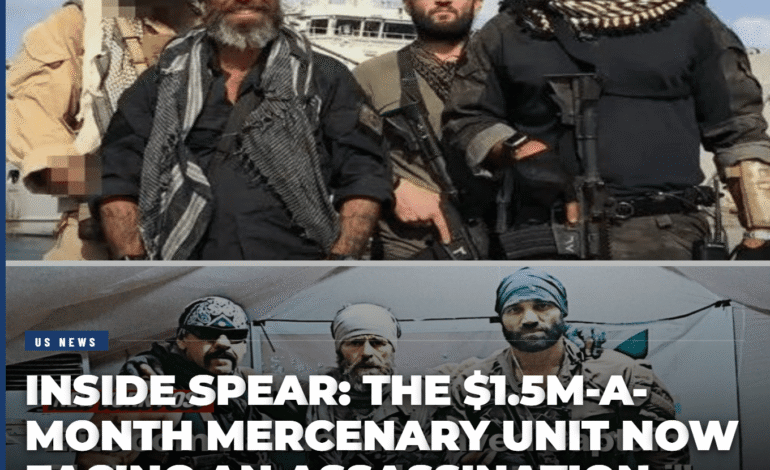
Inside Spear: The $1.5M-a-Month Mercenary Unit Now Facing an Assassination Lawsuit

|
An Elite Unit. A Covert Contract. Now a Federal Lawsuit.
They were among the most decorated operators in the United States military — Navy SEALs, Army Special Forces veterans, men who had hunted Osama bin Laden, rescued hostages from Somali pirates, and operated in some of the world’s most dangerous environments. Then, in 2015, several of them formed a private company and allegedly went to work for a foreign government — killing people for money.
That company was called Spear. And in April 2026, it became the subject of a major civil lawsuit alleging that it ran a covert targeted assassination program in Yemen on behalf of the United Arab Emirates — a $1.5 million-a-month contract that, the complaint claims, included a 23-man kill list and at least one confirmed assassination attempt that went catastrophically wrong.
The case has pulled into public view a world that usually stays in the shadows: the booming industry of private military contracting, where the line between sanctioned government operations and illegal killing-for-hire can be razor thin — and sometimes indistinguishable.
Key People & Facts at a Glance
| Organization | Spear (private military contractor) |
| Founded | August 2015, Rancho Santa Fe, San Diego, CA |
| Founders | Abraham Golan and Issac Gilmore (both former Navy SEALs) |
| Contract Value | $1.5 million per month + bonuses for successful killings |
| Client (alleged) | United Arab Emirates (UAE) government |
| Lawsuit Defendants | Abraham Golan, Issac Gilmore, Dale Comstock |
| Plaintiff | Anssaf Ali Mayo — former member, Yemeni House of Representatives |
| Primary Target | Al-Islah party HQ in Aden, Yemen (December 2015) |
| Lawsuit Filed | 2026 |
| Notable Member | Daniel Corbett — ex-Navy SEAL Team 6, not named as defendant |
What Was Spear? Building a Private Kill Team
Spear wasn’t a rogue outfit run by amateurs. It was a carefully constructed private military company assembled by former US special operations veterans with the explicit pitch that their military pedigree — and their access to men with top-level combat experience — was the product they were selling.
Abraham Golan, a San Diego-based former Navy SEAL, co-founded Spear in August 2015 alongside fellow former SEAL Issac Gilmore. According to the lawsuit, Golan personally approached the UAE with a pitch to carry out “targeted assassinations” on the Emirates’ behalf — particularly in Yemen, where the UAE was deeply involved in the ongoing civil war against Houthi rebels.
“There was a targeted assassination program in Yemen. I was running it. We did it. It was sanctioned by the UAE within the coalition,” Golan allegedly said, according to the complaint.
The UAE, for its part, was fighting a proxy war in Yemen as part of a Saudi-led coalition against the Houthi movement. It had also designated al-Islah — Yemen’s second-largest political party, linked to the Muslim Brotherhood — as a terrorist organization, making members of that party high-priority targets in its eyes.
How Spear Was Assembled
Once the UAE deal was allegedly reached, Golan and Gilmore began recruiting. Their pitch was straightforward: former US military operators were the most capable and most deniable assets available. The lawsuit alleges they brought in Dale Comstock, a former US Army Special Forces soldier, to run the “killing team” on the ground at a rate of $40,000 a month plus bonuses.
By December 2015, the group was assembled. According to the complaint, they boarded a chartered jet at Teterboro Airport in New Jersey — loaded with body armor and specialized tools for building explosives — and flew to Yemen.
| CONTEXT: The UAE in Yemen
The UAE entered Yemen’s civil war in 2015 as part of the Saudi-led coalition. While its stated goal was combating Houthi rebels, Emirati forces also conducted operations against political Islamist groups like al-Islah, which it viewed as linked to the Muslim Brotherhood — an organization the UAE considers a terrorist group. This political context is central to understanding who Spear’s alleged targets were and why. |
The Aden Assassination Attempt: What the Lawsuit Claims Happened
The primary target named in the lawsuit is Anssaf Ali Mayo — a member of Yemen’s House of Representatives and a figure in the al-Islah party. He was allegedly at the top of Spear’s kill list specifically because of his party affiliation and the UAE’s animosity toward al-Islah.
The alleged plan: travel to the al-Islah party headquarters in Aden, place explosives, detonate them, and then kill any survivors with small arms. Drone footage from December 2015 captured what happened next.
The team drove to the headquarters. Comstock allegedly placed an explosive charge packed with shrapnel and detonated it. A massive explosion tore through the building. Shots were fired. Then a second explosion — from a booby-trapped SUV positioned to add to the destruction — rocked the site again.
“I was gonna try to open the door, throw a couple hand grenades, and then just go in there and shoot everyone,” Comstock said, according to the lawsuit.
Mayo survived. He had been warned his life was in danger and fled the building moments before the first explosion. He claims to have suffered severe psychological trauma from the event and now lives in exile in Saudi Arabia.
| VERIFIED / UNVERIFIED VERIFIED: Drone footage of the December 2015 explosion at the al-Islah party headquarters in Aden exists and is referenced in the lawsuit. | ALLEGED (not yet proven in court): That Spear’s members specifically planned and executed the attack on behalf of the UAE. The defendants have been contacted for comment. The case is civil litigation — no criminal charges have been announced. |
Daniel Corbett: The SEAL Who Wasn’t Named — But Still Made Headlines
While Corbett is not named as a defendant in the Spear lawsuit, his connection to the group is well documented — and his own story runs parallel to this one in remarkable ways.
Corbett served in SEAL Team 6 — the elite counterterrorism unit responsible for hunting Osama bin Laden. He was also part of the rescue mission for Captain Richard Phillips, the American cargo ship captain taken hostage by Somali pirates in 2009, a story dramatized in the Tom Hanks film Captain Phillips.
He was photographed alongside Golan and other Spear members, and he wrote about his time with the unit in his 2024 book, American Mercenary. But before the book came out, Corbett had already become the subject of an international incident.
The Serbia Incident: Arrested and Accused of Presidential Assassination
In 2018, Corbett was arrested in Belgrade, Serbia — in an apartment alongside three Serbian nationals — after police found a firearm with a crossed-out serial number. Serbian press immediately claimed he was in the country to assassinate President Aleksandar Vucic.
Serbian officials were publicly suspicious. The president himself told media that Corbett did not come “to shoot fish in the Danube” — a pointed remark suggesting he believed something more sinister was underway.
Corbett spent 18 months in a Serbian jail. He later described the arrest vividly on the Mike Drop podcast:
“All of a sudden the front door flies open… and there’s a 20-year-old kid with a pistol at my head. I can hear the spring in the magazine shaking, his fingers on the trigger, and I was just like whoa whoa whoa.”
A senior officer then told him point-blank: “You’re here to assassinate the president.” Corbett denied it. The officer, he recalled, replied: “All right, bro, I totally believe you — but the media already has it so it’s already in the news.”
In June 2019, Corbett was acquitted of all major charges due to lack of evidence and ordered to leave the country immediately. In a grim coda, his lawyer was subsequently shot dead in what was reported as an unrelated gangland-style killing.
Corbett devoted a chapter of American Mercenary to the episode, with the blunt subtitle: “F—ing Serbia, man.”
Corbett’s Career Highlights
| Year | Event | Significance |
| 2009 | Somalia — Captain Phillips rescue | Contributed to SEAL operation freeing hostage from Somali pirates |
| ~2010s | SEAL Team 6 — bin Laden hunt | Part of elite unit that tracked and killed Osama bin Laden |
| 2015 | Joins Spear mercenary unit | Photographed with founders; details in his 2024 memoir |
| 2018 | Arrested in Belgrade, Serbia | Accused by press of plotting to kill President Vucic |
| 2019 | Acquitted; expelled from Serbia | All major charges dropped; lawyer murdered shortly after |
| 2024 | Publishes American Mercenary | Chronicles his time as a SEAL and private contractor |
The Bigger Picture: Private Military Contractors in the Modern Age
The Spear lawsuit doesn’t exist in isolation. It is the latest chapter in a long, murky story about what happens when governments — particularly wealthy Gulf states — outsource violence to private operators.
The private military and security industry is worth an estimated $100 billion globally, according to the Stockholm International Peace Research Institute. Companies range from logistics firms providing food and transport in conflict zones to highly classified groups carrying out direct-action missions that governments can deny.
What makes Spear allegedly unusual is the directness of the arrangement: a named foreign government, a specific monthly payment, a defined kill list, and former US special operations personnel doing the killing. If the lawsuit’s allegations are proven true, it would represent one of the clearest examples ever documented of American military veterans operating as private assassins for a foreign power.
Why This Raises Legal and Ethical Questions
- US citizens cannot legally murder people on behalf of foreign governments under US law, regardless of whether the target is designated an enemy
- The laws governing private military contractors operating abroad are notoriously difficult to enforce
- The Neutrality Act prohibits US citizens from waging war against countries at peace with the United States — its application to non-state or proxy conflicts is contested
- The Foreign Sovereign Immunities Act can complicate lawsuits involving actions taken at a foreign government’s direction
- Drone footage and testimony cited in the lawsuit could prove central to any future criminal referrals
| PEOPLE ALSO ASK: Are private military contractors legal in the US?
Private military contracting is legal in the US when properly licensed and when operations comply with US law. However, US citizens are prohibited from committing or planning acts of violence on behalf of foreign governments — this can constitute murder, conspiracy, and violations of the Neutrality Act. The line between “security consulting” and “assassination” is precisely what courts are asked to determine in cases like this. |
The Three Defendants: Who They Are
The civil lawsuit names three men: Abraham Golan, Issac Gilmore, and Dale Comstock. Here is what is known about each.
Abraham Golan — The Architect
Golan is the central figure in the lawsuit. A former Navy SEAL based in San Diego, he is alleged to have conceived, pitched, and run the assassination program. According to the complaint, it was Golan who negotiated the deal with the UAE, hired the team, and oversaw operations. His alleged statement — “We did it. It was sanctioned by the UAE within the coalition” — is the most damning quote in the complaint.
Issac Gilmore — The Co-Founder
Gilmore co-founded Spear with Golan in August 2015. Also a former Navy SEAL, he is named as a co-defendant in the lawsuit. His specific operational role is less detailed in the publicly available complaint than Golan’s or Comstock’s.
Dale Comstock — The Ground Commander
Comstock is a former US Army Special Forces soldier who is named in the complaint as the man who allegedly planted the explosive device at the al-Islah headquarters in Aden. Paid $40,000 a month plus bonuses, he is described as running the killing team on the ground. His quote about planning to throw grenades and shoot survivors is the most visceral detail in the complaint.
Who Is Anssaf Ali Mayo — And Why Was He a Target?
Anssaf Ali Mayo is a Yemeni politician who served as a member of the House of Representatives and was affiliated with the al-Islah party. Al-Islah is Yemen’s second-largest political party and has Islamist roots, which led the UAE to designate it as linked to the Muslim Brotherhood — an organization the Emirates considers a terrorist group.
According to the lawsuit, Mayo was placed at the top of Spear’s kill list because of this affiliation. He was not a Houthi fighter or a designated terrorist under US law — he was a politician whose party the UAE disliked.
Mayo says he was warned about the threat to his life and fled the building before the explosion. He now lives in exile in Saudi Arabia and claims to suffer ongoing psychological trauma from the assassination attempt. He is suing for damages in US civil court.
| IMPORTANT CONTEXT ON AL-ISLAH
Al-Islah is a mainstream political party in Yemen with deep roots in the country’s political landscape. It is not designated as a terrorist organization by the United States. The UAE’s designation of the party — and by extension, its members — as legitimate assassination targets is deeply controversial and not recognized under international or US law. |
Frequently Asked Questions
What is Spear?
Spear was a private military contracting company founded in August 2015 in Rancho Santa Fe, San Diego, by former Navy SEALs Abraham Golan and Issac Gilmore. According to a 2026 civil lawsuit, the company entered a contract with the UAE to conduct targeted assassinations in Yemen for $1.5 million per month.
Who is Daniel Corbett?
Daniel Corbett is a former Navy SEAL who served with SEAL Team 6, participated in the rescue of Captain Richard Phillips from Somali pirates in 2009, and later worked with Spear. He is not named as a defendant in the current lawsuit. He is best known publicly for his 2018 arrest in Serbia on weapons charges — from which he was acquitted — and his 2024 memoir, American Mercenary.
What happened in Yemen in December 2015?
According to the civil lawsuit, Spear operatives traveled to Aden, Yemen, in December 2015 and detonated explosive devices at the headquarters of the al-Islah political party in a failed attempt to kill party member Anssaf Ali Mayo. Drone footage of the attack exists. Mayo had been warned and escaped moments before the explosion.
What charges are the Spear defendants facing?
As of publication, the case is a civil lawsuit — not a criminal prosecution. Mayo is suing Golan, Gilmore, and Comstock for damages related to the alleged assassination attempt. No criminal charges against the defendants have been publicly announced.
Could the Spear members face criminal prosecution?
Potentially, yes — though it is legally complex. US citizens who commit violence on behalf of foreign governments can be prosecuted under multiple federal statutes, including laws against murder and conspiracy. However, the international nature of the alleged crimes, questions about sovereign immunity, and the classified context of some operations create significant legal hurdles for prosecutors.
Key Takeaways
- Spear was a San Diego-based private military unit founded by former Navy SEALs in 2015.
- A 2026 civil lawsuit alleges the group ran a UAE-backed assassination program in Yemen for $1.5 million per month.
- The lawsuit names Abraham Golan, Issac Gilmore, and Dale Comstock as defendants.
- Plaintiff Anssaf Ali Mayo claims he survived a December 2015 assassination attempt at the al-Islah party headquarters in Aden — captured on drone footage.
- Daniel Corbett, a prominent Spear member, is not named in the lawsuit but became internationally known after his 2018 arrest in Serbia on weapons charges, from which he was acquitted.
- The case raises profound questions about the legal and ethical limits of private military contracting, especially when US veterans operate on behalf of foreign governments.
- Al-Islah — the party whose members were allegedly targeted — is not designated as a terrorist organization by the United States.
Related Reading (Internal Linking Suggestions)
- Private Military Contractors: How a $100 Billion Industry Operates in the Shadows
- SEAL Team 6: Inside the US Military’s Most Elite Counterterrorism Unit
- The Yemen War Explained: Proxy Conflict, Civilian Casualties, and Global Stakes
- The Maersk Alabama Rescue: What Really Happened When Somali Pirates Took Captain Phillips
- Mercenary Law 101: What American Citizens Can and Cannot Do Abroad
Sources: California Post / NY Post (April 5, 2026) | Civil lawsuit complaint (Anssaf Ali Mayo v. Golan, Gilmore, Comstock) | American Mercenary by Daniel Corbett (2024) | Mike Drop Podcast | Stockholm International Peace Research Institute (sipri.org) | Parkinson’s Foundation (parkinson.org)
Discover more from MatterDigest
Subscribe to get the latest posts sent to your email.