Soleimani’s Niece Arrested: Rubio Revokes Green Cards
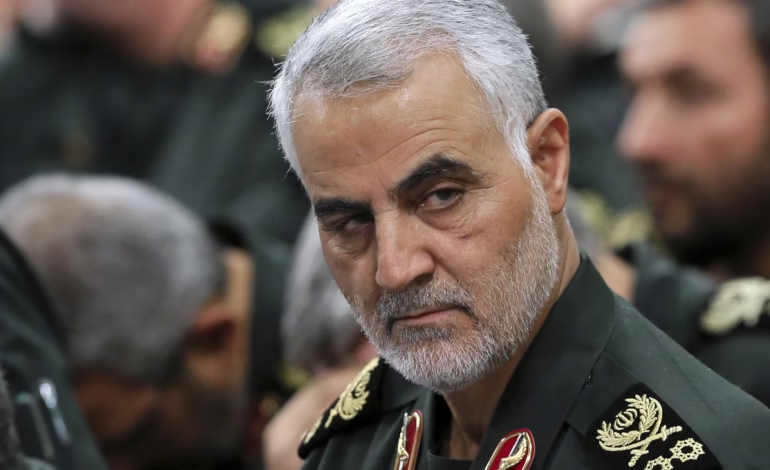

A High-Profile Arrest That Shocked Washington
On the night of April 3, 2026, federal immigration agents descended on a Los Angeles residence and arrested two women with a powerful, controversial connection: they are the niece and grand-niece of Qasem Soleimani — the most feared Iranian military commander of his generation.
Secretary of State Marco Rubio made the announcement the following morning. He had personally terminated the lawful permanent resident (LPR) status of Hamideh Soleimani Afshar and her daughter, Sarinasadat Hosseiny. Both are now in Immigration and Customs Enforcement (ICE) custody and are pending removal from the United States.
The move sent shockwaves across Washington, the Iranian diaspora community, and legal circles. It raised sharp questions about immigration law, free speech, national security — and just how far the Trump administration will go in its confrontation with Tehran.
| What happened to Soleimani’s niece?
Secretary of State Marco Rubio revoked the green cards of Hamideh Soleimani Afshar (niece of deceased IRGC Major General Qasem Soleimani) and her daughter on April 3, 2026. Both were arrested by ICE in Los Angeles and are pending deportation. The State Department cited Afshar’s public support for the Iranian regime, celebration of attacks on Americans, and alleged fraudulent asylum claims as grounds for terminating their lawful permanent resident status. |
Who Was Qasem Soleimani?
To understand why this arrest carries so much weight, you need to know who Soleimani was. Qasem Soleimani served as the commander of the Quds Force — the elite foreign operations branch of Iran’s Islamic Revolutionary Guard Corps (IRGC) — from 1998 until his death in 2020.
The IRGC is a U.S.-designated foreign terrorist organization. The Quds Force, which Soleimani led, was its most feared arm. It orchestrated proxy warfare across Iraq, Syria, Lebanon, Yemen, and Gaza. The U.S. government holds Soleimani responsible for the deaths of hundreds of American soldiers through the bomb networks and militia groups he commanded in Iraq.
On January 3, 2020, a U.S. drone strike near Baghdad International Airport killed Soleimani on direct orders from President Donald Trump. The killing triggered an enormous crisis: Iran fired ballistic missiles at U.S. bases in Iraq, and Iranian officials vowed revenge that, they said, would never end.
| Key Fact
The IRGC was designated a foreign terrorist organization by the U.S. State Department in April 2019 — the first time the U.S. had ever designated an arm of another country’s government as a terrorist group. |
Who Are Hamideh Soleimani Afshar and Her Daughter?
Hamideh Soleimani Afshar
Hamideh Soleimani Afshar is the niece of Qasem Soleimani. According to the Department of Homeland Security (DHS), she entered the United States on a tourist visa in June 2015. Four years later, in 2019, she was granted asylum. In 2021, under the Biden administration, she became a lawful permanent resident — a green card holder.
The State Department says she did not lay low. According to officials, she maintained an active Instagram account (now deleted) where she routinely promoted Iranian regime propaganda, celebrated attacks on American soldiers and military facilities in the Middle East, praised Iran’s Supreme Leader, and called the United States the ‘Great Satan.’ She was living, the statement said, a ‘lavish lifestyle’ in Los Angeles.
Sarinasadat Hosseiny (Her Daughter)
Her daughter, Sarinasadat Hosseiny, entered the U.S. on a student visa in July 2015, also received asylum in 2019, and became a green card holder in 2023. She is described as Soleimani’s grand-niece.
The Naturalization Application That Triggered Scrutiny
In July 2025, Hamideh Soleimani Afshar filed an application for U.S. citizenship — a naturalization application. That application required her to disclose her travel history. She admitted she had traveled to Iran at least four times since receiving her green card.
That admission was a red flag. She had originally been granted asylum on the grounds that she faced persecution in Iran. If she was traveling back to Iran voluntarily and repeatedly, DHS argued, her asylum claim was fraudulent from the start.
| DHS Statement (Paraphrased)
“Her trips to Iran illustrate her asylum claims were fraudulent. It is a privilege to be granted a green card to live in the United States of America. If we have reason to believe a green card holder poses a threat to the U.S., the green card will be revoked.” — DHS Assistant Director |
What Did the State Department Say?
The official announcement came from the State Department’s Office of the Spokesperson on April 4, 2026. In it, officials confirmed the arrest, explained the legal basis for the action, and placed it within the broader context of the Trump administration’s Iran policy.
Secretary Rubio also posted directly on X (formerly Twitter), personally taking credit for the decision. He wrote that he had terminated the legal status of both women and stated that the Trump Administration would not allow the country to become a home for foreign nationals who support anti-American terrorist regimes.
The State Department’s statement also noted that Afshar’s husband had been barred from entering the United States, meaning the entire immediate family unit has now been effectively shut out of the country.
How Did They Get Green Cards Under a Different Administration?
This is the question many observers are asking. How did the niece and grand-niece of one of America’s most wanted adversaries obtain asylum and permanent residence in the United States?
The short answer: they applied through legal immigration channels, and under the Biden administration’s policies, their applications were processed and approved. The asylum system is designed to protect individuals who claim a well-founded fear of persecution in their home country.
There is no evidence in the public record that their family connections to Soleimani were hidden. However, critics of the Biden-era approvals argue that the national security vetting process was inadequate. Supporters of the original approvals argue that family members of a dictator or military leader can, themselves, be at genuine risk — many such relatives have faced persecution by the very regimes their relatives led.
The Trump administration’s view is clear: regardless of how they obtained their status, their conduct in the U.S. — publicly supporting the IRGC, celebrating attacks on Americans, and making multiple undisclosed trips to Iran — retroactively exposed the fraudulent basis of their asylum claims.
Timeline of Key Events
| Date | Event |
| June 2015 | Hamideh Soleimani Afshar enters the U.S. on a tourist visa |
| July 2015 | Her daughter, Sarinasadat Hosseiny, enters the U.S. on a student visa |
| 2019 | Both mother and daughter are granted asylum in the United States |
| January 3, 2020 | Qasem Soleimani is killed in a U.S. drone strike near Baghdad |
| 2021 | Afshar receives a green card (LPR status) under the Biden administration |
| 2023 | Her daughter receives a green card under the Biden administration |
| July 2025 | Afshar files for naturalization, disclosing 4+ trips to Iran — raising fraud flags |
| Early April 2026 | Secretary Rubio terminates LPR status for Afshar and her daughter; husband banned |
| April 3, 2026 (Friday night) | ICE arrests both women at their Los Angeles residence |
| April 4, 2026 (Saturday) | Secretary Rubio publicly announces the arrests and revocations |
What Legal Authority Did Rubio Use?
The Secretary of State’s Power Over LPR Status
This is one of the more legally interesting aspects of the case. The Secretary of State has broad authority under U.S. immigration and foreign policy law to make national security-based determinations about immigration status. The Immigration and Nationality Act (INA) grants the executive branch significant discretion in these matters.
LPR status, while strong, is not unconditional. It can be revoked through removal proceedings. What is unusual here is the speed and the high-profile nature of the revocation — the Secretary of State personally announcing that he had terminated someone’s legal residency is not a routine occurrence.
The Asylum Fraud Angle
The strongest legal ground the administration appears to have is the alleged asylum fraud. If a person is granted asylum based on a fear of persecution in their home country, but is then discovered to have traveled back to that country multiple times voluntarily, it undermines the entire basis of the asylum claim.
Immigration courts have consistently held that voluntary return to a country of alleged persecution can constitute ‘firm resettlement’ or evidence that the fear of persecution was not genuine. This gives prosecutors and DHS officials strong legal footing to pursue removal.
| Legal Note
Revoking LPR status does not automatically result in deportation. The individuals are entitled to immigration court proceedings, where they can contest removal. However, pending those proceedings, they remain in ICE detention unless released on bond. |
The Broader Iran Immigration Crackdown
This case did not happen in a vacuum. It is part of a broader, systematic effort by the Trump administration to revoke immigration benefits from individuals with ties to the Iranian government or its affiliated terror organizations.
Fatemeh Ardeshir-Larijani Case
Earlier in April 2026, Secretary Rubio also terminated the legal status of Fatemeh Ardeshir-Larijani, the daughter of former Secretary of the Supreme National Security Council of Iran Ali Larijani, and her husband Seyed Kalantar Motamedi. Ardeshir-Larijani had been working as a physician at Emory University School of Medicine in Georgia. Both she and her husband have since left the United States and are permanently barred from re-entry.
UN Mission Visa Revocations
In late 2025, the State Department also revoked the visas of several Iranian diplomats and staff at Iran’s mission to the United Nations in New York. This is a more traditional diplomatic tool, but its use in combination with the green card revocations signals a coordinated strategy.
Wider Immigration Policy Context
The Soleimani arrest fits into the Trump administration’s second-term immigration posture, which has moved aggressively to halt certain visa processing and reexamine green card eligibility for individuals from countries viewed as national security risks — including Iran, China, Russia, and others.
| Target | Action Taken | Status |
| Hamideh Soleimani Afshar (Soleimani’s niece) | LPR status revoked, arrested by ICE | In ICE custody, pending removal |
| Sarinasadat Hosseiny (Soleimani’s grand-niece) | LPR status revoked, arrested by ICE | In ICE custody, pending removal |
| Afshar’s husband | Barred from entering the U.S. | Entry banned |
| Fatemeh Ardeshir-Larijani (Larijani’s daughter) | Legal status terminated | Deported, entry banned |
| Seyed Kalantar Motamedi (her husband) | Legal status terminated | Deported, entry banned |
| Iranian UN diplomats/staff | Visas revoked | Left U.S. |
Reactions and Controversy
Supporters of the Action
Conservative commentators and national security hawks have largely applauded the move. They argue that allowing relatives of a designated terrorist organization’s leadership to reside in the United States — while they publicly promote that organization’s propaganda — is a national security contradiction that should never have been permitted.
Laura Loomer, a far-right influencer and ally of President Trump, claimed on social media that she had personally reported Soleimani Afshar to the State Department, and publicly thanked Rubio for acting on the tip. A Change.org petition calling for Afshar’s deportation had reportedly gathered over 4,000 signatures before her arrest.
Civil Liberties Concerns
Legal experts and civil liberties advocates have raised significant concerns. The core question: Is promoting a viewpoint — even a repugnant one — enough legal basis to revoke a green card and deport someone?
The First Amendment generally protects speech, even political speech that is critical of the U.S. government or supportive of foreign governments. Critics argue that if the basis for deportation is primarily Afshar’s social media posts rather than any specific illegal act, the case raises profound free speech questions.
Al Jazeera noted that the case raises questions about the limits of free speech rights in the U.S. and the extent to which family members should be punished for their relations — as opposed to their own actions.
The Free Speech Debate
The Trump administration’s counter-argument is that this is not simply about speech. It is about the combination of: (1) alleged asylum fraud — repeatedly returning to the country one claimed to be fleeing; (2) active promotion of a U.S.-designated terrorist organization; and (3) a family connection to the leader of that organization. They argue this combination justifies removal regardless of any individual speech act.
What Happens Next: The Deportation Process
Being arrested by ICE and having LPR status revoked does not automatically mean immediate deportation. Here is what the legal process typically looks like:
- ICE Detention: The individuals are held in federal immigration detention, usually a contracted facility.
- Notice to Appear (NTA): ICE files formal charges with the immigration court, initiating removal proceedings.
- Immigration Court Hearings: The individuals have the right to appear before an immigration judge and contest removal. They can hire attorneys, present evidence, and argue their case.
- Appeals: If the immigration judge orders removal, the individuals can appeal to the Board of Immigration Appeals (BIA), and potentially to federal circuit courts.
- Final Order of Removal: If all appeals are exhausted, DHS executes the removal — deportation to Iran.
However, the process can be significantly shortened. If the individuals choose not to contest removal, deportation can happen within weeks. Given the political climate and the strength of the government’s fraud argument, some legal observers believe the case could move relatively quickly.
Key Legal Questions and Precedents
Can the Secretary of State Personally Revoke a Green Card?
Technically, the Secretary of State has authority over visa issuances and related consular functions. In practice, LPR revocations are handled through DHS and immigration courts. What appears to have happened here is that Rubio used his authority to determine these individuals were no longer eligible for their status, which then triggered DHS/ICE enforcement action. This is not without precedent, but doing it this publicly and at this level is highly unusual.
Does Asylum Fraud Override Other Protections?
If asylum was obtained fraudulently, it can be terminated. The immigration court has the power to terminate asylum status, which then removes the basis for the derived green card. This is a well-established legal path, and the multiple trips to Iran disclosed in the naturalization application provide DHS with solid documentary evidence.
Is There a Precedent for Revoking LPR Status Based on Political Speech?
This is the legally murkiest territory. There are historical precedents — including Cold War-era deportations of Communist Party members — that were later viewed as constitutional overreach. Courts have been inconsistent on this issue. The administration is careful to frame this as an asylum fraud case rather than a speech-based deportation, which is strategically sound legally.
People Also Ask: Frequently Asked Questions
Why did Rubio revoke Soleimani’s niece’s green card?
Secretary Rubio cited three main reasons: Afshar’s public promotion of Iranian regime propaganda and support for the IRGC (a designated terrorist organization); her celebration of attacks on American soldiers; and evidence of alleged asylum fraud, specifically that she traveled back to Iran multiple times after claiming she needed asylum to flee Iranian persecution.
Where is Soleimani’s niece now?
As of April 6, 2026, Hamideh Soleimani Afshar and her daughter Sarinasadat Hosseiny are in ICE custody, pending removal proceedings. They were arrested on April 3, 2026, in Los Angeles.
Was Soleimani’s niece a U.S. citizen?
No. She was a lawful permanent resident (green card holder), not a U.S. citizen. She had filed a naturalization application in July 2025, but that application appears to have been denied and the underlying LPR status has now been revoked.
What is an LPR and how can it be revoked?
LPR stands for Lawful Permanent Resident — commonly known as a green card holder. It allows foreign nationals to live and work in the United States indefinitely. It can be revoked through removal proceedings initiated by DHS if the holder is found to have obtained the status fraudulently, has committed certain crimes, or is determined to pose a national security threat.
What is the IRGC and why is it relevant?
The Islamic Revolutionary Guard Corps (IRGC) is a branch of Iran’s armed forces designated as a foreign terrorist organization by the U.S. State Department. Qasem Soleimani led its elite Quds Force. Publicly supporting a designated terrorist organization can be grounds for immigration consequences under U.S. law.
Has anything like this happened before?
The Ardeshir-Larijani case earlier in April 2026 is the most direct parallel. More broadly, the Trump administration has used immigration enforcement against individuals tied to foreign adversaries in several high-profile cases during its second term, including students and academics with alleged ties to foreign intelligence services.
Discover more from MatterDigest
Subscribe to get the latest posts sent to your email.