“Senator Murphy Drops 25th Amendment Bombshell on Trump”
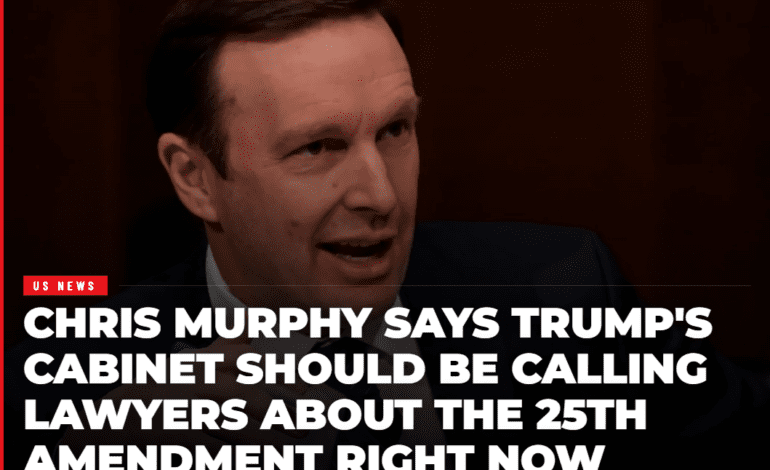

Senator Chris Murphy Says Trump’s Cabinet Should Be Calling Lawyers About the 25th Amendment Right Now — Here Is Why That Statement Matters
While most of the country observed Easter weekend, Senator Chris Murphy of Connecticut delivered a statement that landed like a thunderclap inside Washington’s political and legal circles. Murphy said publicly that if he were a member of Donald Trump’s Cabinet, he would be spending the holiday on the phone with constitutional lawyers — specifically about the 25th Amendment, the constitutional provision that allows the Cabinet to remove a president they deem unfit to carry out the duties of office. The senator’s message was direct and deliberate: in his assessment, the president’s recent behavior — including threats of mass destruction directed at adversaries, the purge of senior military generals, and what Murphy described as a pattern of conduct inconsistent with sound leadership — has raised questions about fitness for office that the Cabinet has a constitutional obligation to at least examine.
The statement did not come in isolation. It arrived in the middle of a week that had already seen the dismissal of General Randy George and more than a dozen other senior military commanders for refusing to support a proposed military action against Iran, the continued growth of the No Kings Day protest movement that has brought millions of Americans into the streets, and an ongoing public battle between the president and the federal courts processing legal challenges to his personal assets. Against that backdrop, Murphy’s invocation of the 25th Amendment was not a fringe constitutional argument. It was a serious political statement from a sitting U.S. senator about where the country stands and what the Constitution requires.
The question Murphy’s statement puts on the table is one that has been whispered in Washington for months and is now being asked out loud: Does the Cabinet have not just the legal authority but the moral duty to evaluate whether the president’s fitness for office has become a matter of constitutional concern?
What Is the 25th Amendment and How Does It Actually Work?
The 25th Amendment to the United States Constitution was ratified in 1967, following the assassination of President John F. Kennedy and the concerns it raised about the lack of clear procedures for presidential succession and the handling of presidential incapacity. The amendment established a formal framework for what happens when a president is unable to perform the duties of the office — whether temporarily or permanently, whether voluntarily or involuntarily.
The provision most relevant to Senator Murphy’s statement is Section 4 of the amendment — the most rarely discussed and most constitutionally dramatic of its provisions. Section 4 allows the vice president and a majority of the principal officers of the executive departments — in practical terms, the vice president and a majority of the Cabinet — to transmit a written declaration to Congress stating that the president is unable to discharge the powers and duties of the office. Upon that transmission, the vice president immediately assumes the powers and duties of the president as acting president.
The president can contest that declaration by sending his own written statement to Congress asserting that no inability exists. If the president does so, Congress has 21 days to vote on the question. A two-thirds majority in both the House and the Senate is required to sustain the Cabinet’s determination and keep the vice president in the acting role. If Congress does not reach that threshold, the president resumes the powers of the office.
Section 4 of the 25th Amendment has never been invoked against a sitting president. It was discussed during the final days of the Nixon administration and raised informally during both the first Trump term and the final months of the Biden presidency. Each time, it remained unused. What Murphy is suggesting is that the moment to take it seriously has arrived.
The word unable in Section 4 is deliberately broad. The amendment does not limit its application to physical incapacity or medical emergency. It covers any situation in which the president is unable to discharge the powers and duties of the office — a phrase that constitutional scholars have debated extensively without reaching consensus on its precise boundaries. That deliberate breadth reflects the founders’ understanding that the scenarios requiring this provision could not all be anticipated in advance and that a flexible standard was preferable to a rigid one.
What Murphy is arguing — implicitly but unmistakably — is that the pattern of behavior he has observed from President Trump in recent weeks falls within that broad concept of inability. Not medical inability, but something that he believes reasonable people in the Cabinet should at minimum be examining with legal expertise at hand.
What Specific Behavior Is Senator Murphy Pointing To as Evidence of Unfitness?
Murphy’s statement identified several specific categories of presidential behavior that he believes warrant serious concern — and that, in his assessment, should be prompting the Cabinet to seek legal counsel about their constitutional obligations.
The first and most alarming is what Murphy described as threats of mass destruction. The specific content and context of these threats has not been fully detailed in public reporting, but the reference appears to connect to statements made by the president in connection with the ongoing military confrontation involving Iran — statements that critics argue crossed lines that responsible national security communication does not cross. When a president makes public statements that suggest a willingness to use military force in ways that could result in mass casualties, the question of whether that willingness reflects sound judgment or something more concerning is one that the constitutional order provides specific mechanisms to address.
The second category is the military purge. The dismissal of General Randy George and more than a dozen other senior commanders for refusing to support a proposed invasion of Iran has been described by Murphy and other critics as an act that reflects not disciplined executive management of the military but something more troubling — a pattern of removing independent professional voices and replacing the institutional checks that the military’s senior leadership is supposed to provide with something closer to personal loyalty. That pattern, Murphy argues, is not consistent with the sound exercise of commander-in-chief authority.
The third category is broader — the overall pattern of conduct that Murphy believes adds up to a picture of a leader whose decision-making is driven by personal interest, personal grievance, and the consolidation of personal power rather than by the kind of measured, institutionally grounded judgment that the Constitution assumes when it vests enormous authority in a single executive.
Murphy’s argument is not that Trump has committed a specific impeachable act. It is that the pattern of his recent behavior — taken together, in the context of a potential military conflict, with the military leadership being purged and the courts being attacked — raises a question about fitness that the Cabinet has a duty to at least ask with legal expertise available.
The distinction between impeachment and the 25th Amendment is important here. Impeachment is a congressional process designed to address specific high crimes and misdemeanors — defined categories of conduct that rise to the level of requiring removal from office through a political accountability mechanism. The 25th Amendment is an executive process designed to address a different kind of problem: a president who may not have committed specific crimes but who is, for whatever reason, unable to fulfill the duties of the office. Murphy is invoking the second framework, not the first — suggesting that the question is not primarily about legal wrongdoing but about functional capacity.
Who Is Senator Chris Murphy and Why Is His Voice Significant on This Issue?
Chris Murphy is a Democratic senator from Connecticut who has served in the Senate since 2013 and in the House before that. He has built a national profile around several signature issues — most prominently gun violence prevention, where he played a central role in negotiating the Bipartisan Safer Communities Act in 2022, the most significant federal gun legislation passed in nearly three decades.
On foreign policy and national security, Murphy has positioned himself as one of the Senate’s more hawkish Democrats when it comes to challenging what he sees as reckless or impulsive presidential decision-making. He has been consistently critical of Trump’s foreign policy approach — particularly on questions involving the use of military force, the management of international alliances, and the appropriate relationship between civilian leadership and the military chain of command.
Murphy is not a figure known for impulsive or irresponsible statements. He is careful, policy-focused, and generally measured in his public communications. The fact that he chose Easter weekend — a period when major political statements are typically avoided — to raise the question of the 25th Amendment publicly is itself a signal about how seriously he believes the current moment should be taken. He was not making a casual comment or scoring a political point. He was making a deliberate intervention designed to move a specific question from the margins of political conversation to its center.
His statement has already accomplished that goal. Within hours of its circulation, the 25th Amendment was trending on social media, constitutional lawyers were being asked for their assessments by media outlets, and members of both parties were being pressed to respond to Murphy’s assertion that the Cabinet has a duty to at least consult legal expertise on the question of presidential fitness.
How Has the No Kings Movement Shaped the Political Context of Murphy’s Statement?
Murphy’s 25th Amendment statement did not arrive in a political vacuum. It arrived in the context of a No Kings Day protest movement that has grown from a social media hashtag into a genuine national civic mobilization — one that has brought millions of Americans into the streets across all 50 states and in dozens of countries around the world.
The No Kings movement, as covered extensively in recent weeks, is driven by a broad and ideologically diverse coalition of Americans who share a concern that the current direction of the Trump administration represents a dangerous accumulation of executive power — one that is eroding the checks and balances that the Constitution relies on to prevent any single person or branch of government from dominating the others.
Murphy’s invocation of the 25th Amendment fits naturally within that broader movement. The amendment is, at its core, one of the most powerful checks that the constitutional system has created against presidential excess — a mechanism by which the president’s own Cabinet can, if they conclude it is necessary, step in to protect the constitutional order. By suggesting that the Cabinet should at minimum be consulting lawyers about whether that mechanism is appropriate to consider, Murphy is aligning himself with the broader No Kings movement’s call for institutional accountability from within the executive branch itself.
The pressure on Cabinet secretaries to act as what Murphy called the final legal safeguard is directly connected to the reality that Congress — divided and constrained by partisan dynamics — has not mounted a sustained institutional challenge to the administration’s most controversial actions. If congressional oversight is insufficient to check executive overreach, and if the courts are being attacked as weaponized, then the Cabinet — the only other body with a specific constitutional role in evaluating presidential fitness — becomes the last internal mechanism available within the executive branch itself.
That is a heavy weight to place on a group of people who were appointed by the president they are being asked to evaluate. It is also the specific weight that the framers of the 25th Amendment chose to place there — because they understood that the people closest to the president are the ones best positioned to assess whether his capacity to govern has been compromised.
What Is the Cabinet’s Actual Legal Obligation Under the 25th Amendment?
Murphy’s statement raises a question that constitutional scholars have not fully resolved: Does the Cabinet have a legal obligation to actively consider invoking Section 4 of the 25th Amendment when circumstances raise genuine questions about presidential fitness, or is the decision entirely discretionary?
The answer, based on the text of the amendment and the available constitutional scholarship, is that the decision is discretionary — the amendment creates a power that the Cabinet may exercise, not a duty that it must exercise. There is no constitutional provision that requires Cabinet members to invoke Section 4, or even to formally evaluate whether to invoke it, in any specific set of circumstances. The decision is left entirely to the judgment of the vice president and the Cabinet members themselves.
But legal obligation and moral obligation are different things. Murphy’s statement is primarily a moral argument — a claim that the current circumstances are serious enough that the Cabinet has a duty to at least seek legal expertise and engage seriously with the question, even if the ultimate decision about whether to act remains entirely theirs. He is not arguing that the law requires them to act. He is arguing that the moment requires them to think seriously, with professional legal guidance, about whether their constitutional authority is being called upon.
Constitutional scholars who have commented on the 25th Amendment in recent years have noted that the provision has never been invoked against a sitting president precisely because the political barriers to doing so are so high. Cabinet members are political appointees who owe their positions to the president. Invoking Section 4 against the person who appointed you, in the face of that person’s likely furious opposition, requires a level of institutional courage that has historically been absent whenever the question has been raised.
Murphy’s statement is, among other things, a public challenge to the members of Trump’s Cabinet to demonstrate that kind of courage — or at least to demonstrate that they are taking their constitutional responsibilities seriously enough to seek legal advice about what those responsibilities require in the current moment.
What Are the Political Responses to Murphy’s 25th Amendment Statement?
The political responses to Murphy’s statement have been swift, predictable in their broad outlines, and genuinely revealing about where the lines of the current debate are drawn.
Republicans have largely dismissed the statement as partisan political theater — an attempt by a Democratic senator to use the constitutional machinery as a weapon against a president his party opposes. Trump’s allies have been more forceful, calling the suggestion dangerous, un-American, and a direct attack on the democratic will of the voters who elected Trump. The argument from this quarter is that the 25th Amendment was designed for situations of genuine physical incapacity and that applying it to political disagreements about a president’s judgment represents a fundamental distortion of its purpose.
Democrats have been more cautious than Murphy in their public responses. Some have expressed support for his willingness to raise the question. Others have been reluctant to fully endorse his specific framing, either because they believe the political moment is not right for this argument or because they have genuine reservations about the constitutional appropriateness of invoking the 25th Amendment in the current circumstances. The party is not speaking with one voice on this question — which itself reflects the genuine complexity of what Murphy has raised.
Constitutional scholars and legal analysts have offered the most substantive responses. The consensus among those who have commented publicly is that Murphy’s statement raises legitimate questions — particularly about the scope of the Cabinet’s constitutional responsibilities and the standard for what constitutes presidential inability — while also acknowledging that the political barriers to any actual invocation of Section 4 remain extremely high. The amendment is a serious constitutional tool. Using it would be an unprecedented and enormously consequential act. Whether the current circumstances meet the threshold for that act is a question on which reasonable and informed people genuinely disagree.
Key Takeaways: Murphy, the 25th Amendment, and the Cabinet’s Constitutional Moment
Senator Chris Murphy has publicly called on Trump’s Cabinet to consult constitutional lawyers about the 25th Amendment — arguing that the president’s recent behavior, including threats of mass destruction and the purge of senior military commanders, raises questions about fitness for office that the Cabinet has a duty to take seriously.
Section 4 of the 25th Amendment allows the vice president and a majority of the Cabinet to transmit a written declaration to Congress stating that the president is unable to discharge the duties of the office — immediately transferring power to the vice president as acting president, subject to congressional review.
The provision has never been invoked against a sitting president. The political barriers to doing so are extremely high, and the amendment creates a power that is discretionary rather than obligatory — the Cabinet may exercise it, but nothing in the Constitution requires them to do so in any specific circumstances.
Murphy’s statement arrives in the context of the No Kings movement, the Iran military standoff, the general purge at the Pentagon, and a broader public debate about whether the constitutional checks on executive power are functioning as the framers intended.
The question Murphy poses — whether the Cabinet has a moral duty to at least consult legal experts on presidential fitness — is one that constitutional scholars, political observers, and the American public are now debating with an intensity that reflects how seriously the current moment is being taken across the political spectrum.
Whether the Cabinet acts, declines to act, or simply remains silent will itself be a statement about where the lines of institutional accountability in the American constitutional order actually run — and whether the final safeguards built into the system are prepared to function when the moment demands it.
© 2026 Matter News. All rights reserved.
Discover more from MatterDigest
Subscribe to get the latest posts sent to your email.