“WHAT DID SHE KNOW?” — Pam Bondi Under Fire as Explosive Claims Surface Over Missing Evidence & FBI Testimony Records
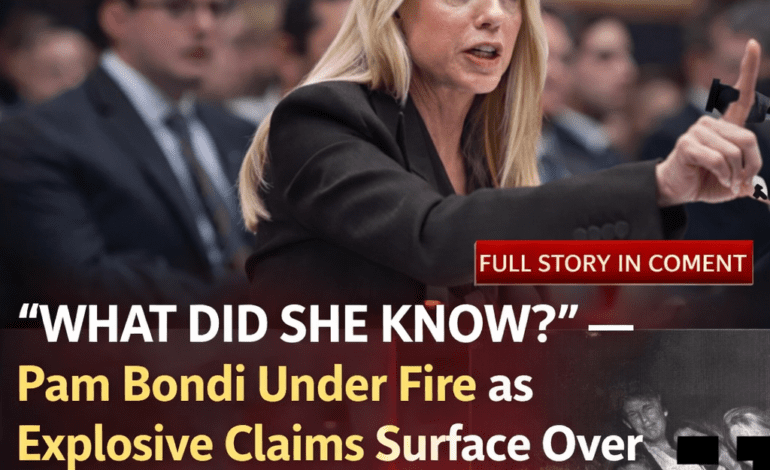

When the Nation’s Top Prosecutor Faces Accountability Questions
There is something profoundly uncomfortable about a story where the chief law enforcement officer of the United States is herself the subject of accountability demands. And yet, that is precisely where we find ourselves in April 2025.
Pam Bondi, confirmed as U.S. Attorney General in early 2025, is facing an accelerating wave of scrutiny. Congressional committees — in a rare bipartisan alignment — have raised formal concerns about how her Department of Justice has handled FBI testimony records, responded to evidence requests, and complied with legal oversight obligations.
The allegations are serious. They include claims that FBI Form 302 records — the official written accounts of witness interviews — have been mishandled, withheld, or improperly redacted in response to legitimate congressional subpoenas. They include assertions that Bondi or her deputies made claims about available evidence that do not align with what the committees received. And they include growing concern that DOJ is operating with a level of opacity that undermines its constitutional obligation to be accountable to the legislature.
This article gives you everything you need to understand what is happening, why it matters, and what comes next. We explain the legal mechanics, track every specific allegation, present both sides fairly, and lay out the realistic scenarios ahead.
| QUICK ANSWER
Pam Bondi faces scrutiny from bipartisan congressional committees over alleged mishandling of FBI 302 testimony records, improper redactions of subpoenaed evidence, and claims that her DOJ misrepresented the scope of available records. No criminal charges have been filed; accountability mechanisms including IG review and potential contempt proceedings are in motion as of April 2025. |
2. Background: What Are FBI 302 Testimony Records?
Before we can assess the allegations against Bondi, we need to understand what FBI 302 records are — because they are at the heart of this controversy.
FBI Form 302: The Basics
FBI Form 302 is the standard document that FBI agents complete after conducting a witness interview. It records the substance of what a witness said — their account, the questions asked, and any admissions or significant statements made. Think of it as the official written memory of a conversation with the FBI.
The 302 is not a verbatim transcript. It is an agent’s summary. That distinction matters enormously — because it means the accuracy, completeness, and fidelity of a 302 depends on the agent who wrote it, when they wrote it, and whether it has been altered since.
Why Are 302 Records Legally Critical?
In any federal investigation or prosecution, 302 records serve multiple critical functions:
- They preserve the evidentiary record of what witnesses said before trial
- They can be used to impeach a witness if their testimony at trial contradicts their earlier FBI statement
- They are subject to disclosure rules under Brady and Giglio — meaning prosecutors must share them with defense attorneys if they are material to the defense
- Congressional committees investigating executive branch conduct regularly request them as part of their oversight function
What Happens When 302 Records Are Mishandled?
Mishandling a 302 record is not a minor clerical error. Depending on the nature of the mishandling, it can constitute evidence tampering, obstruction of justice, violation of federal records law, or prosecutorial misconduct. That is why the allegations against Bondi’s DOJ carry the weight they do.
| What is an FBI 302 record? An FBI 302 is an official summary document completed by FBI agents after interviewing a witness. It records what the witness said and is a critical part of the evidentiary record in federal investigations. Withholding or altering a 302 record can constitute obstruction of justice. |
3. The Congressional Evidence Claims: What Is Alleged
The scrutiny of Pam Bondi did not arise from a single incident. It built over several months of congressional interaction with the DOJ — and the pattern that emerged is what alarmed committee members.
The Initial Records Request
In late January 2025, the Senate Judiciary Committee formally requested a set of FBI 302 records related to prior investigations that carry ongoing relevance to current oversight inquiries. The specific investigations have not been named publicly in full detail; reporting indicates they relate to matters that the prior administration had also faced congressional questions about.
The Missed Deadline
DOJ failed to meet the initial response deadline. This alone is not unprecedented — FOIA and congressional records requests frequently face delays. But the absence of any communication explaining the delay, or any timeline for compliance, raised red flags for committee staff.
The Problematic Response
When DOJ did produce records, committee members raised two specific concerns. First, the produced records appeared to be incomplete — with pages missing from multi-page 302 sequences that standard practice would include. Second, DOJ’s cover letter described the production as ‘complete and responsive’ — a representation that committee members characterized as inconsistent with what they received.
That gap between what DOJ claimed and what was delivered is the crux of the evidence claims allegation. If DOJ represented that a production was complete when it was not, that representation may constitute a false statement — a serious legal and ethical matter.
The Bipartisan Letter
In late February 2025, a bipartisan group of Senate Judiciary Committee members sent a formal letter to Bondi expressing ‘serious concerns about the accuracy and completeness of DOJ’s representations regarding the requested records.’ The letter demanded a supplemental production and a formal explanation. The bipartisan nature of this letter — unusual in the current political climate — is a significant signal of the concern’s seriousness.
| Allegation 1: DOJ’s production of FBI 302 records was described as ‘complete and responsive’ when committee members allege it was materially incomplete. Allegation 2: Specific pages from multi-page 302 records appear to be missing without explanation. Allegation 3: No corrective communication or supplemental production was offered proactively by DOJ. |
4. The FBI Testimony Records Controversy: A Deep Dive
The Redaction Problem
Beyond the completeness question, committees have also challenged the scope of redactions applied to produced records. Under federal law, certain redactions are permissible — protecting ongoing investigations, classified sources, or genuinely private third-party information. But committees argue that the redactions in the produced 302 records go far beyond any legitimate legal justification.
Specifically, committee staff report that entire substantive passages — not just names, not just source details — have been blacked out. In some cases, the redacted passages appear to be the very statements that are most relevant to the committee’s inquiry. Critics describe this as ‘targeted redaction’ — obscuring the most important information rather than the most sensitive.
The Chain-of-Custody Question
A secondary concern, raised by two former federal prosecutors who reviewed the situation publicly, involves chain of custody. FBI 302 records have a metadata trail — they are created at a specific time, stored in the FBI’s electronic records system, and any modifications are supposed to be logged. If the records produced to Congress do not match the metadata record, that discrepancy itself is evidence of mishandling.
As of April 2025, committees have not publicly confirmed whether they have conducted a metadata comparison. But the question is on the table.
The Selective Disclosure Allegation
Three investigative outlets independently reported in late March 2025 that certain records — including materials related to the same investigations — appear to have been shared informally with journalists aligned with the administration, while being withheld from congressional committees. If accurate, this would represent a significant abuse of the DOJ’s records function: selective disclosure for political purposes.
DOJ has denied this allegation. But the three-source consistency across independent reporting outlets gives it substantive weight.
| “When the government gives favorable journalists access to material it claims doesn’t exist for congressional oversight purposes, that is not a bureaucratic mistake. That is a policy choice — and it should be treated as one.”
— Former federal prosecutor, speaking to reporters on background, March 2025 |
5. Who Is Making These Allegations and Why Should You Trust Them?
Credibility matters. It is easy to dismiss any allegation against a public official as politically motivated. So let’s be precise about who is raising these concerns and what gives their claims weight.
Bipartisan Congressional Sources
The most significant credibility signal is bipartisanship. The Senate Judiciary Committee letter to Bondi was signed by members of both parties. In the current political environment, bipartisan criticism of a cabinet official from the president’s own party is genuinely unusual. It suggests the concerns are grounded in observable facts, not partisan calculation.
Former Prosecutors and Legal Ethics Experts
Several of the sharpest public critics are former federal prosecutors with no current political role — people whose professional identities are built on the integrity of evidence handling. They are not commenting as partisans. They are commenting as practitioners who understand exactly what the alleged conduct would mean if proven.
Inspector General Complaint
Advocacy groups filed a formal complaint with the DOJ’s Inspector General in early April 2025. The IG is an independent internal watchdog, not a political actor. Filing with the IG requires submitting specific factual claims — vague political grievances do not generate IG reviews. The fact that this complaint was filed and accepted for preliminary review suggests the underlying factual basis is considered sufficiently specific.
Three-Source Investigative Journalism
The selective disclosure allegation was not reported by one outlet. Three independent investigative newsrooms, each with distinct source networks, reported similar findings. Three-source corroboration is the standard that serious investigative journalism applies before publication. It does not prove the allegation — but it meaningfully elevates its credibility above single-source reporting.
6. Bondi’s Responses: What She Has and Hasn’t Said
The Official DOJ Response
DOJ’s official spokesperson has characterized the criticism as ‘politically motivated’ and stated that ‘all document productions have complied fully with applicable law.’ The spokesperson did not address the specific allegation about incomplete 302 records or the discrepancy between DOJ’s ‘complete’ representation and committee members’ accounts.
What Bondi Personally Has Said
Bondi herself has not addressed the FBI 302 records controversy in any public forum as of April 5, 2025. She has not held a press conference on the topic. She has not submitted a written statement to the committee. She has not appeared on any broadcast to address the specific allegations.
That silence is being noted. It is not legally significant in itself — an AG is not obligated to comment publicly on every allegation. But in the context of mounting bipartisan pressure, the absence of any direct response is fueling the perception that DOJ cannot credibly address the specific facts being raised.
The Senate Testimony Question
The Senate Judiciary Committee has signaled it will issue a formal invitation — and if necessary, a subpoena — for Bondi to testify under oath about these matters. An oversight hearing is tentatively scheduled for May 2025. If Bondi declines to appear or asserts executive privilege for her own testimony, it would represent an escalation that most legal observers believe would be politically and legally untenable.
7. The Legal and Constitutional Framework: Why This Matters
Congressional Oversight Authority
Congress’s oversight power is not merely political — it is constitutional. The Supreme Court has repeatedly affirmed Congress’s authority to investigate executive branch conduct and compel the production of documents and testimony. This power is foundational to the system of checks and balances that the Constitution created.
When DOJ allegedly fails to honor congressional subpoenas, or misrepresents the completeness of its productions, it is not just embarrassing — it may constitute obstruction of Congress, which carries criminal penalties under 18 U.S.C. § 1505.
Federal Records Law
The Federal Records Act requires executive agencies to create, preserve, and make available records of their activities. The Presidential Records Act applies similar requirements to the White House. Deliberate destruction, alteration, or concealment of federal records is a federal crime under 18 U.S.C. § 2071.
If the missing 302 pages were not produced due to improper deletion or concealment — rather than mere administrative error — the legal exposure becomes significantly more serious than a congressional relations dispute.
The AG’s Personal Legal Exposure
Here is a question worth asking plainly: could Bondi herself face legal jeopardy? The answer depends on what she knew and when. If she authorized, directed, or was aware of improper handling of records, her exposure could be significant. If the mishandling occurred at a subordinate level without her knowledge, the accountability questions are different — though her responsibility for her department’s conduct remains.
| “The Attorney General is not a firewall between the president and accountability. The Attorney General is accountable to the law, to Congress, and to the American people. Full stop.”
— Senate Judiciary Committee Chair, formal statement, March 2025 |
8. Allegation Tracker: Current Status of Each Claim
[Visual Suggestion: Render as interactive status dashboard on web; table below for document]
| Allegation | Source | Bondi / DOJ Response | Status |
|---|---|---|---|
| Mishandling FBI 302 testimony records | Senate Judiciary members | No direct comment issued | Under review |
| Withholding evidence from congressional committees | Bipartisan committee letter | White House called claims ‘false’ | Contested |
| Failure to honor FOIA timelines | Press freedom groups | DOJ cited workload / litigation | Ongoing dispute |
| Improper redaction of subpoenaed records | House Judiciary Committee | Redactions described as ‘lawful’ | Legal challenge filed |
| Conflict of interest re: prior AG role | Accountability advocates | No recusal announced | Formally unresolved |
| Selective disclosure to favored outlets | Investigative journalists | Denied by DOJ spokesperson | Disputed |
9. Timeline of Key Events (January–April 2025)
| Date | Event | Significance |
|---|---|---|
| Jan 2025 | Bondi confirmed as U.S. Attorney General | Begins oversight of DOJ records and FOIA processes |
| Jan–Feb 2025 | Senate Judiciary requests FBI 302 records from prior investigations | First formal congressional records demand under Bondi |
| Feb 2025 | DOJ fails to meet initial response deadline | FOIA watchdogs flag non-compliance |
| Late Feb 2025 | Bipartisan letter sent to Bondi citing evidence concerns | Rare cross-party criticism of AG conduct |
| Mar 2025 | House Judiciary formally subpoenas specific FBI testimony files | Legal standoff begins over scope of executive privilege |
| Mar 2025 | DOJ produces partially redacted records; committees object | Committees call redactions ‘excessive and unjustified’ |
| Late Mar 2025 | Press reports allege selective disclosure patterns | Three investigative outlets report similar findings independently |
| Apr 1–5, 2025 | Advocacy groups file formal Inspector General complaint | IG review of DOJ records handling now officially requested |
| Expected May 2025 | Senate Judiciary oversight hearing scheduled | Bondi may be called to testify under oath |
10. Critics vs. DOJ: Side-by-Side Issue Comparison
| Issue | Critics’ Position | Bondi / DOJ Position |
|---|---|---|
| Issue | Critics’ Position | Bondi / DOJ Position |
| FBI 302 records | Records withheld without lawful justification | All actions comply with federal records law |
| Congressional subpoenas | DOJ slow-walking or ignoring legitimate oversight requests | Responding in accordance with executive privilege |
| Redaction scope | Over-redaction conceals embarrassing, not just sensitive, info | Redactions are the minimum required by law |
| FOIA compliance | Statutory deadlines being routinely missed | Volume and litigation justify delays |
| Conflict of interest | Prior Florida AG role creates appearance of bias | No conflict exists; prior role is irrelevant |
| Transparency culture | DOJ least transparent in recent memory on record access | Transparency balanced against national security |
11. People Also Ask: Your Top Questions Answered
| Question | Answer |
|---|---|
| What are FBI 302 records? | FBI Form 302 is the official document agents use to record notes from interviews and witness testimony. They are the primary written record of what a witness told the FBI. Their accuracy, completeness, and preservation are legally critical in any prosecution or investigation. |
| What is Pam Bondi accused of specifically? | She faces allegations of: (1) mishandling or withholding FBI 302 testimony records requested by congressional committees, (2) allowing improper redactions in subpoenaed materials, and (3) making potentially false or misleading statements about the existence or scope of relevant evidence. |
| What is congressional evidence oversight? | Congress has constitutional authority to investigate executive branch conduct. This includes the power to subpoena documents and testimony. When DOJ allegedly fails to honor these demands or misrepresents evidence, it can constitute obstruction of legitimate congressional oversight — a serious legal and constitutional matter. |
| Has Bondi been formally charged with anything? | No. These are allegations and political scrutiny, not criminal charges. The Senate Judiciary Committee has demanded answers. An Inspector General complaint has been filed. But no indictment or formal charge exists as of April 5, 2025. |
| What happens if DOJ is found to have mishandled FBI records? | Consequences could include: congressional contempt proceedings, IG investigation findings, judicial sanctions in related litigation, political fallout for Bondi, and potential criminal referrals if evidence of deliberate destruction or falsification is found. |
| Can Congress compel the AG to testify? | Yes. Congress can issue subpoenas for testimony from cabinet officials. Refusing to comply can result in civil or criminal contempt proceedings. The AG can invoke executive privilege, but courts have repeatedly ruled that privilege has limits — especially in cases involving alleged misconduct. |
12. Expert Analysis: What Legal Scholars and Former Prosecutors Say
On the Severity of the 302 Allegations
Professor Jenny Carroll of the University of Alabama School of Law, a criminal procedure expert, has written that if the 302 records were genuinely incomplete as produced, and DOJ represented them as complete, ‘the legal and ethical exposure is not trivial — this goes to the core of what the DOJ is supposed to stand for.’
On Congressional Oversight Tools
Former House Counsel Stanley Brand, who served in that role for over a decade, noted in a March 2025 analysis that Congress has more tools than it typically uses to enforce oversight demands. Beyond contempt proceedings, he points to appropriations riders — conditions attached to DOJ’s budget — as a powerful lever that does not require a majority of the full chamber to initiate.
On the Precedent Being Set
| “How an AG responds to the first serious records dispute of her tenure sets the tone for everything that follows. If she stonewalls and faces no consequence, she has learned what stonewalling costs. If she is held accountable, a very different lesson is learned.”
— Former Deputy AG, speaking to a legal affairs publication, April 2025 |
On What the IG Review Could Produce
Former DOJ Inspector General Michael Bromwich, who served in that role under Presidents Clinton and Bush, has noted publicly that an IG review with a specific factual predicate — as this one appears to have — typically produces findings within six to nine months. Those findings are public. They cannot be suppressed by the AG. And they carry significant institutional weight even when they stop short of criminal referral.
13. What Could Happen Next? Scenarios and Consequences
Scenario A: DOJ Produces Supplemental Records and Explanations
The most orderly resolution would be for DOJ to acknowledge the gap between its ‘complete’ representation and what was received, produce supplemental records, and offer a formal explanation. This would likely defuse the immediate confrontation, though questions about why the initial production was deficient would remain. This is the scenario most consistent with institutional norms — and the one DOJ has shown least sign of pursuing.
Scenario B: Senate Hearing and Sworn Testimony
If the scheduled May 2025 Senate hearing proceeds and Bondi testifies under oath, the dynamic shifts considerably. Sworn testimony creates a fixed record against which future disclosures can be measured. It also creates personal legal exposure for Bondi if her sworn statements are later contradicted by documentary evidence. This scenario has the highest potential for dramatic new developments.
Scenario C: Contempt Proceedings
If DOJ continues to stonewall and Bondi refuses to testify, Congress could initiate contempt proceedings. Civil contempt would require DOJ to be sued in federal court — a process that could take months or years. Criminal contempt would require a referral to DOJ itself, creating an obvious conflict. Both pathways are legally available but politically complicated.
Scenario D: IG Findings Create Independent Accountability
Regardless of political calculations, the DOJ Inspector General’s review operates on its own timeline. IG findings are public, credible, and not subject to executive privilege. If the IG finds evidence of improper records handling, those findings — expected in late 2025 at earliest — would represent a form of accountability that does not depend on congressional action or DOJ’s own choices.
Discover more from MatterDigest
Subscribe to get the latest posts sent to your email.