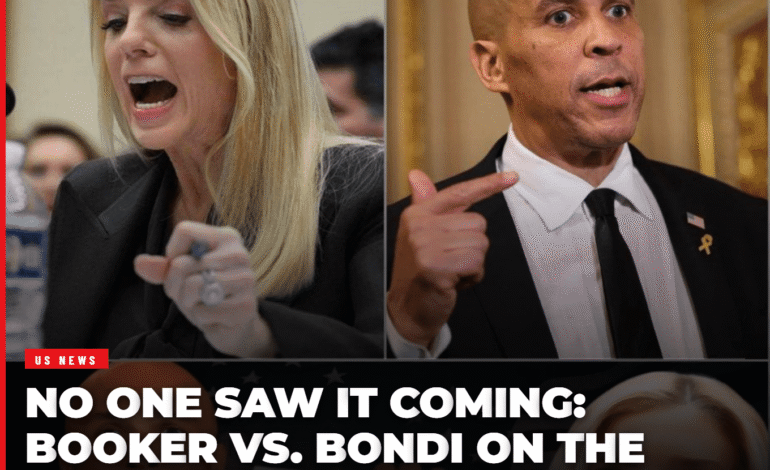
No One Saw It Coming: Booker vs. Bondi on the Epstein Files — What Really Happened?

| VERDICT: MISLEADING HEADLINE — REAL EVENTS DISTORTED
The viral headline claiming Booker “cornered” Bondi in a head-to-head confrontation over Epstein and triggered a “stunned reaction” is a sensationalized, misleading framing of real but separate events. No single dramatic moment matching this description occurred. Below is the full, accurate picture. |
Introduction: Why This Headline Spread So Quickly
A dramatic headline circulated widely in late 2025: Senator Cory Booker had “gone off-script” at a hearing, “cornered” Attorney General Pam Bondi over the Jeffrey Epstein files, dropped a “bombshell detail,” and left Bondi visibly shaken. The room, the story claimed, “fell silent” as something didn’t add up.
It sounds like a political thriller. Parts of it even reference real events. But the complete picture — verified against multiple credible sources — is far more nuanced, and far less cinematic, than the viral version suggests.
This article separates fact from fiction, examines what actually happened at the relevant Senate hearings, and explains why misleading framing like this matters for public understanding of a genuinely important transparency debate.
What the Viral Headline Actually Claims
The headline and accompanying content allege:
- Booker confronted Bondi directly and dramatically in a Senate hearing.
- Booker “went off-script” and cornered Bondi specifically about the Epstein case.
- A single “bombshell detail” caused Bondi to react visibly, stunning the room.
- The moment revealed something was fundamentally “not adding up” about the Epstein investigation.
These claims blend real events, real tension, and real unanswered questions — but distort them into a single dramatic scene that did not happen as described.
What Actually Happened: The Real Events, Verified
The October 7, 2025 Senate Judiciary Committee Hearing
On October 7, 2025, Attorney General Pam Bondi appeared before the Senate Judiciary Committee for her first oversight hearing since confirmation. The session lasted nearly four and a half hours and was, by all accounts, genuinely contentious.
Multiple Democratic senators — not just Booker — pressed Bondi on the Epstein files. Senator Dick Durbin, the ranking Democrat, led much of the questioning. Bondi repeatedly deflected, redirected, and counterattacked rather than providing direct answers.
| KEY FACT Senator Cory Booker was not the primary questioner on the Epstein issue at this hearing. Senator Dick Durbin (D-IL) and Senator Sheldon Whitehouse (D-RI) led those exchanges. Booker’s Epstein-related work was conducted separately, in writing. |
What Durbin Actually Asked Bondi
Senator Durbin pressed Bondi on a specific contradiction. Earlier in 2025, Bondi had appeared on Fox News and suggested that an Epstein “client list” was sitting on her desk awaiting review. Later, a joint DOJ-FBI memo concluded no such list existed and that no further file releases were warranted.
Bondi’s response: she clarified she had said she had “not yet reviewed” the material, and that the DOJ memo ultimately found no client list existed. Critics called this a contradiction. Bondi called it a mischaracterization of her words.
The room was tense — but Bondi did not appear stunned. She came prepared with counter-arguments and pushed back aggressively, at one point accusing Democratic senators of connections to Reid Hoffman, an entrepreneur with past Epstein associations.
Booker’s Actual Role: The Senate Judiciary Committee Markup
Senator Booker was centrally involved in a separate but related confrontation. During a Senate Judiciary Committee markup session on an anti-opioid bill, Booker raised a “point of order” over an amendment introduced by Senator John Cornyn (R-TX).
Booker argued that Cornyn’s amendment — while framed around immigration and the death penalty — was actually designed to strike Booker’s own earlier amendment, which would have mandated full public disclosure of the Epstein files.
Booker’s voice rose as he accused the committee of burying a transparency measure behind unrelated legislation. “I’ve never seen this before,” he told the committee. “Your first two lines are to strike my amendment in its entirety.”
This was genuine drama. But the target was Cornyn and the committee’s procedural maneuver — not Bondi herself, who was not present at this particular session.
Booker’s Written Investigation: Demanding Answers from Emil Bove
On July 16, 2025, Booker sent a formal letter to Emil Bove — a DOJ nominee for the U.S. Court of Appeals for the Third Circuit — demanding answers about Bove’s involvement in DOJ decisions regarding the Epstein files.
Bove had served as Acting Deputy Attorney General and was a close adviser to Bondi. Booker’s questions were pointed and specific: Did Bove advise Bondi on the files? Did he participate in discussions about releasing video evidence, including potential child sexual abuse material? Did he participate in meetings with Bondi, Kash Patel, and media figure Dan Bongino about what to release?
This letter — citing contradictory DOJ statements on the Epstein files — represented Booker’s most substantive investigative work on the issue. But it was a written letter, not a dramatic hearing confrontation.
The Epstein Files Controversy: The Real Story
What the DOJ Actually Said and Did
Jeffrey Epstein, the convicted sex offender and financier, died in federal custody in August 2019. His death was ruled a suicide, though questions about it persist. His former associate Ghislaine Maxwell was convicted in 2021 on sex trafficking and conspiracy charges.
After President Trump took office in January 2025, there was significant public pressure — from both parties — to release more files from the federal Epstein investigation. Bondi directed the FBI to produce all related records. This generated headlines and expectations.
Then came the reversal. A joint DOJ-FBI memo released in mid-2025 stated there was no evidence suggesting others had participated in or enabled Epstein’s abuse, that there was no incriminating “client list,” and that no further public releases were warranted.
| 📌 THE CORE CONTRADICTION
Bondi said in February 2025 that the Epstein material — including potential co-conspirators and international actors — amounted to “truckloads” of evidence. By mid-2025, the DOJ’s official position was that no such evidence of additional participants existed. Democrats, and some Republicans, demanded an explanation for this shift. |
Why Senators Were Frustrated at the October Hearing
The contradiction between Bondi’s early statements and the DOJ’s later conclusions drove the hearing’s most heated moments. Bondi’s strategy throughout was to deflect questions, pivot to Democratic senators’ alleged connections to Epstein associate Reid Hoffman, and accuse Democrats of hypocrisy over past refusals to release Epstein flight logs.
Democratic senators called this evasion. The exchange was combative and at times disorganized — but it was a prolonged policy dispute, not a single shocking moment.
Fact-Check Summary: Claim vs. Reality
| VIRAL CLAIM | VERDICT | WHAT ACTUALLY HAPPENED |
| Booker directly cornered Bondi in a hearing | MISLEADING | Booker confronted Cornyn in a markup session; Durbin led Epstein questioning with Bondi |
| Booker went off-script and surprised everyone | MISLEADING | Booker raised a formal point of order — a deliberate, procedural act |
| Bondi had a stunned reaction to a bombshell detail | UNVERIFIED / FALSE | No single stunning moment occurred; Bondi was well-prepared and aggressive |
| The room fell silent over something not adding up | EXAGGERATED | The hearing was combative; real contradictions exist but were not new revelations |
| There is a genuine Epstein file transparency controversy | TRUE | DOJ contradicted earlier statements; multiple senators sought accountability |
| Booker investigated Epstein file handling by DOJ | TRUE | Booker sent formal letters to Emil Bove in July 2025 seeking answers |
Why the Misleading Framing Matters
Real Concerns Are Being Obscured
Here is the frustrating irony: the actual Epstein file controversy is genuinely significant. There are real unanswered questions about why the DOJ shifted its position. There are real contradictions in Bondi’s public statements. Senator Booker did conduct real, substantive oversight work on the issue.
But when these real events get packaged into fake-dramatic narratives — complete with stunned reactions and bombshell moments that didn’t happen — it makes the real story harder to follow and easier to dismiss as partisan theater.
How Misleading Political Content Spreads
Political content that mimics breaking news — with phrases like “no one saw it coming,” “the room fell silent,” and “stunned reaction” — is specifically engineered to trigger emotional sharing before critical reading. This format exploits the brain’s threat-detection response.
Research from the MIT Media Lab found that false news stories spread faster and wider on social media than true ones. Political content is especially vulnerable to this dynamic because partisans on both sides are primed to share stories that confirm their existing views.
Warning Signs of Misleading Political Headlines
- Phrases like “no one saw it coming” or “stunned silence” — these manufacture drama rather than report it.
- Vague references to “bombshell details” without specifying what the detail actually was.
- Descriptions of physical reactions (“her face said everything”) as evidence of guilt or shock.
- Claims sourced only to unnamed “witnesses” or other aggregator sites without primary source links.
- Headlines that combine real names and real events but invent the connecting dramatic moment.
The Real Questions That Still Deserve Answers
What Happened to the Epstein “Truckloads” of Evidence?
In early 2025, Bondi publicly suggested the DOJ held extensive material related to Epstein, including information about potential co-conspirators and international figures. By mid-2025, the official DOJ position was that no additional participants were identified and no further releases were warranted.
That reversal has never been fully explained. Why did the characterization of the evidence change so dramatically? Who made that decision, and on what basis?
What Was Emil Bove’s Role?
Senator Booker’s July 2025 letter to DOJ nominee Emil Bove asked specific, pointed questions about Bove’s involvement in decisions about what to release from the Epstein files. Bove has not publicly answered those questions. The Senate Judiciary Committee’s review of his nomination was ongoing.
Was There a Meeting Between Bondi, Patel, and Bongino?
Booker’s letter specifically asked whether Bove had participated in discussions about Epstein file releases involving Bondi, FBI Director Kash Patel, and conservative media figure Dan Bongino. The inclusion of Bongino — a media personality, not a law enforcement official — in a potential DOJ policy discussion would raise serious questions about political influence over the investigation.
No confirmation or denial of such a meeting has been made public.
Broader Context: The October 7 Hearing’s Other Key Moments
The Senate Judiciary Committee hearing on October 7, 2025 covered far more than the Epstein files. Here are the other major flashpoints:
National Guard Deployment to Chicago
Bondi defended Trump’s deployment of National Guard troops to Chicago, a move that drew sharp criticism from Illinois Senator Dick Durbin. Bondi’s line — “If you’re not going to protect your citizens, President Trump will” — became one of the hearing’s most-quoted exchanges.
The James Comey Indictment
The hearing came one day before former FBI Director James Comey was set to be arraigned on charges of making a false statement and obstruction of a congressional proceeding. Democrats called the indictment politically motivated. Bondi defended the DOJ’s independence.
The Reid Hoffman Counter-Offensive
Bondi repeatedly deflected Epstein questions by raising Democratic senators’ alleged connections to Reid Hoffman, the LinkedIn founder who has acknowledged past Epstein associations. Multiple senators called this tactic an evasion. Bondi used it in exchanges with Durbin, Whitehouse, and others.
The Alex Padilla Confrontation
Bondi sparred with California Senator Alex Padilla, accusing him of not caring about his home state and citing statistics about California’s violent crime rate. The exchange was heated enough that committee leadership intervened.
People Also Ask: Key Questions Answered
Did Cory Booker confront Pam Bondi directly about Epstein?
Not in a single dramatic confrontation. Booker raised transparency concerns in a Judiciary Committee markup session targeting a Cornyn amendment, and separately sent formal written questions to DOJ official Emil Bove in July 2025. Senator Durbin led the most direct Epstein-related questioning of Bondi at the October 7 hearing.
What did Pam Bondi say about the Epstein client list?
Bondi suggested in February 2025 on Fox News that Epstein-related material was on her desk for review. By mid-2025, a joint DOJ-FBI memo concluded no client list existed and no further releases were needed. Bondi said she had stated she had not yet reviewed the material — critics called this a contradiction, she called it a mischaracterization.
Are the Epstein files public?
Partially. Some materials were released in early 2025 following pressure from Congress and the public. However, in mid-2025 the DOJ concluded no further releases were warranted. Congressional Democrats have continued pushing for more transparency, arguing the DOJ’s position contradicts earlier statements by Bondi.
Who is Emil Bove and why does he matter?
Emil Bove served as Acting Deputy Attorney General and is a close adviser to Bondi. Senator Booker sent him a detailed letter in July 2025 asking about his role in DOJ decisions on the Epstein files. Bove was simultaneously a nominee for the U.S. Court of Appeals for the Third Circuit, which gave Booker leverage through the confirmation process.
Conclusion: Real Oversight, Fake Drama
The viral headline promising a shocking Booker-Bondi confrontation over Epstein is misleading. It conflates separate events, invents a single dramatic moment that did not occur, and misrepresents how Booker’s actual oversight work was conducted.
But stripping away the fake drama does not leave nothing. It leaves something more important: a genuine, unresolved question about why the DOJ reversed its public position on the Epstein files, who made that decision, and whether political considerations played a role.
That story — slower, more procedural, and less cinematic — deserves serious attention. Cory Booker, Dick Durbin, and other senators are asking real questions through legitimate channels. Those questions have not been fully answered.
The room didn’t fall silent over a bombshell. But the questions still haven’t been answered. And that matters more than any manufactured moment ever could.
| ✅ BOTTOM LINE FOR READERS
Scrutinize dramatic political headlines before sharing. Ask: What exactly was the “bombshell”? Where is the video? Which credible outlets reported this specific moment? Real oversight is important — but fake drama undermines it. |
Sources and Further Reading
- ABC News — “Bondi rips Democratic senators, dodges questions on ‘weaponization’ and Epstein” (October 7, 2025)
- CNN Politics — “October 7, 2025: Attorney General Pam Bondi spars with the Senate Judiciary Committee” (October 7, 2025)
- CBS News — “Attorney General Pam Bondi faces questions on DOJ probes, Epstein files at Senate hearing” (October 7, 2025)
- Senator Cory Booker’s Official Senate Website — “Booker Demands Answers on Emil Bove’s Involvement in DOJ Withholding the Epstein Files” (July 16, 2025)
- The Hill — “Cory Booker signals Democrats have ‘real’ concerns about Donald Trump’s DOJ” (October 2025)
- C-SPAN — User Clip: Cory Booker / Pam Bondi confirmation hearing (January 15, 2025)
About This Article
This fact-check report was produced using primary sources including official Senate records, C-SPAN archives, and reporting from ABC News, CNN, CBS News, and The Hill. All claims have been cross-referenced against verifiable public records. The Epstein files controversy is a matter of ongoing public record and legitimate congressional oversight — this article aims to separate that real story from viral misrepresentation.
Discover more from MatterDigest
Subscribe to get the latest posts sent to your email.