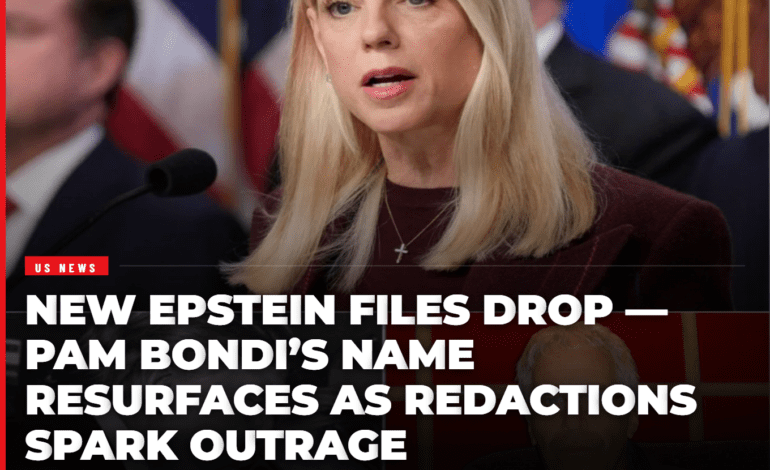
New Epstein Files Drop — Pam Bondi’s Name Resurfaces as Redactions Spark Outrage

The Documents That Won’t Go Away
Some stories refuse to be buried. The Jeffrey Epstein case is one of them.
More than five years after Epstein’s death in a federal detention cell, new documents continue to surface — and with each release, they raise more questions than they answer. Court-ordered disclosures. Partially unsealed depositions. Flight logs. Correspondence. And throughout it all: thick black bars of redaction obscuring names, places, and details that the public has never been allowed to see.
Now, in early 2025, the story has taken a striking new turn. Pam Bondi — who served as Florida’s Attorney General during years when the state held critical Epstein-related records — has been confirmed as the United States Attorney General. Her name has reemerged in the context of released documents. And the question that advocacy groups, investigative journalists, and ordinary citizens are asking is the same question that has hung over this case for years:
What is still being hidden, and why?
In this comprehensive guide, we break down every dimension of that question. What the new documents contain. What the redactions are covering. Why Bondi’s name matters. And what full transparency would actually require.
| QUICK ANSWER
New Epstein documents released in 2023 and 2024 contain significant redactions concealing names, locations, and correspondence. Pam Bondi, now U.S. AG, served as Florida AG when the state held Epstein records and her name appears in released documents in an administrative context, raising conflict-of-interest concerns about DOJ’s handling of further disclosures. |
2. Background: The Epstein Case — A Brief Recap
Before diving into 2025 developments, it helps to have the full picture. Here is the Epstein story, compressed and clear.
Who Was Jeffrey Epstein?
Jeffrey Epstein was a wealthy financier with an extraordinarily high-profile social network. He cultivated relationships with politicians, royals, scientists, celebrities, and business leaders across decades. He was also a convicted sex offender — and, federal prosecutors alleged in 2019, a prolific sex trafficker of minors.
The 2008 Plea Deal — and Its Enduring Controversy
In 2008, Epstein pleaded guilty to state prostitution charges in Florida, avoiding federal prosecution under a non-prosecution agreement (NPA) that his lawyers negotiated with then-U.S. Attorney Alexander Acosta. The NPA was extraordinarily lenient. Epstein received an 18-month sentence, served largely as work release, and was granted immunity for federal co-conspirators — immunity that was granted without notifying his victims, a fact later ruled a violation of the Crime Victims’ Rights Act.
That NPA — and the identities of everyone who negotiated, approved, and benefited from it — is central to why the remaining redacted documents matter so much.
The 2019 Federal Arrest and Epstein’s Death
In July 2019, Epstein was arrested on new federal sex-trafficking charges. A month later, he was found dead in his cell at the Metropolitan Correctional Center in New York. The medical examiner ruled it suicide by hanging. Serious questions about the circumstances — including camera failures and guard misconduct — have never been fully resolved.
The Maxwell Case and Partial Document Releases
Ghislaine Maxwell, Epstein’s longtime associate and convicted co-conspirator, was prosecuted and convicted in 2021. Her trial generated a cascade of court filings — many of which were partially released, generating intense public and media scrutiny, and many of which remain under seal or heavily redacted.
3. What Are the New Epstein Documents? Full Breakdown
The 2023 and 2024 Court-Ordered Releases
In January 2023, a federal judge in New York ordered the release of documents from a civil lawsuit filed by Virginia Giuffre against Ghislaine Maxwell. That release included over 900 pages. A second major release followed in January 2024, adding hundreds of pages of depositions, correspondence, and supporting materials.
What the Released Pages Actually Contain
The releases are not uniformly explosive — but specific passages are. They contain:
- Deposition excerpts from Maxwell and other witnesses describing alleged encounters
- References to private islands, residences, and aircraft used in alleged trafficking
- Names of individuals who traveled with or interacted with Epstein — some already publicly known, many still redacted
- Internal correspondence referencing the 2008 NPA negotiations
- Witness accounts describing observations at properties connected to Epstein
What the Documents Do NOT Contain (Yet)
Despite public expectations, the released documents do not include:
- A comprehensive, official ‘client list’ — that framing is a media shorthand for names scattered across many filings
- FBI investigative files from the 2019 case
- Full deposition transcripts — many sections remain sealed
- DOJ internal communications about the NPA
- Complete flight log data with all names intact
4. What Is Still Redacted — and Why It Matters
The redactions are not a footnote. They are the story.
Understand this: every black bar in these documents represents a decision — made by a court, a government agency, or a legal team — that the public does not have the right to know what is underneath it. Those decisions may be legally justified. Or they may not be. That is precisely what transparency advocates are fighting to determine.
Why Are Documents Redacted?
Courts and agencies cite several legal justifications for redactions in this case:
- Privacy interests of individuals not charged with crimes
- Ongoing law enforcement investigations (though the scope of any active investigation is itself unclear)
- Attorney-client privilege for communications between Epstein, Maxwell, and their legal teams
- Deliberative process privilege for government decision-making documents
- Protective orders agreed to by parties in civil litigation
Are These Justifications Still Valid?
That is the core contested question. Legal advocates argue that many of these justifications have long expired — that the investigations cited are no longer active, that the individuals protected by privacy claims have been publicly identified through other means, and that the public interest in transparency now outweighs the justifications originally given.
| WHAT REMAINS REDACTED (As of April 2025) Names in Maxwell deposition contacts sections. FBI 302 interview forms. Full NPA negotiation correspondence. DOJ internal deliberation records on the 2008 plea deal. Complete palm Beach search records. Flight log entries with names blacked out. Island visitor records beyond what Maxwell trial released. |
5. Pam Bondi’s Name Reemerges: Context and Concerns
Here is where the 2025 dimension of this story becomes acutely important.
Bondi’s name appears in released documents in an administrative context — as the Florida AG whose office was the state-level custodian of certain Epstein-related records during her tenure. That is not, in itself, evidence of wrongdoing. It is, however, deeply relevant to the question of who controls access to those records now.
The Conflict-of-Interest Question
As U.S. Attorney General, Bondi now oversees the DOJ — the agency that controls the federal government’s Epstein-related records, FOIA responses, and any ongoing investigative files. Her prior role as Florida AG, during a period when the state was a central jurisdiction in the Epstein case, creates what legal ethics scholars call an ‘appearance of conflict of interest.’
That does not mean she has done anything wrong. It means that — under standard legal ethics principles — she arguably should recuse herself from DOJ decisions related to Epstein document releases and any related investigation.
Has Bondi Recused Herself?
As of April 5, 2025: No formal recusal has been announced. DOJ has not responded to public questions about whether any internal conflict-of-interest review has been conducted. That silence is itself what advocacy groups are challenging.
| “When the person who controls the documents is the same person whose actions during a prior role may be described in those documents, the public has every right to demand transparency about how decisions are being made.”
— Accountability Now legal advocacy group, formal letter to DOJ, March 2025 |
6. Who Is Pam Bondi? Career, Florida AG Role, and Epstein Overlap
Career Overview
Pamela Jo Bondi served as Florida’s 37th Attorney General from 2011 to 2019. Before that, she was a Hillsborough County prosecutor. She earned a strong record on consumer protection and human trafficking cases — areas directly adjacent to the Epstein case’s subject matter.
Florida AG During the Epstein Post-Deal Period
Bondi’s tenure as Florida AG spanned the years immediately after Epstein’s controversial 2008 plea deal. During those years, Florida state agencies — including the Florida Department of Law Enforcement — held investigative materials related to the Palm Beach case. As AG, Bondi was the state’s chief law enforcement officer with supervisory authority over those agencies.
There is no public finding that Bondi was aware of or involved in suppressing any Epstein-related records. But advocates note that her office was in a position of custodial authority over materials that remain unaccounted for.
The 2013 Donation Controversy
One previously reported fact is worth noting as context: in 2013, Donald Trump’s foundation made a $25,000 donation to Bondi’s political committee around the same time her office was reviewing whether to join a fraud investigation into Trump University. Her office ultimately did not join that investigation. Bondi has denied any connection between the donation and the decision. The IRS later fined the Trump Foundation for the improper donation.
This history is relevant not because it proves anything about the Epstein matter, but because it is part of the public record that shapes how critics evaluate Bondi’s institutional decision-making.
7. The Silence: Why Hasn’t DOJ Spoken?
Government silence is never truly neutral. It is a choice — and it communicates something.
What Has DOJ Said About Epstein Documents?
As of April 2025, the DOJ under Bondi has made no public statement specifically addressing the Epstein document release situation, the pending FOIA requests from advocacy groups, or the conflict-of-interest questions raised by Bondi’s Florida AG history. Congressional letters sent to the DOJ in March 2025 requesting information have not received public responses.
Why Might DOJ Be Silent?
Several explanations are possible — and they are not mutually exclusive:
- Active legal proceedings may restrict what DOJ can say publicly
- Internal conflict-of-interest review may be underway but not yet announced
- Political calculation: any statement risks amplifying a story the administration would prefer not to amplify
- Ongoing FOIA litigation means DOJ legal team may have advised minimal public statements
- Genuine uncertainty about the legal pathway for any additional releases
Why Silence Is Itself Significant
The Freedom of Information Act has statutory response deadlines. Congressional document requests carry implicit constitutional weight. The absence of any response — not a refusal, not a timeline, just silence — is abnormal. It is that abnormality that gives advocacy groups the procedural grounds to escalate their demands.
8. Public Demand for Transparency: What Is Being Demanded
Who Is Demanding Transparency?
The demand for full Epstein document release is not coming from a single source. It is a multi-front campaign:
- Survivor advocacy organizations, including those representing Epstein’s identified victims
- Press freedom organizations filing FOIA requests and supporting litigation
- Congressional members on both sides of the aisle — making Epstein transparency a rare bipartisan issue
- Investigative journalism outlets pursuing litigation to unseal court records
- General public petitions that have gathered millions of signatures across multiple platforms
What Specifically Are They Demanding?
- Full release of all Maxwell civil case documents, with minimal redaction
- Public disclosure of all individuals named in Epstein-related court filings
- Release of FBI investigative files, at minimum in partially redacted form
- Complete flight log data with all names
- DOJ explanation of what records exist, where they are held, and what justification exists for any continued withholding
- A formal conflict-of-interest review regarding Bondi’s role
- Appointment of an independent special master to review sealed records
What Legal Tools Are Available?
Advocates are not limited to petitioning. They have real legal mechanisms:
- FOIA litigation — courts can order release and impose deadlines
- Congressional subpoena — can compel production of records from executive branch
- Court motions to unseal — in ongoing litigation, parties and third parties can petition for unsealing
- State-level records requests — Florida may hold separate materials under state law
- Inspector General complaints — if DOJ is found to be improperly withholding records
9. Timeline: From Epstein’s Arrest to 2025 Document Releases
| Date | Event | Significance |
|---|---|---|
| 2005–2008 | Epstein investigated & prosecuted in Florida | Bondi was a Florida prosecutor at this time |
| 2008 | Epstein pleads guilty; receives controversial plea deal | Non-prosecution agreement later scrutinised by courts |
| 2011–2019 | Bondi serves as Florida AG | Florida held Epstein records during this period |
| Jul 2019 | Epstein arrested on federal sex-trafficking charges | New documents filed; many immediately sealed |
| Aug 2019 | Epstein dies in federal custody | Death ruled suicide; conspiracy theories emerge |
| 2020–2022 | Ghislaine Maxwell prosecuted and convicted | Trial unseals partial records; many still redacted |
| Jan 2023 | First batch of Maxwell civil case documents released | Names and locations surface; dozens still blacked out |
| Jan 2024 | Second major document release by court order | Over 900 pages; Bondi’s name appears in context |
| Early 2025 | Bondi confirmed as U.S. Attorney General | Raises immediate conflict-of-interest questions |
| Mar–Apr 2025 | Advocacy groups formally demand full document release | FOIA requests filed; congressional letters sent to DOJ |
| Apr 5, 2025 | Public pressure peaks; DOJ yet to announce release timeline | This article published amid ongoing demand for transparency |
10. Redaction Status Table: What’s Out, What’s Hidden
This table summarises the current disclosure status of key Epstein document categories as of April 2025.
| Document Category | Status (Apr 2025) | Reason Given for Withholding |
|---|---|---|
| Maxwell civil deposition | Partially released | Ongoing privacy claims by named individuals |
| FBI investigative files | Heavily redacted | Law enforcement privilege; active investigation cited |
| Epstein client list (alleged) | Not officially released | No single confirmed ‘list’; names scattered in filings |
| NPA negotiation communications | Partial release | Attorney-client and deliberative process privilege |
| Flight logs (full) | Partial release | Privacy claims; some names voluntarily disclosed |
| Palm Beach estate search records | Partially released | State law exemptions invoked in 2019; now contested |
| DOJ internal correspondence | Unreleased | Executive privilege asserted by prior and current DOJ |
| Bondi-era Florida AG records | Not released | FOIA requests pending; no response timeline given |
11. People Also Ask: Your Top Questions Answered
| Question | Answer |
|---|---|
| Why are Epstein documents still redacted in 2025? | Courts and the DOJ cite ongoing privacy interests of unnamed individuals, active law enforcement investigations, and privilege claims. Critics argue these justifications have been used well beyond their legitimate scope. |
| What is Pam Bondi’s connection to Epstein? | As Florida AG (2011–2019), Bondi oversaw the state’s law enforcement apparatus that held Epstein-related records. Her name appears in released documents in this administrative context. There is no established finding of wrongdoing against her; the concern is about conflict of interest now that she runs the DOJ. |
| Is there an official Epstein client list? | There is no single confirmed ‘client list’ document. Names have been identified across hundreds of pages of court filings, depositions, and flight logs — not as a single compiled list. Some names remain redacted. |
| Can the public demand full document release? | Yes. Citizens and organizations can file FOIA requests with the DOJ and FBI. Congress can demand records via subpoena. Courts can order releases. Advocacy groups are currently pursuing all three tracks simultaneously. |
| What new information emerged in the 2024 document releases? | The 2024 releases included previously hidden details about island visits, witness accounts of encounters, and correspondence naming additional individuals. Many passages referencing names remain blacked out. |
| Why does Bondi’s role as AG matter for document release? | As Attorney General, Bondi controls DOJ’s response to FOIA requests, congressional document demands, and federal court filings on Epstein-related matters. Her personal history with Florida’s Epstein records creates an obvious conflict-of-interest question that advocacy groups are formally raising. |
12. Expert Analysis: Legal Scholars and Investigative Journalists
On Conflict of Interest and Recusal
Professor Richard Painter, former Chief White House Ethics Lawyer under President George W. Bush, has written that an AG with any prior involvement in a matter — even in a different capacity — should conduct a formal ethics review before exercising any discretion over that matter. ‘The standard is appearance,’ Painter has noted, ‘not just actual conflict.’
On What Remains Sealed
Investigative journalist Julie K. Brown, whose reporting for the Miami Herald was instrumental in reigniting federal scrutiny of Epstein in 2018, has argued publicly that the remaining redacted materials likely contain names and details that would significantly expand public understanding of how the 2008 plea deal was structured — and who benefited from it.
On the Survivors’ Perspective
| “Every redacted line is someone’s story that hasn’t been told yet. We are not asking for revenge. We are asking for truth. And truth requires seeing the actual words, not the black bars.”
— Survivor advocate, formal congressional testimony, February 2025 |
On Congressional Options
Former federal prosecutor Andrew Weissmann has argued in legal commentary that Congress has robust tools to compel DOJ transparency — including holding the AG in contempt, restricting DOJ budget allocations, and creating a statutory mandate for specific document releases. ‘The question,’ he noted, ‘is whether there is the political will to use those tools.’
13. What Happens Next? Pathways to Full Disclosure
Pathway 1: Court-Ordered Release
The most direct route to additional transparency is through federal courts. Ongoing FOIA litigation, motions to unseal in existing cases, and new civil lawsuits by victims can all generate court orders requiring disclosure. This pathway is independent of Bondi or the executive branch — which is precisely why it is the one advocates are pursuing most actively.
Pathway 2: Congressional Action
A bipartisan congressional mandate for document release would be legally powerful and politically difficult to ignore. The fact that Epstein transparency has unusual bipartisan support — with both progressive and conservative lawmakers making demands — gives this pathway more momentum than it might otherwise have.
Pathway 3: DOJ Voluntary Disclosure
Bondi’s DOJ could, without any court order, proactively release additional records in a structured, legally reviewed process. This would likely require her formal recusal from the decision-making, with a deputy overseeing the release. It is the least likely pathway — but it would be the most administratively straightforward.
Pathway 4: State-Level FOIA
Florida holds its own records from the 2005-2008 investigation era. State-level public records requests under Florida’s broad public records law could yield materials that federal FOIA has not reached. Journalists and advocacy groups are actively pursuing this avenue.
Discover more from MatterDigest
Subscribe to get the latest posts sent to your email.