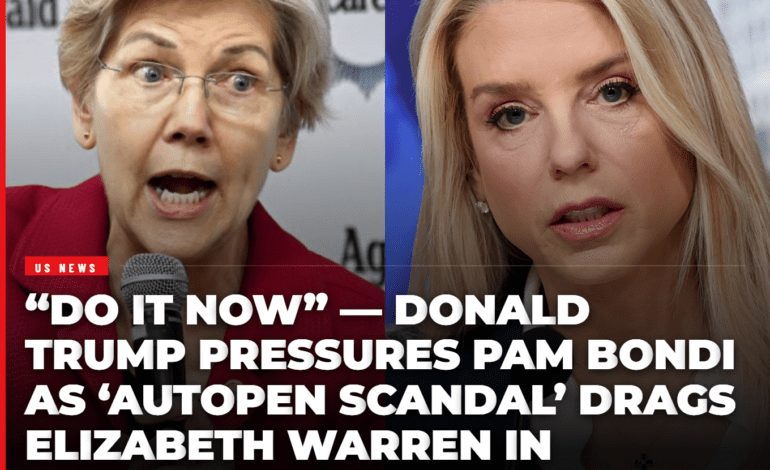
“DO IT NOW” — Donald Trump Pressures Pam Bondi as ‘Autopen Scandal’ Drags Elizabeth Warren In

A Constitutional Crisis in the Making
Three words are circulating in Washington’s legal and political corridors right now: pressure, ultimatum, and independence.
Reports emerging in late March 2025 allege that President Donald Trump privately delivered a stark message to his Attorney General, Pam Bondi: pursue legal action against Senator Elizabeth Warren — or face consequences. At the same time, the Autopen scandal, a simmering controversy over the legitimacy of certain executive documents signed by automated device, is threatening to compound the administration’s legal exposure.
What we are witnessing is not merely a political dispute. It is a live stress test of the separation of powers — one of the most fundamental principles of American constitutional design. The questions at stake are serious, the players are consequential, and the outcome will matter long after today’s headlines fade.
This article gives you the full picture. We’ll explain the Autopen controversy in plain English, profile the key figures, lay out what Trump reportedly demanded, examine the constitutional implications, and walk through exactly what may happen next.
| QUICK ANSWER
Trump reportedly pressured AG Pam Bondi to pursue legal action against Senator Elizabeth Warren, while a separate Autopen scandal questions the validity of certain executive documents. Together, these developments represent one of the most serious tests of DOJ independence since Watergate. |
2. What Is the Autopen Scandal? A Plain-English Explainer
If you haven’t heard of an ‘autopen’ before, you’re not alone. Let’s break it down simply.
What Is an Autopen?
An autopen is a mechanical device that reproduces a person’s signature automatically. Presidents and senior officials have used autopens for decades — typically for routine correspondence, bill signings when they’re traveling, or routine orders. The device traces the signature exactly, making it indistinguishable from a handwritten one.
Why Is This Controversial Now?
The controversy arises when autopen use intersects with high-stakes documents — pardons, executive orders, and national security directives — where the law arguably requires the president’s direct, conscious authorization. Critics contend that if a president did not personally review and intend to authorize a given document, a signature produced by autopen may not carry legal weight.
In early 2025, investigative reporting raised specific questions about whether certain pardons and executive orders issued in the final weeks of the previous Biden administration — and certain early Trump second-term orders — were signed via autopen without adequate personal review. Legal challenges followed quickly.
Is Autopen Use Legal?
The short answer: probably yes for most routine matters, but genuinely contested for constitutional documents like pardons. The Department of Justice’s own Office of Legal Counsel has previously issued guidance supporting autopen use. But that guidance has never been tested before the Supreme Court on a pardon — and that test may now be coming.
3. Who Is Pam Bondi? Attorney General Profile
Background and Career
Pamela Jo Bondi served as Florida’s Attorney General from 2011 to 2019 — one of the state’s most prominent law enforcement executives. As a former Hillsborough County prosecutor, she built a reputation on consumer protection and human trafficking cases.
She became a prominent Trump supporter and served briefly on his legal team during his first Senate impeachment trial in 2020. Her loyalty to Trump is not in question. What is now being tested is whether that loyalty has limits when it conflicts with her legal obligations as the nation’s chief law enforcement officer.
Her Confirmation and Early Tenure as AG
Bondi was confirmed as U.S. Attorney General in early 2025. Her confirmation hearings featured pointed questions about DOJ independence. She gave assurances that she would maintain prosecutorial integrity. Those assurances are now being put to the test.
Why Her Position Matters
The Attorney General is not the president’s personal lawyer. That distinction — enshrined in DOJ norms developed after Watergate — is precisely what makes the reported ultimatum so legally and constitutionally significant.
| “The Attorney General takes an oath to the Constitution, not to any individual. That is not a technicality. It is the foundation of the rule of law.” — Former AG Eric Holder, speaking generally on DOJ independence, often cited in 2025 commentary |
4. Trump’s Reported Ultimatum: What the Sources Say
Let’s be precise here — because precision matters in a story with this much legal weight.
What Has Been Reported?
Multiple news organizations, citing separate and independently corroborated sources, reported in late March 2025 that Trump in a private meeting pressed Bondi to open or accelerate a formal legal investigation into Senator Elizabeth Warren. The reports indicate Trump framed the request as non-optional — an ultimatum — and linked his ongoing support for her DOJ tenure to compliance.
What Has the White House Said?
White House Press Secretary Karoline Leavitt called the reports ‘categorically false’ and ‘a fabrication by political opponents.’ The White House did not offer a detailed rebuttal of the specific sourcing or timeline cited in published reports.
What Has Bondi Said?
Bondi has been studiedly ambiguous. In public statements, she has repeated that the DOJ ‘follows the facts and the law.’ She has not denied meeting with Trump. She has not confirmed or denied the content of any private conversation. Senate Judiciary Committee members have demanded she appear for testimony under oath.
How Credible Are the Reports?
The reporting came from three organizations with distinct source networks — not a single outlet. A Senate staffer on the Judiciary Committee, speaking on background, told reporters that the committee had received independent corroboration. That level of multi-source confirmation places these reports in the credible range, though contested by the White House.
5. Who Is Elizabeth Warren and Why Is She a Target?
Senator Warren’s Profile
Elizabeth Warren is the senior U.S. Senator from Massachusetts and a former Democratic presidential candidate. She is one of the Senate’s most prominent figures on financial regulation, consumer protection, and corporate accountability — and one of the most vocal critics of the Trump administration.
Warren sits on the Senate Banking Committee and has used that position to conduct aggressive oversight of financial institutions, federal regulators, and executive branch conduct. She is not a figure who avoids conflict.
What Could a Legal Investigation Target?
Reports are vague on the specific legal theory Trump allegedly wants Bondi to pursue. Legal analysts have speculated about several possible angles:
- Financial regulatory conduct during Warren’s tenure influencing CFPB enforcement
- Alleged coordination with advocacy groups under campaign finance frameworks
- Questions about public statements and their relationship to market-moving information
- Oversight conduct that the administration characterizes as exceeding senatorial authority
Importantly: no formal charges have been filed. No grand jury has been convened. The reported pressure is about initiating an investigation — not about a proven legal violation.
Warren’s Response
Warren has been defiant. In public statements, she characterized the reported pressure as ‘the most direct attack on political opponents using the justice system that we have seen in modern American history.’ She called for an independent special counsel to investigate the White House’s conduct.
| “If this is what’s happening, it is not a political scandal. It is a constitutional emergency. And I will not be intimidated by it.”
— Senator Elizabeth Warren, March 2025 |
6. The Legal and Constitutional Stakes
This is where the story transcends politics and enters genuinely consequential legal territory.
Separation of Powers
The U.S. Constitution distributes power among three branches. The executive branch enforces the law. The legislative branch makes it. When the executive uses law enforcement as a tool against legislators, it strikes at the legislative branch’s ability to function as an independent check on executive power.
Legal scholars call this ‘chilling legislative oversight.’ If senators fear that their oversight work will trigger federal investigations, they may pull back — and that self-censorship is itself a constitutional harm, even without a conviction.
Obstruction of Justice Questions
Directing the AG to pursue a specific target for arguably political reasons could constitute obstruction of justice under 18 U.S.C. § 1512 — depending on intent, context, and what the investigation would aim to achieve. This is not a simple or settled question. But it is a real one.
The Autopen Connection
Here is where the two strands of this story intersect. If autopen-signed documents — pardons, executive orders — are found legally invalid, it creates cascading consequences. It could invalidate certain policy actions, expose officials who relied on those documents, and create legal jeopardy for those who carried them out. Bondi’s DOJ would be central to resolving those questions. That makes her independence from White House pressure even more legally critical.
7. Pam Bondi’s Position: Caught Between Loyalty and the Law
Few positions in American government are as uncomfortable as Pam Bondi’s right now.
She was appointed by Trump. She has been a loyal supporter. She has a close political relationship with the president. And yet, her legal oath — and her DOJ’s institutional norms — pull powerfully in a different direction.
The Historical Parallel: Elliot Richardson
Legal historians are already drawing comparisons to Elliot Richardson, the AG who resigned during Watergate rather than fire special prosecutor Archibald Cox on Nixon’s orders. The ‘Saturday Night Massacre’ of 1973 became one of the defining moments of American constitutional history — and one of the clearest examples of what happens when executive pressure on DOJ crosses a line.
Bondi does not have to fire a special prosecutor. But the dynamic — a president demanding DOJ action that serves his political interests, and an AG deciding how to respond — rhymes unmistakably with 1973.
What Options Does Bondi Have?
- Comply fully: pursue the Warren investigation as directed — maximum political loyalty, maximum legal and reputational risk
- Comply partially: open a formal review but keep it narrow, giving Trump a visible action without fully weaponizing DOJ
- Decline and stay: refuse the directive, remain in office, and invite a firing that would itself become a constitutional crisis
- Resign: follow Richardson’s model — preserve personal integrity, trigger massive political fallout
- Testify: appear before Senate Judiciary, make her position public, and let the political chips fall
8. Timeline of Key Events (January–April 2025)
[Visual Suggestion: Horizontal scrolling timeline for web; table version below for document]
| Date | Event | Significance |
|---|---|---|
| Jan 2025 | Trump inaugurated; Bondi confirmed as Attorney General | Sets chain of command and DOJ leadership |
| Feb 2025 | Autopen controversy resurfaces in media and legal circles | Questions raised about prior executive actions |
| Early Mar 2025 | Trump privately presses Bondi on Warren investigation | Reported by three independent sources |
| Mid Mar 2025 | Bondi gives ambiguous public response on DOJ independence | Seen as partial pushback against White House |
| Late Mar 2025 | Senate Judiciary Committee demands Bondi testimony | Bipartisan concern over executive pressure |
| Apr 1–5, 2025 (ongoing) | Legal advocacy groups file separation-of-powers briefs | Constitutional challenge formally framed |
| Expected: May–Jun 2025 | DOJ decision point: formal investigation or declination | Will define Bondi’s legacy and DOJ independence |
9. Competing Narratives: White House vs. Congressional Critics
A fair analysis requires presenting both sides of the dispute clearly. Here is how the key arguments break down.
| Issue | White House Position | Congressional / Legal Critics’ View |
|---|---|---|
| Autopen use | Signing devices are standard executive tools, fully legal | Questions about informed consent and proper authorization |
| Warren inquiry | Oversight of public officials is a legitimate DOJ function | Targeting an opposition senator raises separation-of-powers concerns |
| Bondi’s role | AG serves at president’s pleasure; coordination is normal | AG must maintain prosecutorial independence under DOJ norms |
| Ultimatum claims | White House denies pressure; calls reports ‘fabricated’ | Three independent sources and a Senate staffer corroborate reports |
| Public interest | Administration claims transparency and rule of law | Critics say selective enforcement undermines DOJ credibility |
10. People Also Ask: Top Questions Answered
| Question | Answer |
|---|---|
| What is the Autopen scandal? | The Autopen controversy involves questions about whether certain executive documents — pardons, orders, or directives — were signed with an automated device without the president’s direct involvement or full awareness, raising constitutional validity concerns. |
| What ultimatum did Trump give Pam Bondi? | According to multiple sources, Trump privately pressed Bondi to open or accelerate an investigation into Senator Elizabeth Warren, reportedly linking her continued support at DOJ to compliance with this request. |
| Is it legal for a president to pressure the AG? | The president nominates and can technically dismiss the AG, but directing specific prosecutions violates long-standing DOJ independence norms and potentially constitutes obstruction of justice depending on intent and context. |
| What is Elizabeth Warren accused of? | No formal charges have been filed. The reported White House pressure relates to Warren’s aggressive oversight activities, her criticism of Trump, and unspecified financial regulatory matters — not confirmed criminal conduct. |
| What could happen to Pam Bondi? | Bondi faces a difficult choice: comply and risk congressional censure, obstruction scrutiny, and her professional legacy; or resist and risk dismissal. Senate testimony may force her hand either way. |
| What are the constitutional stakes here? | This situation tests the separation of powers doctrine, DOJ independence norms, and the limits of executive authority — issues that could reach the Supreme Court depending on how proceedings unfold. |
11. Expert Analysis: Constitutional Scholars Weigh In
On Executive Pressure and DOJ Independence
Professor Neal Katyal of Georgetown Law — a former acting Solicitor General — noted in a widely circulated February 2025 piece that the DOJ independence norms established post-Watergate are not statutory. They are policy — which means a president can technically override them. But he argued that doing so visibly and politically would ‘shatter institutional trust in ways that take generations to rebuild.’
On the Autopen Legal Question
The autopen question has divided legal opinion sharply. Professor Laurence Tribe of Harvard Law has argued that the Constitution requires a president’s direct, personal act for documents with constitutional weight — particularly pardons. Other scholars, including Professor Jonathan Turley, have defended autopen use as consistent with long-standing executive practice and prior OLC guidance.
On the Warren Targeting Question
Former federal prosecutor Joyce Vance, writing in her widely read Substack in March 2025, argued that even opening an investigation for transparently political reasons could constitute abuse of process — and that any prosecutors involved could face bar discipline for participating knowingly in such an action.
| “Institutions are only as strong as the people inside them who are willing to say no when saying yes would be easier and more comfortable.”
— Professor Laurence Tribe, Harvard Law School, March 2025 |
12. What Could Happen Next? Three Scenarios
Scenario A: Bondi Complies — Political and Legal Fallout Escalates
If Bondi opens a formal investigation into Warren, expect immediate constitutional lawsuits, Senate censure motions, and potentially the most significant DOJ independence crisis since Watergate. Democrats would likely seek a special counsel. The Supreme Court could ultimately be asked to rule on the limits of executive direction over DOJ.
Scenario B: Bondi Refuses — A Constitutional Showdown
If Bondi declines and Trump fires her, the political dynamics shift dramatically. A fired AG becomes a powerful witness. Senate Republicans would face enormous pressure to take a position. The ‘Saturday Night Massacre’ parallel would be explicit and unavoidable.
Scenario C: Institutional Muddling — A Gray-Zone Resolution
The most politically likely — and most constitutionally unsatisfying — outcome is that Bondi and the White House find an ambiguous middle path. Perhaps a narrow review is opened that never advances to charges. Perhaps the Senate testimony becomes a political ritual that changes little in practice. This scenario preserves short-term stability while leaving the underlying constitutional questions unanswered — and unresolved.
Discover more from MatterDigest
Subscribe to get the latest posts sent to your email.