Bolton Says Trump Is in “Panic Mode” After F-15 Shot Down
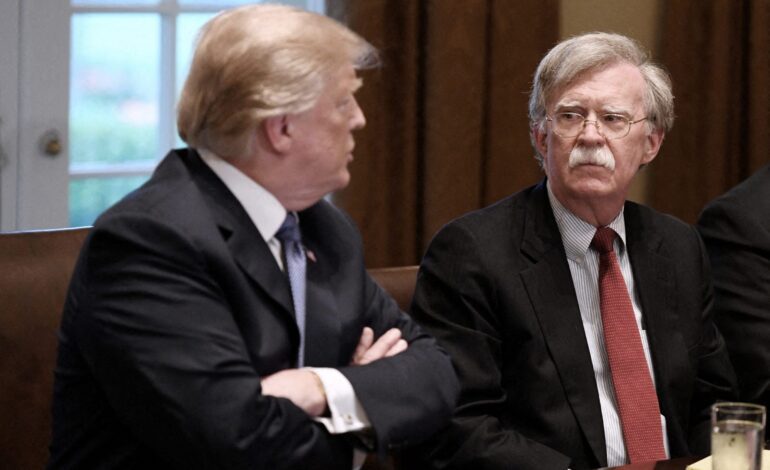

Bolton Says Trump Is in “Panic Mode” After F-15 Shot Down and Pilot Goes Missing in Iran — Here Is What We Know
Just days after President Donald Trump declared in a prime-time address that Operation Epic Fury was “nearing completion” and that the United States had Iran’s military “decimated,” the war took a dramatic and dangerous turn. Iran shot down an American F-15E Strike Eagle fighter jet over its airspace. One of the two crew members was rescued. The other is still missing — somewhere inside Iran — as search teams scramble to find him before Iranian forces do.
Almost immediately after news of the downed jet broke, one of the most recognizable voices in American national security stepped forward to offer a blunt assessment. John Bolton — former national security adviser to Trump, former U.S. ambassador to the United Nations, and one of Washington’s most hawkish foreign policy voices — went on CNN and said plainly that the president is “probably back in panic mode.”
Those words landed like a grenade in an already volatile political environment. Because Bolton is not a liberal critic of Trump. He is a conservative hawk who spent his career arguing for military strength and American dominance. When someone with that background says the president is panicking, the political weight of the statement is enormous.
This article breaks down exactly what happened, what Bolton said, what the White House is not saying, and why this moment matters so much for the direction of the war — and for Trump’s political future.
The Incident That Triggered Everything: Two Jets Down, One Pilot Missing
On Friday, April 4, 2026, Iran’s Islamic Revolutionary Guard Corps shot down an American F-15E Strike Eagle over Qeshm Island in the Strait of Hormuz. The two-person crew ejected. One crew member was recovered by U.S. search-and-rescue teams. The other is officially listed as missing in action inside Iranian territory.
Separately, Iran also claimed to have shot down an American A-10 Warthog ground-attack aircraft. The pilot of that plane made it to Kuwaiti airspace and was rescued. During the search-and-rescue effort for the F-15 crew, Iranian fire also struck a U.S. Army UH-60 Black Hawk helicopter and a second rescue helicopter. Both helicopters managed to escape, but the incidents show just how dangerous the search operation for the missing pilot has become.
Iranian state media immediately broadcast footage of what it claimed was wreckage from the F-15. Iranian state TV anchors called on civilians in the area to report the location of any American pilots. Tehran even offered a bounty for information leading to the capture of the crew.
The timing of all of this is what makes it so politically explosive. Just three days earlier — on Wednesday, April 1 — Trump had delivered his first prime-time national address on Operation Epic Fury. He told the American people the war was going well. He said U.S. objectives were “nearing completion.” He celebrated American air dominance. He had previously declared on March 19 that Iran’s anti-aircraft systems were gone and that U.S. planes were flying wherever they wanted with nobody even shooting at them. That statement came hours after a U.S. F-35 had actually been struck by Iranian fire.
What Bolton Said — and Why His Words Hit So Hard
John Bolton appeared on CNN with anchor Kaitlan Collins the night of April 4. He did not mince words.
When Collins asked whether Trump’s absence from public view following the jets being shot down was notable, Bolton responded without hesitation. He told her it sounds like the president is “probably back in a panic mode” — someone who is now desperately looking for a way to declare victory and exit the war, regardless of whether the core objectives have actually been achieved, including reopening the Strait of Hormuz.
Bolton also took direct aim at the credibility problem created by the White House’s pattern of overstating military progress. He said that when you brag publicly about what you have accomplished and then evidence surfaces showing those claims were exaggerated, you end up looking foolish — and in this case, the damage was self-inflicted by the White House, not caused by the Iranians.
He went further. Bolton argued that if Trump was unprepared for the possibility of setbacks in a war he chose to start, that is a leadership failure. In his words: if these concerns were raised before the war began and they bothered the president, he had the option not to start the attack. The fact that he apparently did not think through those scenarios before launching Operation Epic Fury is, Bolton said, a problem — not just for Trump, but for the entire country.
Bolton also addressed the missing pilot directly. He said that even if Iran captures the airman, it does not fundamentally change the course of the conflict. But it is, he acknowledged, a propaganda victory for Iran and a major test of American resolve. The question is whether the president and the White House are steady enough to handle it — or whether, as Bolton clearly implied, they are not.
The President’s Silence — And What It Signals
One of the most striking things about the hours following the F-15 shootdown was what the president did not do.
Trump did not appear on camera. He did not address the nation. He did not hold a press conference or take questions from reporters. The White House Press Secretary confirmed that the president had been briefed on the situation. But the only public communication from Trump himself came through Truth Social posts — one of which warned Iran that “time is running out” and threatened to bomb bridges and power plants.
In one of those posts, Trump appeared to confuse the word “rain” with “reign,” writing that “all Hell will reign down on them.” The typo drew attention, but the bigger issue was the tone of the posts overall. Rather than projecting calm confidence, they read as reactive and escalatory — exactly the opposite of what military analysts say is needed when a pilot is still missing in enemy territory.
For Bolton, the silence itself told a story. When a president disappears from public view at a moment of military crisis, it raises serious questions about the decision-making environment inside the White House. Is the situation being managed with clear strategy and calm leadership? Or is the administration in reactive mode, unsure of what to do next?
The Credibility Problem: What Trump Said vs. What Happened
To understand why Friday’s events hit the White House so hard, you need to look at the specific claims Trump and his team made before them.
On March 19, Trump publicly stated that Iran’s anti-aircraft equipment was gone and that U.S. planes were flying wherever they wanted with no one even shooting at them. That was not true. Hours after he made that statement, a U.S. F-35 was struck by Iranian fire — though that pilot managed an emergency landing outside Iranian borders.
Defense Secretary Pete Hegseth separately boasted that the U.S. had “dominated the skies” in Operation Epic Fury. That claim also looks very different in light of an F-15 being shot down over Iran’s airspace, an A-10 being struck, and a pilot currently missing on Iranian soil.
In his April 1 prime-time address, Trump declared that “the hard part is done” and that U.S. forces had achieved their core strategic objectives. Three days later, Iran shot down an American plane and took a U.S. pilot.
This pattern — of bold claims followed quickly by contradicting events — is exactly what Bolton was pointing to when he said the White House’s credibility has been degraded. And critically, he said that damage is self-inflicted. The administration did it to itself by overstating the situation repeatedly and publicly.
The Human Cost: What the Numbers Actually Show
Behind the political back-and-forth, there is a human cost to this war that has not received nearly enough attention.
Since Operation Epic Fury began on February 28, 2026, at least 13 U.S. service members have been confirmed killed. Six soldiers died in a drone strike in Kuwait. One was killed in Saudi Arabia at Prince Sultan Air Base. Six airmen died when a refueling tanker went down over friendly territory in Iraq. More than 300 additional U.S. troops have been wounded in action — a number that defense reporters have noted is being actively understated by official Pentagon statements.
Independent reporting by The Intercept found that U.S. Central Command has been sending outdated casualty numbers to the media — in one case providing figures that were three days old and did not include at least 15 additional troops wounded in a Friday attack on Prince Sultan Air Base in Saudi Arabia. A defense official described the situation to The Intercept as a “casualty cover-up.”
And beyond the American toll, the broader human picture is staggering. The Strait of Hormuz — through which roughly one-fifth of the world’s oil passes — remains effectively closed. Iran’s blockade has driven gas prices above four dollars a gallon in the United States. Global energy markets are in turmoil. Neighboring countries that had nothing to do with the conflict have seen their tankers attacked.
Who Is John Bolton — and Why Does His Opinion Matter Here?
John Bolton served as Trump’s national security adviser from April 2018 until September 2019, when Trump fired him. Since then, Bolton has been one of the most vocal Republican critics of the president — but his criticism comes from a specific and important place.
Bolton is not a dove. He is not someone who believes America should shy away from military force. Quite the opposite — throughout his long career, he has consistently argued for a more aggressive American posture in the world. He supported military action against Iran long before Trump launched Operation Epic Fury. He has been one of the most hawkish voices in mainstream American foreign policy for decades.
That background is exactly why his criticism of Trump’s handling of this war carries so much weight. He is not saying the United States should not have military objectives in Iran. He is saying that the way this operation has been planned, executed, and communicated to the American public reflects a fundamental failure of strategic thinking and leadership. When one of America’s most hawkish foreign policy voices says the president panicked, that is not a partisan attack. It is a professional judgment from someone who spent his career thinking about exactly these kinds of situations.
The Pentagon’s Casualty Problem: What Is Not Being Reported
One of the most troubling aspects of this war has been the management — or mismanagement — of information about American casualties.
According to investigative reporting, the Pentagon has repeatedly provided the media with casualty numbers that were already outdated by the time they were released. In one documented case, a CENTCOM spokesperson sent a statement noting that approximately 303 U.S. service members had been wounded since the start of Operation Epic Fury. That statement was three days old when it was released and did not account for at least 15 additional troops wounded in an attack that had already happened.
The pattern suggests that the administration is managing the optics of the war’s human cost very carefully — releasing numbers slowly enough that the public never gets a full picture of the true toll at any given moment.
This matters beyond the politics. When the American public cannot trust the numbers it is being given about how many of its soldiers have been killed or wounded, it cannot make an informed judgment about whether the war is going well or badly, whether the cost is worth the objective, or whether its leaders are being honest with them. That gap between what the government says and what is actually happening is corrosive — and it feeds directly into the kind of credibility crisis Bolton was describing.
What Happens Next: The Strait of Hormuz and the Search for a Way Out
The central objective that the Trump administration has cited most consistently for continuing the war is the reopening of the Strait of Hormuz. Iran closed the strait after the U.S. launched the operation, and it remains blocked to most oil traffic. The economic consequences of that closure are real and growing — for the United States and for the world.
Trump has issued increasingly aggressive warnings to Iran about the strait — giving Tehran deadlines, threatening devastating new strikes, and warning of attacks on civilian infrastructure including bridges and power plants. Legal experts have noted that targeting civilian infrastructure is a violation of international humanitarian law and the Geneva Conventions.
Meanwhile, Trump has also been signaling that he wants to wind the war down. He told the American public that the operation could be over in as little as two to three weeks. He hinted at the possibility of negotiations. He even posted that Iran’s new leadership had asked to talk. These mixed signals — threaten total destruction one day, hint at peace talks the next — are exactly the kind of contradictory behavior Bolton was pointing to as evidence of a White House that has not thought through its endgame.
Former Marine fighter pilot and one-time Democratic congressional candidate Amy McGrath captured the military reality well when she told CNN: “I don’t see a way out right now for the United States that’s easy.” She noted that Iran is geographically enormous — roughly the size of Vietnam, Iraq, and Afghanistan combined — and that any long-term ground or air campaign over that territory would be extraordinarily difficult and costly.
The Political Fallout: Impeachment Talk and Congressional Pressure
Back in Washington, the political pressure on Trump over this war has been building since before the jets were shot down. Critics — primarily Democratic lawmakers, but also a small number of Republicans — have raised serious constitutional questions about how the war was authorized.
Under the U.S. Constitution, Congress has the power to declare war. Trump launched Operation Epic Fury without a formal declaration of war or explicit congressional authorization. Opponents argue this makes the military campaign legally questionable at its foundation. The War Powers Act gives the president limited authority to initiate military action, but it also requires congressional notification and, within 60 days, either congressional approval or a withdrawal of forces.
The word impeachment has been growing louder on Capitol Hill in recent days — louder than it has been at any point since Trump returned to office. Critics argue that starting an unauthorized war, overstating military progress to the American public, and presiding over a growing casualty toll while managing information about those casualties all together paint a picture of a president who has exceeded his authority and misled the people he serves.
Whether that pressure translates into actual impeachment proceedings depends entirely on Republicans — who control enough of Congress to either advance or block any such effort. So far, the vast majority of Republican lawmakers have publicly supported the operation. But fractures have been appearing, particularly among those representing communities with large military populations who are watching casualty numbers climb.
Final Thoughts: A War That Is Not Going as Promised
Operation Epic Fury is now more than five weeks old. In that time, the United States has struck over 12,000 targets inside Iran, killed Iran’s supreme leader, decimated much of its navy, and damaged its missile capabilities. These are real military achievements. No one serious is pretending the operation has accomplished nothing.
But the gap between what the president told the American people and what has actually happened is now too wide to ignore. Iran still has working air defenses that just shot down an F-15. The Strait of Hormuz is still closed, raising gas prices for every American who fills up a tank. At least 13 U.S. service members are dead. More than 300 are wounded. And a U.S. pilot is missing inside Iranian territory with Iranian forces actively searching for him.
John Bolton’s characterization of the situation — a president in panic mode, looking for an exit with no clear plan to get there — may be harsh. But given the documented gap between what the White House promised and what is actually happening on the ground, it is a characterization that the administration has given the public very little ammunition to refute.
The American people deserve honest answers. They deserve to know the real casualty numbers. They deserve a clear explanation of what victory looks like and how long it will take to get there. And most of all, they deserve a president who tells them the truth about the war being fought in their name — even when that truth is uncomfortable.
Discover more from MatterDigest
Subscribe to get the latest posts sent to your email.