“He Said What? Donald Trump Targets Pope Leo XIV—Then Comes an Unexpected Reply”
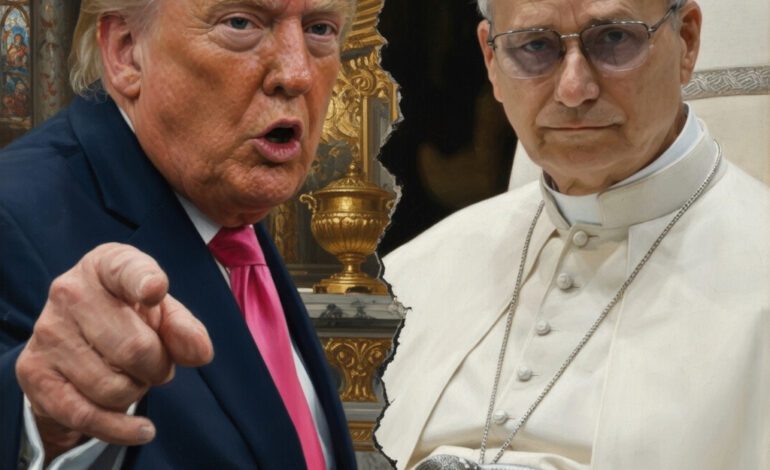

Trump Attacks Pope Leo XIV — The Pope’s Response Left the Entire Room in Stunned Silence
It began as a political jab — the kind that dominates headlines for a day and then fades away. But this time was different. When Donald Trump publicly attacked Pope Leo XIV, calling him an insult to America and accusing the pontiff of being beyond order, few anticipated what would come next. What followed was not a political counterattack. It was not a defensive statement. It was something far more powerful — a moment that many are now calling one of the most unforgettable moral rebukes in modern public life.
The exchange has traveled far beyond the walls of the room where it happened. It has become a defining moment in the ongoing national conversation about power, faith, politics, and the moral lines that leaders — both political and religious — are expected to hold. And at the center of it is a pope whose response to being publicly attacked said more in a few quiet sentences than most people say in a lifetime of speeches.
What Did Trump Say When He Attacked Pope Leo XIV?
Donald Trump’s criticism of Pope Leo XIV was delivered publicly — in the style Trump has used throughout his political career. Direct. Forceful. Designed to dominate the conversation and put his target on the defensive.
Trump called the Pope an insult to America and accused him of going beyond order. Those phrases, familiar in their aggression, were aimed at a man who has made global headlines for his calm, principled leadership of the Catholic Church since becoming its first American pope. Trump’s criticism appeared to be rooted in the Pope’s public positions on issues including immigration, war, poverty, and the treatment of vulnerable populations — positions that have frequently placed Leo XIV at odds with the rhetoric and policy direction of the Trump administration.
For Trump, attacking a religious figure is not entirely unprecedented. He has clashed with religious leaders before — most famously with Pope Francis, whom he criticized during his first presidential campaign in 2016. The pattern of using aggressive rhetoric against moral and religious voices that challenge his positions has been consistent throughout his political career.
But what made this moment different was not the attack itself. It was what happened next.
How Did Pope Leo XIV Respond to Trump’s Public Criticism?
The room where the Pope’s response took place was filled with journalists, clergy, and political observers. The atmosphere was already tense before he spoke. Trump’s comments had spread rapidly online. Many expected the Pope to respond carefully, diplomatically — or perhaps to avoid direct confrontation altogether.
Instead, Pope Leo XIV walked to the podium calmly. He looked out at the audience. He began speaking in a quiet, steady voice that quickly commanded the entire room.
He started by acknowledging Trump’s attack directly.
The president of the United States just said that I insulted Jesus. The coin fell completely silent. Then he continued, slowly and deliberately: Do you want to know what insults Jesus?
What followed was a sentence-by-sentence dismantling of policies and priorities that he argued stand in direct contradiction to the teachings of the faith that both he and many of his critics claim to follow. He did not raise his voice. He did not use inflammatory language. But his words carried an unmistakable weight.
Kicking the sick off their health care while cutting taxes for billionaires.
A pause. A shift in the room.
Sending innocent children and women to die in endless wars, and protecting the powerful while the weak suffer in silence.
Another pause.
Deporting the stranger and separating babies from their mothers.
At that point, people in the audience were no longer taking notes. They were simply listening. But he was not finished.
What Was the Most Powerful Moment of Pope Leo XIV’s Response?
Many who were present or watched recordings of the exchange later described one particular moment as the turning point — the part of the response that shifted the room from tension to something closer to genuine reckoning.
After delivering his list of what he described as true insults to the teachings of Jesus, Pope Leo XIV lowered his voice further. He spoke in the kind of quiet tone that makes a crowded room go absolutely still.
There is only ever one perfect Christian. And he was crucified on a cross 2,000 years ago.
That single line drew a long silence from the audience. It was not the silence of disagreement. It was the silence of people who had just heard something that cut through the noise and landed with the weight of truth. For supporters of the Pope, it was a masterclass in moral clarity delivered without cruelty. For critics, it was deeply provocative. But almost no one who witnessed it disputed that it was powerful.
Then came the moment that many later described as the most shocking of the entire speech — when the Pope expanded his message beyond politics and into what he called the most serious responsibilities of power.
He spoke about war, corruption, and hypocrisy. He argued that faith cannot be used as a weapon against the vulnerable. He returned once more to the question he had asked at the beginning.
You know what insults Jesus? Bombing innocent children. Sending young men and women to die in endless wars, and protecting the powerful while the weak suffer in silence.
By the time he finished, the speech had transformed. What began as a response to a political attack had become something much larger — a full moral indictment of modern politics, power, and the way religion is often used in public debates.
What Made Pope Leo XIV’s Approach So Unusual and So Effective?
One of the most striking aspects of the Pope’s response was not just what he said — but how he said it. And perhaps even more importantly, what he did not say.
He did not claim moral superiority for himself. In fact, he did the opposite. By stating that there is only ever one perfect Christian and that person was crucified 2,000 years ago, he explicitly placed himself and every other human being — including Trump, including his critics, including himself — on the same side of imperfection. He was not positioning himself above the fray. He was calling everyone in the room to a higher standard.
That approach is unusual in modern public discourse, where attacks are almost always met with counterattacks and where moral arguments are typically used as weapons to elevate the speaker while diminishing the target. Pope Leo XIV did something different. He used moral language not to win an argument but to reframe the entire conversation around values and consequences.
Political communication experts who analyzed the speech afterward noted its structural sophistication. The Pope repeated a single question — what insults Jesus? — and answered it repeatedly with specific, concrete examples drawn directly from current policy debates. It was a rhetorical technique as old as the Sermon on the Mount, and it worked in the modern media environment for exactly the same reasons it has always worked: it is direct, it is specific, and it is impossible to dismiss as vague or abstract.
He also made himself personally vulnerable. Rather than presenting himself as a moral authority immune to criticism, he acknowledged his own imperfection. He said plainly that he is not a perfect Christian. That admission — coming from the leader of the world’s largest Christian denomination — was not weakness. It was credibility.
How Did the Public React to Pope Leo XIV’s Response to Trump?
The reaction was immediate, intense, and global. Within hours of recordings spreading across the internet, the exchange between Trump and Pope Leo XIV had become one of the most widely discussed moments in recent political and religious history.
Supporters of the Pope called the response brave, moral, and necessary. They praised his willingness to name specific policies and connect them directly to the moral framework of the faith that those policies are sometimes invoked to defend. They shared clips with messages describing the speech as something they had been waiting to hear from a major religious leader for years.
Critics called it political and controversial. Some argued that a religious leader should stay out of partisan political debates. Others suggested that the Pope was overstepping his role by directly challenging a sitting president of the United States. Trump’s supporters pushed back strongly, accusing Leo XIV of being a political operative disguised as a religious figure.
But across those divided reactions, almost everyone agreed on one thing: the moment was powerful. It landed. It spread. And it started conversations in places far removed from political commentary — in churches, in homes, in community spaces where discussions about faith, politics, and moral responsibility rarely intersect so directly or so publicly.
Within religious communities specifically, the response generated intense discussion. For many practicing Catholics and Christians of other denominations, the Pope’s words raised a question that goes to the heart of how faith is practiced in a polarized political environment: Can you claim to follow the teachings of Jesus while supporting policies that the Pope argues stand in direct contradiction to those teachings? That question does not have a simple answer. But the fact that it is now being asked loudly and publicly is itself significant.
What Does This Confrontation Mean for the Relationship Between Religion and Politics in America?
The clash between Trump and Pope Leo XIV is not just a story about two powerful figures disagreeing. It is a window into one of the most important and unresolved tensions in American public life: the relationship between political power and moral authority.
For decades, the intersection of religion and politics in the United States has been a source of both enormous energy and enormous conflict. Religious communities have shaped major political movements — from the civil rights movement to the anti-abortion movement to the immigration justice movement. Political leaders have sought the endorsement of religious institutions and used the language of faith to build and mobilize coalitions.
But the relationship between political leaders and religious institutions has always been complicated by a fundamental tension. Politicians want religious authority on their side. Religious leaders want to speak truth to power without being captured by it. When those two goals conflict, the resulting confrontations can reveal something important about where each side actually stands.
Pope Leo XIV’s response to Trump’s attack is a clear example of a religious leader choosing truth over comfort. He did not soften his message to avoid political conflict. He did not retreat into vague spiritual language that could be interpreted to support any position. He named specific policies and said, plainly, that he believes they are morally wrong.
That kind of directness carries risk. It invites political backlash. It potentially alienates members of his own congregation who support the policies he criticized. It draws the Church into partisan political territory in ways that make many people uncomfortable.
But it also does something that carefully managed religious communication rarely does: it makes people actually think. It forces a direct confrontation with the question of what values really mean when they are put into practice through policy. And it refuses to allow faith to be used as a decorative backdrop for positions that, upon examination, may not align with the values being claimed.
What Happens Next Between Trump and Pope Leo XIV?
The immediate aftermath of the confrontation has left several questions open. Will Trump respond further? Will the administration move to formalize its criticism of the Pope through official channels? Will the Catholic Church face political pressure as a result of Leo XIV’s willingness to directly challenge the president?
Trump has not issued a formal follow-up statement in response to the Pope’s speech. His supporters have continued to criticize Leo XIV across social media and in conservative media outlets. But the administration has not, as of this writing, escalated beyond public rhetoric.
Pope Leo XIV has not walked back a single word of what he said. He has continued to speak publicly on the issues he raised in his response — immigration, war, poverty, and the responsibilities of power. If anything, the global attention generated by the confrontation has expanded the audience for his message and given his words a platform larger than any single press conference or statement could have created on its own.
For the millions of people who watched the exchange unfold and felt something shift — whether that feeling was admiration, anger, discomfort, or inspiration — the moment is not easily forgotten. It touched something real about what leadership looks like, what faith demands, and what it means to speak with moral clarity in a world that is desperately short of it.
Trump had intended to put the Pope on the defensive. Instead, he handed him a stage. And on that stage, Pope Leo XIV delivered a response that may be quoted, studied, and remembered long after the political moment that prompted it has faded from memory.
Key Takeaways: Trump vs. Pope Leo XIV and the Moment That Silenced the Room
Donald Trump publicly attacked Pope Leo XIV, calling him an insult to America — setting off one of the most remarkable exchanges between a sitting U.S. president and a sitting pope in modern history.
Pope Leo XIV responded calmly and directly, asking his audience to consider what truly insults the teachings of Jesus — and answering that question with specific references to current U.S. policies on health care, immigration, war, and economic inequality.
His statement that there is only one perfect Christian, and he was crucified 2,000 years ago, drew a long and stunned silence from those present and became one of the most widely shared lines from any public figure in recent memory.
The public reaction was divided but intense — with supporters praising the Pope’s moral courage and critics accusing him of overstepping his role by directly challenging a sitting president.
The confrontation has sparked a broader national and global conversation about the relationship between faith, power, and moral responsibility — and about what it means to claim religious values while holding or supporting political power.
Discover more from MatterDigest
Subscribe to get the latest posts sent to your email.