“What Prince William Just Said Has Everyone Talking—And Donald Trump Isn’t Staying Quiet!”
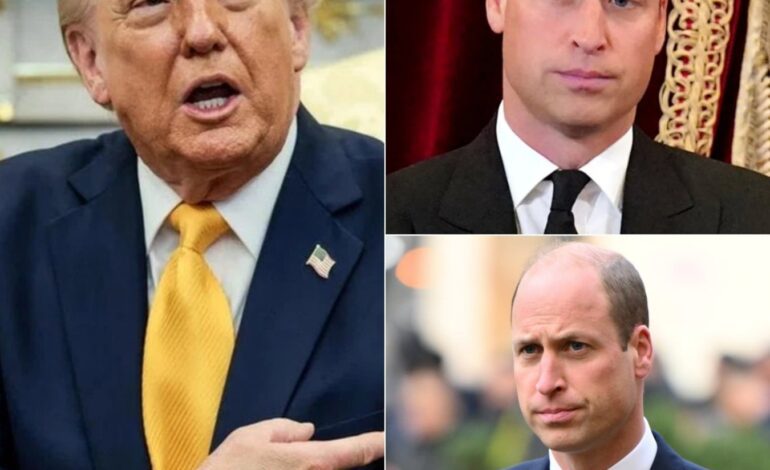

Prince William Sparks Online Frenzy With Bold Remarks as Washington Reacts to Donald Trump Commentary
Prince William’s bold public remarks about Donald Trump have set off a firestorm of reaction across social media and political circles in Washington. The Prince of Wales, known for measured diplomacy, stepped into controversial territory with comments that many observers are calling unusually direct for a senior member of the British royal family. As tensions between the UK and the US continue to simmer over trade, foreign policy, and political culture, William’s words have landed with striking force — and the internet has not been quiet about it.
What Did Prince William Actually Say About Trump?
The remarks that ignited the online frenzy were made during a high-profile public engagement, where Prince William deviated from the carefully scripted language typically expected of British royals. While the Palace has long maintained a strict policy of political neutrality — especially when it comes to commenting on foreign leaders — William appeared to break from that tradition in a way that caught both royal watchers and political commentators off guard.
Reports confirmed that William’s comments touched on issues of global leadership, democratic values, and the responsibilities that powerful nations hold toward their allies. Though his words were framed diplomatically, their underlying message was widely read as a pointed response to statements made by former and current US President Donald Trump — specifically regarding NATO commitments, the UK-US special relationship, and America’s role on the world stage.
For many royal observers, the moment felt historic. The future King of England does not casually wade into American domestic politics. The fact that he chose to do so — even in veiled terms — signaled that something had shifted in how the British royal family views its role in the modern political landscape.
How Washington Reacted to Prince William’s Comments on Trump
Washington’s reaction was swift and divided along predictable lines. Democratic lawmakers and liberal commentators praised William’s comments, calling them refreshing and principled. Several prominent US politicians took to social media to express their appreciation, with some even sharing clips of the remarks and tagging the official accounts of the British royal family.
On the Republican side, the response was sharp. Several Trump allies pushed back against what they described as foreign interference in American political affairs. One prominent commentator argued that the heir to the British throne had no business weighing in on US leadership — and that such remarks could damage the special relationship that has historically united the two countries.
Inside the White House, sources suggested that Trump himself was briefed on William’s remarks. While there was no immediate official response from the administration, those familiar with the President’s communication style noted that a social media reaction was likely imminent. Trump has never been shy about firing back at critics — including foreign heads of state and royal family members.
Prince William and the Pressure to Speak Out: Why Now?
To understand why Prince William made these remarks, it helps to look at the broader context of his evolution as a public figure. Over the past few years, William has worked deliberately to shape a more defined public identity — one that is distinct from the cautious, ceremonial role his father King Charles played for decades before ascending to the throne.
William has been increasingly vocal on issues close to his heart: climate change, mental health, and global homelessness. His Earthshot Prize has given him a platform that regularly pulls him into contact with world leaders and policymakers. Through that work, he has built relationships across the political spectrum — and developed a more confident, assertive public voice.
Sources close to Kensington Palace have suggested that William is acutely aware of the shifting geopolitical climate. With Trump back in the White House and pursuing an increasingly unilateral foreign policy, the Prince is said to believe that silence in the face of threats to the post-war international order is itself a political act. In other words: saying nothing is no longer an option he is comfortable with.
This puts him in a delicate position. As future King, he is bound by constitutional conventions that restrict the royal family from overt political commentary. What he appears to be doing — and what this latest episode illustrates — is threading that needle carefully: speaking on values rather than party lines, on principles rather than policies, in ways that allow him to make a point without technically crossing into prohibited territory.
The UK-US Special Relationship Under Strain: What Is at Stake?
The so-called special relationship between the United Kingdom and the United States is one of the most storied alliances in modern history. Forged in the fires of World War II and cemented by shared language, culture, intelligence networks, and military cooperation, it has survived wars, recessions, trade disputes, and political upheaval for more than 80 years.
But in recent years — and especially since Trump returned to the presidency — that relationship has come under significant stress. Trump’s repeated skepticism of NATO, his transactional approach to foreign alliances, and his administration’s trade policy have all created friction with British officials. The UK, navigating a post-Brexit identity and still seeking a favorable trade deal with the US, has found itself in the uncomfortable position of needing American goodwill while also trying to maintain its own diplomatic integrity.
Into this already complicated dynamic, Prince William’s comments arrive like a match near a gas leak. They may energize those who feel the UK has been too deferential to the Trump administration. But they also risk alienating a White House that has shown it will use economic leverage — tariffs, trade restrictions, and intelligence-sharing arrangements — to punish perceived slights.
British politicians have responded to William’s remarks with a mixture of admiration and anxiety. Some senior figures from both the Conservative and Labour parties welcomed what they saw as moral clarity from the Palace. Others, speaking off the record, worried about the diplomatic fallout — and what it might mean for ongoing UK-US negotiations.
Social Media Explodes: How the Internet Responded to Prince William vs. Trump
Within hours of Prince William’s remarks becoming public, social media platforms lit up with reaction. On X (formerly Twitter), hashtags related to the story trended in the United States, the United Kingdom, Canada, and Australia. The phrase “Prince William Trump” generated millions of impressions in a single day — a clear sign that the story had crossed from the royal gossip niche into mainstream political discourse.
On TikTok and Instagram Reels, short clips of William’s public appearance were shared widely, often paired with commentary tracks from political creators and royal family enthusiasts. Many videos framed William as a dignified counterpoint to Trump’s combative style. Others questioned whether a member of an unelected monarchy had any standing to weigh in on a democracy’s elected leader.
Facebook groups dedicated to both royal family news and US politics saw enormous surges in activity. Royal watchers who typically focus on fashion and family drama found themselves deep in debates about the constitutional limits of royal speech. Trump supporters organized counter-campaigns, flooding royal-adjacent accounts with criticism of what they called unwarranted foreign commentary.
Perhaps most strikingly, the story achieved something rare in today’s fragmented media environment: it got people across political divides talking. Conservatives who typically dismiss royal coverage were engaging with it. Progressives who have historically been ambivalent about the monarchy found themselves sharing William’s comments approvingly. Whatever one thinks about the Prince’s decision to speak, the story proved that the royal family still holds enormous cultural power — and that its intersection with American politics creates uniquely viral moments.
King Charles, the Palace, and the Question of Royal Political Neutrality
One of the most fascinating subplots of this story concerns King Charles III and how Buckingham Palace has navigated the situation. Charles himself has long faced criticism — and praise — for being willing to speak out on causes he believes in, particularly environmental issues. He did so for decades as Prince of Wales, and the debate about whether a monarch should do the same has never fully been settled.
Now, with his son following a similar path — but in an even more politically charged direction — the Palace faces a delicate communications challenge. Officials are understood to have been caught off guard by the volume of reaction William’s remarks generated. While they were aware of what he planned to say, the speed and scale of the global media response has required careful management.
There is no indication that Charles asked William to walk back his comments. In fact, people close to both men suggest that the King broadly supports his son’s instinct to engage with the issues that define their era. What the Palace is more focused on is ensuring that any future statements are managed with even greater care — and that the diplomatic consequences are fully thought through before William speaks publicly again.
Princess Catherine’s Role: Support Behind the Scenes
As William finds himself at the center of a geopolitical storm, his wife Princess Catherine — still recovering from her health challenges over the past year — has been a steady presence behind the scenes. Those close to the couple say that Catherine has been William’s most trusted sounding board as he navigates the fine line between royal duty and personal conviction.
Catherine is said to have encouraged William to be authentic in his public engagements while also urging caution about the potential blowback. Her instinct for reading public sentiment — honed through years of navigating intense media scrutiny — has been an asset as the couple charts their course for the years ahead.
Publicly, Catherine has remained largely out of the political fray. But those who know her well say she is anything but passive in the private conversations that shape William’s public choices. In the growing narrative of William as a more outspoken future king, Catherine’s influence is a quiet but significant thread.
What Does This Mean for the Future King’s Public Role?
Prince William’s Trump commentary moment raises bigger questions about the role of the modern British monarchy in a world that is more polarized, more interconnected, and more volatile than at any point in recent memory. The old model — smiling wave, ribbon cutting, stay above the fray — feels increasingly out of step with a public that expects its leaders, elected or not, to have a voice on the great questions of the day.
William seems to understand this. He has watched what happened to his younger brother Prince Harry, who left the royal family in part because the institution felt too rigid and suffocating. He has also watched his father spend decades being criticized for speaking too much on politics, only to find that much of what Charles said turned out to be ahead of its time. William is threading his own path — one that draws lessons from both men.
What seems clear is that William intends to be a different kind of future king — more engaged, more willing to engage with controversy, more present in the public conversations that matter. Whether that will ultimately serve the monarchy well or expose it to new forms of political risk remains to be seen. But the genie, as they say, is out of the bottle.
The Bottom Line: A Royal Moment That Resonated Far Beyond Palace Walls
Prince William’s bold remarks on Donald Trump have done something that few royal moments achieve: they have cut through the noise of modern media and forced people to pay attention. In Washington, in London, and across social media feeds worldwide, the story has sparked real debate about power, diplomacy, democratic values, and the responsibilities that come with influence — whether you inherited it or earned it at the ballot box.
What happens next — whether Trump responds, whether the UK-US relationship suffers a diplomatic bump, whether William doubles down or pulls back — will be watched closely by royal observers, political analysts, and millions of ordinary people who have found themselves unexpectedly invested in this transatlantic drama.
One thing is already certain: Prince William is no longer just a prince waiting in the wings. He is making moves — and the world is watching.
Discover more from MatterDigest
Subscribe to get the latest posts sent to your email.