“Pressure Mounts on Donald Trump as Pam Bondi Replacement Rumors Intensify—Sidney Powell Emerges”
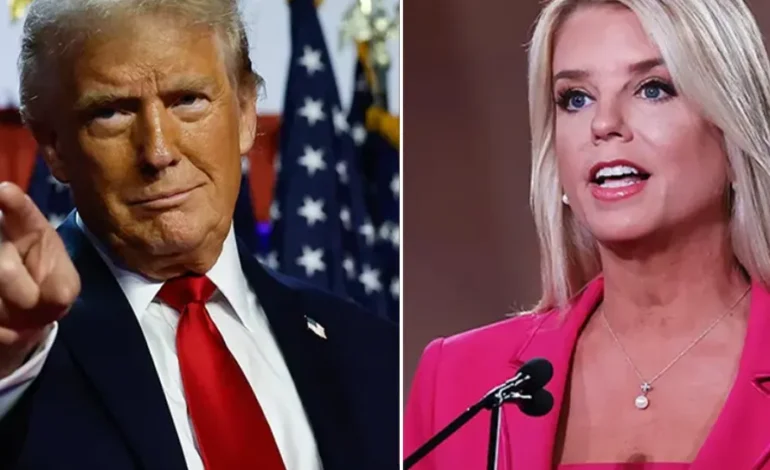

Trump Nears Breaking Point: Pam Bondi Replacement Rumors Grow as Sidney Powell Steps Into the Spotlight.
Trump is reportedly losing patience with Attorney General Pam Bondi, and speculation is mounting that a major shake-up could be coming to the Department of Justice. Sources close to the administration suggest the president has reached what some are calling a breaking point — frustrated by what he views as a lack of aggressive legal action against his political enemies. Now, a surprising name is surfacing as a possible replacement: Sidney Powell, the controversial attorney who made waves over her role in the 2020 election controversy. If these rumors hold any truth, the implications for the American justice system could be enormous.
Why Is Trump Reportedly Frustrated With Pam Bondi?
When Pam Bondi was confirmed as Attorney General, many expected her to serve as one of the most loyal figures in the Trump administration. She had a long record as a Trump ally and was seen as someone who shared his vision for reshaping the federal government. But according to multiple insider reports, the relationship has grown tense.
Trump has reportedly grown frustrated that Bondi has not moved fast enough — or aggressively enough — against individuals the president views as political opponents. The so-called “Deep State,” a term Trump has used repeatedly to describe career government officials he believes are working against him, remains a central concern. Sources say the president wants more action, more investigations, and a harder push against those he sees as obstructing his agenda.
Bondi, for her part, has maintained a more measured approach. She has shown a willingness to pursue investigations where she believes evidence supports it, but she has also demonstrated caution that critics on the right say is holding the administration back. For Trump, that kind of caution may no longer be acceptable.
No official statement has confirmed any planned change at the top of the DOJ. But Washington insiders say the chatter has grown louder in recent weeks, and those close to the president say his dissatisfaction is real and growing.
What Is the ‘Deep State’ and Why Does It Matter to Trump?
To understand why Trump is reportedly so frustrated, it helps to understand one of the driving forces behind his second term: the belief that the federal bureaucracy is working against him.
Trump and his allies have long claimed that entrenched career officials — in the FBI, the DOJ, intelligence agencies, and elsewhere — have conspired to block his policy goals, investigate him unfairly, and protect his political opponents. This loose network of resisters is what Trump and his base call the “Deep State.”
During his first term, Trump clashed repeatedly with officials he believed were disloyal. His second term began with a renewed commitment to rooting out that perceived resistance. He signed executive orders, fired agency heads, and pushed for loyalty among senior officials. But for some of his supporters, those moves have not gone far enough.
The Attorney General is arguably the most powerful tool a president has when it comes to pursuing legal accountability. The DOJ controls federal prosecutions, manages the FBI, and sets enforcement priorities. If Trump believes Bondi is not using that power the way he wants, it is easy to see why tensions might be rising.
Who Is Sidney Powell and Why Is Her Name Coming Up?
Of all the names that could have surfaced in the Attorney General replacement conversation, Sidney Powell may be the most polarizing.
Powell is a former federal prosecutor who gained national attention after the 2020 presidential election when she became one of the loudest voices claiming widespread voter fraud. She appeared alongside Rudy Giuliani and other Trump attorneys and made sweeping claims about rigged voting machines, foreign interference, and a coordinated effort to steal the election. Courts across the country rejected those claims repeatedly. Federal and state election officials, many of them Republicans, found no evidence to support the allegations.
Powell later faced legal consequences for her role in those efforts. She was indicted in Georgia as part of a broad criminal case and eventually pleaded guilty to misdemeanor charges. She was disbarred in Texas and faced professional and legal scrutiny on multiple fronts. Despite all of this, she retains a passionate following among many conservatives who see her as a fighter who refused to back down.
Among her supporters, Powell is seen as someone who will take on the establishment without hesitation. She has called for aggressive investigations into government corruption and has never walked back her core claims about election integrity, even as courts found no merit in them. To the MAGA base, that consistency reads as courage. To her critics, it reads as a disqualifying pattern of behavior that would embarrass the country if she were put in charge of the nation’s top law enforcement agency.
Could Sidney Powell Actually Be Confirmed as Attorney General?
Even setting aside the policy debate, there are serious practical questions about whether Sidney Powell could actually be confirmed by the Senate.
Senate confirmation for Attorney General is not a rubber stamp. Nominees face detailed questioning about their legal views, their qualifications, and their conduct. Powell’s disbarment, her guilty plea in Georgia, and her track record of making public claims that courts have rejected would all become central issues in any confirmation hearing.
Some legal experts argue that a disbarred attorney serving as the nation’s chief law enforcement officer would represent a historic and deeply troubling precedent. The Attorney General is expected to be the top legal mind in the executive branch — a person who upholds the rule of law, not someone whose license to practice law has been stripped.
On the other hand, Powell has supporters who argue that the justice system has been weaponized against her and that her disbarment was itself politically motivated. They would likely rally hard for her confirmation if Trump were to nominate her.
Whether she could actually secure enough votes in the Senate remains a serious open question. Even in a chamber with a Republican majority, a handful of votes against her nomination could sink it.
What Would a Powell Appointment Mean for the Justice Department?
If Sidney Powell were to become Attorney General, the effects on the Department of Justice would be immediate and far-reaching.
The DOJ oversees federal law enforcement across the entire country. It handles national security cases, public corruption investigations, civil rights enforcement, immigration law, antitrust cases, and more. The person at the top sets the tone and the priorities for tens of thousands of employees.
Powell has been a vocal critic of the DOJ itself, arguing that it has been captured by political interests and used as a weapon against conservatives. If she were in charge, observers would expect a sharp pivot in enforcement priorities — likely focusing heavily on investigations of Democratic officials, government employees she views as part of the Deep State, and cases tied to the 2020 election.
Critics warn this could severely damage confidence in the independence of American law enforcement. The DOJ’s legitimacy depends in large part on the public perception that it applies the law equally and without political favoritism. A Powell-led department would face immediate scrutiny about whether that standard was being met.
Supporters counter that the DOJ already operates with political bias, and that Powell’s appointment would simply redirect that bias toward holding the correct people accountable. For them, the shake-up would be long overdue.
How Does the Political Climate in Washington Factor In?
Washington, D.C. is once again charged with tension. Trump’s second term has been defined by battles over loyalty, control, and the pace of the administration’s agenda. Cabinet members who are seen as insufficiently aggressive face real pressure — and in some cases, real consequences.
The reported frustration with Bondi fits into this broader pattern. Trump has consistently signaled that he expects his appointees to fight hard for his agenda, not to moderate their approach out of concern for political blowback or institutional norms. Officials who do not meet that standard tend to find their positions questioned.
At the same time, there are those within the Republican Party who are watching this situation closely. Some senior Republicans believe that a Powell nomination would be a political mistake — a distraction that would consume Senate time and energy, generate enormous negative press coverage, and ultimately fail. They would prefer a nominee who is aggressive but confirmable.
Others believe that the boldness of a Powell nomination would fire up the base and send a powerful message that Trump is serious about his promises. For this faction, the controversy is a feature, not a bug.
Is This Part of a Larger Pattern of Trump Administration Shake-Ups?
It is worth stepping back and looking at the bigger picture. Changes at the top of major departments are not unusual in any administration, but Trump’s second term has featured a particularly aggressive approach to personnel.
From the early days of his return to office, Trump moved quickly to install loyalists in key positions across the government. He fired officials he viewed as insufficiently loyal, rewarded those who defended him publicly, and used executive authority to reshape the federal workforce in ways that previous administrations had not attempted.
The situation with Bondi, if the reports are accurate, fits this pattern. Trump is not simply frustrated with one official — he is signaling what he expects from all of them. The DOJ, given its role in investigating and prosecuting federal cases, is perhaps the most sensitive arena for these expectations.
For voters who supported Trump’s second run on a platform of accountability and taking on the establishment, reports like these confirm that he is still pushing hard. For those who opposed him, the same reports raise alarms about the politicization of federal law enforcement.
What Happens Next? Key Things to Watch
The coming days and weeks will be telling. Several key developments could clarify whether the Bondi-Powell story has real substance or whether it is largely Washington speculation.
First, watch for any public signals from Trump himself. He has a history of using social media and press appearances to float ideas, test reactions, and sometimes make decisions public before they are formally announced. If he starts signaling dissatisfaction with Bondi on Truth Social or in press gaggles, that would be a strong indicator that the reports have merit.
Second, watch for any response from Bondi or her allies. A public show of loyalty or a high-profile action on a major case could be an effort to demonstrate that she is on board with what Trump wants. Conversely, any public tension or a conspicuous lack of support from her allies could suggest that her position is more fragile than it appears.
Third, watch for Senate Republicans to take public positions. If key senators begin expressing concerns about a potential Powell nomination, that will shape the political calculus significantly. If they signal openness, it becomes a more realistic possibility.
Finally, watch for any formal announcements. Until something official comes from the White House, everything in this story remains in the realm of rumor and speculation — albeit highly credible rumor and speculation that is being taken seriously by people close to the administration.
The Bottom Line: A Justice Department at a Crossroads
The reports about Trump’s frustration with Pam Bondi, and the emergence of Sidney Powell as a potential replacement, tell us something important about where this administration is headed. The president clearly wants a Department of Justice that fights for his agenda without hesitation or restraint. Whether Bondi can satisfy that demand — or whether a far more controversial figure will be called upon to do so — remains to be seen.
What is clear is that the stakes are high. The Attorney General of the United States holds enormous power. Decisions made at the top of the DOJ shape the course of federal investigations, influence public trust in law enforcement, and set the tone for how justice is applied across the country.
If Powell does emerge as a serious contender, the confirmation battle that would follow could be one of the most explosive political events of Trump’s second term. If Bondi manages to survive and recalibrate her approach, the friction may fade — at least for a while. Either way, the tension at the heart of this story is real, and its consequences will be felt far beyond the walls of the Department of Justice.
Discover more from MatterDigest
Subscribe to get the latest posts sent to your email.