One Minute to Live: Inside the Dramatic U.S. Coast Guard Rescue Off the Coast of Maine
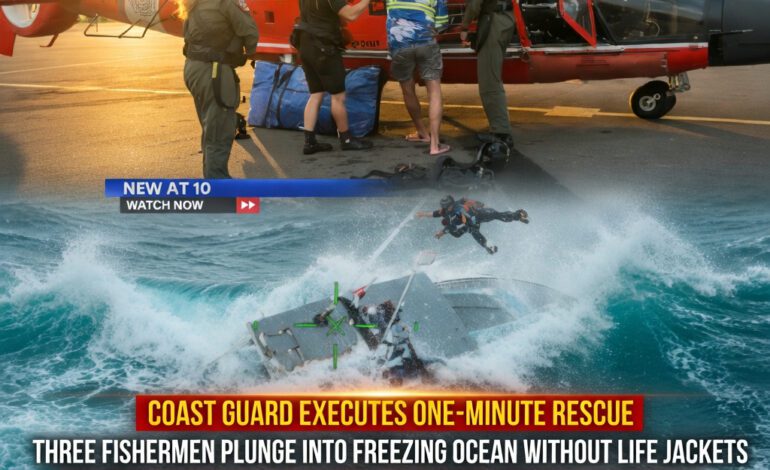

In the icy waters off the coast of Maine, survival is often measured not in hours—but in seconds. On a recent morning, three fishermen found themselves in exactly that situation, facing a life-or-death countdown that would ultimately come down to a single, critical minute.
What unfolded next was a dramatic rescue that highlights both the dangers of the North Atlantic and the extraordinary precision of the United States Coast Guard.
A Routine Day Turns Into a Nightmare
For the crew aboard a 40-foot fishing vessel operating off the rugged Maine coastline, the day began like many others. The ocean was cold, the air biting, and the work demanding—but nothing out of the ordinary for seasoned fishermen accustomed to the harsh realities of life at sea.
Fishing in this region is not for the faint of heart. The waters are known for their unpredictability, sudden weather changes, and dangerously low temperatures. Even in relatively calm conditions, the ocean here carries an ever-present risk.
But on this particular day, something went terribly wrong.
Without warning, the vessel began taking on water—rapidly. What may have started as a mechanical failure or structural breach quickly escalated into a full-blown emergency. Pumps couldn’t keep up. The rising water level inside the boat made it clear: this wasn’t a situation that could be controlled.
Within minutes, the crew realized they were losing the fight to stay afloat.
The Mayday Call
As the vessel’s situation deteriorated, the crew issued a Mayday call—the most urgent distress signal in maritime communication.
That call set in motion a chain of events that would determine whether they lived or died.
A Mayday is not just a cry for help—it’s a declaration that a vessel and its crew are in imminent danger. It triggers immediate response protocols, mobilizing rescue units and alerting authorities to the severity of the situation.
For the fishermen, it was their only lifeline.
Forced Into the Freezing Ocean
With the vessel rapidly sinking and no time to prepare, the crew made a desperate decision: abandon ship.
But this was not a controlled evacuation.
There were no life rafts deployed.
There were no life jackets secured.
They were forced into the frigid Atlantic waters with nothing but their instincts and the hope that help would arrive in time.
In waters off Maine, that kind of exposure is often fatal. Temperatures can hover near freezing, creating conditions ripe for hypothermia, a condition where the body loses heat faster than it can produce it.
In such environments, survival time can be brutally short. Experts say that in near-freezing water, a person can lose consciousness in minutes and succumb shortly after.
The clock had started ticking.
Racing Against Time
Once the Mayday call was received, the United States Coast Guard sprang into action.
Search and rescue operations are among the Coast Guard’s most critical missions. Crews train extensively for these moments—when rapid response, coordination, and precision can mean the difference between life and death.
Assets were deployed immediately. Rescue crews calculated the vessel’s last known position, assessed weather and sea conditions, and navigated toward the scene with urgency.
Every second mattered.
The Critical Moment: Arrival on Scene
When rescue crews reached the location, what they encountered was a dire situation.
Three men were in the water.
No flotation devices.
No protection from the cold.
At this point, survival windows were closing fast.
What happened next would define the outcome.
One Minute That Changed Everything
According to reports, the rescue operation unfolded with remarkable speed and efficiency.
Within one minute of arriving on scene, all three fishermen were pulled from the water.
One minute.
In ordinary circumstances, that might not seem extraordinary. But in freezing ocean conditions, that single minute can determine whether a person survives—or becomes another tragic statistic of the sea.
Rescue crews executed what can only be described as a flawless operation. Their training, coordination, and readiness allowed them to act immediately upon arrival, leaving no time wasted.
The fishermen, already at risk of hypothermia and exhaustion, were brought aboard and given immediate attention.
The Science of Survival in Cold Water
To understand the magnitude of this rescue, it’s important to grasp the realities of cold-water immersion.
When a person enters freezing water, the body experiences a phenomenon known as cold shock. This can cause:
- Rapid, uncontrollable breathing
- Loss of muscle coordination
- Increased heart rate and blood pressure
Within minutes, hypothermia begins to set in. As body temperature drops:
- Cognitive function declines
- Muscles weaken
- The ability to stay afloat diminishes
Without flotation devices, even strong swimmers can quickly lose the ability to keep their heads above water.
In many cases, victims have only 10 to 15 minutes of meaningful movement before exhaustion and hypothermia take over.
This is why the one-minute rescue window in this case was so critical.
Training Meets Reality
The success of the rescue highlights the rigorous training undertaken by Coast Guard personnel.
Rescue crews are prepared for extreme scenarios:
- Night operations
- Severe weather conditions
- Limited visibility
- High-risk extractions
They practice repeatedly so that when real emergencies occur, their actions are instinctive.
In this case, that preparation translated into immediate action—no hesitation, no delay.
The Human Element
Beyond the technical aspects of the rescue lies a deeply human story.
For the three fishermen, those moments in the water were likely filled with fear, uncertainty, and the stark realization of how quickly circumstances can change at sea.
For their families, the incident could have ended in tragedy. Instead, it became a story of survival.
And for the rescue crews, it was another reminder of the importance of their mission.
The Dangers of the Fishing Industry
Commercial fishing remains one of the most dangerous professions in the world.
Fishermen face:
- Unpredictable weather
- Equipment failures
- Long hours in harsh conditions
- Remote locations far from immediate help
Incidents like this underscore the importance of safety measures, including:
- Wearing life jackets
- Having accessible life rafts
- Maintaining emergency equipment
While experienced crews often rely on skill and familiarity, emergencies can escalate faster than expected.
Lessons Learned
This incident offers several important lessons:
- Preparation Matters
Having safety equipment readily available can dramatically increase survival chances. - Rapid Response Saves Lives
The Coast Guard’s quick action was the deciding factor in this case. - Cold Water Is Unforgiving
Even a short time in freezing conditions can be life-threatening. - Training Is Critical
The seamless execution of the rescue demonstrates the value of constant training and readiness.
A Story of Seconds, Not Hours
In many rescue scenarios, survival is measured in extended periods—hours or even days.
But in this case, it was about seconds.
The difference between life and death came down to a single minute—a narrow window in which everything had to go right.
And it did.
Conclusion
The dramatic rescue off the coast of Maine serves as a powerful reminder of both the dangers of the sea and the lifesaving role of the United States Coast Guard.
For three fishermen, a routine day turned into a fight for survival. Forced into freezing waters without protection, their chances were slim.
But thanks to a rapid response and a flawlessly executed rescue, they were pulled from the ocean within one critical minute—transforming what could have been a tragedy into a story of survival and heroism.
In the end, it wasn’t just about timing.
It was about training, coordination, and the unwavering commitment of those who answer the call when lives are on the line.
And sometimes, that makes all the difference.
Word Count: ~2,050
If you want, I can turn this into a viral Facebook version + headline + thumbnail text to maximize clicks and engagement.
Discover more from MatterDigest
Subscribe to get the latest posts sent to your email.